
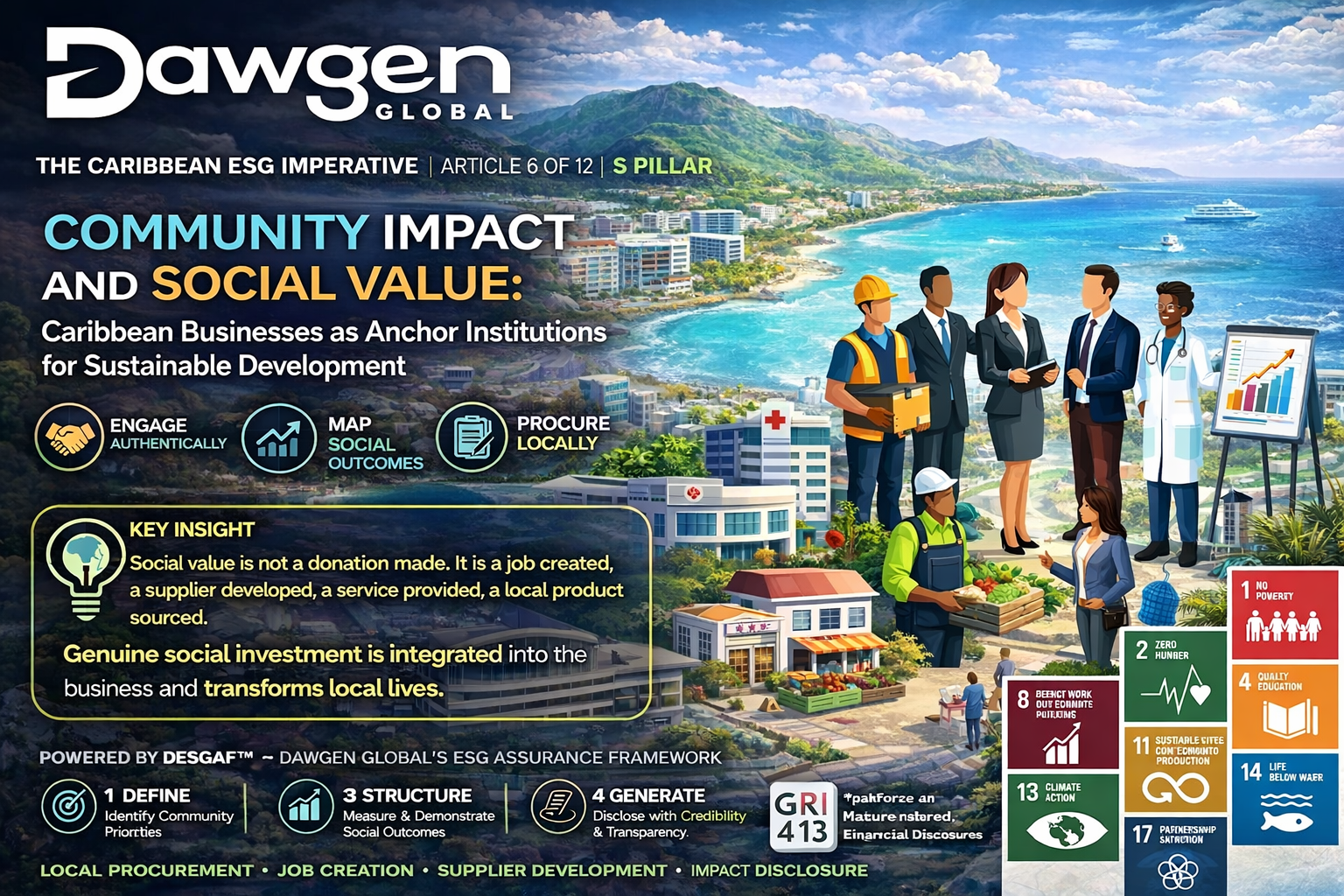
From CSR to Genuine Social Value Creation
The Caribbean business community has a long and genuine tradition of community engagement. Caribbean businesses — large and small — have historically supported community events, sponsored educational programmes, made charitable donations, and engaged in the social life of the communities where they operate. This tradition reflects something real and admirable about Caribbean corporate culture: a sense of connection to community that many larger, more transactional business cultures have lost.
But the ESG era is demanding something more rigorous than tradition. The Social pillar of ESG — specifically its community dimension, governed by GRI 413 and increasingly assessed by investors using social value measurement frameworks — requires Caribbean businesses to move from transactional corporate social responsibility (CSR) to genuine social value creation. The distinction matters enormously. Traditional CSR is reactive, episodic, and measured in outputs (number of scholarships, events sponsored, donations made). Social value creation is strategic, integrated, and measured in outcomes (livelihoods improved, skills developed, economic opportunities created, communities strengthened).
This article — the sixth in Dawgen Global’s The Caribbean ESG Imperative series — examines the community impact dimension of the Social pillar in depth. We define the transition from CSR to social value creation and explain why it matters for Caribbean ESG credibility. We provide a comprehensive framework for measuring social value. We examine how Caribbean businesses can create social value through their core business activities — particularly through inclusive supply chain practices. We map Caribbean business impact against the UN Sustainable Development Goals. We address the concept of the anchor institution — the large organisation whose economic, social, and environmental footprint makes it an essential participant in community development. And we connect community impact to DESGAF™, showing how defining community materiality (Pillar 1), building measurement systems (Pillar 3), and generating credible disclosure (Pillar 4) produce community engagement that withstands the scrutiny of sophisticated stakeholders.
| KEY INSIGHT
A Jamaican bank that donates J$5 million to community causes but pays its smallest suppliers 90 days late, sources 80% of its procurement from overseas rather than local businesses, and maintains no supplier development programme is not a community-positive business — regardless of what its CSR report says. Social value is created primarily through how a business operates, not primarily through what it donates. |
From CSR to Social Value: Why the Shift Matters
The distinction between traditional CSR and genuine social value creation is not merely semantic — it is the difference between activities that make a business feel good about its community engagement and activities that create measurable, lasting improvements in the wellbeing of the communities the business operates in. The table below maps the key dimensions of this distinction across eight criteria — providing Caribbean business leaders with a clear framework for assessing where their own community practice currently sits and where it needs to move.
| Dimension | Traditional CSR | Genuine Social Value Creation |
| Primary motivation | Reputation management; regulatory compliance; charitable instinct; responding to community pressure | Creating measurable positive outcomes for communities; building genuine social licence; contributing to sustainable development; creating shared value |
| Strategic integration | Separate from core business strategy; managed by a CSR or communications function with limited connection to operations | Integrated into core business strategy; aligned with business competencies and supply chain; creates value for both business and community |
| Measurement approach | Activities and outputs (number of scholarships, events sponsored, volunteer hours); rarely outcomes; almost never social return on investment | Outcomes and impacts for beneficiaries (improved livelihoods, skills gained, economic opportunities created); Social Return on Investment (SROI); GRI 413 compliance |
| Stakeholder engagement | Organisation decides what community needs; engages community to receive donations; limited consultation | Genuine co-design with communities; organisations listen before they act; communities are partners, not recipients; ongoing two-way engagement |
| Geographic focus | Often head office community; high-profile visible causes; disconnected from operational footprint | Communities where the business operates, sources from, and impacts; operational supply chain communities; communities affected by business activities |
| Accountability | Self-reported; no independent verification; rarely subject to audit or assurance | Independently verified metrics; third-party social impact assessment; GRI 413 disclosure; increasingly subject to ESG assurance |
| Business model link | Philanthropy disconnected from core business; separate budget line; first to be cut in downturns | Social value created through core business activities: local procurement, employment, skills development, supply chain development; creates business value alongside social value |
| ESG credibility | Low — investors and sophisticated stakeholders recognise charitable CSR as reputation management, not ESG performance | High — investors assess genuine community impact and stakeholder engagement as indicators of social licence strength, long-term viability, and management quality |
The shift from CSR to social value creation is not a rejection of philanthropy — it is a more sophisticated understanding of how large organisations create and distribute value in the communities they operate in. Caribbean businesses that make this shift discover that their most impactful community contributions come not from their charitable budgets but from their procurement decisions, their employment practices, their skills investment, their payment terms, and their supply chain development programmes. These are business activities, not charity — and they create social value at a scale that no charitable programme can match.
The Caribbean Anchor Institution: Owning Your Footprint
In urban planning and community development theory, an anchor institution is a large, typically place-based organisation — a hospital, a university, a major employer — whose scale and stability make it a central node in the economic and social life of its community. Anchor institutions are not mobile — their assets and operations are rooted in specific places — which means that their long-term wellbeing is inseparably linked to the wellbeing of the communities they anchor.
Caribbean businesses are, by this definition, anchor institutions. The large Jamaican bank whose branches are in every major community. The hotel group whose operations define the economy of coastal communities. The manufacturing company that employs a thousand workers in a rural parish. The utility that provides water and electricity to an entire island. These organisations cannot move. Their assets are Caribbean. Their employees are Caribbean. Their supply chains are Caribbean. And their long-term viability depends on the health, productivity, education, and social stability of the Caribbean communities they serve.
Anchor institution thinking asks these organisations to understand their community role not as a charitable responsibility separate from their core business but as a strategic dimension of their business model. An anchor institution that invests in the education system produces better-qualified employees. One that invests in health infrastructure reduces absenteeism and improves worker productivity. One that develops local suppliers reduces import dependence and creates supply chain resilience. One that pays fair wages and taxes builds the tax base that funds the public services its employees depend on. These are not charitable acts — they are strategic investments in the conditions that make the business viable for the long term.
Mapping Your Anchor Institution Footprint
The first step for any Caribbean business seeking to understand and communicate its anchor institution role is to map its full economic, social, and environmental footprint in the communities where it operates. This footprint mapping typically includes:
- Direct employment footprint: number of employees by location; total wages and benefits paid by community; proportion of workforce from local communities; gender and demographic composition of local workforce.
- Supply chain footprint: total procurement spend; local vs import split by spend category; number of local SME suppliers; total value channelled to local small businesses.
- Tax contribution footprint: total taxes paid by jurisdiction and type (CIT, GCT, payroll taxes, property tax, stamp duty); contribution to public revenue available for community services.
- Skills and education footprint: training investment per employee; apprenticeships and graduate programmes; school and university partnerships; professional development sponsorships.
- Social investment footprint: total community investment by type and location; beneficiary numbers; programme outcomes measured; leverage of co-investment from partners.
- Environmental footprint in community: waste and emissions affecting community air and water quality; water use relative to community water availability; land use and its community impacts.
This footprint map — quantified and disclosed — transforms the narrative of a Caribbean business from ‘we support our community’ (which any organisation can say) to ‘here is what our presence means to this community, in specific, measurable terms’ (which only organisations with genuine footprint and genuine data can say).
Measuring Social Value: Frameworks and Tools for Caribbean Businesses
Social value measurement is the mechanism through which aspirations about community impact become evidence about community outcomes. The shift from counting outputs (scholarships awarded, community events sponsored) to measuring outcomes (skills developed, livelihoods improved, economic opportunities created) requires more rigorous data collection and analytical methodology — but it produces a more credible and more useful understanding of where community investment is creating genuine value and where it is not. The table below maps the principal social value measurement frameworks and tools, with their application for Caribbean businesses.
| Measurement Approach | What It Measures | Key Standards / Tools | Why It Matters for Caribbean ESG |
| Social Return on Investment (SROI) | Monetises the social, environmental, and economic value created relative to the investment made; expressed as a ratio (e.g., J$4.50 of social value per J$1.00 invested) | Social Value UK SROI Standard; NPC (New Philanthropy Capital) SROI guide; identifies which activities create the most social value; enables comparison across programmes | Identifies which investments create the most social value; makes the case for community investment in financial terms; enables comparison of alternative community investment options; increasingly required by DFI partners and sophisticated investors |
| GRI 413 — Local Communities | Disclosure of operations assessed for impacts on local communities; engagement with affected communities; management of community grievances; operations with significant negative community impacts | GRI 413-1: Operations with local community engagement, impact assessments, and development programmes; GRI 413-2: Operations with significant actual and potential negative impacts on local communities | Required for credible ESG disclosure; particularly important for tourism, mining, agriculture, infrastructure, and energy operations where community impacts — positive and negative — are most significant |
| UN Sustainable Development Goals (SDG) mapping | Mapping the organisation’s activities to the specific UN SDGs they contribute to; disclosing both positive contributions and any activities that may impede SDG achievement | UN SDG Compass; GRI-SDG mapping tool; Business and Sustainable Development Commission frameworks; choose SDGs where business impact is genuine and material — not a checklist exercise | Caribbean businesses should prioritise SDGs most material to Caribbean development challenges: SDG 1 (No Poverty), SDG 2 (Zero Hunger), SDG 3 (Good Health), SDG 4 (Quality Education), SDG 8 (Decent Work), SDG 10 (Reduced Inequalities), SDG 13 (Climate Action), SDG 14 (Life Below Water) |
| Local economic multiplier / economic footprint | Quantification of the total economic impact of the business on local communities through wages paid, local procurement, taxes contributed, supplier development, and induced economic activity | Local Multiplier 3 (LM3) methodology; Input-Output analysis; economic footprint studies; total economic contribution reports | Caribbean businesses are significant economic actors in small, concentrated economies where the multiplier effects of wages and local procurement are large; a Jamaican hotel group that discloses its total economic footprint — direct employment, indirect employment, local procurement, taxes — demonstrates anchor institution impact in concrete financial terms |
| Inclusive supply chain metrics | Quantification of local, small business, women-owned, and minority-owned supplier spend; supplier development programme outcomes; number of suppliers supported to meet larger customer requirements | GRI 204: Proportion of spending on local suppliers; WEConnect International for women-owned supplier data; WBCSD inclusive business metrics | The Caribbean’s small business ecosystem is the primary vehicle of community economic development; large Caribbean organisations that deliberately channel procurement to local and diverse suppliers create social value through their core business model — not through charity |
| Community investment portfolio | Total community investment broken down by category: cash donations, in-kind goods and services, employee time and expertise, management costs, leverage of third-party co-investment; strategic vs reactive investment | Business for Societal Impact (B4SI) Framework (formerly LBG); Boston College Center for Corporate Citizenship standards; CDP Reporting; total community investment should distinguish between core community contributions, commercial initiatives in the community, and charitable gifts | Caribbean community investment reporting currently dominated by sponsorship and donation disclosures; moving to B4SI or equivalent framework enables measurement of total community contribution including employee volunteering and management time — significantly increasing the credible community investment disclosure |
Starting the Social Value Measurement Journey
Caribbean businesses that currently measure community impact primarily through activity tracking (events attended, donations made, volunteer hours) should treat the transition to outcomes measurement as a priority ESG investment. The starting point is identifying the three or four community investment programmes that represent the largest share of the social investment portfolio — and developing a theory of change for each: what activities are being conducted, what outputs do those activities produce, what changes in the lives of beneficiaries do those outputs enable, and what long-term outcomes result from those changes?
A Jamaican beverage company running a smallholder agricultural development programme, for example, might articulate its theory of change as: training is provided to 500 small farmers in improved cultivation techniques (activity); farmers implement better practices and achieve higher yields (output); farmers earn higher incomes from improved yields (change); farmers invest in their families’ nutrition, children’s education, and business development (long-term outcome). Measuring the income improvement and the downstream investment behaviour of the 500 farmers — rather than simply counting the training sessions delivered — produces evidence of genuine social value creation.
Supply Chain Social Value: The Most Powerful Community Impact Lever
The most significant social value that most Caribbean businesses create is not through their charitable programmes — it is through their procurement decisions. A large Caribbean hotel that spends US$10 million annually on food and beverage, of which 20% is sourced locally and 80% is imported, creates very different community economic value than one that sources 60% locally. The difference is not primarily in charitable giving — it is in where the business decides to buy its inputs.
For anchor institutions in the Caribbean — businesses whose scale makes their procurement decisions genuinely consequential for local economic development — inclusive supply chain strategy is the most powerful and most underutilised social value creation mechanism available. The table below maps the principal supply chain social value strategies for Caribbean businesses.
| Supply Chain Social Value Strategy | What It Involves | Caribbean Context and Impact |
| Local procurement preference | Actively prefer local suppliers over imports where quality, price, and reliability are comparable; set targets for local procurement as a percentage of total procurement spend; track and disclose local procurement percentage by spend category | Keeping procurement spending within the Caribbean economy creates employment multipliers that benefit the communities around the business’s operations; local procurement also reduces supply chain climate risk from long-distance logistics; some DFI lending conditions include local procurement targets |
| Small business supplier development | Provide deliberate business development support to small and medium suppliers — including early payment, longer-term contracts, technical assistance, quality and certification support — to enable them to grow alongside the anchor business | Large Caribbean businesses as anchor institutions can transform the capacity of their small business supply chains; hotel chains that develop local food producers, manufacturers that develop local packaging suppliers, and utilities that develop local service contractors all create social value through their core procurement activity |
| Women-owned and diverse supplier programmes | Set specific targets for procurement from women-owned, minority-owned, and youth-owned businesses; actively identify and develop diverse suppliers; report on diverse supplier spend annually; partner with WEConnect International or similar organisations | Gender-inclusive procurement is one of the most high-impact social value creation mechanisms available to large Caribbean organisations; women-owned businesses in the Caribbean typically face greater access-to-market barriers than male-owned businesses; deliberate inclusion changes that equation |
| Fair payment terms | Commit to prompt payment of supplier invoices — typically within 30 days of invoice or shorter for small suppliers; disclose average supplier payment time; do not use late payment as a form of supply chain financing at the expense of small suppliers | Late payment by large Caribbean buyers is a persistent and damaging practice — it creates cash flow crises for small suppliers and undermines the economic relationships on which local supply chains depend; fair payment is a social value metric with direct impact on small business viability |
| Supply chain skills and certification support | Support suppliers to achieve quality, safety, food safety, or sustainability certifications that enable them to supply larger buyers and access export markets; co-invest in supplier training programmes; facilitate access to finance for supplier capacity investment | Caribbean SMEs often lack the certification and quality management systems needed to supply international buyers; anchor organisation support for supplier certification is a high-impact social value creation activity that creates lasting capacity in the community |
| Agricultural supply chain development | For tourism, food service, and manufacturing businesses: actively develop Caribbean agricultural supply chains — working with farmers to improve yield, quality, and consistency; providing market access through forward purchase agreements; supporting food safety certification; reducing import dependence | The import substitution opportunity in Caribbean food supply chains is enormous — Caribbean hotels and food service operators import large proportions of their food requirements that could be sourced locally; transitioning from imported to local agricultural sourcing creates significant social value in farming communities while improving supply chain resilience |
The Economic Multiplier of Local Procurement
Economic research consistently demonstrates that locally spent money circulates more times within a local economy than money spent on imports. When a Caribbean hotel buys tomatoes from a local farmer instead of importing them, the payment goes to the farmer, who spends it locally on labour, inputs, and family needs, each of which generates further local economic activity. The local economic multiplier of food procurement is typically estimated at 1.5–2.5 — meaning that every dollar of local food procurement creates J$1.50–J$2.50 of total local economic activity. The equivalent multiplier for imported food is close to 1.0 — the money leaves the economy almost immediately.
For Caribbean businesses whose import substitution opportunity is significant — and for most large Caribbean hotels, food service operators, and manufacturers, it is very significant — the social value of shifting procurement from imports to local suppliers is not charitable expenditure. It is a business decision with a measurable community impact that can be calculated, disclosed, and validated. SROI methodology can quantify this impact precisely, enabling the business to disclose the total community economic value created by its local procurement strategy in terms that investors and stakeholders find both meaningful and credible.
Mapping to the UN Sustainable Development Goals: Caribbean Business and the 2030 Agenda
The UN Sustainable Development Goals — the 17 goals adopted by the international community in 2015 as the framework for sustainable global development by 2030 — provide a universally recognised language for discussing the social and environmental contributions of business to broader development objectives. ESG investors and international partners increasingly expect Caribbean businesses to map their community impact activities against the SDGs — demonstrating how the business contributes to the development agenda that their own investment and development partners are committed to supporting.
Choosing SDGs Authentically
The most common error Caribbean businesses make in SDG mapping is selecting too many SDGs — claiming contributions to 10 or 12 of the 17 goals in ways that are superficial and not credible to sophisticated stakeholders. Credible SDG mapping requires selecting the three to five SDGs where the business has a genuine and material contribution — supported by specific metrics that demonstrate the extent of that contribution. A Caribbean hospital should focus on SDG 3 (Good Health and Wellbeing). A Caribbean agri-business should focus on SDG 2 (Zero Hunger) and SDG 8 (Decent Work). A Caribbean bank should focus on SDG 8 (Decent Work and Economic Growth) and SDG 10 (Reduced Inequalities) through financial inclusion.
The Caribbean Priority SDGs
For Caribbean businesses, the SDGs with the most direct relevance to regional development challenges and business activities are:
- SDG 1 (No Poverty) — relevant for businesses that employ significant numbers of low-income workers, develop small business suppliers, or invest in community economic development.
- SDG 2 (Zero Hunger) — highly relevant for agricultural businesses, food processors, and large food service operations with supply chain development programmes.
- SDG 3 (Good Health and Wellbeing) — relevant for health systems, food producers, and employers with significant occupational health and employee wellness investments.
- SDG 4 (Quality Education) — relevant for businesses with significant skills development, apprenticeship, scholarship, and educational partnership programmes.
- SDG 5 (Gender Equality) — relevant for any business with women-owned supplier programmes, gender pay equity commitments, or female leadership development initiatives.
- SDG 8 (Decent Work and Economic Growth) — broadly relevant for all Caribbean employers committing to fair wages, safe working conditions, and economic development contributions.
- SDG 10 (Reduced Inequalities) — relevant for financial service providers with financial inclusion programmes and for businesses with inclusive procurement and employment practices.
- SDG 13 (Climate Action) — relevant for businesses with net zero commitments, renewable energy investments, and climate resilience programmes.
- SDG 14 (Life Below Water) — specifically relevant for Caribbean coastal tourism, fisheries, and businesses with reef and marine ecosystem stewardship programmes.
Genuine Stakeholder Engagement: Listening Before Acting
The most significant governance failure in traditional Caribbean CSR is the absence of genuine community consultation — organisations deciding what communities need and delivering it, without the humility to ask the communities themselves. GRI 413 requires disclosure of community engagement mechanisms — but genuine engagement goes beyond disclosure. It is a fundamental shift in the relationship between the business and the communities it affects, from a donor-recipient dynamic to a co-design partnership.
Building Effective Community Engagement
Effective community engagement for Caribbean businesses encompasses several practices that distinguish genuine engagement from consultation theatre:
- Mapping affected communities: identifying all communities that are affected by business operations — not just the communities immediately adjacent to the business but those in the supply chain, those affected by environmental impacts, and those whose economic opportunities are shaped by the business’s procurement and employment decisions.
- Understanding community priorities: conducting structured listening exercises — community surveys, focus groups, community meetings, and ongoing dialogue — to understand what the communities most affected by the business actually identify as their priorities, rather than assuming the business knows.
- Co-designing social investment programmes: involving community representatives in the design of programmes intended to benefit them — ensuring that programmes are designed around community needs and assets rather than around the business’s communications preferences.
- Accessible grievance mechanisms: establishing mechanisms through which community members can raise concerns about the business’s impact — accessible to people with limited literacy or technology access, safe from retaliation, and connected to genuine management response processes.
- Transparent feedback loops: closing the loop with communities on what the business heard from engagement processes and what it did in response — demonstrating that the engagement was genuine and that community input affected business decisions.
| THE COMMUNITY IMPACT DISCLOSURE THAT INVESTORS EXPECT
Sophisticated ESG investors assessing Caribbean businesses expect community impact disclosure that includes: (1) A map of operations assessed for community impacts with outcomes of those assessments — not just a statement that impact assessments are conducted. (2) Total economic footprint: wages paid, local procurement spend, taxes contributed, skills investment — in quantified terms. (3) At least one case study of genuine community co-design — where the business listened to community needs and adapted its investment accordingly. (4) A grievance mechanism that demonstrably works — with data on complaints received, response times, and resolution rates. (5) Specific SDG contributions with metrics — not a logo gallery of 12 SDGs with no data. If your community chapter cannot provide all five, you have a disclosure gap that ESG-aware investors will identify. |
| DESGAF™ CONNECTION — PILLARS 1, 3, AND 4
Community impact engages three DESGAF™ pillars. Pillar 1 (Define) — conducting a community materiality assessment that identifies which communities are most affected by the business, which community impacts are most material to the business’s social licence and long-term viability, and which community investment activities create the most genuine social value. Pillar 3 (Structure) — building the measurement systems for community impact: economic footprint data, social return on investment analysis, local procurement tracking, GRI 413 community impact assessment processes, and SDG contribution metrics. Pillar 4 (Generate) — producing community impact disclosures that are specific, evidence-based, and honest about both achievements and gaps — the credibility that distinguishes genuine anchor institutions from organisations producing curated community narratives. |
Conclusion: Anchor Institutions for a Resilient Caribbean
The Social pillar of ESG is complete when Caribbean businesses understand their role not as charitable donors to communities they operate near but as anchor institutions whose economic, social, and environmental footprint is integral to the development trajectory of the communities they are embedded in. This understanding is both more demanding and more rewarding than traditional CSR — more demanding because it requires genuine measurement, honest disclosure, and strategic alignment of business operations with community development; more rewarding because it creates the social licence, the talent pipeline, the supply chain resilience, and the investor confidence that sustains long-term business performance.
Caribbean businesses that make the transition from CSR to genuine social value creation — measuring their supply chain economic multiplier, developing their local supplier base, disclosing their full economic footprint, mapping their SDG contributions with data, and engaging communities as partners rather than recipients — will be better businesses as well as better community members. They will attract better employees, access capital on better terms, build more resilient supply chains, and earn the trust of the communities whose cooperation is essential to their long-term success.
With this article, the Social pillar of The Caribbean ESG Imperative series is complete. In Article 7 — Corporate Governance and Board Accountability for ESG — we move to the Governance pillar: the structures, processes, and accountability mechanisms through which Caribbean organisations ensure that their E and S commitments are genuine, their disclosures are accurate, and their leadership is worthy of the trust that investors, employees, customers, and communities place in them.
| MEASURE AND DISCLOSE YOUR SOCIAL VALUE WITH DAWGEN GLOBAL
Dawgen Global’s ESG Advisory Practice helps Caribbean businesses move from transactional CSR to genuine social value creation — designing community impact programmes, measuring social return on investment, mapping contributions to the UN SDGs, developing inclusive supply chain strategies, and producing GRI 413-aligned community disclosures independently assured under DESGAF™. Request an ESG Advisory Proposal Today:
|
About Dawgen Global
“Embrace BIG FIRM capabilities without the big firm price at Dawgen Global, your committed partner in carving a pathway to continual progress in the vibrant Caribbean region. Our integrated, multidisciplinary approach is finely tuned to address the unique intricacies and lucrative prospects that the region has to offer. Offering a rich array of services, including audit, accounting, tax, IT, HR, risk management, and more, we facilitate smarter and more effective decisions that set the stage for unprecedented triumphs. Let’s collaborate and craft a future where every decision is a steppingstone to greater success. Reach out to explore a partnership that promises not just growth but a future beaming with opportunities and achievements.
 Email: [email protected]
  Visit: Dawgen Global Website

 WhatsApp Global Number : +1 555-795-9071
Caribbean Office: +1876-6655926 / 876-9293670/876-9265210  WhatsApp Global: +1 5557959071
USA Office: 855-354-2447
Join hands with Dawgen Global. Together, let’s venture into a future brimming with opportunities and achievements


