

For decades, Caribbean territories competed for investment partly through low tax rates, tax holidays and generous incentives. The global minimum tax, known as Pillar Two, changes the terms of that competition. It is now law in several Caribbean territories, it is already increasing tax bills, and it affects many more businesses than the small number that pay it directly.
This article explains how the rules work, where they apply in the region, who is caught, what must be filed, and how businesses that are not in scope are still affected.
What Pillar Two is
Pillar Two is an internationally agreed set of rules, developed through the OECD and G20 and known formally as the Global Anti-Base Erosion (GloBE) rules. Its aim is that large multinational groups pay an effective tax rate of at least 15% on their profits in every jurisdiction where they operate.
The key features are:
- The rules apply to multinational groups with annual consolidated revenue of at least EUR 750 million in at least two of the four preceding years. Smaller groups and purely domestic businesses are outside the rules.
- The effective tax rate test. For each jurisdiction, the group compares the taxes it has paid (including deferred taxes) with its profits measured on an adjusted accounting basis. If the jurisdictional rate is below 15%, a top-up tax is due on the shortfall.
- A carve-out for real activity. Part of the profit is excluded from the calculation based on payroll costs and tangible assets in the jurisdiction, so businesses with real people and premises benefit.
- Who collects the top-up tax. If the low-tax jurisdiction does not collect it, the parent company’s country can, through an income inclusion rule, and other countries can through an undertaxed profits rule. This is why so many low-tax jurisdictions have chosen to collect the tax themselves.
- The domestic minimum top-up tax. A jurisdiction can introduce its own qualified domestic minimum top-up tax (QDMTT), so that any top-up tax on profits earned there is paid locally rather than to a foreign treasury.
Where the rules apply in the Caribbean
Caribbean territories have taken different paths.
- Barbados enacted the Corporation Top-up Tax Act in 2024, introducing a qualified domestic minimum top-up tax on in-scope groups. During 2026 the Barbados Revenue Authority issued guidance on the domestic minimum top-up tax safe harbour, the transitional country-by-country reporting safe harbour, the de minimis exclusion, the GloBE Information Return and notifications, and payment, and announced a waiver of penalties and interest for early notification and filing periods. Barbados also moved its general corporate rate to 9% for domestic companies, so the top-up regime applies only to large groups.
- The Bahamas, which has no corporate income tax, enacted its Domestic Minimum Top-up Tax Act in November 2024, intended to qualify as a QDMTT. Registration opened in 2026, and the Act requires payment no later than fifteen months after the end of the fiscal year.
- Bermuda chose a different route: a 15% corporate income tax, effective from 1 January 2025, for entities in groups that meet the EUR 750 million threshold. Article 4 looks at this in detail.
- Other territories have not yet introduced domestic rules. Some, such as Jamaica, Trinidad and Tobago and Suriname, already have statutory corporate rates above 15%, while others have not committed to the rules at all.
Who is caught
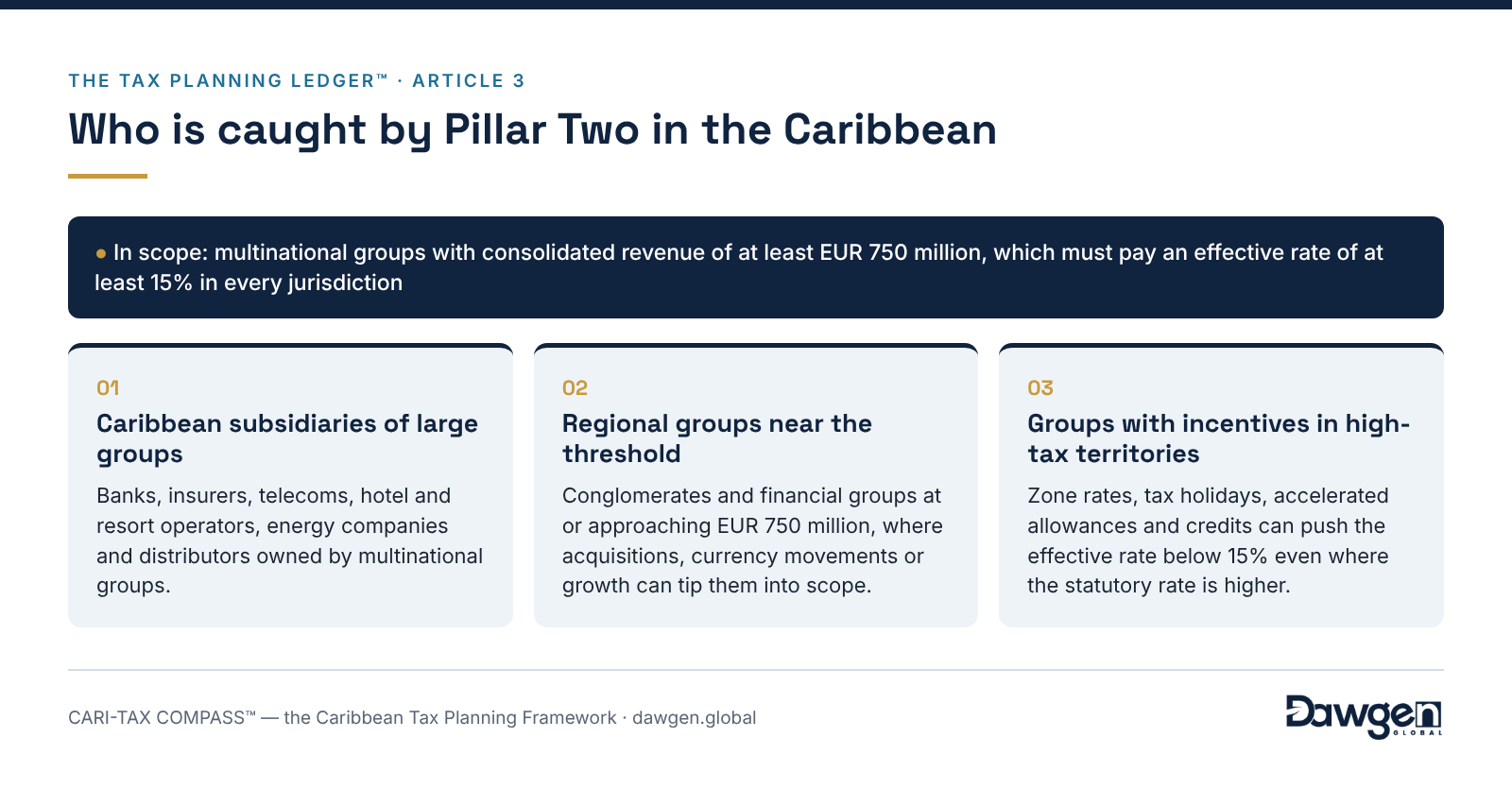
Caribbean subsidiaries of large international groups. Banks, insurers, telecommunications companies, hotel and resort operators, energy companies and distributors owned by multinational groups are the most common examples. Each entity must supply data to its group, and may have local filing and payment obligations.
Caribbean-headquartered groups near the threshold. A small number of regional conglomerates and financial groups are at or approaching EUR 750 million in consolidated revenue. Acquisitions, currency movements or strong growth can bring a group into scope sooner than expected, and the two-of-four-years test means planning must begin early.
Groups in high-tax territories that enjoy incentives. A statutory rate above 15% does not guarantee safety. Special economic zone rates, tax holidays, accelerated allowances and certain credits can push the effective rate in a jurisdiction below 15%. An incentive that saves tax locally may simply produce a top-up tax elsewhere.
Dawgen Global illustration
Who is affected without being caught
Most Caribbean businesses are well below the threshold. Yet they feel the rules in four ways:
- As suppliers and partners. In-scope customers are reviewing their supply chains, service arrangements and intercompany charges, and may ask suppliers for information or renegotiate terms.
- As targets for acquisition. Buyers that are in scope will value a Caribbean business on its after-top-up-tax profits, and will look closely at incentives in tax due diligence.
- As beneficiaries of incentives. Governments are reviewing incentive regimes that no longer attract in-scope groups. Incentives may be redesigned, for example as qualified refundable credits, which can change their value for everyone.
- As future groups. Fast-growing regional businesses should design their structures now so they do not have to unwind them later.
What must be filed
The exact obligations depend on the territory and the group’s structure, but in-scope groups should expect:
- Registration or notification with each relevant tax authority, identifying the group, its ultimate parent and the entity that will file.
- A GloBE Information Return, a detailed standard return setting out the group’s structure and the calculations for each jurisdiction. Under the model rules it is generally due fifteen months after the year end, with a longer period for the first year. A group can often file once centrally and notify local authorities where it has been lodged.
- A domestic top-up tax return in territories with a QDMTT, such as Barbados, filed separately from the ordinary corporate tax return.
- Payment of any domestic top-up tax by the local due date.
Behind each filing sits a demanding data exercise. Groups need, for every entity and jurisdiction, accounting profits, current and deferred taxes, payroll costs, tangible asset values and adjustments, often in more detail than local finance teams currently keep.
The mistakes we see
- Assuming a high statutory rate means no exposure, without testing the effect of incentives, losses and deferred tax.
- Leaving it to the parent company. Local entities still carry local registration, filing and payment duties, and local penalties.
- Missing early deadlines. Registration and notification deadlines often fall well before the first return, and some territories have already extended them once.
- Not using safe harbours. Transitional and QDMTT safe harbours can greatly reduce the work, but only if the conditions are tested and documented.
- Treating it as a one-off. The calculations must be repeated every year, and the data processes need to be built to last.
A practical readiness checklist
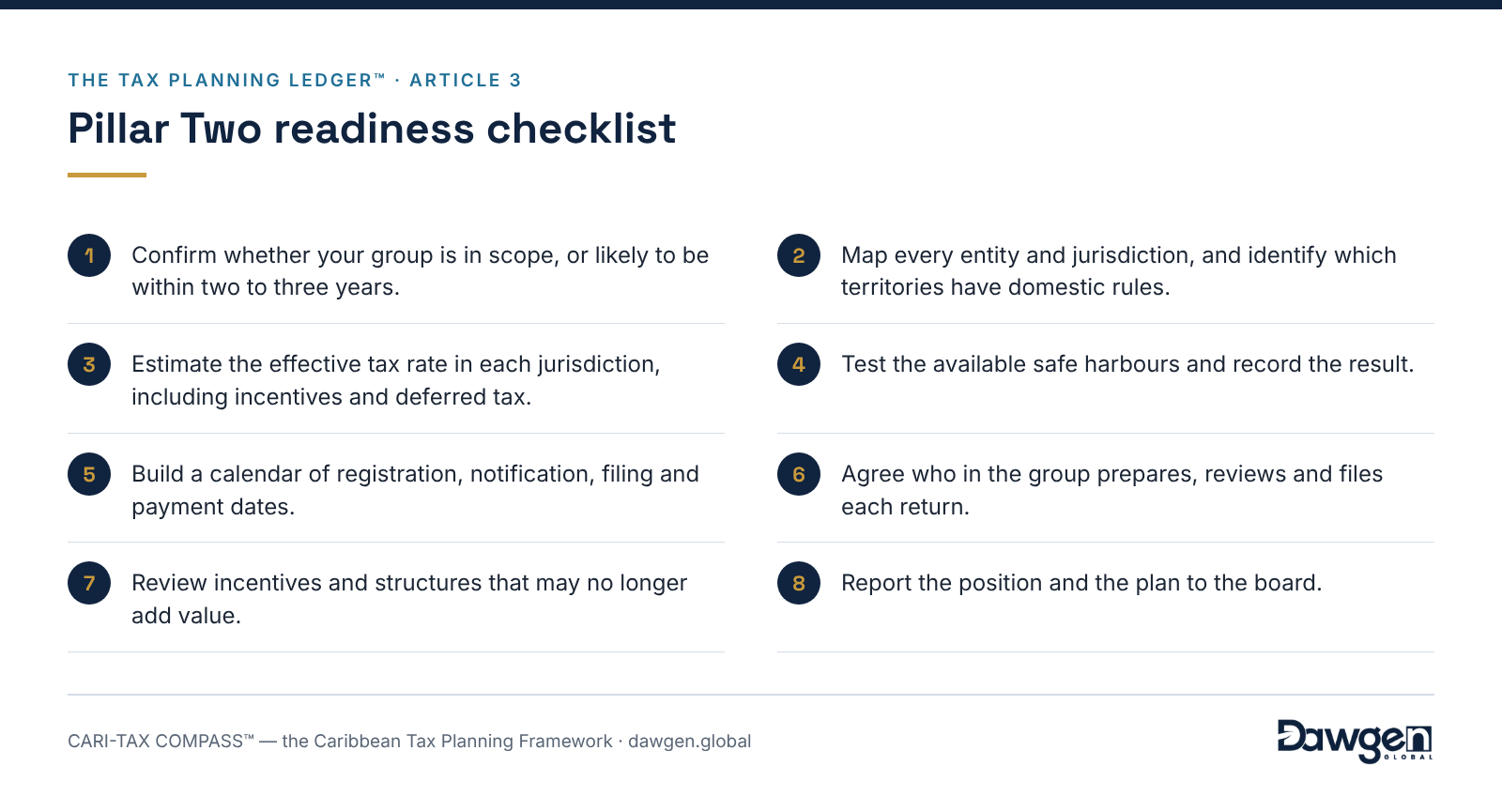
- Confirm whether your group is in scope, or likely to be within the next two to three years.
- Map every entity and jurisdiction, and identify which territories have domestic rules.
- Estimate the effective tax rate in each jurisdiction, including the effect of incentives and deferred tax.
- Test the available safe harbours and record the result.
- Build a calendar of registration, notification, filing and payment dates.
- Agree who in the group prepares, reviews and files each return.
- Review incentives and structures that may no longer add value.
- Report the position and the plan to the board.
 Dawgen Global illustration
How Dawgen Global can help
Our Pillar Two Readiness Review is designed for Caribbean subsidiaries of large groups and for regional groups approaching the threshold. Over four to six weeks we confirm scope, estimate your jurisdictional effective tax rates, test the safe harbours, map your data and set out a registration and filing plan for each territory.
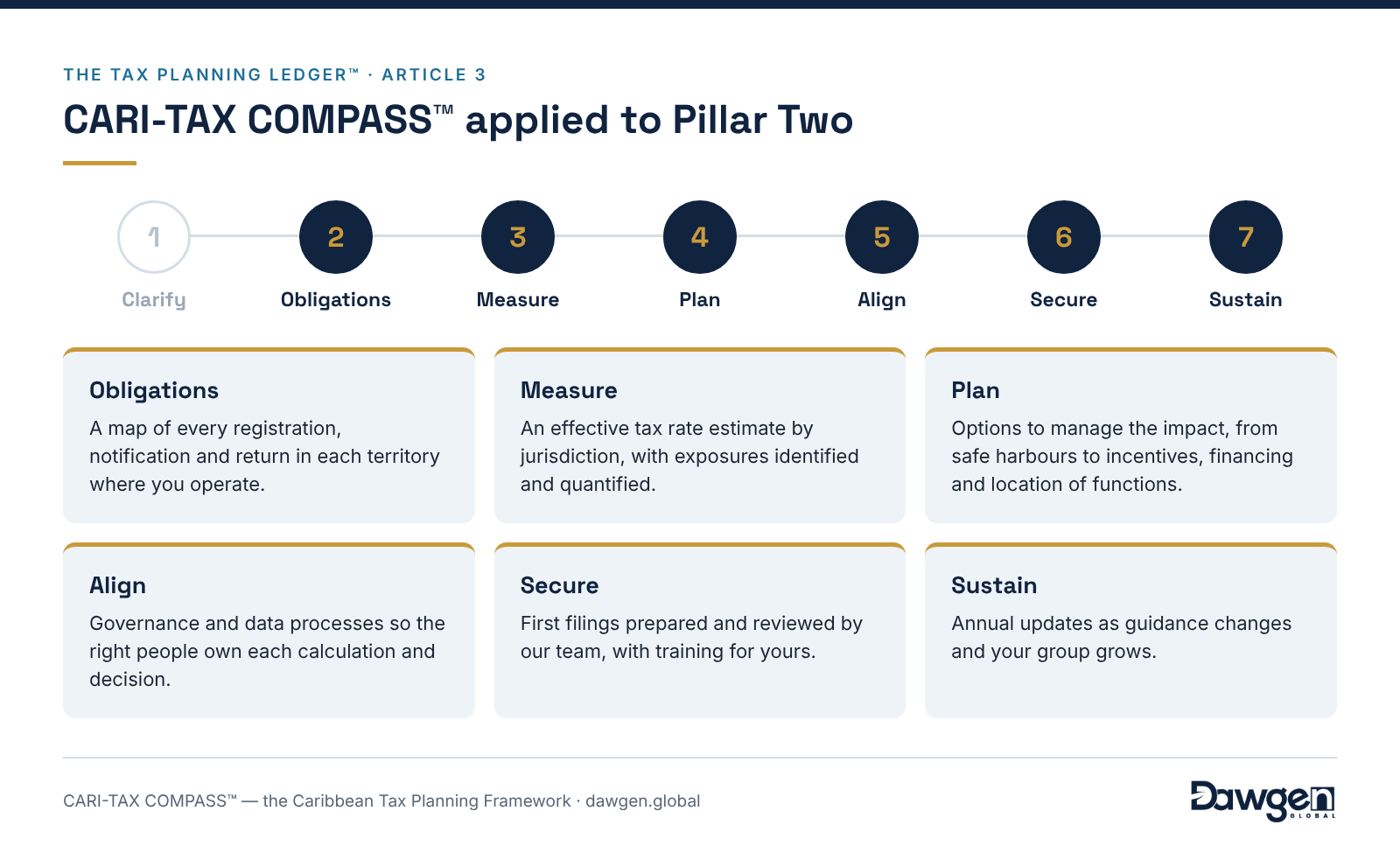
Under CARI-TAX COMPASS™, the Caribbean Tax Planning Framework, the work sits in clear stages:
- Obligations: a map of every registration, notification and return in each territory where you operate.
- Measure: an effective tax rate estimate by jurisdiction, with exposures identified and quantified.
- Plan: options to manage the impact, from using safe harbours to reviewing incentives, financing and the location of functions, each tested for substance.
- Align and Secure: governance, data processes and the first filings, prepared and reviewed by our team, with training for yours.
- Sustain: annual updates as guidance changes and your group grows.
For groups not yet in scope, our Tax Position Diagnostic includes a forward look at when the rules could apply and how to design your structure now so it does not need to be unwound later.
 Dawgen Global illustration
Where to start
Take the CARI-TAX COMPASS™ Tax Health Score at dawgen.global/tax-health-score; its readiness questions include the global minimum tax. Or speak with our Caribbean Tax Service Desk at info@dawgen.global or (876) 926-5210, or with your territory desk at country@dawgen.com.
In Article 4, we look at Bermuda’s 15% corporate income tax and what it means for structures across the region.
Dawgen Global — Big Firm Capabilities. Caribbean Understanding.
This article is general information and is not a substitute for advice on your circumstances. Pillar Two rules and guidance are changing quickly; confirm the current position in each territory before acting.
About Dawgen Global
Dawgen Global is an independent, integrated multidisciplinary professional services firm headquartered at 47 Trinidad Terrace, New Kingston, Jamaica, serving 35 territories across the Caribbean. Founded and led by Dr. Dawkins Brown, Executive Chairman, the firm is independent and not affiliated with any international network. It delivers a full suite of professional services under one roof: audit and assurance; tax advisory; IT and digital transformation; risk management; cybersecurity; actuarial and insurance regulatory advisory; HR advisory; mergers and acquisitions; corporate recovery; business advisory and strategy; accounting BPO and virtual CFO services; and legal process outsourcing.
The proposition is simple: big-firm capability without the big-firm price. Dawgen Global’s integrated approach is built for the specific complexities and opportunities of the Caribbean market, helping organizations make sharper, better-informed decisions that drive measurable progress.
To explore a partnership, reach out:
- Website: dawgen.global
- Email: info@dawgen.global
- WhatsApp (Global): +1 555-795-9071
- Caribbean offices: +1 876-665-5926 | +1 876-929-3670 | +1 876-926-5210