
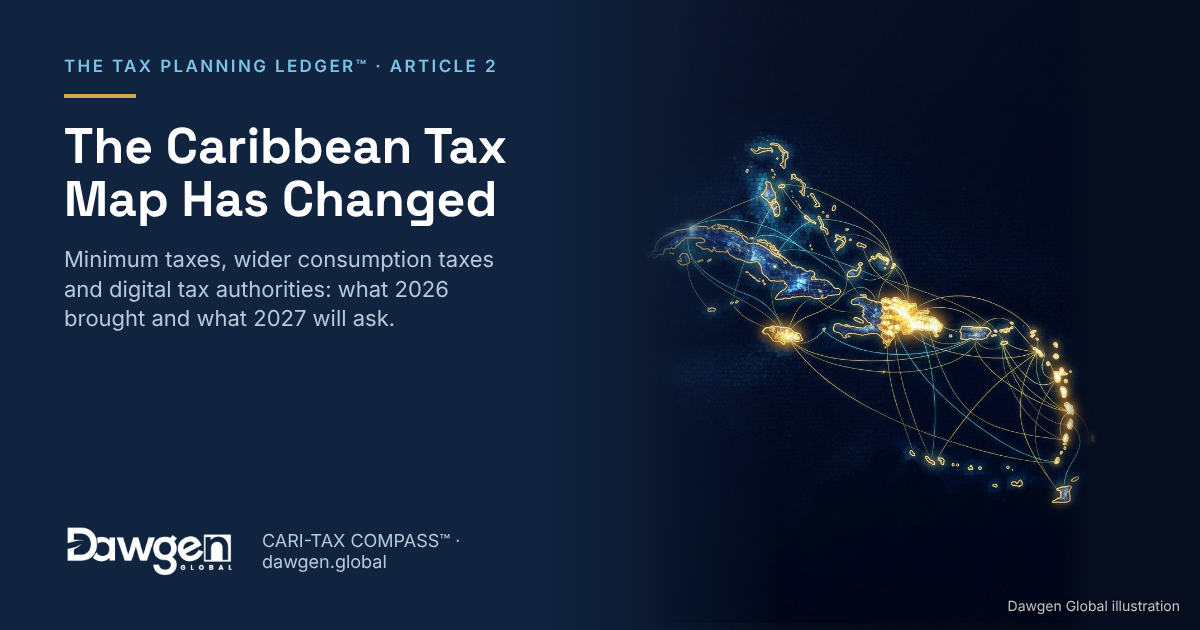
Every year, each Caribbean territory presents a budget, passes amendments and issues guidance. Read one at a time, the changes can look modest. Read together, as we do each year in preparing our Budget Reviews for all 35 territories we serve, they tell a clear story: the region’s tax systems are being rebuilt around three ideas. Large groups will pay a minimum level of tax. Consumption taxes will reach further, including into the digital economy. And tax administrations are becoming digital, connected and better at finding what is missing.
For a business that operates in one territory, these shifts are manageable. For a group in three or five territories, they combine into a question that no single tax return can answer: what does all of this mean for us, together, and what should we do before it applies?
This article sets out the main changes of 2026, the patterns behind them, and what a well-run business should do in 2027.
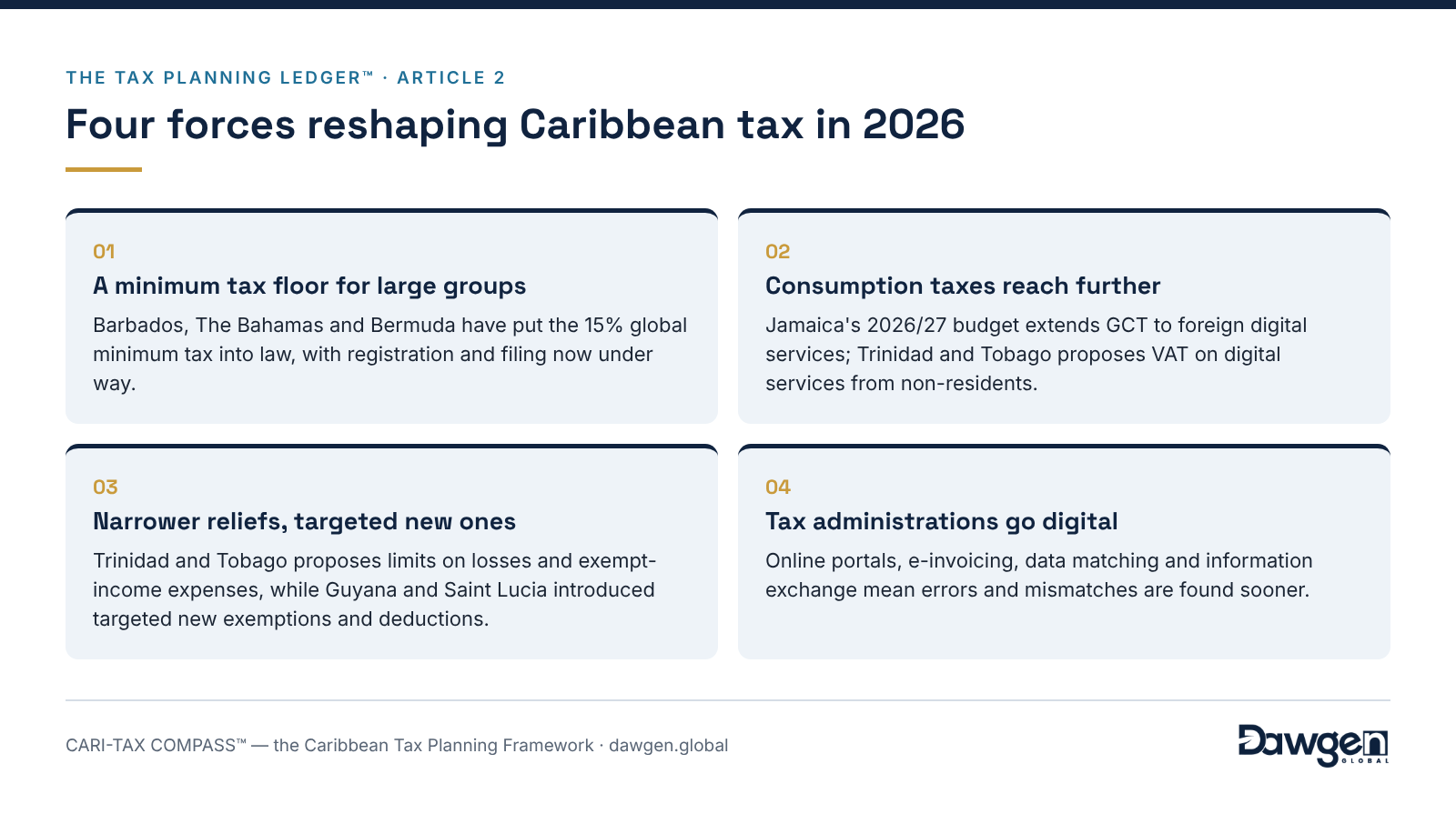
1. A minimum tax floor for large groups
The most significant structural change is the arrival of the global minimum tax, often called Pillar Two, in Caribbean law. It aims to ensure that multinational groups with consolidated revenue of at least EUR 750 million pay an effective tax rate of at least 15% in every country where they operate.
- Barbados enacted the Corporation Top-up Tax Act in 2024 and, during 2026, the Barbados Revenue Authority issued a series of guidance notes on the qualified domestic minimum top-up tax, safe harbours, registration, the GloBE Information Return and payment, together with a waiver of penalties and interest for early filing periods.
- The Bahamas enacted its Domestic Minimum Top-up Tax Act in November 2024 and opened registration in 2026, with filing obligations falling due during the year.
- Bermuda, long a zero-tax centre, has applied a 15% corporate income tax since 1 January 2025 to entities in large multinational groups, and added a tax credit regime in late 2025.
The effect is already visible in published accounts: one regional bank reported that the Bahamian top-up tax added US$10.98 million to its tax bill in a single year. Article 3 in this series explains in detail who is caught and what must be filed; Article 4 looks at what Bermuda’s change means for regional structures.
Most Caribbean businesses are well below the EUR 750 million threshold and will not pay a top-up tax themselves. But many are suppliers to, partners of or subsidiaries in groups that are in scope, and the rules change how those groups price, structure and finance their Caribbean operations.
2. Consumption taxes reach further
Where governments have needed revenue, they have turned mainly to consumption taxes rather than income tax rates.
- Jamaica’s 2026/27 budget, delivered after Hurricane Melissa, was the country’s first broad tax package in a decade and placed the burden on indirect taxes. It extends General Consumption Tax (GCT) to digital services and intangibles supplied from abroad and consumed in Jamaica, expected to be fully operational in 2027, and raises GCT on tourism activities from 10% to the standard rate of 15% from 1 April 2027.
- Trinidad and Tobago’s 2027 budget, presented in October 2026, proposes VAT at the standard rate on digital services supplied by non-residents.
Article 5 compares the two digital services measures in detail. For now, the point is simple: overseas suppliers will have new registration and collection duties, and local businesses that buy software, platforms and online services from abroad will see their costs, invoices and records change.
3. Narrower reliefs, and some targeted new ones
Budgets in 2026 both restricted and extended reliefs.
- Trinidad and Tobago’s 2027 budget proposes a restriction on the use of tax losses, an increase in withholding tax on distributions, an amendment to the definition of “payments” subject to withholding tax, and the disallowance of expenses incurred in earning exempt income. Full details await the Finance Bill, but each measure can raise the effective tax rate of a group that relied on losses, paid dividends or earned exempt income.
- Guyana, by contrast, exempted income from agriculture and agro-processing from corporation tax from the 2026 year of income, alongside exemptions for childcare and elderly care services.
- Saint Lucia extended its VAT exemption on key construction materials until November 2030 and introduced a deduction for interest on loans used by first-time landowners.
- Antigua and Barbuda announced no new taxes for 2026 but focused on compliance: full digitisation of its sales tax system, electronic invoicing and a new tax administration platform. It has also proposed bringing offshore banks under its standard 25% corporate tax rate.
The lesson is that incentives and restrictions now change faster than many businesses review their positions. A relief that existed when a structure was set up may have narrowed; a new one may be available and unclaimed.
4. Tax administrations are going digital
The quietest change may be the most important for day-to-day compliance. Across the region, revenue authorities are moving to online filing portals, electronic invoicing and data matching. Beneficial ownership registers, exchange of information under international standards and country-by-country reporting mean that authorities increasingly see information from other countries before a taxpayer files.
In practice, this means errors are found sooner, mismatches between returns are flagged automatically, and the old assumption that a small discrepancy will go unnoticed no longer holds.
Dawgen Global illustration
What this means for your business
Three practical consequences follow.
First, a single-territory view is no longer enough. A group with entities in Jamaica, Trinidad and Tobago and Barbados now faces different rules on digital services, losses, withholding and minimum tax in each. Decisions taken in one territory, such as where to hold intellectual property or how to finance a subsidiary, have consequences in the others.
Second, timing matters more. New measures often take effect months after the budget speech and depend on legislation and guidance that arrives later still. Businesses that wait for final rules before acting often find themselves registering, re-pricing or re-invoicing in a rush.
Third, documentation is now a defence, not a formality. With more data in the hands of tax authorities, a position that cannot be explained with documents prepared at the time is a position at risk.
Five questions to ask before your 2027 planning cycle
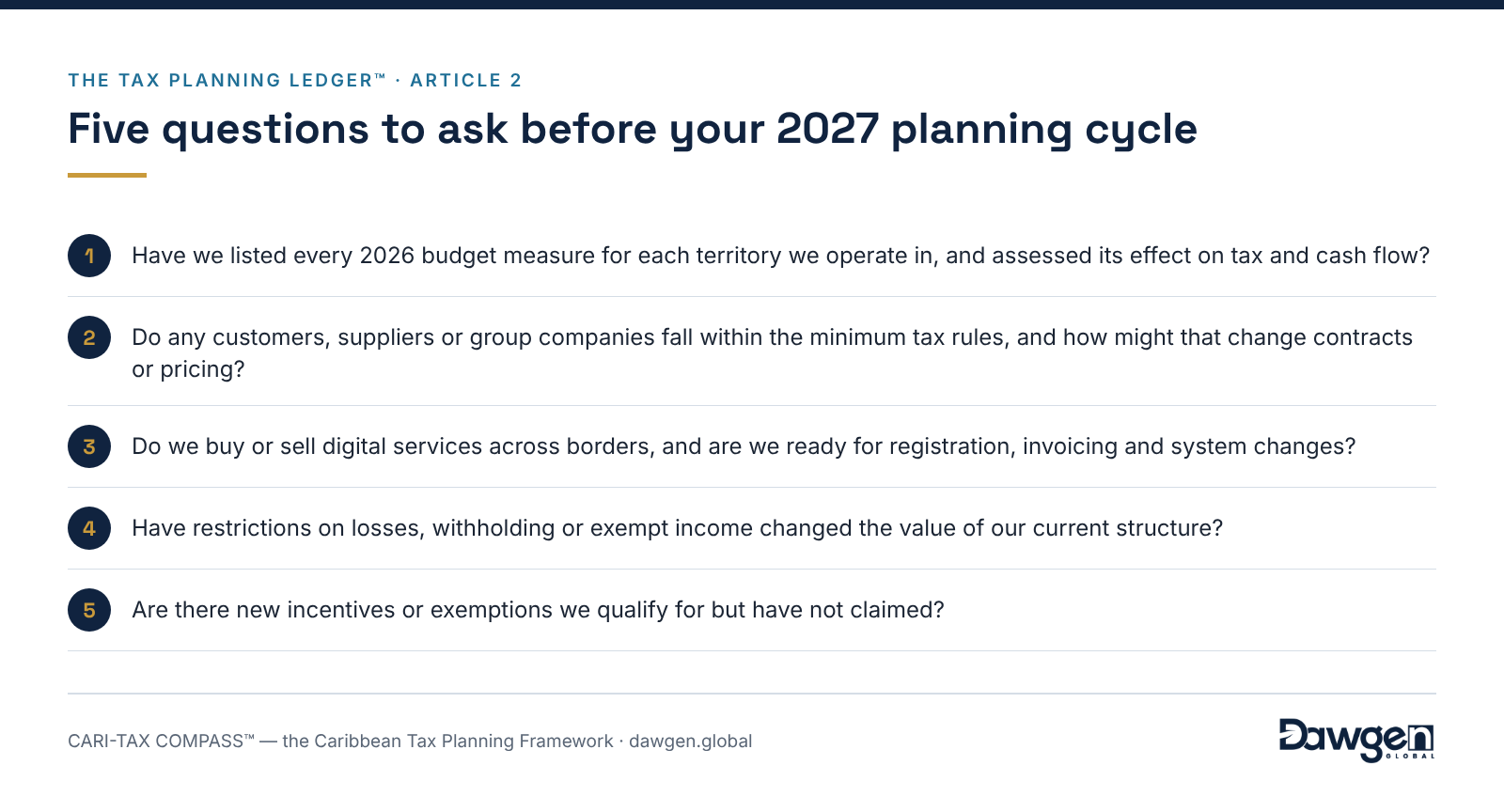
- Have we listed every budget measure announced in 2026 for each territory we operate in, and assessed its effect on our tax and cash flow?
- Do any of our customers, suppliers or group companies fall within the minimum tax rules, and how might that change our contracts or pricing?
- Do we buy or sell digital services across borders, and are we ready for registration, invoicing and system changes?
- Have restrictions on losses, withholding or exempt income changed the value of our current structure?
- Are there new incentives or exemptions we qualify for but have not claimed?
Dawgen Global illustration
How Dawgen Global can help
Keeping track of 35 tax systems is our daily work. We publish a Tax Guide, a Budget Review and a Doing Business Guide for every territory we serve, and our Caribbean Tax Service Desk in Kingston coordinates advice across all of them.
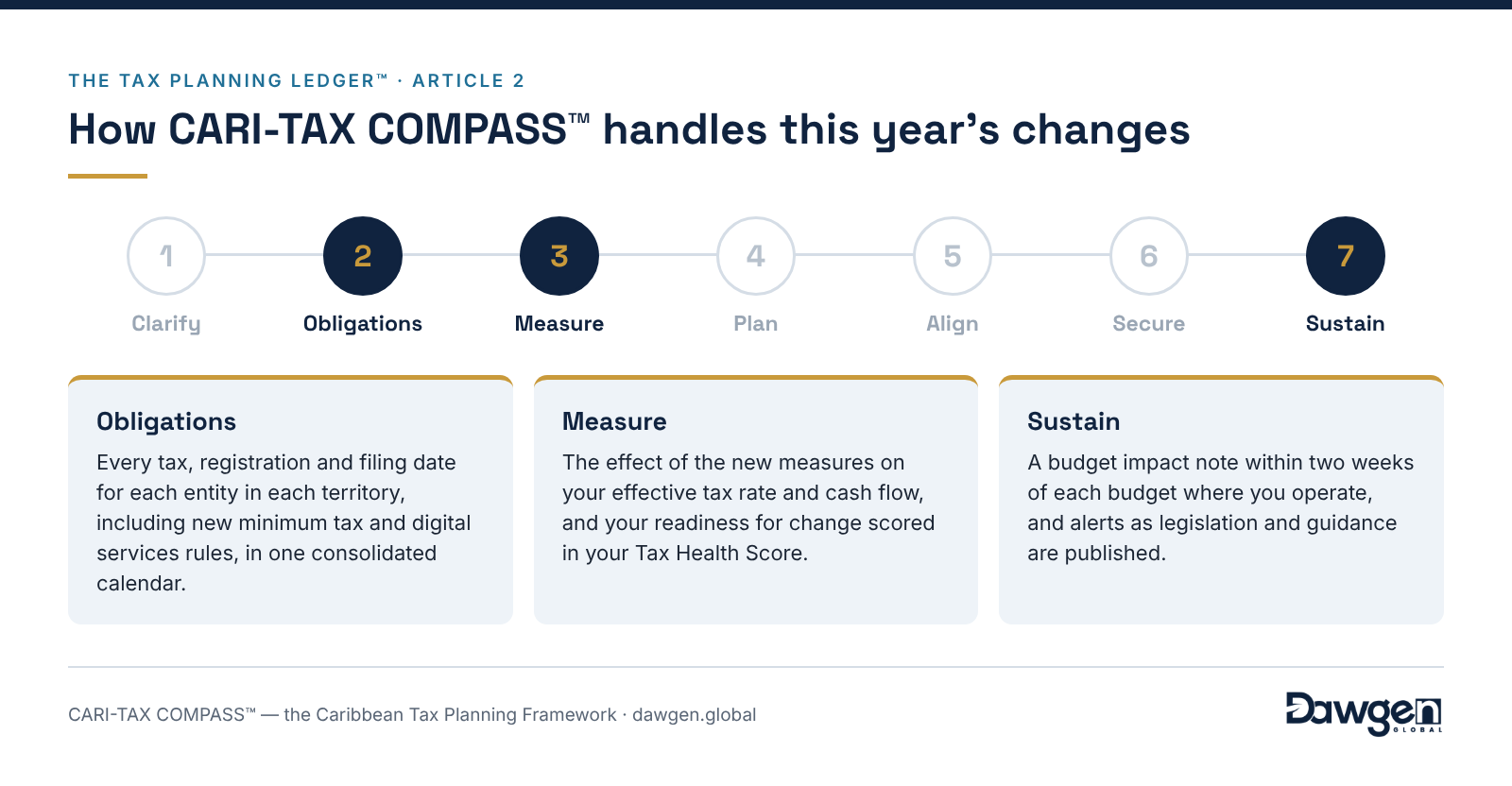
Under CARI-TAX COMPASS™, the Caribbean Tax Planning Framework, this year’s changes are handled in three stages:
- Obligations: we map every tax, registration and filing date for each of your entities in each territory, including new obligations such as minimum tax registrations and digital services rules, into one consolidated calendar.
- Measure: we quantify the effect of the new measures on your effective tax rate and cash flow, and score your readiness for change as part of your Tax Health Score.
- Sustain: within two weeks of each budget in the territories where you operate, you receive a budget impact note explaining what changed for you and what to do, together with alerts as legislation and guidance are published.
For businesses that want a single, clear starting point, our Tax Position Diagnostic covers your obligations, your exposures and your Tax Health Score in three to four weeks, and ends with a costed plan.
Dawgen Global illustration
Where to start
Take the CARI-TAX COMPASS™ Tax Health Score at dawgen.global/tax-health-score: 19 questions, about five minutes, with an indicative score out of 100 and your three priorities. Or speak with our Caribbean Tax Service Desk at info@dawgen.global or (876) 926-5210, or with your territory desk at country@dawgen.com.
In Article 3, we look closely at Pillar Two: who is caught, what must be filed, and what it means for groups that are not.
Dawgen Global — Big Firm Capabilities. Caribbean Understanding.
This article is general information and is not a substitute for advice on your circumstances. Tax rules change frequently; confirm the current position before acting.
About Dawgen Global
Dawgen Global is an independent, integrated multidisciplinary professional services firm headquartered at 47 Trinidad Terrace, New Kingston, Jamaica, serving 35 territories across the Caribbean. Founded and led by Dr. Dawkins Brown, Executive Chairman, the firm is independent and not affiliated with any international network. It delivers a full suite of professional services under one roof: audit and assurance; tax advisory; IT and digital transformation; risk management; cybersecurity; actuarial and insurance regulatory advisory; HR advisory; mergers and acquisitions; corporate recovery; business advisory and strategy; accounting BPO and virtual CFO services; and legal process outsourcing.
The proposition is simple: big-firm capability without the big-firm price. Dawgen Global’s integrated approach is built for the specific complexities and opportunities of the Caribbean market, helping organizations make sharper, better-informed decisions that drive measurable progress.
To explore a partnership, reach out:
- Website: dawgen.global
- Email: info@dawgen.global
- WhatsApp (Global): +1 555-795-9071
- Caribbean offices: +1 876-665-5926 | +1 876-929-3670 | +1 876-926-5210
Related service: Explore how we can help →