
Banks, credit unions, payment providers and merchants across the region process card, mobile and wire payments every second. Attackers target every link in the chain, from ATMs and card terminals to payment messaging and online banking. Security protects more than data. It protects the trust that keeps customers using your services.
Dawgen Global illustration
Every day, millions of payments flow through Caribbean financial systems. Tourists tap cards at hotel front desks. Residents withdraw cash from ATMs, pay bills through mobile apps and send remittances across borders. Businesses pay suppliers by wire transfer. Credit unions issue debit cards to members. Fintech wallets move money between phones.
Each of these transactions passes through a chain of systems, people and partners. Attackers study that chain carefully, looking for the weakest link: a card terminal that can be tampered with, an ATM running outdated software, a payment server with shared administrator passwords, a payment messaging terminal without proper controls or an online banking login without strong authentication.
Payment security is about protecting every link. When it fails, the costs are measured not only in direct losses but in card reissue costs, scheme penalties, regulatory scrutiny and, above all, lost customer trust.
Why payment systems are prime targets
Payment systems attract criminals for an obvious reason: they move money. But the specific threats vary across the chain.
Card data is valuable because it can be sold and used quickly. Breaches of card data lead to fraud, reissue costs, investigations and potential penalties from card schemes.
ATMs and point-of-sale terminals are targeted by skimming devices, malware that forces machines to dispense cash, and physical attacks on the machines themselves.
Payment messaging systems used for interbank and wire transfers have been the target of some of the largest cyber thefts in the world, where attackers compromised banks’ environments and sent fraudulent transfer instructions.
Digital banking channels face account takeover through stolen credentials, phishing and malware, along with fraud that exploits weaknesses in onboarding and transaction controls.
Third-party processors and partners extend the chain. A weakness at a processor, acquirer or card issuing partner can expose your customers.
| Payment security protects more than data. It protects the trust that keeps customers using your services. |
PCI DSS: the baseline for card security
Any organisation that stores, processes or transmits payment card data must comply with the Payment Card Industry Data Security Standard, or PCI DSS. This includes banks and credit unions issuing cards, payment processors, and merchants such as hotels, retailers and e-commerce businesses.
Version 4.0 of the standard introduced significant changes, with many new requirements becoming mandatory from 31 March 2025. Key themes include broader use of multi-factor authentication for access to the cardholder data environment, targeted risk analysis to justify how often certain controls are performed, stronger logging and monitoring, protection against phishing and against malicious scripts on payment pages, and more rigorous management of service providers.
For many organisations, the most effective first step is scope reduction. The fewer systems that store or handle card data, the smaller the area that must meet the standard. Discovering where card data actually sits, removing it where it is not needed and using tokenisation or outsourced payment pages can dramatically reduce cost and risk.
A structured path to compliance
PCI DSS readiness follows a clear sequence.
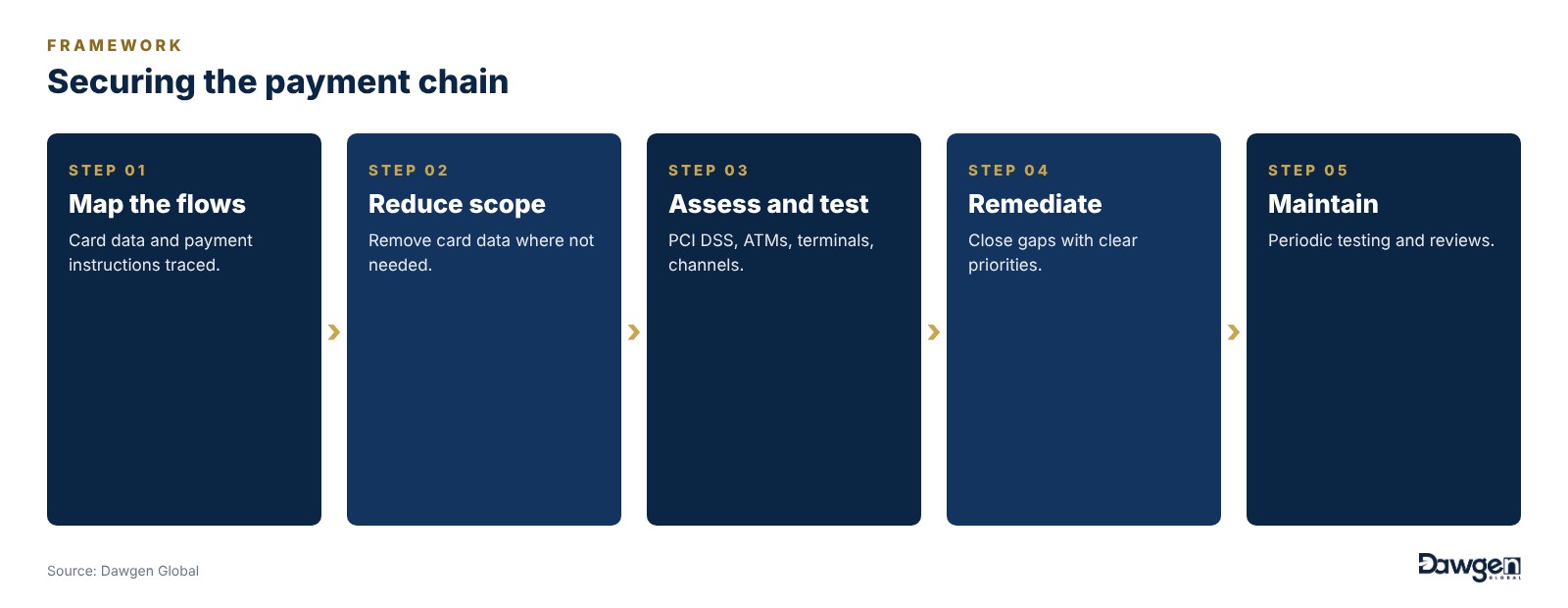
Figure 1. Securing the payment chain
It begins by mapping payment flows, tracing how card data and payment instructions move through systems, people and partners. Scope reduction removes unnecessary card data. A gap assessment measures controls against each requirement of the standard. Remediation closes the gaps, with clear priorities and evidence. Finally, controls are maintained through periodic testing and reviews, so compliance does not lapse as systems change.
Formal validation, such as a Report on Compliance, is issued by a Qualified Security Assessor where required. Readiness work makes that validation faster, cheaper and less stressful.
ATM and terminal security
ATMs and card terminals sit in public places, which makes them uniquely exposed. Specialist testing assesses them against known attack techniques.
For ATMs, testing typically examines resistance to malware and “black box” attacks, where criminals connect a device to the ATM’s internal components to command it to dispense cash; the security of the ATM’s operating system and network connection; physical access to internal components; and protections against card skimming.
For point-of-sale terminals and self-service kiosks, testing examines tamper resistance, how card data is protected in the device and in transit, and how terminals are managed and updated.
Credit unions expanding ATM networks, banks upgrading fleets and merchants deploying new terminals all benefit from independent testing before and after deployment.
Payment messaging security
Interbank payment messaging is critical infrastructure. Banks connected to international payment networks must protect the environment in which payment messages are created and sent. The SWIFT Customer Security Programme, for example, sets out mandatory and advisory controls that connected institutions must attest to each year.
Key areas include segmenting the payment environment from the wider network, controlling operator and administrator access, protecting credentials, monitoring transactions for anomalies and detecting unusual activity. Independent assessment supports accurate annual attestation and identifies weaknesses before attackers do.
Digital banking security
Online and mobile banking are now the main channels for many customers. Testing should cover the full chain: the app or website, the APIs behind it and the core systems they connect to.
Priorities include strong authentication and protection against account takeover, secure onboarding and identity verification, protection against transaction tampering, and fraud scenarios such as abuse of payee changes and transfer limits. Mobile wallets and remittance apps face similar risks and similar expectations from partners and regulators.
Where payment security breaks down
In practice, the same weaknesses appear repeatedly across institutions and merchants.
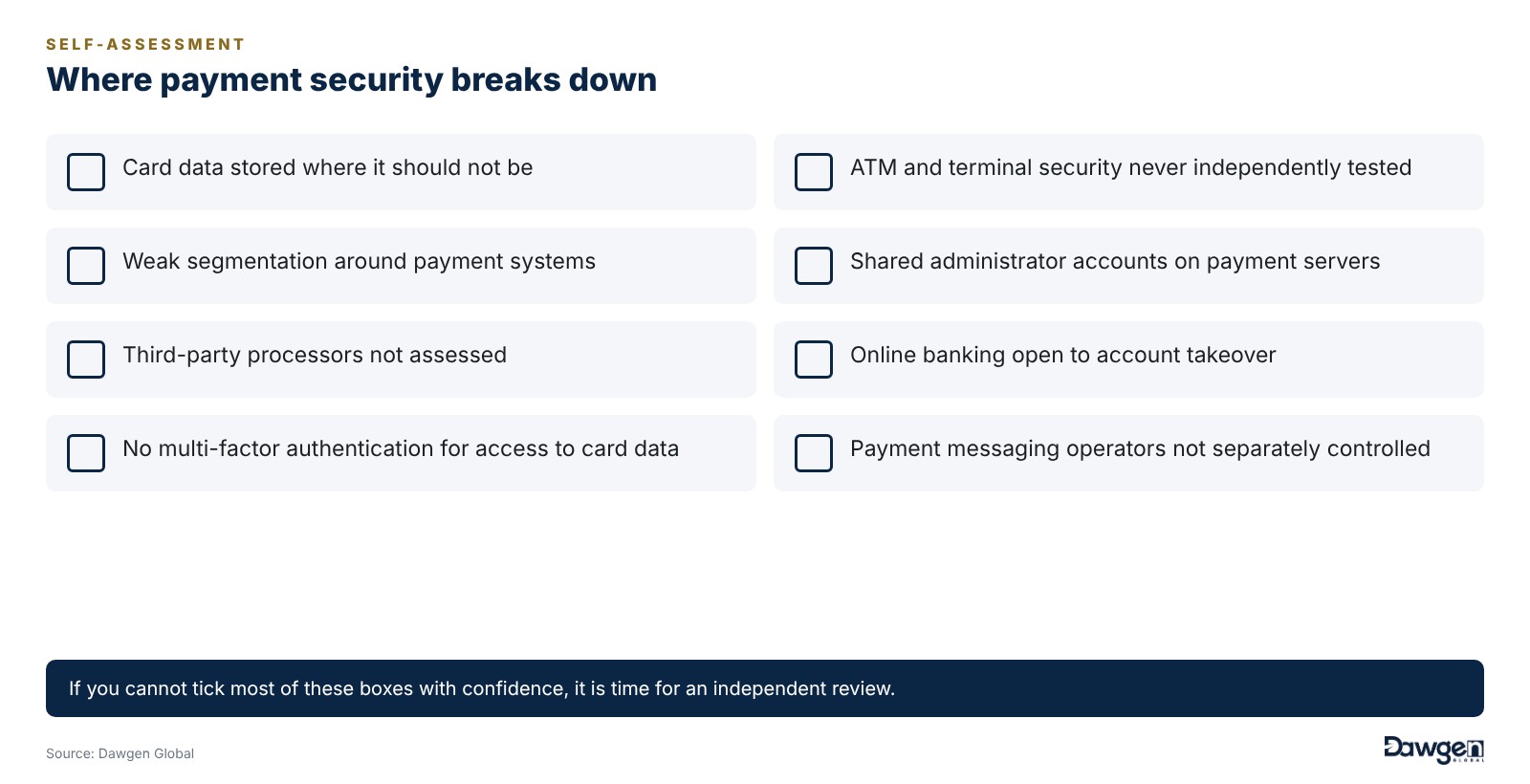
Figure 2. Where payment security breaks down
A composite case: preparing for card issuing
Consider a credit union preparing to issue its own debit cards and expand its ATM network. It needed to meet PCI DSS and its card scheme’s security requirements before launch.
The work began by mapping card data flows across the card management system, core banking platform, ATMs and partners. Scope reduction removed card data from several systems where it had been stored unnecessarily. A gap assessment identified missing multi-factor authentication for administrators, weak segmentation around the card management system and gaps in logging. ATM testing found an outdated operating system configuration and an exposed maintenance interface on one model.
With priorities agreed, the credit union remediated the gaps, documented its controls and introduced annual ATM testing. The card programme launched on schedule, with evidence ready for validation.
Merchants: hotels, retailers and e-commerce
Payment security is not only a concern for banks. Hotels, restaurants, retailers and online stores that accept cards must also meet PCI DSS. Common risks include card data written down or stored in reservation systems, outdated terminals, payment pages vulnerable to malicious scripts and staff who are unaware of skimming and social engineering risks. Simple measures, such as using validated payment terminals, outsourcing online payment pages to compliant providers and never storing full card numbers, reduce both risk and compliance burden.
Common objections, answered
“Our processor handles PCI compliance.” Outsourcing can reduce scope, but responsibility for your own environment, staff and processes remains with you.
“Our ATMs come from a reputable vendor.” Vendor security depends heavily on configuration, maintenance and the network the machine sits on. Independent testing checks how machines are actually deployed.
“Compliance is a once-a-year exercise.” Version 4.0 places greater emphasis on continuous security. Controls must work every day, not just during the assessment.
Remittances and digital wallets
Remittances are a vital part of many Caribbean economies, and the companies and apps that move money across borders face their own security challenges. Account takeover, synthetic identities, mule accounts and fraud during onboarding are common. Strong identity verification, transaction monitoring, secure APIs and independent testing of mobile apps protect both the provider and the families who depend on these transfers.
Digital wallets and mobile money services, often launched by fintech companies or telecoms providers, face similar risks. Regulators and banking partners increasingly expect independent security testing and clear evidence of controls before launch and after major changes.
Monitoring the payment environment
Payment systems should be monitored around the clock. Unusual administrator activity, new devices on the payment network, changes to transaction limits and connections from unexpected locations can all signal an attack in progress. Connecting payment environment logs to a managed SOC provides continuous oversight, and transaction monitoring adds a business-level view that can detect fraud patterns technical tools may miss.
The role of the board
Boards of banks, credit unions and payment providers should receive regular reporting on payment security: compliance status, results of ATM and channel testing, significant fraud incidents and trends, and progress on remediation. Payment security is not only a technical matter. It is central to customer trust, regulatory standing and the institution’s reputation.
Linking payment security to the wider programme
Payment security does not stand alone. It depends on strong identity controls, secure cloud and network configuration, staff awareness of social engineering, tested incident response and forensic capability when fraud occurs. Institutions that treat payment security as part of a broader cybersecurity programme, rather than as a once-a-year compliance exercise, are far better protected.
Conclusion
The Caribbean’s payment landscape is growing more digital, more connected and more competitive. Attackers are following the money, targeting every link in the chain. Organisations that map their payment flows, reduce where card data lives, test ATMs, terminals and digital channels, and secure their payment messaging environments protect both their customers and their reputation.
Every transaction depends on trust. Payment security is how that trust is earned and kept.
| TAKE THE NEXT STEP
Secure every link in your payment chain. Our Payment & Banking Security brochure explains our PCI DSS readiness work, ATM and terminal testing, payment messaging reviews and digital banking security testing. Read the brochure: Payment & Banking Security — https://www.dawgen.global/service-brochure/payment-banking-security/ Talk to us: Request a payment security proposal or book a PCI DSS scoping session. Write to info@dawgen.global, or to your territory desk at territory@dawgen.com. |
About Dawgen Global
Dawgen Global is an independent, integrated multidisciplinary professional services firm headquartered at 47 Trinidad Terrace, New Kingston, Jamaica, serving 35 territories across the Caribbean. Founded and led by Dr. Dawkins Brown, Executive Chairman, the firm is independent and not affiliated with any international network. It delivers a full suite of professional services under one roof: audit and assurance; tax advisory; IT and digital transformation; risk management; cybersecurity; actuarial and insurance regulatory advisory; HR advisory; mergers and acquisitions; corporate recovery; business advisory and strategy; accounting BPO and virtual CFO services; and legal process outsourcing.
The proposition is simple: big-firm capability without the big-firm price. Dawgen Global’s integrated approach is built for the specific complexities and opportunities of the Caribbean market, helping organizations make sharper, better-informed decisions that drive measurable progress.
To explore a partnership, reach out:
- Website: dawgen.global
- Email: info@dawgen.global
- WhatsApp (Global): +1 555-795-9071
- Caribbean offices: +1 876-665-5926 | +1 876-929-3670 | +1 876-926-5210
Related service: Explore how we can help →