
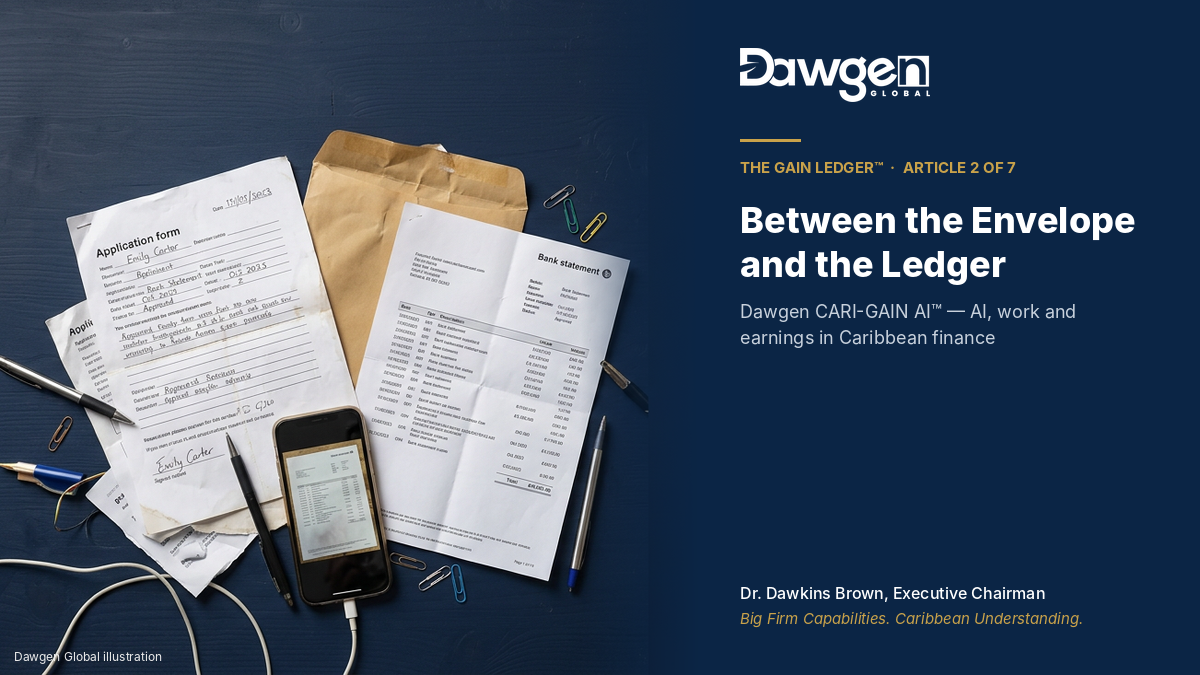
Capture Burden: the hidden cost that decides whether AI saves money or spends it.
New to this series?
The GAIN Ledger™ is a seven-part series for boards and executives of Caribbean financial institutions. It introduces Dawgen CARI-GAIN AI™, Dawgen Global’s framework for redesigning financial operations so that artificial intelligence is used only where it measurably improves performance and earnings. This article examines the first and most underestimated cost in any digital workflow: the work of turning documents and data received from customers into records an institution can trust. It explains how to measure that cost and how to reduce it. It can be read on its own.
Follow a single loan application through a typical Caribbean institution and count the touches. The customer photographs a job letter on a kitchen table. The image arrives at an angle, the bottom line cut off. A loan officer forwards it from a personal phone to a shared mailbox. Someone prints it, someone scans it, someone keys the salary into the origination system. The utility bill is in the spouse’s name. The bank statement shows “$” without saying which dollar. Two pages are missing. A message goes back to the customer. Three days pass.
None of this is credit analysis. All of it is cost.
At Dawgen Global we call it Capture Burden: the total work required to turn received information into an acceptable business record. It includes rescanning, chasing missing pages, retyping, resolving conflicting details and checking authenticity. In most institutions it is unmeasured, spread across branches and back offices, and quietly larger than the decision work it supports. It is also the single biggest reason why AI projects in financial operations deliver less than they promised.
The framework in brief
Dawgen CARI-GAIN AI™ combines what must always be true with the order in which work is done. CARI is four tests applied at every stage: Capture (every material output can be traced to reliable evidence), Accountability (a named person owns each decision), Return (the benefit survives the full cost and is verified by finance) and Inclusion (customers and staff can still use and support the service). GAIN is four phases containing seven stages: Gauge (Frame), Align (Capture, Simplify), Integrate (Connect, Assist) and Net Results (Prove, Expand). Each stage ends at a gate with four permitted outcomes: proceed, repair, pause or stop. This article concerns the Capture test and the Capture stage, the first step of the Align phase. Figure 1 shows where they sit in the model.
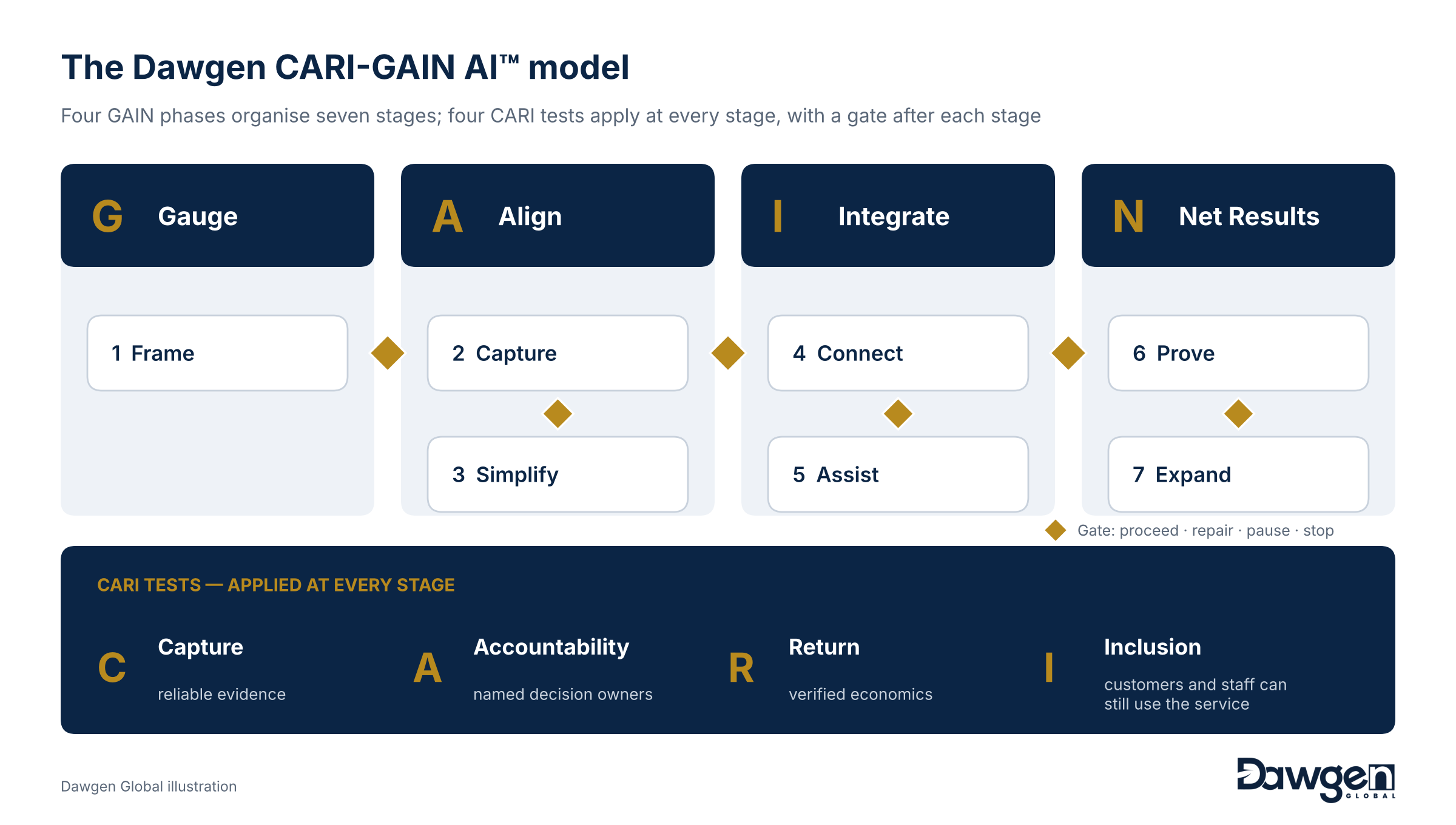
Figure 1 — The Dawgen CARI-GAIN AI™ model; this article focuses on the Capture test and the Capture stage. Dawgen Global illustration.
Scanning is not capture
Many digitisation projects stop at the scanner. The paper becomes a PDF, the PDF goes into a folder, and the institution declares itself paperless. The burden has not moved. Someone still has to open the PDF, find the fields, check them and type them somewhere useful.
Figure 2 shows why. The scan is the visible tip. Beneath it sits the work that consumes most of the time: rescanning poor images, chasing missing pages, retyping, resolving conflicting details between documents, checking that documents are authentic and establishing which currency an amount is in.
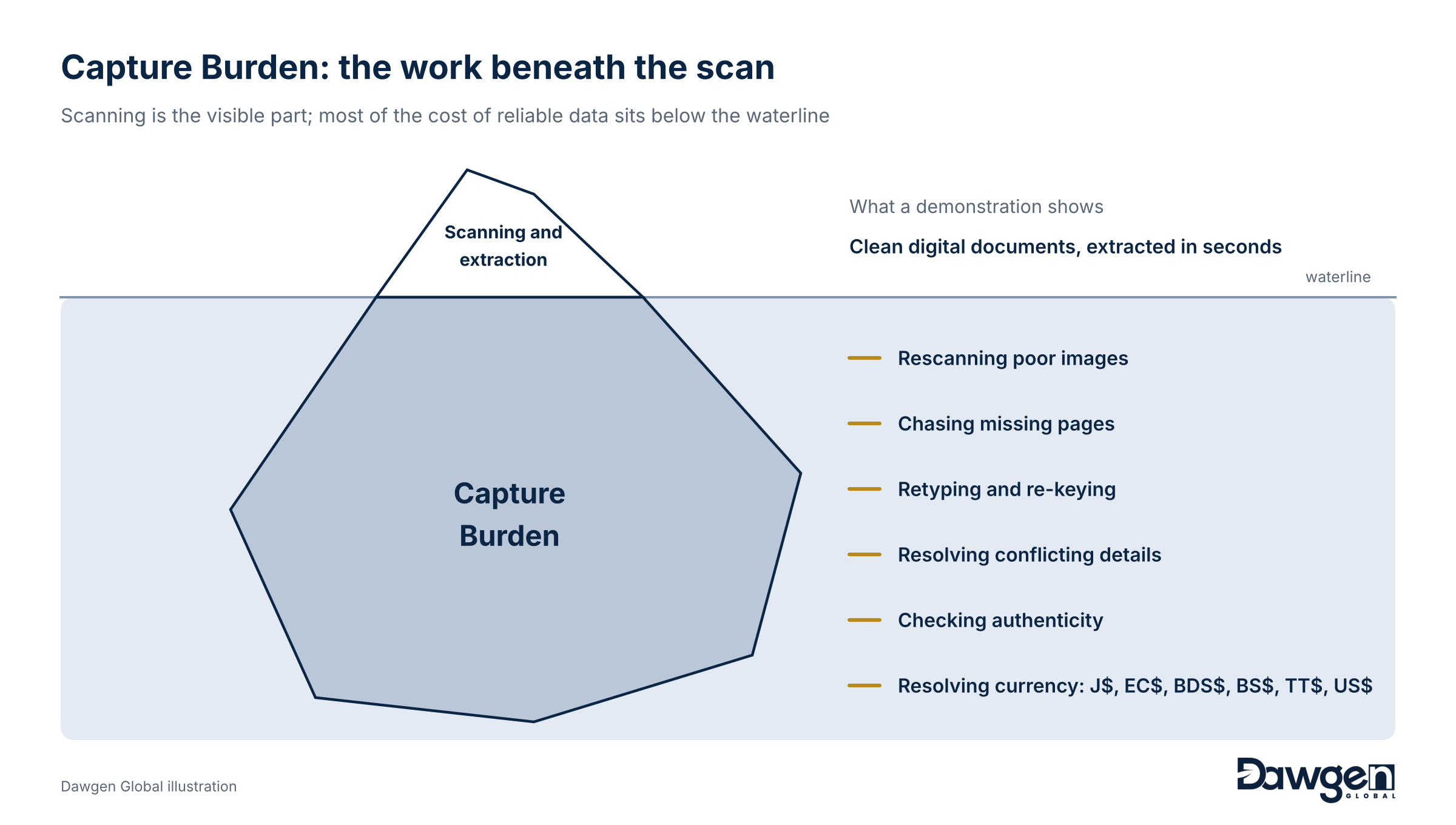
Figure 2 — Capture Burden: the work beneath the scan. Dawgen Global illustration.
AI document tools promise to close this gap, and for the right document types they can. Optical character recognition (OCR) — software that converts the image of text into characters a computer can process — has existed for decades and works well on standard printed forms. Newer document intelligence tools go further, finding fields in documents whose layout varies, such as statements from many different banks. But both introduce a dangerous illusion: a clean extraction looks like a reliable one. A system can read a perfectly sharp image of a forged pay slip with complete confidence. Image quality is not proof that a document is genuine. A model’s stated confidence is not measured correctness.
This is why Capture is the first of the four CARI tests. The test is simple to state: every material output must be traceable to a permitted source, a verified field and the rule or model version that produced it.
Why Capture Burden is larger in the Caribbean
Several features of the regional operating environment make capture especially demanding, and none of them is a weakness to be embarrassed about. They are conditions to design for.
Mixed channels. Customers submit documents in person, by email, through upload portals and, very often, through messaging applications. Each channel has different quality and different control risks. Documents forwarded from staff members’ personal phones are difficult to retain lawfully and impossible to audit.
Varied issuers. A single loan file may contain pay slips from a small employer, a statement from an overseas bank, a utility bill from one of several providers and a letter written by hand. Templates that work for one issuer fail for the next.
Multiple currencies. Jamaican, Eastern Caribbean, Barbadian, Bahamian, Trinidad and Tobago and US dollars routinely appear on the same desk, and many documents simply print “$”. An amount whose currency is uncertain cannot be processed safely.
Connectivity and weather. Uploads fail on weak connections and branches lose power in storms. Capture design must allow controlled offline intake and safe resubmission without creating duplicates.
A controlled capture sequence
CARI-GAIN treats capture as an operating capability with six steps, shown in Figure 3. The loop back to the customer is deliberate: the fastest correction is the one requested while the customer is still at the counter or on the call.
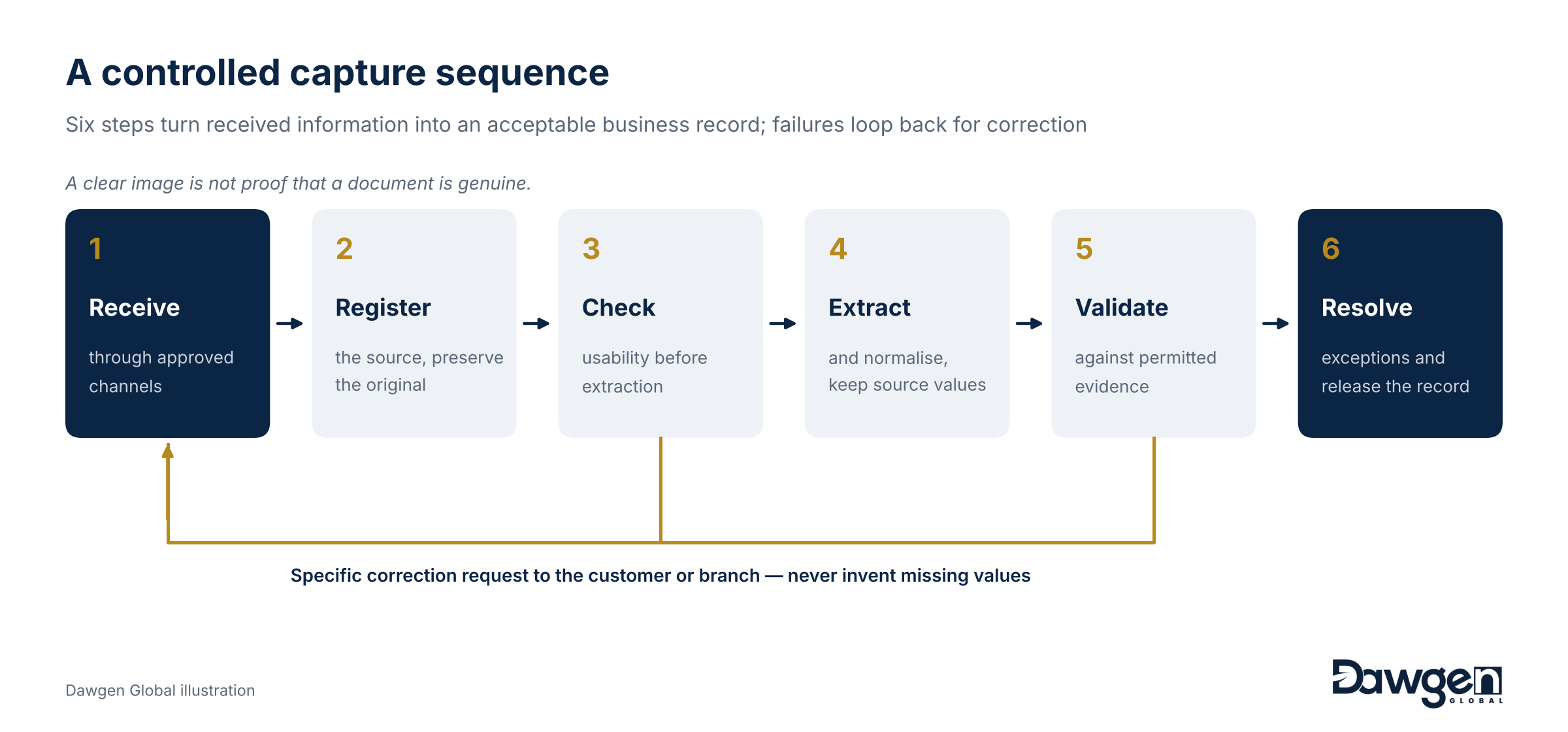
Figure 3 — The six-step controlled capture sequence, with the correction loop back to the customer. Dawgen Global illustration.
- Receive through approved channels. Structured forms and direct system feeds come first where practical. Secure uploads, branch scanning and assisted completion follow. Where customers prefer messaging — and in the Caribbean many do — use an approved business channel with controlled ingestion and retention, not staff members’ personal phones and unmanaged forwarding.
- Register the source. Give each case an identifier, record the time and channel of receipt, preserve the original file and link every extracted field back to where it came from. Detect duplicate submissions. Apply retention and access controls from the first moment.
- Check usability before extraction. Test readability, orientation, missing pages and document type, and give the customer a specific correction request immediately rather than days later.
- Extract and normalise. Use conventional OCR, document parsers or AI according to how variable the documents are. Keep the original value and the standardised value side by side. Resolve any ambiguous dollar sign before financial processing.
- Validate against permitted evidence. Apply format, arithmetic and cross-document checks — does the salary on the job letter match the deposits on the statement? Identity verification follows the institution’s approved process, never merely a name match or an extracted identification number. Where sources conflict, the conflict stays visible to the reviewer rather than being silently resolved by the system.
- Resolve exceptions and release. Apply stricter treatment to the fields where errors are most costly: beneficiary details, identity, amounts and account numbers. Route unreadable or inconsistent records to correction, customer clarification or qualified review. Never invent a missing financial value.
Measure the cost of arriving at reliable data
What gets measured gets fixed. CARI-GAIN asks institutions to track five capture measures, reported by channel and by document type:
- First-pass usable rate — submissions accepted without correction, divided by all submissions received.
- Verified critical-field accuracy — correct critical fields divided by independently checked critical fields. A critical field is one where an error changes a decision or moves money, such as an amount or an account number.
- Capture cost per accepted case — all intake, extraction, correction and checking cost, divided by accepted cases.
- Customer completion burden — repeat submissions, visits and elapsed days needed to complete a valid case.
- Unresolved capture backlog — cases awaiting correction, by age, owner and next action.
Reporting by channel matters. A strong result on clean digital uploads can easily hide failure on branch scans, older forms and handwritten entries. Any capture tool should be tested on the institution’s own real documents — the faded ones, the photographed ones, the ones from small issuers. Results should be measured on a holdout set: a sample of documents set aside purely for testing and never used to configure or tune the tool. Testing a tool on the documents it was tuned on tells you only that it remembers them.
An illustration: motor claims in Bridgetown
The following scenario is illustrative and fictional.
A general insurer in Bridgetown handles motor claims submitted through its branches, by email and through a messaging channel. A claim file typically contains a claim form, photographs of the damage, a police report, a driver’s licence and one or more repair estimates — some in Barbados dollars, some in US dollars for imported parts. Management believes claims handlers spend most of their time assessing claims. A two-week observation shows otherwise: much of their time is spent obtaining missing police reports, asking for clearer photographs, retyping estimate totals and resolving which currency an estimate is in.
Applying the capture sequence, the insurer first moves messaging submissions onto an approved business channel that registers each file against a claim number and preserves the original. It adds an immediate usability check that asks the claimant, within minutes, for a missing page or a clearer image. It introduces a rule that no estimate total is accepted without an explicit currency, and that both the original amount and the converted amount are kept. It then measures first-pass usability by channel for six weeks before choosing any extraction tool. The data show that branch-scanned claim forms are already reliable, that emailed estimates from three regular repairers suit fixed templates, and that only the varied estimates from smaller garages justify document intelligence. That tool is then tested on a holdout set of the insurer’s own estimates, with critical fields — totals, currency, vehicle registration and policy number — checked independently.
The result is a smaller, cheaper and more reliable AI deployment than the one originally proposed, sitting on top of a capture process that is now measured. Claimants also benefit: fewer return trips, fewer calls asking for documents already sent, and a faster settlement.
Why this comes before AI
The economics are straightforward. Every case that fails capture becomes an exception — a case the standard process cannot complete without a person’s intervention — and every exception consumes the staff time the AI project was meant to release. An institution that raises its first-pass usable rate often gains more than one that adds a sophisticated model on top of poor inputs. Sometimes the best capture investment is a clearer document checklist, a branch scanner with an automatic quality check, or a form that stops asking for the same information twice.
The same discipline applies when choosing a capture method. Conventional OCR and fixed templates work well for standard forms from a known issuer. Document intelligence earns its cost on variable statements and supporting evidence. Generative tools can classify and summarise, but they must be restricted to approved sources and tested for unsupported answers. CARI-GAIN compares these options on one measure: the full cost per successfully completed case at the institution’s actual volumes, including failed attempts and human review. A cheaper tool that fails more often is not cheaper.
Capture Burden is also a customer issue, and so it touches the Inclusion test. Every chased page is a customer who had to return, call or resend. For many members of our credit unions and customers of our banks and insurers, that burden is the difference between completing an application and abandoning it. Customers must also be able to see and correct what the institution has captured about them, which data protection obligations across the region increasingly expect.
What to do this month
- Measure your first-pass usable rate for one major workflow, split by channel and by branch.
- Count the documents arriving through personal devices or unmanaged forwarding, and set a date to move them onto an approved channel.
- Define your critical fields for that workflow and how each is verified today.
- Check how your systems treat an amount with no stated currency, and make explicit currency a required field.
- Build a holdout set of your own difficult documents before you evaluate any extraction tool.
- Ask front-line staff which three documents cause the most rework, and why.
Questions for your leadership team
- Do we know our first-pass usable rate for any major workflow, and does it differ by branch or channel?
- How many of our customer documents arrive through staff members’ personal devices or unmanaged forwarding?
- When a vendor quotes extraction accuracy, was it measured on our documents or theirs?
- How do our systems handle an amount where the currency is not stated?
- How many customers abandon an application after being asked for documents a second time?
Key takeaways
- Capture Burden — the work of turning received information into a trusted record — is often larger than the decision work it supports.
- Scanning and extraction are the visible tip; rescans, missing pages, retyping, conflicts, authenticity and currency lie beneath.
- Measure first-pass usability and critical-field accuracy by channel, on a holdout set of your own documents.
- Better capture frequently pays more than a better model, and it reduces customer abandonment.
Start with the CARI-GAIN Scan
Find out what Capture Burden is costing you before it consumes your AI budget. The CARI-GAIN Scan is a fixed-scope diagnostic that samples your real documents and channels, establishes a finance-approved baseline, measures first-pass usability and capture cost, and produces a ranked workflow portfolio and business case showing where better capture will pay more than better models. Contact Dawgen Global to arrange a diagnostic conversation.
info@dawgen.global | dawgen.global | US 855-354-2447 | (876) 926-5210
Big Firm Capabilities. Caribbean Understanding.
About Dawgen Global
Dawgen Global is an independent, integrated multidisciplinary professional services firm headquartered at 47 Trinidad Terrace, New Kingston, Jamaica, serving 35 territories across the Caribbean. Founded and led by Dr. Dawkins Brown, Executive Chairman, the firm is independent and not affiliated with any international network. It delivers a full suite of professional services under one roof: audit and assurance; tax advisory; IT and digital transformation; risk management; cybersecurity; actuarial and insurance regulatory advisory; HR advisory; mergers and acquisitions; corporate recovery; business advisory and strategy; accounting BPO and virtual CFO services; and legal process outsourcing.
The proposition is simple: big-firm capability without the big-firm price. Dawgen Global’s integrated approach is built for the specific complexities and opportunities of the Caribbean market, helping organizations make sharper, better-informed decisions that drive measurable progress.
To explore a partnership, reach out:
- Website: dawgen.global
- Email: info@dawgen.global
- WhatsApp (Global): +1 555-795-9071
- Caribbean offices: +1 876-665-5926 | +1 876-929-3670 | +1 876-926-5210
Related service: Explore how we can help →