
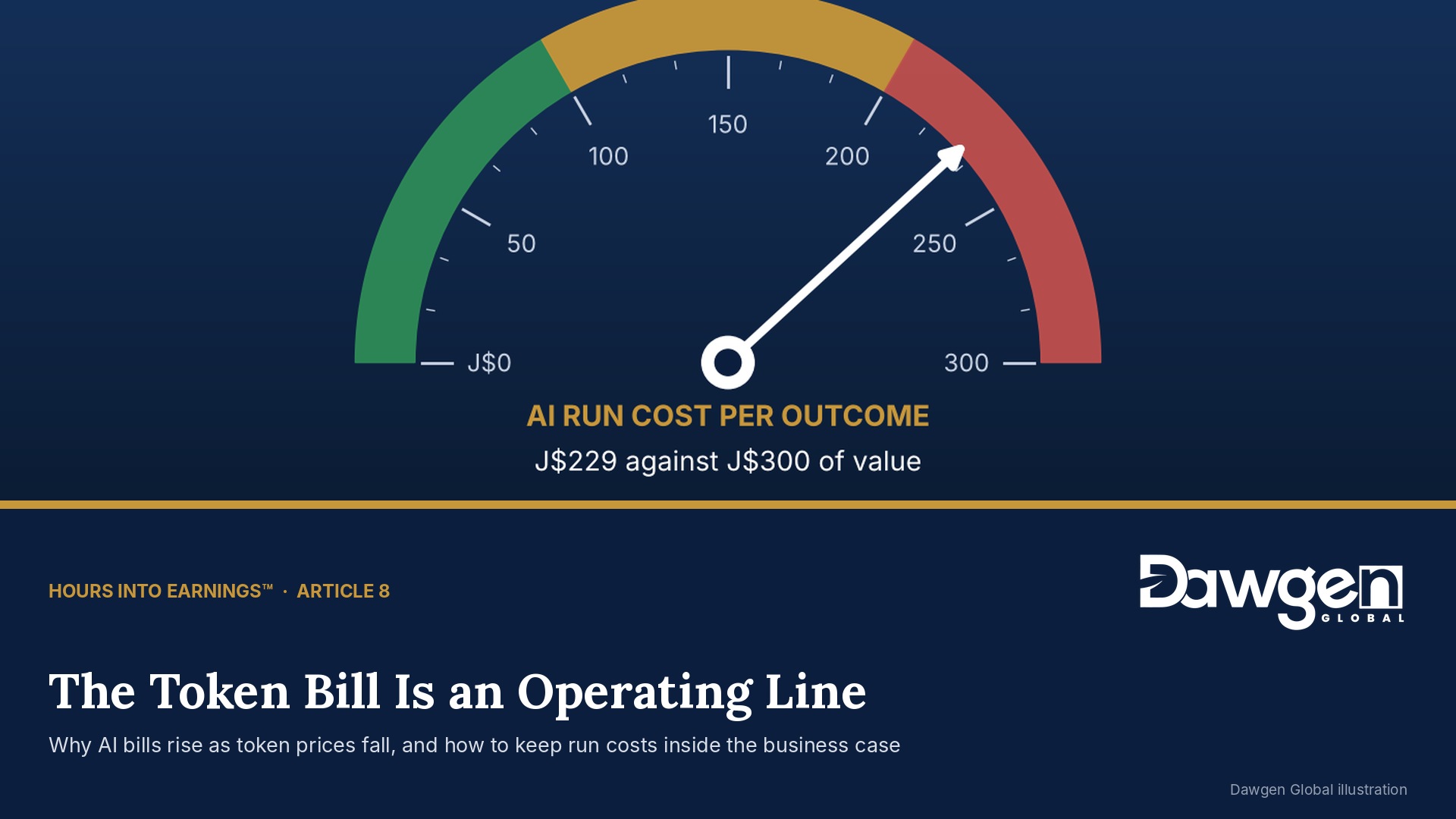
Why AI bills keep rising while the price of AI keeps falling, and how to keep the cost of running AI inside the business case that justified it
The business case for the AI customer-service assistant was approved in a single meeting. The pilot had handled two thousand queries a month and the usage bill was so small that it was rounded to zero. Twelve months later, the assistant has been upgraded to settle routine requests on its own, it handles thirty thousand interactions a month, and the finance team has noticed a new line on the company credit card statement, billed in US dollars, that now runs to almost J$5 million a month.
Nothing went wrong, exactly. The assistant works. Customers like it. But the profit the board approved has shrunk by more than two-thirds, and nobody was watching the number that shrank it.
This eighth article of Hours Into Earnings™ is about that number: the cost of running AI. Most AI business cases count the cost of building or buying a tool and treat what it costs to use as negligible. For the tools of 2023, that was often true. For the AI agents of 2026, which use far more computing power for each task and are billed by the amount they use, it is not. The token bill, the usage fee charged for every request an AI model processes, is now an operating cost like electricity or fuel, and it must be managed like one.
The price per token falls. The bill still rises.
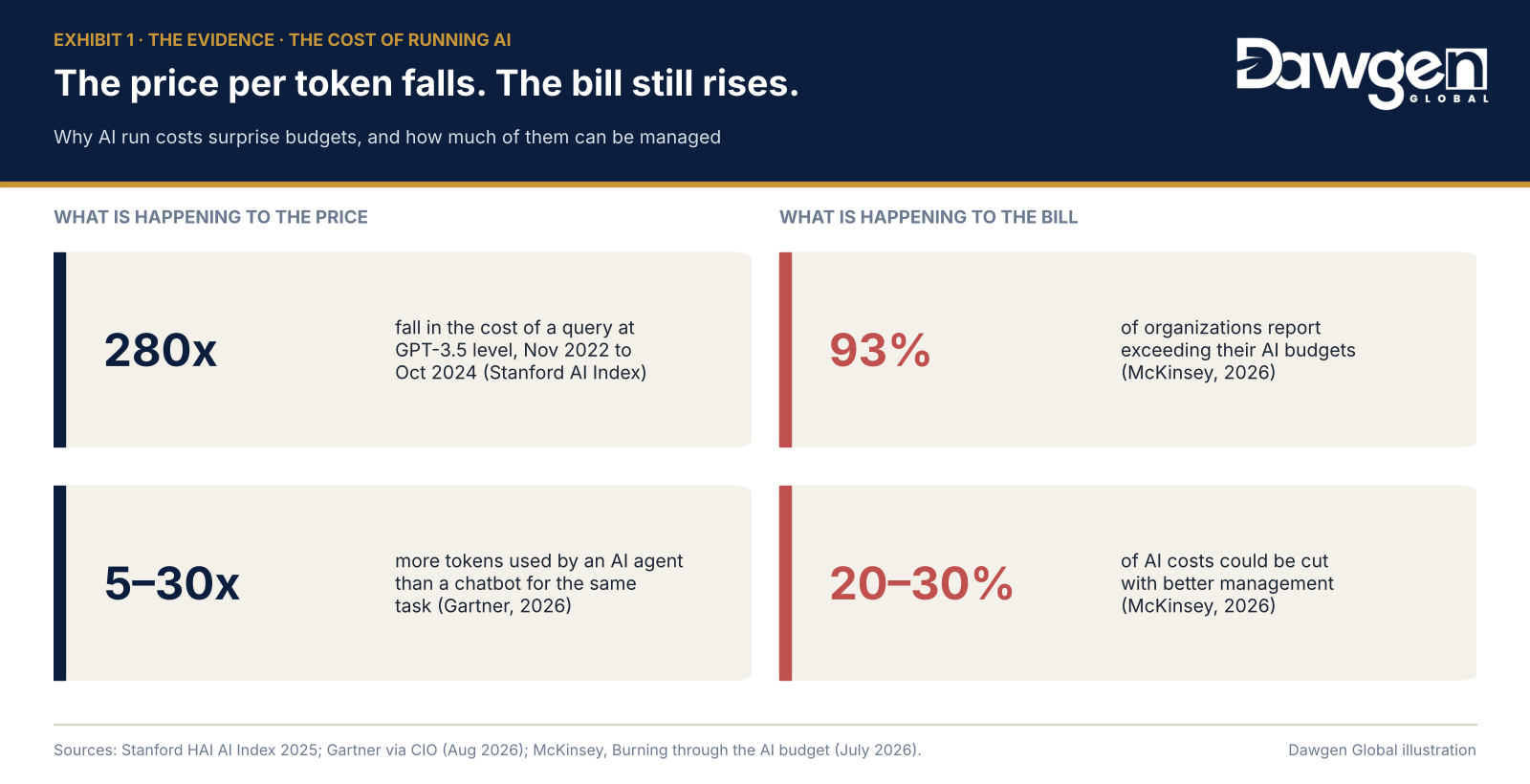
The price of AI is falling faster than the price of almost anything else in business. Stanford University’s AI Index 2025 found that the cost of querying a model performing at the level of GPT-3.5 fell more than 280-fold between November 2022 and October 2024. Research group Epoch AI has measured price falls for a fixed level of performance of between 9 and 900 times a year, depending on the task.
Yet AI budgets are being overrun almost everywhere. McKinsey reported in July 2026 that 93% of organizations had exceeded their AI budgets. A Futurum Group survey of 1,636 technology decision makers published in September 2026 found that 46.9% were spending more than planned on AI, and one in ten had no formal AI budget to measure against. Gartner predicts that at least half of generative AI projects will overrun their budgets through 2028, citing poor design choices and a lack of operating know-how.
The explanation is volume. Each token is cheaper, but businesses are using far more of them. Gartner analysts estimate that an AI agent, a system that plans and carries out a task in several steps rather than answering a single question, uses 5 to 30 times as many tokens as a chatbot for an equivalent task, and that the most advanced reasoning agents can cost up to 150 times more. As companies move from pilots to production and from chatbots to agents, usage grows faster than prices fall.
The encouraging news is that much of the cost can be managed. The same McKinsey analysis estimated that organizations could reduce their AI costs by 20% to 30%.
Why the bill surprises
The cost of running AI catches finance teams out for five reasons, and none of them is that anyone was careless.
The pilot was priced at the wrong scale. A pilot runs on a few hundred or a few thousand requests, often on a free tier or a trial credit. The business case extrapolates from that, but usage in production grows with every user, every customer and every new task the tool is given.
The tool changed, but the business case did not. A chatbot that answers one question at a time is cheap. When the same tool is upgraded to look up the customer’s account, check the policy, draft a reply and log the outcome, each of those steps is a separate request to the model, and the cost of one interaction can rise many times over.
Long instructions are paid for every time. Most AI tools send the model a long set of standing instructions and background documents with every request. That context is billed with every query, whether the question is complicated or trivial.
The most powerful model is used for everything. Teams often choose the most capable model available and use it for every task, including simple ones that a smaller model, at a fraction of the price, would handle equally well.
The bill arrives somewhere nobody is looking. Usage fees are often paid on a corporate card or through a cloud account, coded to IT or to sundry expenses, and never matched to the business outcome they paid for. The cost is real, but it sits outside the line where the benefit is reported.
The common thread is that nobody owns the cost per outcome: what it costs, all in, to resolve one customer query, process one invoice or settle one claim with AI. Without that number, the business cannot tell whether a workflow is still earning its keep.
The Run-Cost Gauge™: four readings, taken every month
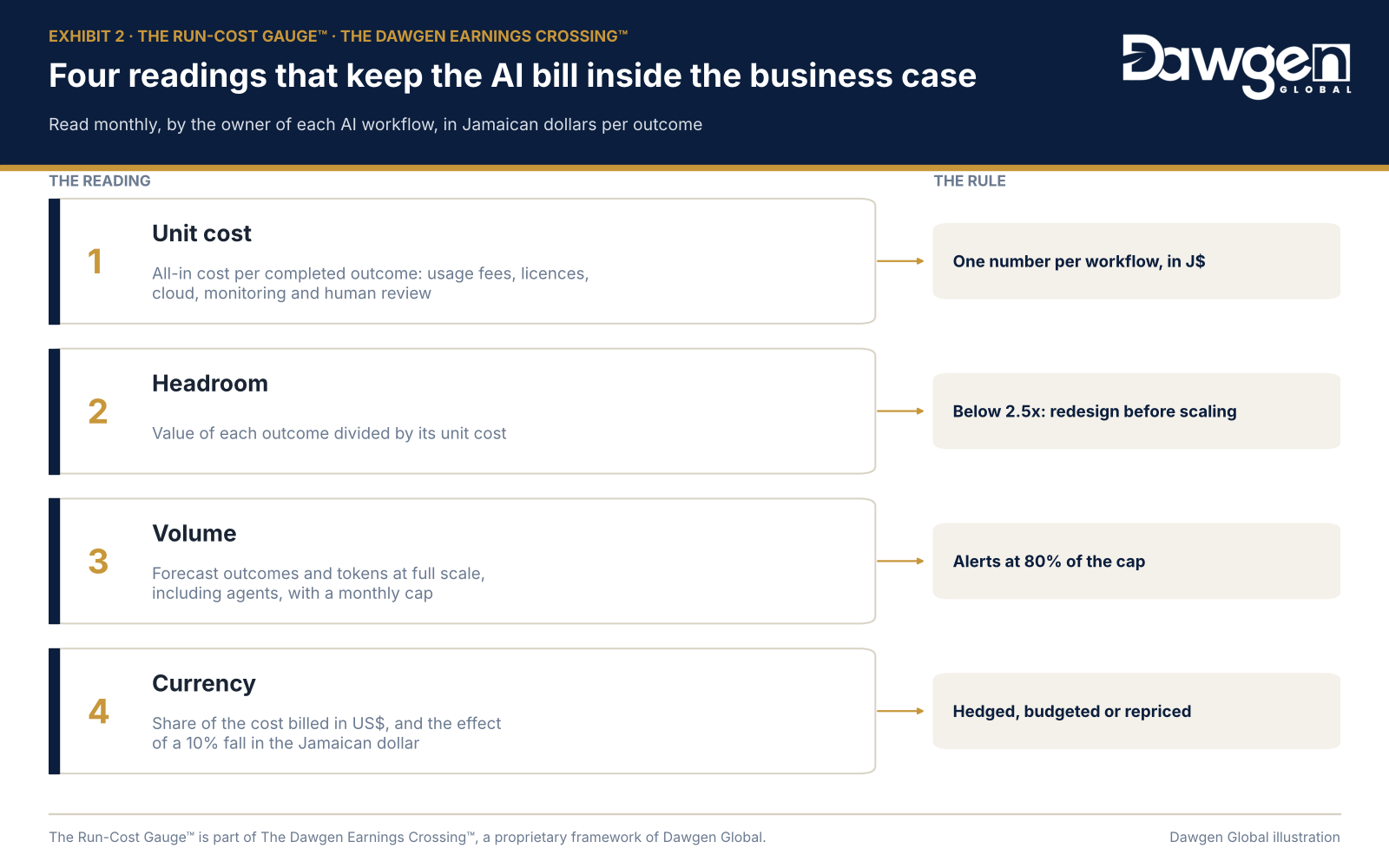
The Run-Cost Gauge™ is how The Dawgen Earnings Crossing™ keeps the cost of running AI inside the business case. It applies to every AI workflow in production and is read monthly by the manager who owns that workflow, not by IT alone. It has four readings.
| Reading | What it measures | The rule |
| 1. Unit cost | The all-in cost of one completed outcome: usage fees, licences, cloud hosting, monitoring and the human review the workflow still needs | One number per workflow, stated in Jamaican dollars (or the local currency) |
| 2. Headroom | The value of each outcome divided by its unit cost | Below 2.5 times, redesign before scaling further |
| 3. Volume | Outcomes and tokens forecast at full scale, including the effect of agents, with a monthly spending cap | Automatic alerts at 80% of the cap |
| 4. Currency | The share of the cost billed in US dollars, and what a 10% fall in the local currency would do to unit cost and headroom | The exposure is hedged, budgeted or priced into the service |
 The Gauge does not only measure. When headroom falls, it points to five practical ways to bring the unit cost down, most of which are design choices rather than negotiations.
- Match the model to the task. Send simple, high-volume requests to a smaller, cheaper model and reserve the most capable model for the complex cases. In many workflows most requests are simple.
- Trim the context. Cut standing instructions to what is needed, and send only the documents relevant to each request rather than everything, every time.
- Reuse what has been paid for. Many providers charge less for repeated context and for answers that can be stored and reused. Common questions do not need to be answered from scratch each time.
- Put a ceiling on agents. Limit the number of steps an agent may take on one task, and hand it to a person when it reaches the limit, rather than letting it loop.
- Buy usage like any other input. Once volumes are known, committed-use agreements, regional pricing and consolidated accounts usually cost less than paying by card at list price.
The Gauge also makes the run cost visible in the right place. Its results are entered in the AI Earnings Register™ next to the benefit each workflow produces, so the board sees net, not gross, AI earnings.
The arithmetic: the same J$108 million of value, three different profits
Return to the customer-service assistant, as an illustrative composite: a Caribbean insurer handling 30,000 customer interactions a month, or 360,000 a year. Each interaction the AI resolves saves about J$300 of staff time and handling cost, so the assistant creates J$108 million of value a year. Usage fees are billed in US dollars, converted here at J$160 to US$1.
The business case. Priced from the pilot, usage was expected to cost about US$0.04 an interaction, or J$2.3 million a year. With J$15 million for licences and the platform, the projected net gain was J$90.7 million a year.
Year one, as built. The assistant was upgraded to an agent that looks up the policy, checks the claim history, drafts a reply and logs the outcome. Each interaction now uses about 25 times as many tokens, costing around US$1.00, or J$160. Usage fees reach J$57.6 million. The complex cases still need a person to check them, at J$10 million a year. Total running cost is J$82.6 million and the net gain falls to J$25.4 million. The Gauge’s first reading shows a unit cost of J$229 against J$300 of value: headroom of 1.3 times, well below the 2.5 rule.
After the Run-Cost Gauge™. The owner of the workflow applies three of the five levers. Seventy per cent of interactions are simple (balance checks, document requests, payment dates) and are routed to a smaller model at about J$8 each. The remaining 30% stay with the agent, but with trimmed context and a ceiling on steps, which cuts their cost to about J$96. The blended usage cost falls to about J$34 an interaction, or J$12.4 million a year.
| Business case | Year one, as built | After the Gauge | |
| Usage fees (US$-billed) | 2.3 | 57.6 | 12.4 |
| Licences and platform | 15.0 | 15.0 | 15.0 |
| Human review | 0.0 | 10.0 | 10.0 |
| Total running cost | 17.3 | 82.6 | 37.4 |
| Value created | 108.0 | 108.0 | 108.0 |
| Net gain a year | 90.7 | 25.4 | 70.6 |
| Unit cost per interaction (J$) | 48 | 229 | 104 |
| Headroom | 6.2x | 1.3x | 2.9x |
J$ millions unless stated.
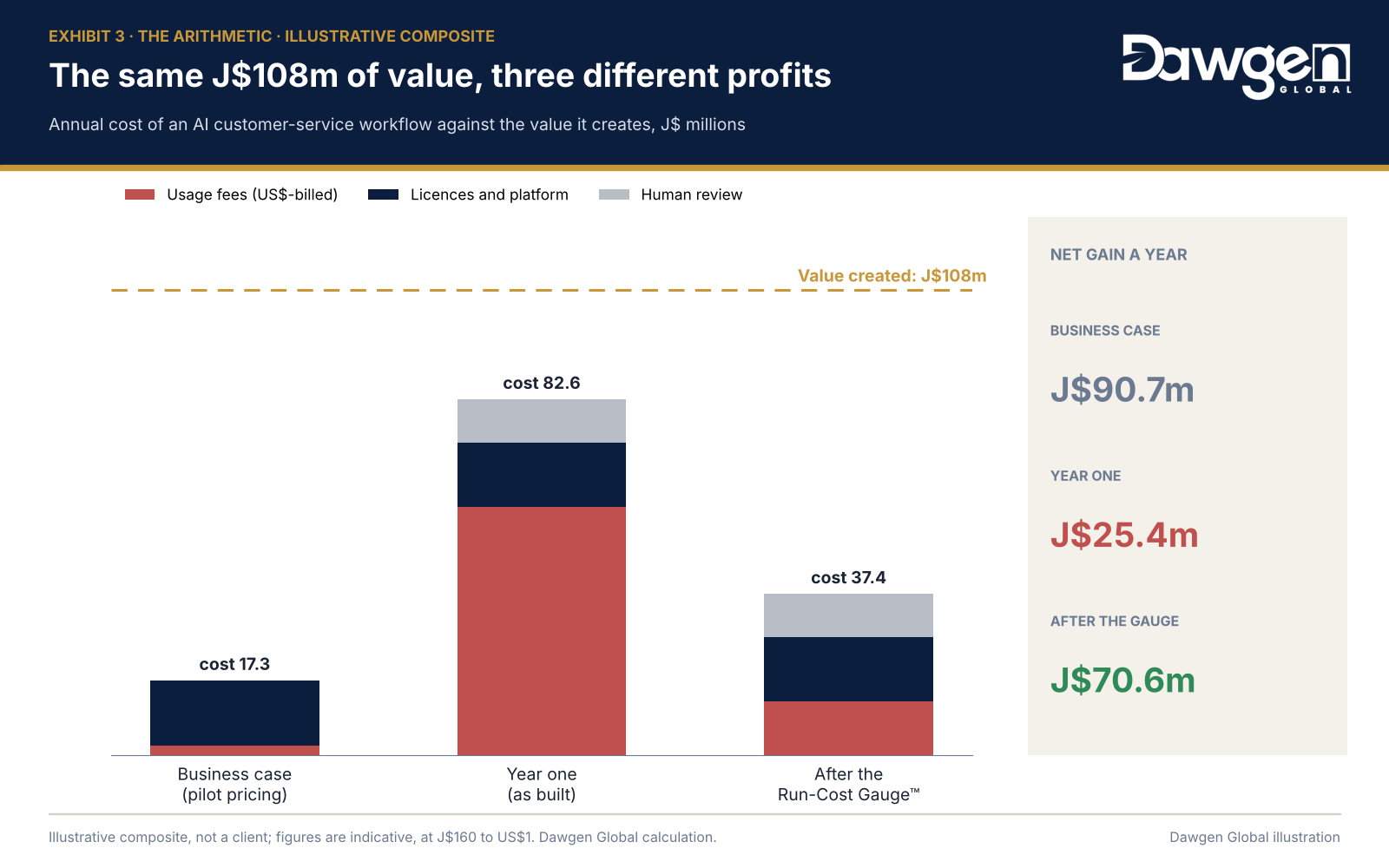
The customers notice no difference. The insurer recovers J$45 million a year of the profit it had quietly lost, and its exposure to the exchange rate shrinks with it: a 10% fall in the Jamaican dollar would have added J$5.8 million to the year-one usage bill, but adds only J$1.2 million after the redesign.
The composite is illustrative and does not describe any client. Figures are indicative.
Why the Caribbean token bill needs closer watching
Four features of regional business make the cost of running AI harder to control, and more important to get right.
It is billed in US dollars. Almost every AI model the region uses is priced in US dollars, while most regional revenue is earned in local currency. Every movement in the exchange rate moves the cost of every AI outcome. Companies that would never leave a large US-dollar supplier contract unhedged or unbudgeted often do exactly that with their AI usage, because it arrives in small, frequent charges rather than one invoice.
It is often paid on a card. Many regional businesses pay for AI services on corporate credit cards, which adds foreign transaction fees, scatters the cost across many statements and makes it hard to match spending to the workflows it serves. Card limits can also stop a production service without warning when usage spikes.
Imported services can carry tax. Services bought from overseas providers can attract consumption tax and, in some cases, withholding obligations, depending on the territory and the business’s own position. Where that tax cannot be recovered, it is part of the unit cost and belongs in the Gauge.
Scale is modest, so design matters more. A regional business rarely has the volume to negotiate large discounts directly with a model provider. Its biggest savings come from design: matching the model to the task, trimming context and limiting agents. Those are within its own control from the first day.
The reward for getting this right is also larger here. In markets where currency movements are a standing business risk, a workflow designed to run cheaply protects its margin against the exchange rate as well as against usage growth.
Three questions to ask this week
Put three questions to the managers responsible for your AI programme:
- What did we spend on AI usage last month, in total and in US dollars, and where in the accounts is it recorded?
- For each AI workflow in production, what does one completed outcome cost, all in, and what is it worth?
- What happens to that cost if volumes double, if we move to agents, or if the Jamaican dollar falls by 10%?
If the answer to the first question has to be assembled from card statements, the AI programme’s running cost is not yet being managed. It is only being paid.
The next article, An Agent You Cannot Audit Is a Liability, follows the AI agent from the cost line to the control environment: what boards, auditors and regulators should expect to see before an AI agent is allowed to act on the company’s systems and money.
Is your AI still earning more than it costs to run?
Dawgen Global’s Earnings Crossing Assurance™ gives your board an independent view of what your AI programme really earns, net of what it costs to run. We apply the Run-Cost Gauge™ to each AI workflow in production, reconcile usage fees, licences and US-dollar charges to the accounts, test unit costs and headroom against the business case, and report net AI earnings in the AI Earnings Register™. Where headroom has slipped, we identify the design changes that restore it. It draws on our assurance, IT and digital transformation, tax and AI transformation specialists across the Caribbean. Fees are customized to each client’s circumstances and agreed deliverables.
Request a scoping conversation: info@dawgen.global · (876) 926-5210 · US 855-354-2447 · dawgen.global
Dawgen Global — Big Firm Capabilities. Caribbean Understanding.
About Dawgen Global
Dawgen Global is an independent, integrated multidisciplinary professional services firm headquartered at 47 Trinidad Terrace, New Kingston, Jamaica, serving more than 15 territories across the Caribbean. Founded and led by Dr. Dawkins Brown, Executive Chairman, the firm is independent and not affiliated with any international network. It delivers a full suite of professional services under one roof: audit and assurance; tax advisory; IT and digital transformation; risk management; cybersecurity; actuarial and insurance regulatory advisory; HR advisory; mergers and acquisitions; corporate recovery; business advisory and strategy; accounting BPO and virtual CFO services; and legal process outsourcing.
The proposition is simple: big-firm capability without the big-firm price. Dawgen Global’s integrated approach is built for the specific complexities and opportunities of the Caribbean market, helping organizations make sharper, better-informed decisions that drive measurable progress.
To explore a partnership, reach out:
- Website: dawgen.global
- Email: info@dawgen.global
- WhatsApp (Global): +1 555-795-9071
- Caribbean offices: +1 876-665-5926 | +1 876-929-3670 | +1 876-926-5210
Related service: Explore how we can help →