
Device downtime is a business continuity risk, not an IT inconvenience. Here is how Caribbean organisations can design it out of the way their people work.
Rethinking how Caribbean organisations equip their people — a three-part series from Dawgen Global.
Three failures, one lesson
It is a Saturday night in February at a resort on the north coast. The front-desk laptop freezes, then refuses to restart. Forty guests are arriving from the airport. The night manager checks them in by hand, the property-management system falls out of step, and the morning team spends half a shift reconciling rooms and charges.
It is the last working day of the month at a credit union branch in a rural parish. A loan officer’s machine will not boot. Members who came in to finalise loans are asked to return on Monday. Some do. Some go to a competitor across the road.
It is the week examination marks are due at a secondary school. A head of department’s laptop dies with a term’s worth of assessments on its local drive. Nobody is sure whether there is a backup.
In each case the repair bill is the smallest part of the cost. The real cost is the guest who waits, the member who leaves, the deadline that slips and the reputation that suffers. When devices fail, people cannot serve customers, collaborate with colleagues or meet their obligations.
Time is money, and downtime is lost revenue
The gap between what workers need and what their devices deliver is wider than many leaders assume. A 2020 Forrester study on employee experience found that only around half of the workers surveyed believed their computers were capable of handling their daily job responsibilities. Since then, expectations of flexible, remote and mobile working have only raised the stakes. People now expect to work from the office, from home, from a client’s premises and on the road, and they expect their equipment to keep up.
Most organisations do not measure what device downtime costs them. The illustrative model below shows why they should. It assumes an organisation of 150 staff; the figures are assumptions for discussion, not benchmarks.
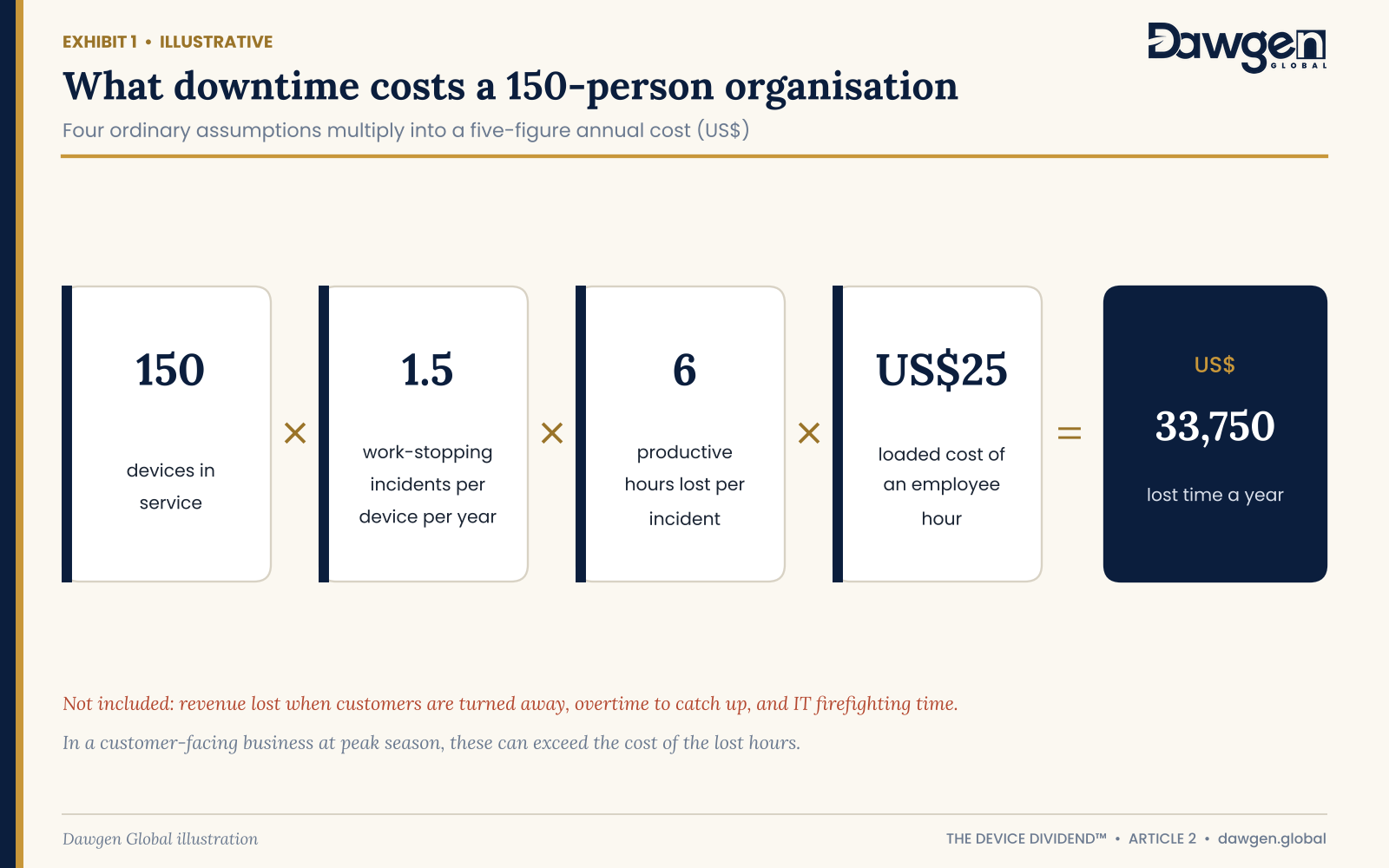
Exhibit 1. Four ordinary assumptions multiply into a five-figure annual cost of lost time.
| Driver | Illustrative assumption |
| Devices in service | 150 |
| Device incidents that stop work, per device per year | 1.5 |
| Average productive hours lost per incident | 6 |
| Loaded cost of an employee hour | US$25 |
| Annual cost of lost time | US$33,750 |
That figure excludes the revenue lost when customers are turned away, the overtime spent catching up, and the time the IT team spends firefighting. For a customer-facing business in peak season, those can be far larger than the cost of the lost hours themselves.
Why the Caribbean is harder on devices
Caribbean organisations operate in conditions that make reliability a sharper problem than it is in many larger markets:
- Heat, humidity, salt air and dust shorten the working life of equipment, especially in hotels, ports, farms, plants and coastal offices.
- Power quality. Outages, surges and voltage fluctuations damage hardware, batteries and storage, and can corrupt data.
- Hurricane season. Every year, organisations must plan for damaged premises, displaced staff, flooded offices and disrupted shipping.
- Distance from parts. A repair that takes a day in Miami can take two weeks in a smaller territory if a part has to be imported and cleared.
- Thin IT benches. Many organisations rely on one or two technical people who cannot be in several places at once, and who become a single point of failure themselves.
- Mobile and field workforces. Sales teams, inspectors, field officers and remote staff carry devices through conditions office equipment was never designed for.
Taken together, these mean that a device strategy designed for a large mainland market will usually underestimate Caribbean downtime. It will also overestimate how quickly a failure can be fixed.
The false economy of buying cheaper and insuring more
When devices fail regularly, the instinctive response is to buy replacements, extend warranties or add insurance. Each step adds cost without addressing the cause. Spending drifts upward, the helpdesk queue grows, staff become frustrated and disillusioned, and leadership starts to hear about the problem from customers rather than from IT.
Consumer-grade equipment bought on price is a particular trap. It is attractive on the invoice, but it is typically built for lighter use, carries shorter or weaker warranties, and is harder to standardise and secure at scale.
The better question is not “how do we pay for failures?” but “how do we design failures out of the way we work?”
Four disciplines that keep people working
Organisations with consistently high device uptime tend to share four disciplines. A well-designed device-as-a-service programme builds all four in from the start.
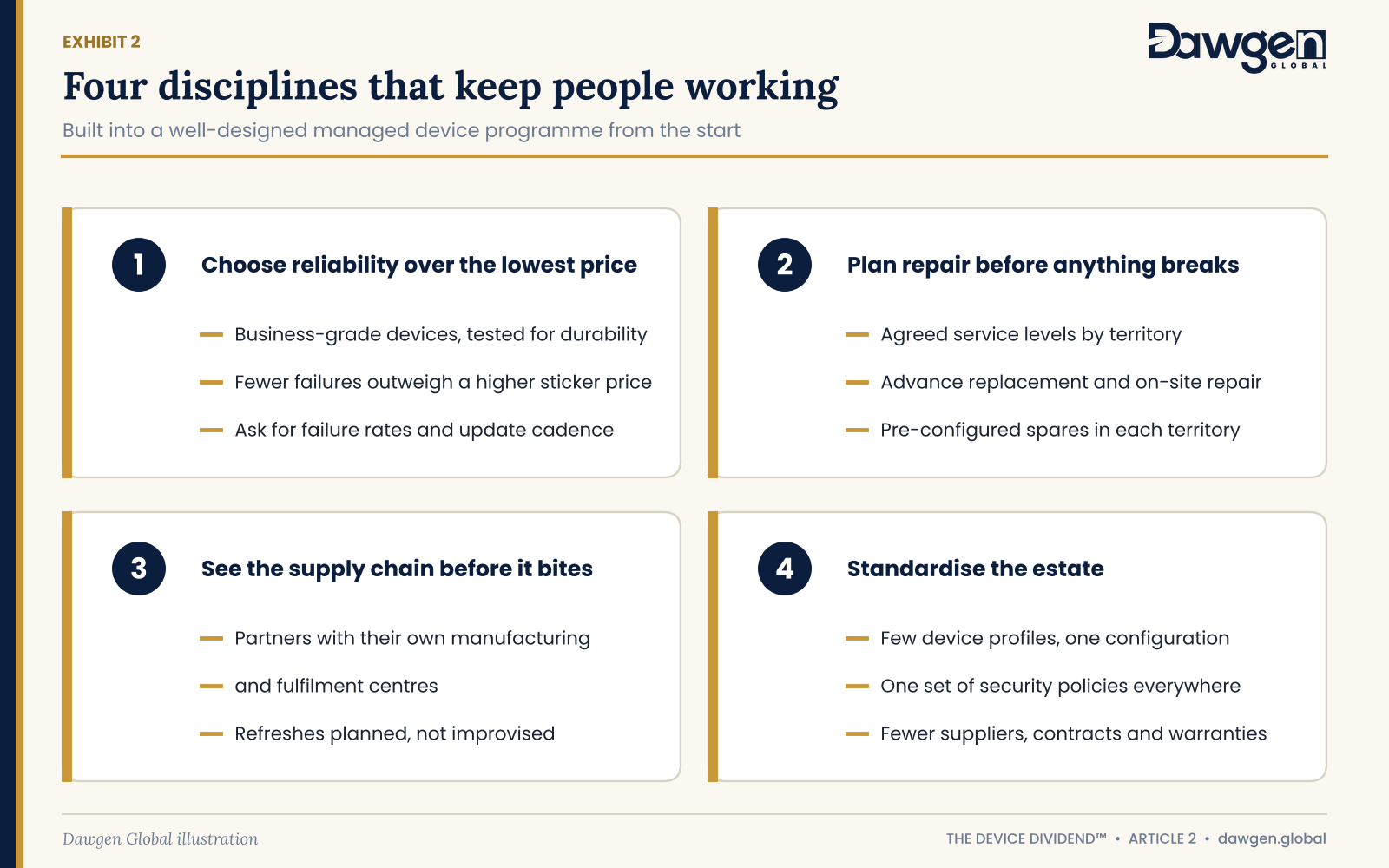
Exhibit 2. The four disciplines shared by organisations with consistently high device uptime.
- Choose reliability over the lowest price. Business-grade devices that are engineered, tested and continuously improved for durability cost more per unit than consumer equipment, but fail less often and last longer. Over a three- or four-year life, fewer failures usually outweigh the higher sticker price. When selecting devices, ask for evidence of durability testing, the expected failure rates the provider works to, and how quickly firmware and security updates are delivered.
- Plan repair and replacement before anything breaks. Several arrangements turn a crisis into a routine swap: agreed service levels, on-site or next-business-day repair where it is available, advance replacement units, and a small pool of pre-configured spare devices in each territory. The question to ask is simple: if this device fails at 9 a.m., when will this person be working again, and who is accountable for making that happen?

- See the supply chain before it bites. Recent global shortages showed how quickly lead times can stretch from weeks to months. Without insight into what will be available and when, organisations struggle both to equip new hires and to complete repairs. Working with partners that operate their own manufacturing facilities and fulfilment centres gives earlier sight of availability, so refreshes and replacements can be planned rather than improvised.
- Standardise the estate. A small number of approved device profiles, one configuration standard and one set of security policies, applied in every office and territory, makes support faster and gaps easier to spot. Standardisation also cuts the number of suppliers, contracts and warranty terms the organisation must manage. Choosing vendors purely on price, one purchase at a time, produces the opposite: a flood of contracts, a zoo of models and inconsistent protection.
Continuity and security are the same conversation

Standardisation is not only an efficiency gain. It is a control.
When every device is configured to the same standard before it reaches the employee, security protections are present from the first login. In many organisations they are added later, if at all. Protection that operates below the operating system, at the level of the hardware and firmware, is in place before an attacker can reach it.
When the organisation knows exactly which devices exist, who holds them and what state they are in, it can respond quickly to loss, theft or compromise. It can lock the device, revoke access and issue a replacement. And when retired devices are collected and securely wiped, with certification, sensitive data does not leave the organisation inside an old laptop sold on or discarded.
Financial institutions, credit unions, insurers, pension funds and public bodies face particular pressure here. Regulators and auditors increasingly expect their boards to evidence these controls, not assume them. A managed programme produces that evidence as a by-product of how it runs.
What a hurricane-ready device plan looks like

Every Caribbean organisation should be able to answer five questions before 1 June each year:
- Which roles cannot stop working, and which devices do those people use?
- Where is critical data stored, and can staff reach it securely from a replacement device?
- How many spare devices are held, and in which territories?
- How quickly can a lost or damaged device be replaced, and by whom?
- Who is accountable for keeping the device register current?
The plan then works in three phases:
- Before the season, critical roles are identified and data is moved off local drives into secured, backed-up storage. Spares are positioned, and devices are checked for current updates.
- During an event, staff know how to protect equipment, how to work remotely and whom to call.
- After the event, damaged devices are logged, replacements are dispatched pre-configured, and lost devices are locked and wiped remotely.
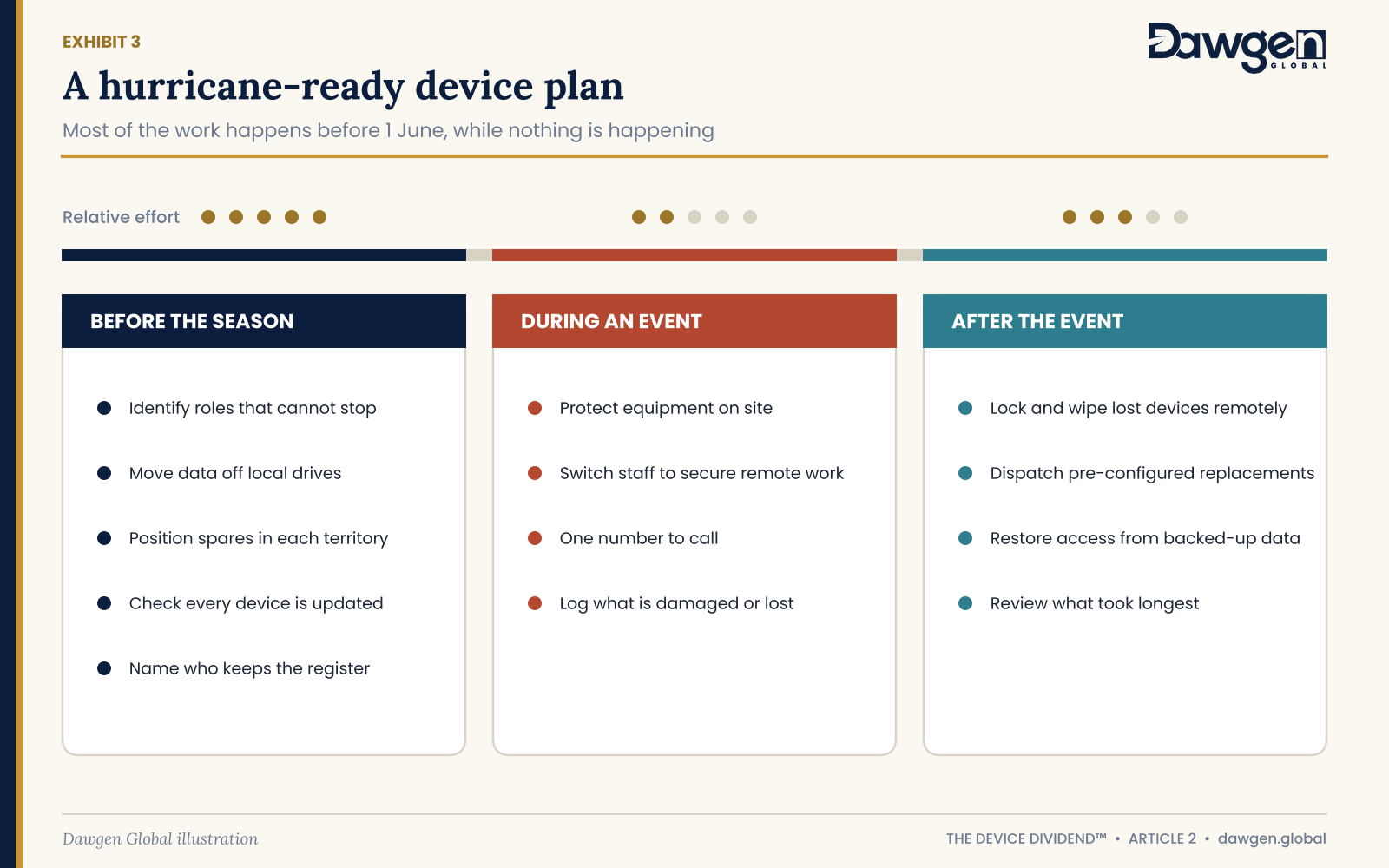
Exhibit 3. A hurricane-ready device plan works in three phases, and most of the work happens before the season.
If any of the five answers is “we are not sure”, device continuity belongs on the risk register and on the board’s agenda.
How it plays out across sectors
Hotels and resorts. Uptime at the front desk, in reservations and at point-of-sale is guest experience. Pre-configured spares on property and agreed replacement times keep service running through peak season and through storms.
Credit unions and financial institutions. Branch staff need devices that work at month-end and that meet security expectations every day. Standard configurations and certified data erasure support both member service and regulatory compliance.
Schools and colleges. Teaching and assessment cannot pause for a broken laptop. Moving work off local drives and holding a small spare pool protects term deadlines and examination records.
Manufacturing and distribution. Plant floors, warehouses and delivery routes are hard on equipment. Durable devices and fast replacement keep orders, inventory and invoicing moving.
Measure what matters
What gets measured gets managed. Organisations serious about device uptime track a handful of indicators each quarter:
- device incidents per 100 devices;
- average time from failure to the employee working again;
- percentage of devices on current security and software updates;
- percentage of the estate within its planned lifecycle; and
- employee satisfaction with their equipment.
A managed programme should report these routinely. If your current arrangement cannot produce them, that tells you something on its own.
Questions leaders often ask
Isn’t this just a better warranty? No. A warranty fixes a device eventually. A managed programme is designed to keep the person working while the device is fixed, through spares, replacement, standard configuration and planning.
Can it cover staff in every territory? That depends on the provider’s reach and the service levels available in each territory. That is why the design stage maps service levels island by island.
We are a small organisation. Is this only for large groups? Smaller organisations often benefit most, because they have the least IT capacity to absorb failures.
How Dawgen Global helps
Dawgen Global brings risk management, cybersecurity and technology advisory together in a single assessment. We look at your devices the way a risk professional would: where failures happen, what they cost, how quickly you recover, and which controls are missing.
We then design a managed device programme that addresses those gaps. It brings together reliable business-grade devices, defined service levels, territory spares, consistent configuration and built-in security under one arrangement. Through our global technology partners, we configure the programme using enterprise manufacturing, fulfilment, supply-chain and support capabilities. It is tailored to your territories and your sector, and managed centrally from our Caribbean headquarters.
| CALL TO ACTION
Request a Workforce Uptime & Continuity Assessment Find out how much device downtime is costing you, and how to design it out. What you receive ✓ A downtime and failure profile of your current device estate, with an estimate of its annual cost ✓ A continuity review covering critical roles, data location, spares, repair arrangements and hurricane readiness ✓ A gap assessment of device configuration and security consistency across your sites and territories ✓ A tailored managed-device design with service levels matched to your operations ✓ A short set of uptime indicators for management and board reporting How it works: A short discovery call, a scoping discussion, then the assessment. Fees are agreed after scoping. Contact [email protected] · |
About Dawgen Global
Dawgen Global is an independent, integrated multidisciplinary professional services firm headquartered at 47 Trinidad Terrace, New Kingston, Jamaica, serving more than 15 territories across the Caribbean. Founded and led by Dr. Dawkins Brown, Executive Chairman, the firm is independent and not affiliated with any international network. It delivers a full suite of professional services under one roof: audit and assurance; tax advisory; IT and digital transformation; risk management; cybersecurity; actuarial and insurance regulatory advisory; HR advisory; mergers and acquisitions; corporate recovery; business advisory and strategy; accounting BPO and virtual CFO services; and legal process outsourcing.
The proposition is simple: big-firm capability without the big-firm price. Dawgen Global’s integrated approach is built for the specific complexities and opportunities of the Caribbean market, helping organizations make sharper, better-informed decisions that drive measurable progress.
To explore a partnership, reach out:
- Website: dawgen.global
- Email: [email protected]
- WhatsApp (Global): +1 555-795-9071
- Caribbean offices: +1 876-665-5926 | +1 876-929-3670 | +1 876-926-5210


