
Jamaica’s Budget, Grenada’s new law and years of quiet collection in Barbados and The Bahamas mean digital tax is no longer a foreign debate. It is a Caribbean compliance question, and boards need a method to answer it.
Executive summary
Until recently, “digital tax” in the Caribbean meant headlines from Paris, London and Ottawa. In February 2026 Jamaica’s Budget proposed General Consumption Tax (GCT) on digital services and intangibles supplied from abroad, with collection due to start between January and March 2027. In May 2026 Grenada’s Parliament passed a value added tax (VAT) amendment requiring non-resident digital suppliers to register. Barbados, The Bahamas and Suriname already collect. The Dominican Republic has tried three times and is preparing a new proposal. In March 2026, officials from 13 countries met under the Caribbean Community (CARICOM) and the Caribbean Organisation of Tax Administrators (COTA) on exactly this issue.
Globally, the movement has gone the other way on one front: Canada has repealed its digital services tax (DST) and is refunding it, while the United Nations (UN) drafts a new tax convention. The practical lesson for Caribbean boards is that “digital tax” is four different taxes, not one. This article maps where each jurisdiction stands, explains the four families and sets out the regional policy choice.
Why now: a year of decisions
The region has imported software, streaming, advertising and cloud services for years. What has changed is that governments have run out of reasons to leave that consumption untaxed, and the consumption tax now looks far safer than the alternatives.
Jamaica. On 12 February 2026 the Minister of Finance and the Public Service, Fayval Williams, tabled Ministry Paper No. 17, “Revenue Measures for Financial Year 2026/2027” [1][2]. Within a J$29.4 billion revenue package is the application of GCT to digital services and intangibles supplied from abroad and consumed in Jamaica, on the destination principle. Examples include streaming, software, apps and e-books [3][4]. The Ministry projects J$300 million in fiscal year (FY) 2026/27, reflecting implementation in the fourth quarter (January to March 2027), rising to about J$4.2 billion a year from FY2027/28 [1]. As far as public sources show, neither the enabling legislation nor Tax Administration Jamaica (TAJ) guidance had been published by late September 2026. It is a proposal, but the revenue is in the fiscal plan.
Grenada. On 7 May 2026 Parliament passed the VAT (Amendment) Bill 2026. Non-resident digital suppliers must register and charge VAT on business-to-consumer (B2C) supplies; business-to-business (B2B) supplies fall under a reverse charge; marketplace operators can be treated as the supplier; and the customer’s location is set by two non-conflicting indicators [5]. The Act awaits assent and commencement by Gazette notice, with a transition period. It is the first Organisation of Eastern Caribbean States (OECS) member to legislate a dedicated regime.
The early movers. Barbados has charged VAT at 17.5 per cent on digital services from foreign suppliers since 1 December 2019, with registration through the Barbados Revenue Authority’s online portal [6]. The Bahamas amended its VAT law in 2019 to tax telecommunications and electronic commerce services supplied to persons in The Bahamas, requiring non-resident suppliers to register; its standard rate is 10 per cent [7][8]. Suriname introduced VAT on 1 January 2023 at 10 per cent, with foreign B2C electronic services inside the regime from the start and the customer’s location established from indicators such as internet protocol (IP) address, subscriber identity module (SIM) card, payment card or billing address [9].
The Dominican Republic. Three attempts to extend the 18 per cent tax on the transfer of industrialised goods and services (ITBIS) to digital services have failed: a 2022 consultation, a 2024 reform and Decree 30-25 of January 2025. In May 2026 the tax authority said a new proposal was being prepared [10].
The region. On 4 March 2026 CARICOM and COTA co-hosted a regional VAT workshop with international partners including the World Bank and the Organisation for Economic Co-operation and Development (OECD). Officials from 13 countries discussed securing VAT on cross-border digital transactions, with Barbados and The Bahamas sharing their experience [11]. No harmonised CARICOM regime or model law exists, but this is plainly a regional agenda.
The Caribbean regime map
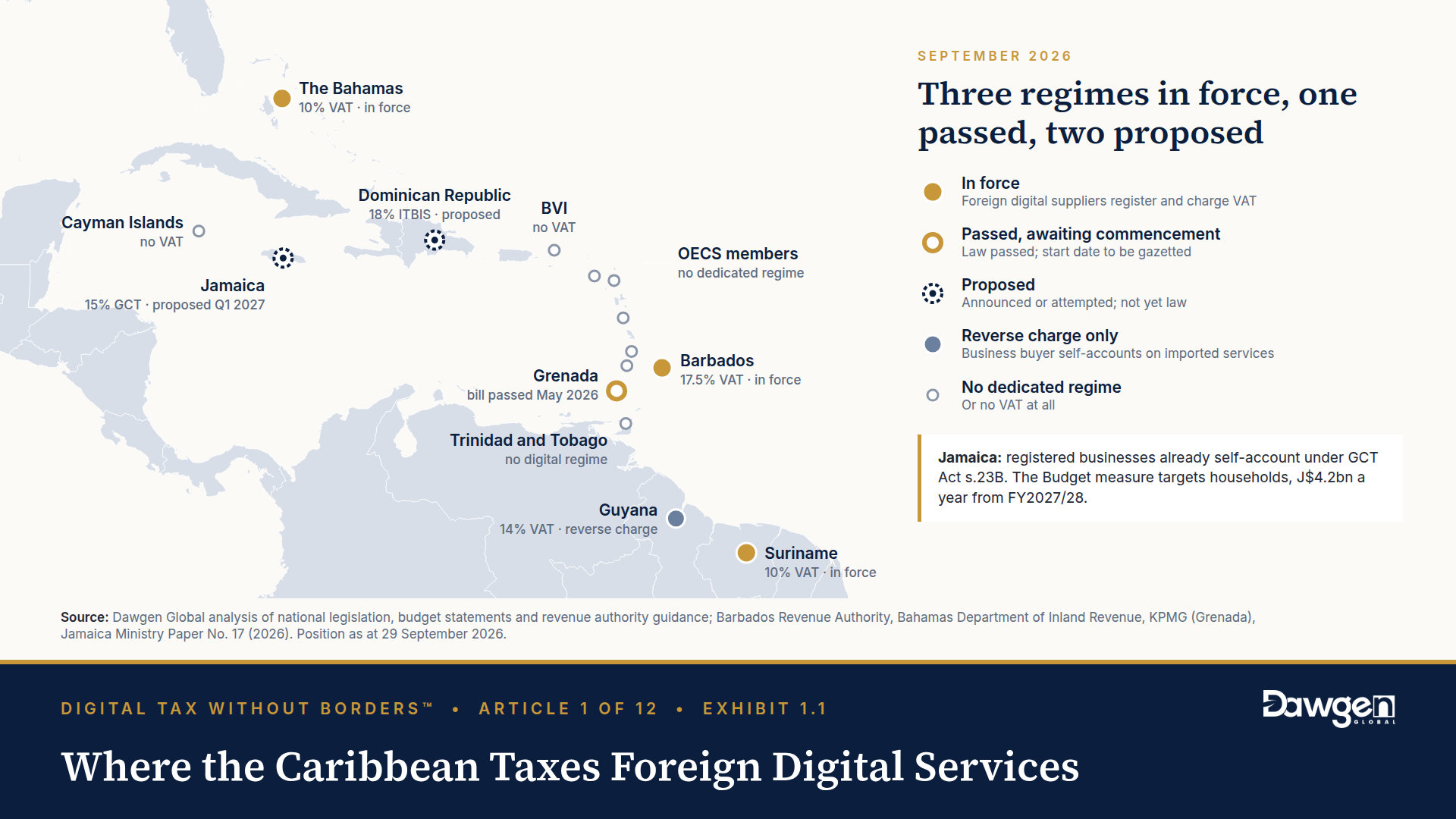
The table covers consumption taxes on cross-border digital services, where Caribbean law has actually moved [1][5]–[10][12][13].
| Jurisdiction | Mechanism | Rate | Status as at Sept 2026 |
| Jamaica | Reverse charge by registered importers of services (GCT Act s.23B); proposed GCT on foreign digital services | 15% GCT | Reverse charge in force; digital measure proposed for January–March 2027 |
| Barbados | Registration of foreign suppliers of digital and electronic services | 17.5% VAT | In force since 1 December 2019 |
| The Bahamas | Registration of non-resident suppliers of telecommunications and electronic commerce services | 10% VAT | In force since 2019 amendment |
| Suriname | Foreign B2C electronic services within VAT; location by indicators | 10% VAT | In force since 1 January 2023 |
| Grenada | Supplier registration for B2C; reverse charge for B2B; marketplace deeming | Standard VAT rate | Passed 7 May 2026; awaiting assent and commencement |
| Guyana | Recipient self-accounts for VAT on imported services | 14% VAT | In force; no non-resident supplier registration regime identified |
| Trinidad and Tobago | No digital services regime; 7% Online Purchase Tax covers goods imported by air, not services | 12.5% VAT | VAT system under review (Budget FY2026) |
| Dominican Republic | ITBIS on digital services proposed repeatedly | 18% ITBIS | Nothing in force; new proposal in preparation |
| OECS (Saint Lucia, Antigua and Barbuda, St Kitts and Nevis, Dominica, St Vincent and the Grenadines) | No dedicated non-resident e-services regime identified | Standard VAT rates | Not in force |
| Cayman Islands, British Virgin Islands | No VAT or goods and services tax | Not applicable | Not applicable |
The map is already a patchwork of supplier registration, recipient self-accounting and platform deeming among close neighbours, and Jamaica and Trinidad and Tobago have yet to put a B2C regime into force.
Law in force vs proposal. Barbados, The Bahamas, Suriname and Jamaica’s s.23B reverse charge are law today. Jamaica’s B2C measure, Grenada’s Act and Dominican plans are not yet in force. Comply with the first group now; prepare for the second.
Four families of “digital tax”
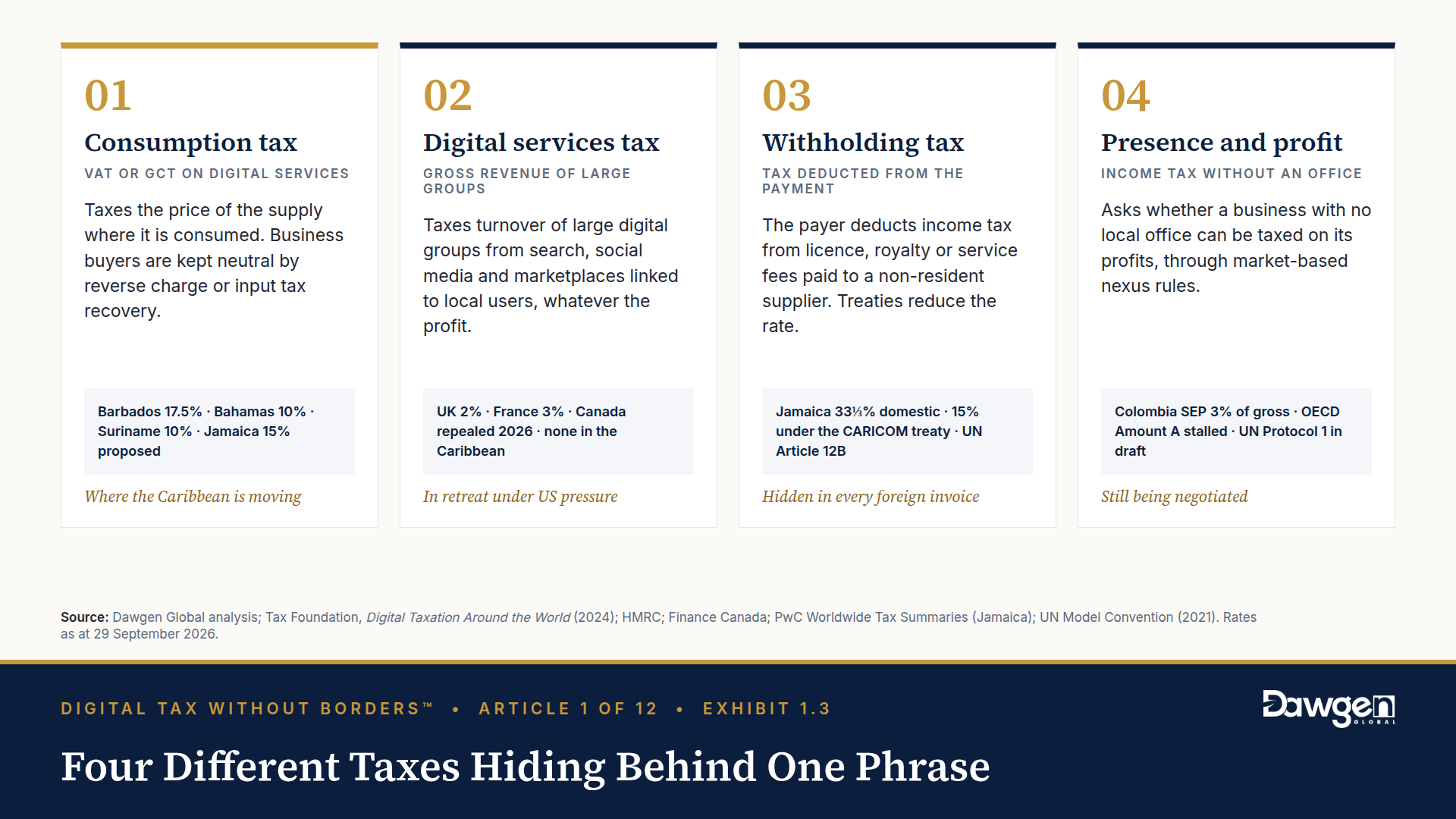
The phrase “digital tax” covers four mechanisms with different taxpayers, bases and remedies. Confusing them is the most common error in board papers and supplier correspondence [14].
Consumption taxes. VAT or GCT is charged where consumption takes place; the OECD’s guidelines on VAT and goods and services tax (GST) make this destination principle the international norm [15]. Reverse charge or input tax recovery keeps business buyers neutral. Every Caribbean regime above sits here, as do Latin America’s: Costa Rica at 13 per cent, Colombia at 19 per cent, Mexico at 16 per cent and Chile at 19 per cent [16].
Digital services taxes. A DST taxes the gross revenue of large digital groups from activities linked to local users. The United Kingdom charges 2 per cent on revenues from search engines, social media platforms and online marketplaces for groups above £500 million global and £25 million United Kingdom revenue [18]; France charges 3 per cent above €750 million worldwide and €25 million in France [19]. No Caribbean jurisdiction has a DST.
Withholding tax. When a Caribbean business pays a foreign supplier for a licence or services, domestic law may require it to withhold income tax. In Jamaica, royalties and management or service fees paid to non-residents attract 33⅓ per cent under domestic law, 15 per cent under the CARICOM Double Taxation Agreement, and potentially less under treaties such as those with the United States and Canada [20][21]. Classification (royalty or service fee?) now drives large amounts.
Nexus and profit rules. Can a business with no office be taxed on profits? Colombia’s Significant Economic Presence (SEP) rule, in force since 1 January 2024, makes non-residents with deliberate and systematic interaction with the market above a revenue threshold choose 10 per cent withholding by payment providers or registration and a 3 per cent charge on gross income [17]. The UN Model Double Taxation Convention added Article 12B on income from automated digital services in 2021, allowing the market country to tax that income [22].
The global backdrop: DSTs in retreat
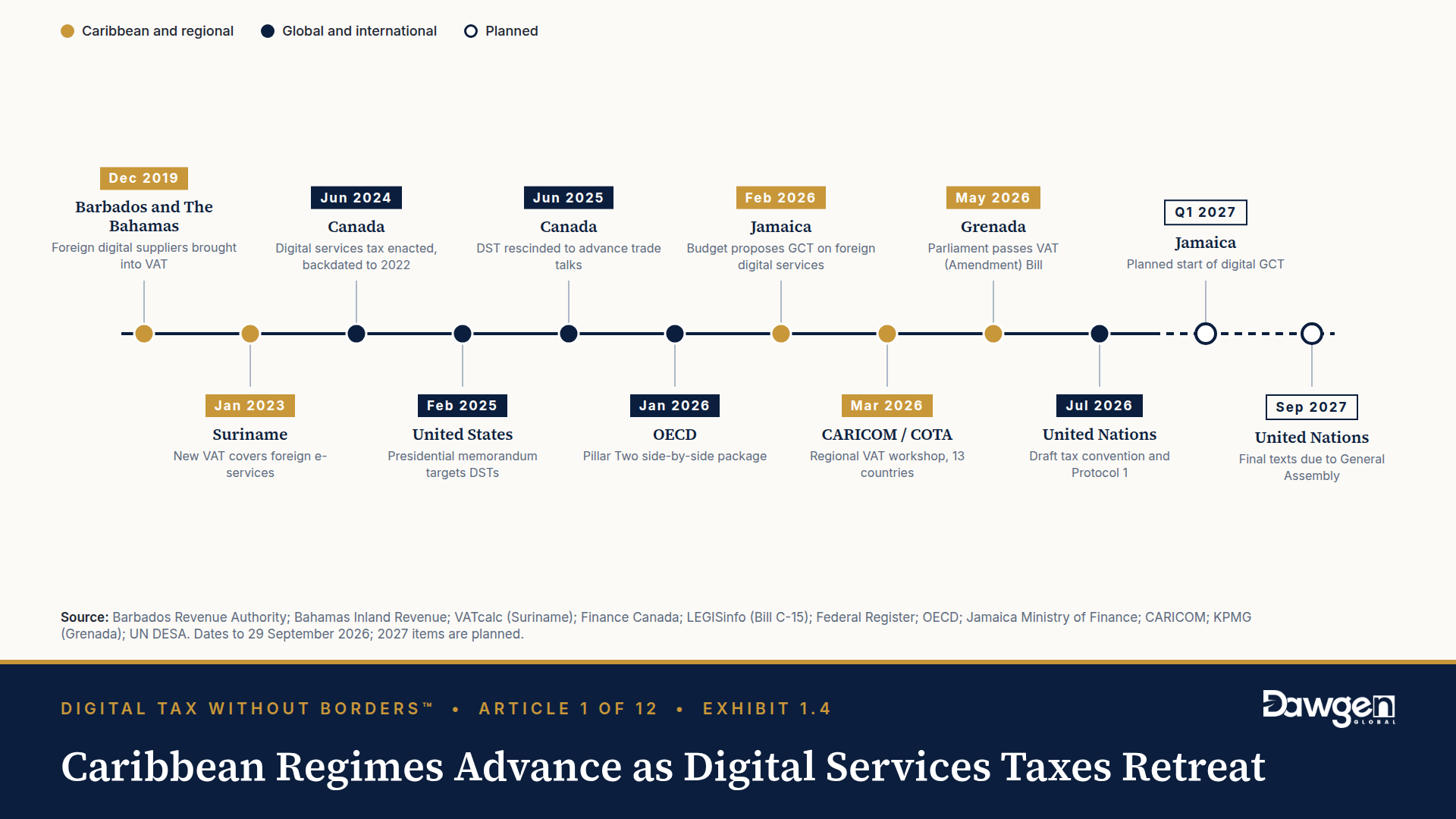
Canada enacted a 3 per cent DST in June 2024, retroactive to 1 January 2022. On 29 June 2025, the day before the first payment was due, Finance Canada announced it would rescind the tax to advance trade negotiations with the United States [23]. Repeal was enacted on 26 March 2026, effective from 20 June 2024, with amounts paid refunded with interest, about C$647 million according to press reports [24]. A United States Presidential Memorandum of 21 February 2025 had directed the Trade Representative to consider action against DSTs [25]. A small economy taxing the gross revenue of United States technology groups invites a trade response it cannot easily absorb.
The OECD route has stalled: the Pillar One Amount A convention, released in October 2023, was never opened for signature, and Pillar Two, the global minimum tax, was reshaped by the “side-by-side” package of 5 January 2026 [26]. The UN has stepped into the gap. Draft texts of a Framework Convention on International Tax Cooperation and two early protocols were released in July 2026; Protocol 1 addresses taxation of income from cross-border services in a digitalised economy. Negotiators meet in Nairobi from 30 November 2026, and final texts are due to the General Assembly in September 2027 [27][28].
For a Caribbean chief financial officer (CFO), the digital taxes that matter over the next two years are consumption taxes and withholding.
Why the Caribbean exposure is different
The region is a heavy net importer of digital services: a Kingston distributor or a Bridgetown hotel buys its enterprise resource planning (ERP) system, software as a service (SaaS) tools, cloud hosting and online advertising from suppliers with no local presence, and each purchase sits in at least two families at once. Central procurement in regional groups sends the invoice to one entity while users sit in several. Caribbean firms are increasingly sellers too: a Jamaican developer selling an app subscription to consumers in Barbados is a foreign supplier under Barbadian law. And a local streaming or e-learning service charges GCT or VAT while its foreign rival often has not, a price gap of 10 to 17.5 per cent.
Illustration: one company, four questions
Consider a hypothetical Kingston-based distributor, GCT-registered, with a sales subsidiary in Barbados. In one year it pays a foreign software house J$12 million for an enterprise licence used by both companies, spends J$4 million on online advertising targeting both islands, and sells a paid ordering app to retailers and consumers in Barbados.
| Transaction | Consumption tax | Withholding | Presence |
| J$12m licence paid by Kingston parent | s.23B reverse charge: J$1.8m GCT self-accounted at 15% and, for fully taxable use, matched by input tax; the recharge to Barbados is a separate supply | Royalty or service fee? At 33⅓%, up to J$4m if a royalty and no treaty relief; 15% (J$1.8m) under the CARICOM agreement if the supplier is resident in a member state | None for the parent |
| J$4m online advertising | s.23B on the Jamaican share; Barbados share depends on which entity contracts | Classification of the advertising fee | None |
| App sales to Barbados consumers | Barbados VAT at 17.5% on a foreign digital supply to consumers | Not applicable | Must the parent register with the Barbados Revenue Authority? |
Illustrative figures only. Each cell needs its own answer, owner and evidence, and withholding can dwarf GCT.
Coordination or 15 separate regimes?
Should the Caribbean legislate country by country or together? The Gleaner argued in February 2026 that Jamaica should pursue a CARICOM-wide digital GCT [29].
The case for coordination is strong. A foreign supplier weighing registration in a market of a few hundred thousand consumers sets a fixed compliance cost against small revenue. Fifteen portals, definitions and return formats multiply that cost and invite non-compliance. Common definitions, a common customer-location standard such as Grenada’s two non-conflicting indicators, and a shared registration front end would lower costs for suppliers and raise collection for governments. The 2021 VAT Digital Toolkit for Latin America and the Caribbean offers a common design reference [30].
The case against full harmonisation is also real. Rates range from 10 per cent in The Bahamas and Suriname to 17.5 per cent in Barbados, each reflecting a domestic fiscal settlement, and exemptions differ. The European Union’s One Stop Shop, often cited as the model, rests on common VAT law, mature data exchange and revenue distribution [31]; CARICOM has none of those for VAT. And Jamaica’s J$4.2 billion a year is not a figure a Minister will defer to a treaty timetable.
The realistic middle path is national legislation built on shared components: aligned definitions, the same location evidence standard, reverse charge for B2B, and shared registration data. Businesses should plan for separate national regimes that may converge, not a single Caribbean system.
What this series will cover
This article opens Digital Tax Without Borders™, a 12-part series: 1 The Caribbean Digital Tax Moment; 2 Jamaica’s GCT on Foreign Digital Services; 3 VAT at the Customer’s Doorstep; 4 Who Collects Tax When a Platform Sits in the Middle; 5 Digital Services Taxes and the Price of Gross Revenue; 6 Canada’s Reversal and the Uncertain Road to Pillar One; 7 When Advertising, SaaS and Royalties Cross a Border; 8 Can a Business Have Taxable Presence Without an Office?; 9 The Hidden Tax Data in Every Online Transaction; 10 What Digital Tax Means for Caribbean Retail and Manufacturing; 11 What Digital Tax Means for Tourism and Creative Services; and 12 A 90-Day Digital Tax Readiness Plan for Caribbean Groups. Each stands alone and applies the same method.
The Dawgen Digital Tax COMPASS™
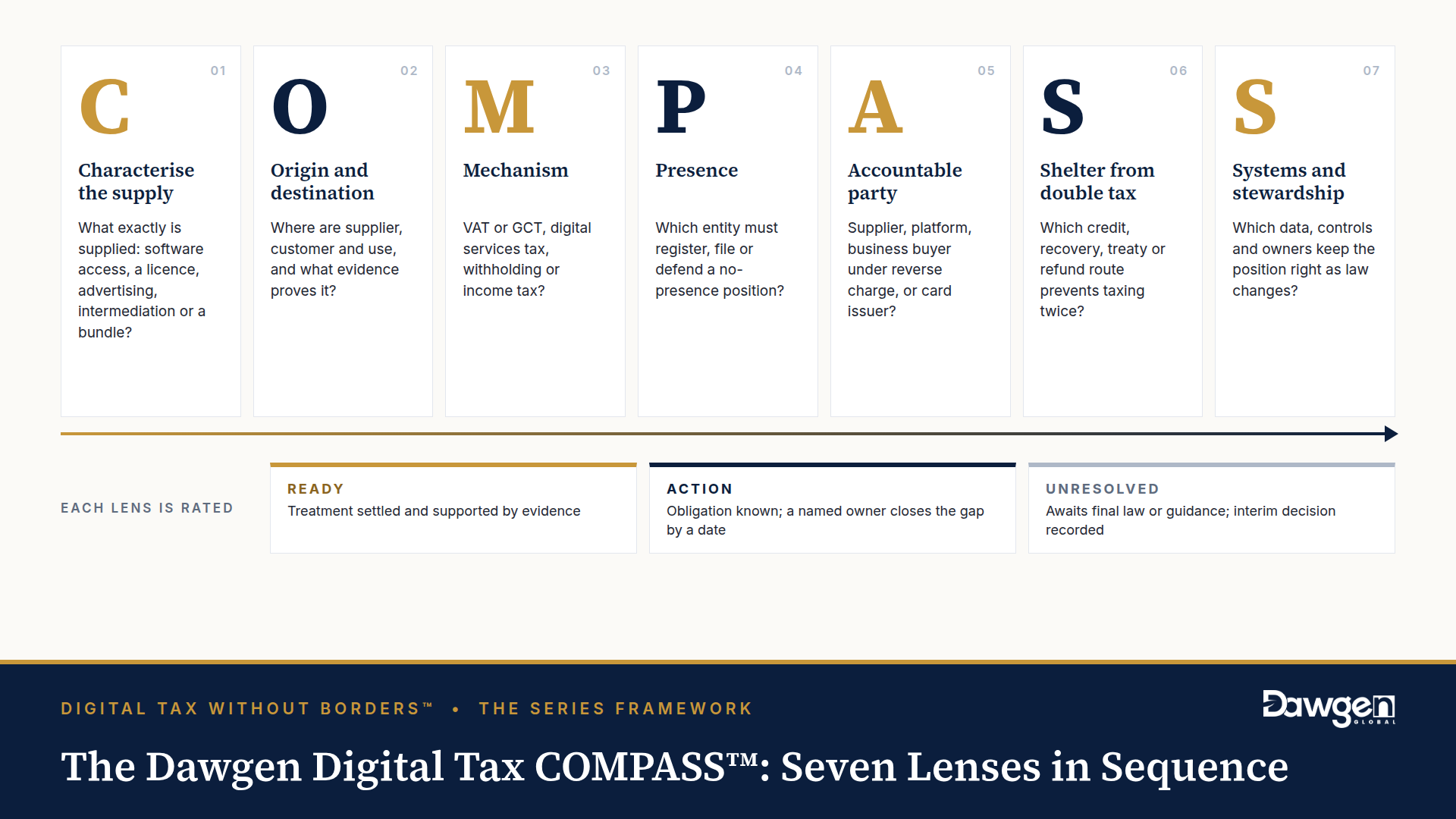
The Dawgen Digital Tax COMPASS™ is the method Dawgen Global uses to turn the broad phrase “digital tax” into specific, answerable questions. It works transaction by transaction, and it applies equally to what a business buys and what it sells. Seven lenses are applied in sequence, because each answer depends on the one before it.
- C — Characterise the supply. What exactly is supplied: access to software, a licence of intellectual property, advertising, intermediation, a professional service delivered remotely, or a bundle of several? The contract and the actual performance decide, not the invoice description.
- O — Origin and destination. Where are the supplier, the customer and the place of use or consumption, and what evidence proves it? Billing address, card country, IP address and contract terms often disagree.
- M — Mechanism. Which tax is in play: VAT or GCT on consumption, a gross-revenue digital services tax, withholding tax on the payment, or income tax on profits? Each has a different taxpayer, base and remedy.
- P — Presence. Which entity has a taxable connection with which jurisdiction, and must it register, file or defend a no-presence position?
- A — Accountable party. Who must actually charge, collect or remit: the supplier, a platform deemed to be the supplier, the business customer under a reverse charge, or a payment intermediary?
- S — Shelter from double taxation. Which credit, input tax recovery, treaty provision or refund route prevents the same value being taxed twice, and is it documented?
- S — Systems and stewardship. Which data fields, controls, owners and monitoring routines keep the position right as volumes grow and the law changes?
Each lens is rated on a simple three-tier scale. Ready means the treatment is settled and supported by evidence. Action means the obligation is known and a named owner is fixing a gap by a date. Unresolved means the answer depends on law or guidance that is not yet final, and an interim commercial decision has been recorded. The output is a transaction-level exposure map and an action plan with owners, not a list of countries. The COMPASS™ identifies and prioritises the questions; each material conclusion is then supported by the law of the jurisdiction concerned.
Applying the COMPASS™ to a regional group’s first digital tax review
| Lens | What to ask in this context | Evidence to hold |
| C — Characterise | Are our top digital purchases and sales software access, licences, advertising or remote services? | Contracts for top suppliers and revenue streams, each classified |
| O — Origin and destination | Which entities use each purchase; where are our customers? | User allocation by entity; customer location data |
| M — Mechanism | Is each item exposed to VAT/GCT, withholding, both or neither in each territory? | A dated regime register separating law in force from proposals |
| P — Presence | Must we register in Barbados, The Bahamas, Suriname or, once commenced, Grenada? | Sales by territory and customer type |
| A — Accountable party | For each flow, who collects: supplier, platform, our entity under reverse charge, or us as seller? | Supplier invoices; platform terms; returns |
| S — Shelter | Where we self-account, do we recover? Where tax is withheld from our receipts abroad, do we claim a credit? | Input tax workings; withholding certificates; tax residence certificates |
| S — Systems | Can our payables and billing systems flag foreign digital services and capture location? Who monitors commencement dates? | Tax codes and vendor master fields; a named monitoring owner |
Questions for the board
- Which families of digital tax affect us today, and which will within 18 months?
- How is each of our 20 largest foreign digital suppliers treated for GCT or VAT and withholding?
- In Jamaica, are we self-accounting for GCT on imported services under s.23B, and is our input tax recovery on those amounts right?
- Do we sell digital services to consumers in Barbados, The Bahamas, Suriname or Grenada, and must we register there?
- What will Jamaica’s proposed GCT on foreign digital services cost us and our customers from early 2027, and who owns that analysis?
- Where we buy centrally and recharge other islands, is each recharge documented and taxed?
- Which of our tax positions depend on proposals rather than law in force, and what interim decision is recorded for each?
- Who monitors Jamaican, Grenadian and regional developments, and how often does the board hear from them?
How Dawgen Global can help
Dawgen Global’s Caribbean Tax Advisory practice helps boards, finance leaders and owner-managers understand how the new wave of Caribbean digital tax rules affects what they buy and what they sell across the region. Using the Dawgen Digital Tax COMPASS™, we map digital transactions across the jurisdictions in which you operate, separate law in force from proposals, quantify exposure and help your team put in place the contracts, systems and controls to stay compliant as the rules change. To discuss your organisation’s position, contact us at [email protected]
This article provides general information and does not constitute tax or legal advice. The application of tax law depends on specific facts and on the law in force at the relevant date; readers should obtain advice before acting.
Abbreviations used
- B2B — business-to-business
- B2C — business-to-consumer
- CARICOM — Caribbean Community
- CFO — chief financial officer
- COTA — Caribbean Organisation of Tax Administrators
- DST — digital services tax
- ERP — enterprise resource planning
- FY — fiscal year
- GST — goods and services tax
- GCT — General Consumption Tax
- IP — internet protocol (as in IP address)
- ITBIS — tax on the transfer of industrialised goods and services (Dominican Republic)
- OECD — Organisation for Economic Co-operation and Development
- OECS — Organisation of Eastern Caribbean States
- SaaS — software as a service
- SEP — Significant Economic Presence
- SIM — subscriber identity module
- TAJ — Tax Administration Jamaica
- UN — United Nations
- VAT — value added tax
Sources
- Jamaica Information Service, “Gov’t projects $29.4B from new revenue measures in fiscal year 2026/27”, February 2026. https://jis.gov.jm/govt-projects-29-4b-from-new-revenue-measures-in-fiscal-year-2026-27/
- Ministry of Finance and the Public Service (Jamaica), Revenue Measures (Ministry Paper No. 17, “Revenue Measures for Financial Year 2026/2027”, 12 February 2026; amended revenue measures, 28 April 2026). https://www.mof.gov.jm/resources-revenue-measures/
- EY, “Jamaica proposes extending General Consumption Tax to digitally supplied services and intangibles from abroad”, Tax Alert, 25 February 2026. https://www.ey.com/en_gl/technical/tax-alerts/jamaica-proposes-extending-general-consumption-tax-to-digitally-supplied-services-and-intangibles-from-abroad
- Jamaica Observer, “GCT imposed on digital services, intangibles supplied overseas — Williams”, 12 February 2026. https://www.jamaicaobserver.com/2026/02/12/gct-imposed-digital-services-intangibles-supplied-overseas-williams/
- KPMG, “Grenada: Nonresident digital services VAT”, TaxNewsFlash, May 2026. https://kpmg.com/us/en/taxnewsflash/news/2026/05/grenada-nonresident-digital-services-vat.html
- PwC, Worldwide Tax Summaries, “Barbados — Corporate — Other taxes”. https://taxsummaries.pwc.com/barbados/corporate/other-taxes
- Department of Inland Revenue (The Bahamas), Value Added Tax Act (consolidated). https://inlandrevenue.finance.gov.bs/wp-content/uploads/2024/11/Value-Added-Tax-Act.pdf
- VATcalc, “Bahamas VAT on foreign digital services”. https://www.vatcalc.com/bahamas/bahamas-vat-on-foreign-digital-services/
- VATcalc, “Suriname 10% VAT on foreign digital service providers 2023”. https://www.vatcalc.com/suriname/suriname-10-vat-on-foreign-digital-service-providers-2023/
- Diario Libre, “La DGII trabaja propuesta de ITBIS para plataformas digitales”, 20 May 2026. https://www.diariolibre.com/economia/finanzas/2026/05/20/la-dgii-trabaja-propuesta-de-itbis-para-plataformas-digitales/3538742
- CARICOM Secretariat, “Coordinated approach necessary for consistent application of VAT systems — tax officials”, March 2026. https://caricom.org/coordinated-approach-necessary-for-consistent-application-of-vat-systems-tax-officials/
- Grant Thornton, Indirect Tax Guide, “Trinidad and Tobago”. https://www.grantthornton.global/en/insights/indirect-tax-guide/indirect-tax—Trinidad_and_Tobago/
- Guyana Revenue Authority, “VAT on imported services”. https://www.gra.gov.gy/tax-services/vat-services/imported-services/
- Tax Foundation, “Digital Taxation Around the World”, April 2024. https://taxfoundation.org/research/all/global/digital-taxation-around-the-world-2024/
- OECD, International VAT/GST Guidelines, 2017. https://www.oecd.org/en/publications/international-vat-gst-guidelines_9789264271401-en.html
- Servicio de Impuestos Internos (Chile), “IVA a los servicios digitales — preguntas frecuentes”. https://www.sii.cl/vat/faq1_esp.html
- DIAN (Colombia), Decree 2039 of 2023. https://normograma.dian.gov.co/dian/compilacion/docs/decreto_2039_2023.htm
- HM Revenue & Customs, “Check if you need to register for Digital Services Tax”. https://www.gov.uk/guidance/check-if-you-need-to-register-for-digital-services-tax
- Direction générale des Finances publiques (France), “TSN — taxe sur les services numériques”. https://www.impots.gouv.fr/professionnel/tsn-taxe-sur-les-services-numeriques
- PwC, Worldwide Tax Summaries, “Jamaica — Corporate — Withholding taxes”. https://taxsummaries.pwc.com/jamaica/corporate/withholding-taxes
- CARICOM, “Double Taxation Agreement” (1994). https://caricom.org/treaties/double-taxation-agreement/
- United Nations, Model Double Taxation Convention between Developed and Developing Countries, 2021 update. https://financing.desa.un.org/sites/default/files/2023-05/UN%20Model_2021.pdf
- Department of Finance Canada, “Canada rescinds digital services tax to advance broader trade negotiations with the United States”, 29 June 2025. https://www.canada.ca/en/department-finance/news/2025/06/canada-rescinds-digital-services-tax-to-advance-broader-trade-negotiations-with-the-united-states.html
- Parliament of Canada, LEGISinfo, Bill C-15, Budget 2025 Implementation Act, No. 1 (S.C. 2026, c. 3). https://www.parl.ca/legisinfo/en/bill/45-1/c-15
- Federal Register (United States), “Defending American Companies and Innovators From Overseas Extortion and Unfair Fines and Penalties”, Presidential Memorandum of 21 February 2025. https://www.federalregister.gov/documents/2025/02/26/2025-03188/defending-american-companies-and-innovators-from-overseas-extortion-and-unfair-fines-and-penalties
- Mayer Brown, “OECD Pillar Two: side-by-side system and new safe harbors”, January 2026. https://www.mayerbrown.com/en/insights/publications/2026/01/oecd-pillar-two-side-by-side-system-and-new-safe-harbors
- UN Department of Economic and Social Affairs, Intergovernmental Negotiating Committee on the UN Framework Convention on International Tax Cooperation. https://financing.desa.un.org/inc/fifthsession
- EY, “UN releases draft Framework Convention on International Tax Cooperation and two early protocols”, Tax Alert, 27 July 2026. https://www.ey.com/en_gl/technical/tax-alerts/un-releases-draft-framework-convention-on-international-tax-cooperation-and-two-early-protocols
- The Gleaner, “Editorial: Get CARICOM digital GCT”, 19 February 2026. https://jamaica-gleaner.com/article/commentary/20260219/editorial-get-caricom-digital-gct
- CIAT, “New toolkit to strengthen value added taxes on e-commerce in Latin America and the Caribbean”, 23 June 2021. https://www.ciat.org/new-toolkit-to-strengthen-value-added-taxes-on-e-commerce-in-latin-america-and-the-caribbean/?lang=en
- European Commission, VAT One Stop Shop. https://vat-one-stop-shop.ec.europa.eu/
About Dawgen Global
Dawgen Global is an independent, integrated multidisciplinary professional services firm headquartered at 47 Trinidad Terrace, New Kingston, Jamaica, serving more than 15 territories across the Caribbean. Founded and led by Dr. Dawkins Brown, Executive Chairman, the firm is independent and not affiliated with any international network. It delivers a full suite of professional services under one roof: audit and assurance; tax advisory; IT and digital transformation; risk management; cybersecurity; actuarial and insurance regulatory advisory; HR advisory; mergers and acquisitions; corporate recovery; business advisory and strategy; accounting BPO and virtual CFO services; and legal process outsourcing.
The proposition is simple: big-firm capability without the big-firm price. Dawgen Global’s integrated approach is built for the specific complexities and opportunities of the Caribbean market, helping organizations make sharper, better-informed decisions that drive measurable progress.
To explore a partnership, reach out:
- Website: dawgen.global
- Email: [email protected]
- WhatsApp (Global): +1 555-795-9071
- Caribbean offices: +1 876-665-5926 | +1 876-929-3670 | +1 876-926-5210


