

The first objection to long-dated interest-only capital is that nobody ever repays it. The answer is a reserve, a glidepath and an election made two years early — and the arithmetic is less comfortable than the concept.
The Endurance Capital Series, Part Seven · The Dawgen Endurance Capital Framework™
Every conversation about long-dated interest-only capital arrives at the same objection, usually within the first ten minutes, and usually from the most experienced person in the room.
If the company only pays interest for twelve years, when exactly does anybody get their money back? You have not solved the repayment problem. You have postponed it, and postponing it for twelve years makes it somebody else’s problem.
The objection is correct as far as it goes, and a framework that answered it with optimism about refinancing markets would deserve to be dismissed. Deferred principal is a real risk and it does not disappear because the instrument is well intentioned.
So this article sets out how the principal is actually retired, what the numbers look like at the point it has to be, and — because this is the part most such arguments leave out — which of the three available routes is genuinely comfortable and which are not.
The framework this belongs to
For readers meeting the instrument here for the first time, the problem it was built to solve is worth stating.
Across Jamaica and the wider Caribbean, enterprises are built from sweat equity and personal savings, and then grown on borrowed money that was never designed for the purpose to which it is put. A company borrows to build a warehouse, a plant or a piece of land that will produce economic value for thirty years or more. It repays that money in five to seven, because five to seven years is what a commercial bank funded by short deposits can prudently write. The repayment schedule bears no relationship to the life of the thing it financed, or to the maturity of the earnings that must service it. It reflects the maturity of the lender’s deposit book. And the security is most often the founder’s residential home, because that is the only titled property with clean unencumbered value the company can offer.
When profit falls by half — a lost customer, a currency move, a storm season — the obligation does not fall by half. It does not fall at all. A solvent enterprise is liquidated by its capital structure rather than by its operations, and the founder loses the business and the house together.
Endurance Capital™ is the alternative: long-dated capital, secured on a qualifying appreciating asset, serviced by interest alone through a defined growth phase, sized so that interest remains covered after a fifty per cent decline in earnings, and conditioned on a binding compact governing what leaves the business for the life of the instrument.
The arithmetic is worth seeing once. Take a composite distributor with normalised earnings before interest, tax, depreciation and amortisation (EBITDA) of J$180 million and a commercial property independently valued at J$1.2 billion, needing J$570 million to expand. Raised conventionally — seven years, amortising, at 11 per cent — annual debt service is about J$121 million, which is coverage of 1.49 times. Halve the earnings and coverage is 0.74 times: arithmetically impossible.
Raised as endurance capital — fifteen years against the same property, interest only for twelve, amortising over the final three — the annual obligation is J$54.2 million. Coverage today is 3.32 times, and after the same halving it is 1.66 times.
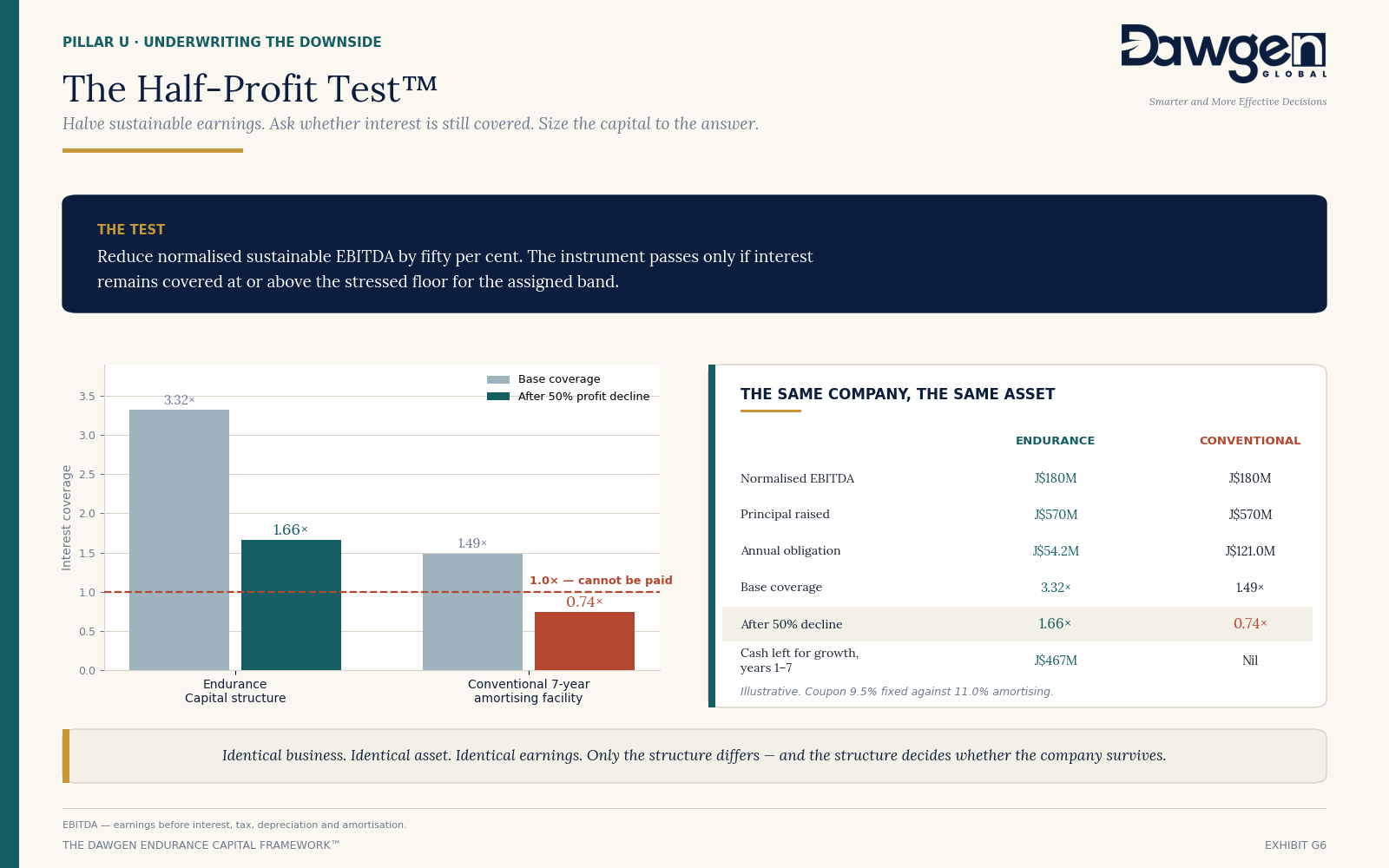
The framework is organised as six pillars, under the acronym ENDURE: the eligible asset base, normalised earnings capacity, duration architecture, underwriting the downside, the redemption runway, and an enforceable governance compact.
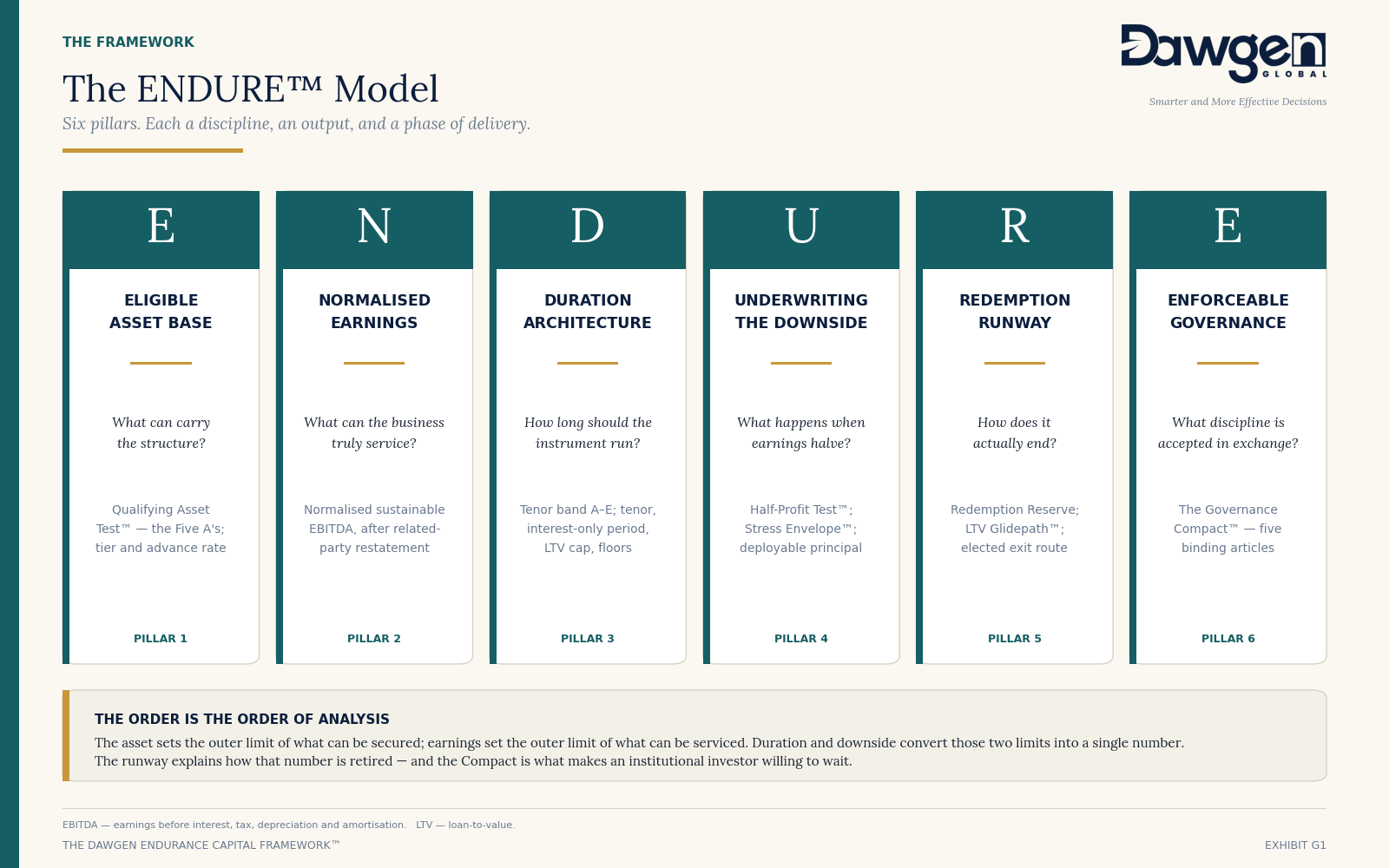
The fifth pillar is the subject of this article, and it is the one that decides whether the other five were worth building. An instrument that services beautifully for twelve years and then cannot be retired has not solved anything.
Three mechanisms, operating together
The framework does not rely on any single route out. It runs three mechanisms in parallel from the fourth year, and the strength of the position at maturity comes from their combination rather than from any one of them working perfectly.
A reserve that accumulates from year four. From the beginning of Phase 2, a defined proportion of post-tax profit is appropriated to a Redemption Reserve, held in identified liquid instruments and released only against principal. The target varies by tenor band — 35 per cent of principal for the earliest stage, falling to 15 for an institutional issuer — with the earlier bands carrying the higher targets precisely because their refinancing access is least certain.
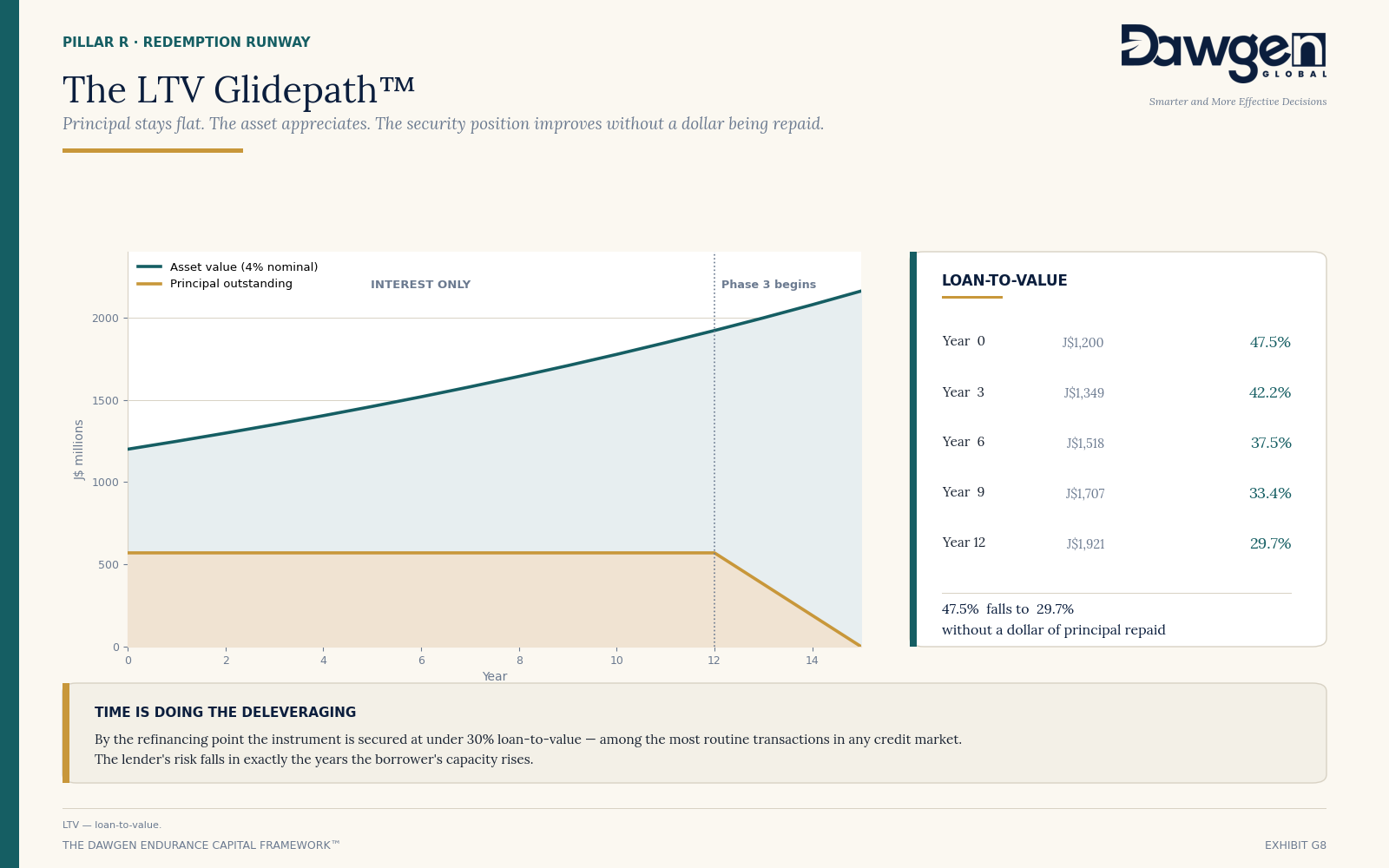
A loan-to-value ratio that falls without repayment. Principal stays flat through the interest-only phase while the securing asset appreciates. At a modest four per cent nominal rate, an exposure opening at 47.5 per cent loan-to-value is under 30 per cent by year twelve. The company has repaid nothing and its security position has improved by eighteen percentage points.
An election made two years before it is needed. No later than twenty-four months before Phase 3 begins, the board must adopt a Redemption Plan electing which route the instrument will take. This is the mechanism that converts refinancing risk from an event into a decision, and it is the one most easily overlooked because it costs nothing to comply with and everything to omit.
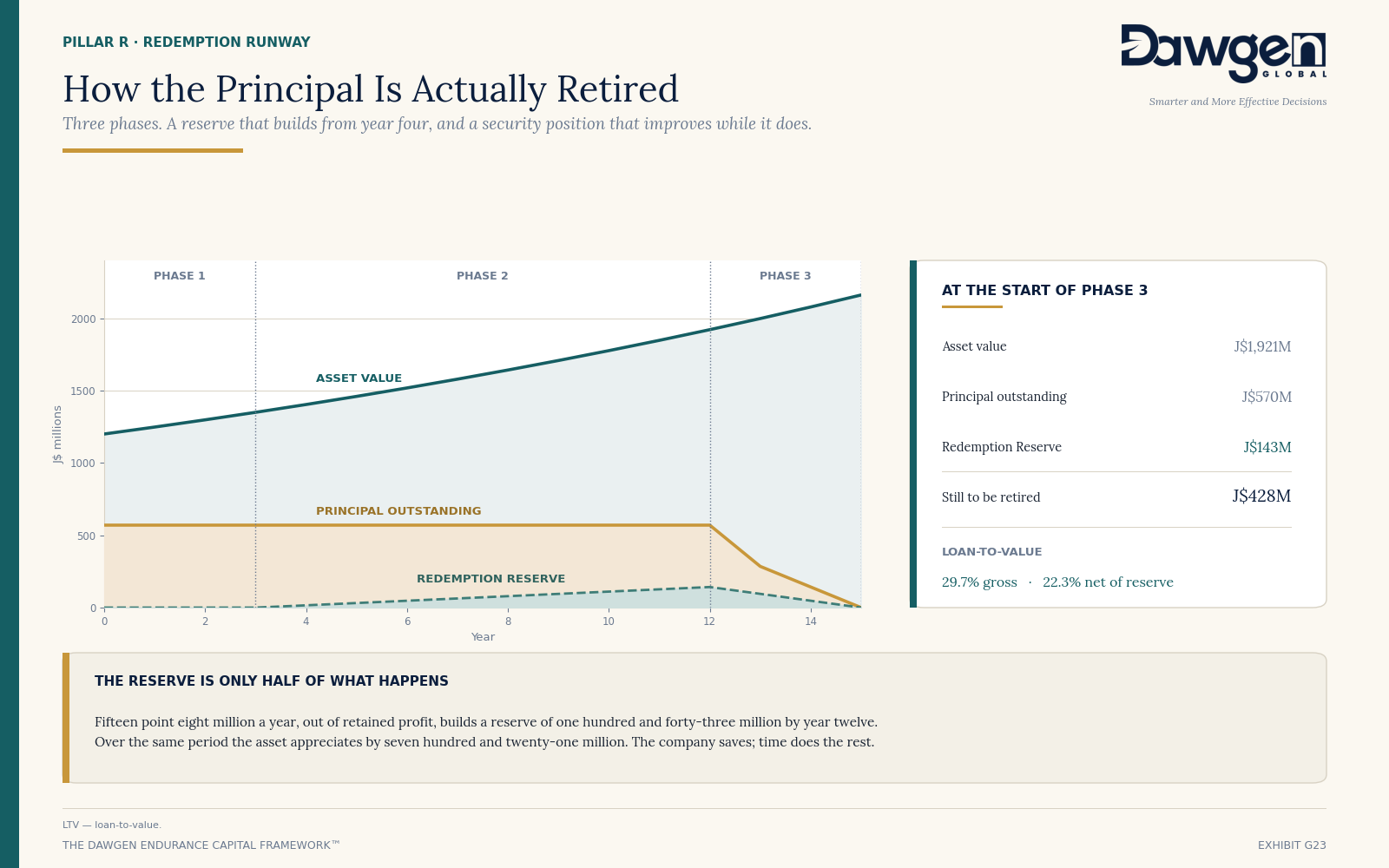
Run the composite company through it. A contribution of J$15.8 million a year from retained profit — comfortably inside a 55 per cent retention floor on post-tax earnings — builds a reserve of J$143 million by year twelve, a quarter of the principal. Over the same period the asset appreciates from J$1.2 billion to J$1.92 billion.
The company saves one hundred and forty-three million. Time contributes seven hundred and twenty-one million. The reserve is the smaller half of what is happening, and it is the only half that requires the company to do anything.
At the start of Phase 3 the position is: principal outstanding J$570 million, reserve J$143 million, balance still to be retired J$428 million, against an asset worth J$1.92 billion. Loan-to-value is 29.7 per cent gross and 22.3 per cent net of the reserve.
How the reserve is held, and what it is not
The word reserve does a lot of work in financing documents and means different things in different structures, so it is worth being specific about what this one is.
It is ring-fenced, not merely designated. The Redemption Reserve is held in identified liquid instruments, disclosed separately, and released only against principal. It is not an accounting appropriation of retained earnings that leaves the cash in the working capital cycle. A reserve that exists only in the equity section of the balance sheet is not a reserve; it is an intention, and it will be consumed by the first difficult quarter.
It is separate from the Debt Service Reserve. Two reserves operate under the framework and they do different jobs. The Debt Service Reserve holds six months of interest at all times from the end of the first year, and exists so that a temporary cash disruption does not become a payment default. The Redemption Reserve builds toward principal and is not available for interest. Neither may be drawn to fund the other, and both must be whole before any discretionary distribution passes the gates.
It sits in a fixed place in the waterfall. Below working capital, statutory obligations, interest and the Debt Service Reserve. Above contracted emoluments, growth capital expenditure and anything discretionary. That position is the whole of its protection: the company cannot fund a dividend ahead of the reserve, and it cannot fund the reserve ahead of paying its tax or its interest.
The framework does not require trustee-held escrow at every band, which would impose cost out of proportion to the risk for an established issuer. What it requires is that the reserve be identifiable, separately held, reported quarterly and incapable of being applied to anything else. In the earliest bands, escrow is the norm.
The mechanism that funds itself
There is a feature of the design worth drawing out, because it is not obvious and it is the reason the reserve tends to build fastest in the years it matters most.
When performance deteriorates, the Four Gates close and every discretionary distribution stops. Dividends, bonuses, and connected-party payments above the contracted level all cease from the quarter the breach is recorded. That cash does not leave the business.
The consequence of a bad year is that money stays inside the company. The reserve is one of the places it stays, and the difficulty that closed the gates is the same difficulty that makes the reserve worth having.
Contrast the same year under an amortising facility. Deterioration produces a covenant breach, the breach produces a demand, and the demand takes cash out at the moment the business has least of it. Both structures respond to a bad year. One of them responds by accumulating and the other by extracting.
This is also why the reserve target is set as a proportion of principal rather than as a fixed annual amount. A company that trades strongly throughout Phase 2 and distributes freely will reach the target on schedule from a smaller share of a larger profit. A company that struggles will reach it from a larger share of a smaller one, because the gates will have been doing the work. The mechanism is indifferent to which of those happened.
The deferred principal is the growth capital
There is a step in the redemption argument that is easy to state as an assumption and should instead be stated as a mechanism, because it is the reason the whole structure holds together.
When a company defers principal, the money does not vanish into a future obligation. It stays inside the business, and if the governance compact is intact, the reporting is sound and retained earnings are directed at growth, it compounds. The earnings that retire the instrument in Phase 3 are built by the principal that was not repaid in Phase 1 and Phase 2.
The growth is not an assumption bolted onto the structure. It is the structure, observed twelve years later.
Take the composite company and hold everything constant except the financing. Both versions retain 55 per cent of post-tax profit; both reinvest it at the same eighteen per cent return; both fund the same reserve. The only difference is that one is repaying principal from year one and the other is not.
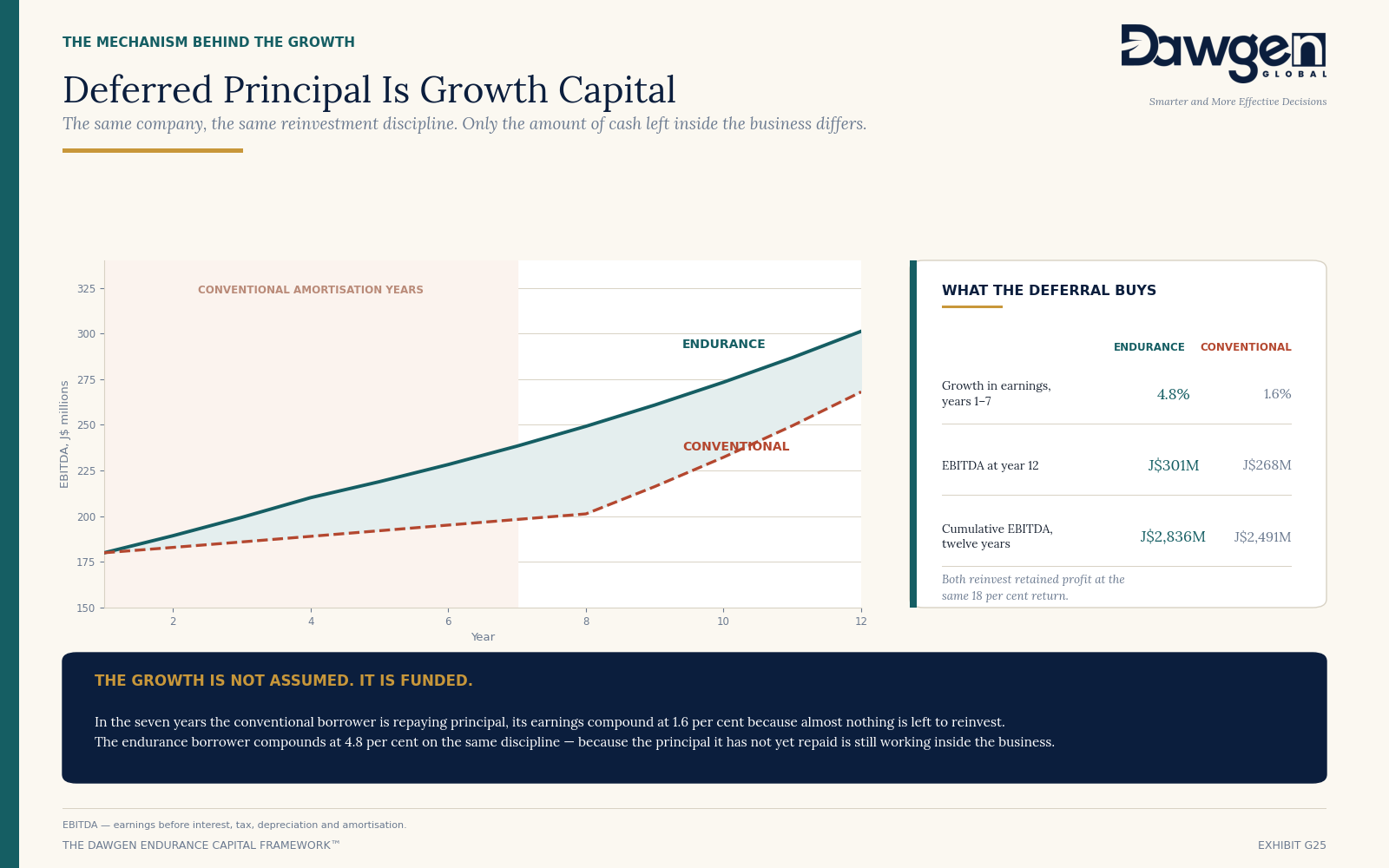
Over the seven years in which the conventional borrower is amortising, its earnings compound at 1.6 per cent a year — not because the business is worse, but because almost nothing survives debt service to be reinvested. The endurance borrower compounds at 4.8 per cent on identical discipline. By year twelve the gap in annual earnings is J$33 million, and the gap in cumulative earnings across the twelve years is J$345 million.
That cumulative figure is roughly sixty per cent of the principal borrowed, generated by nothing more exotic than leaving the money in the business for longer and applying it properly.
| Three conditions, all of them governed rather than hoped for
The compounding above depends on three things, and the framework requires all three rather than assuming them. The governance compact must be intact and complied with, so that the retained cash is not extracted. Retained earnings must actually be directed at growth rather than accumulated idly. And the financial reporting must be sound enough to tell the difference — quarterly management accounts within thirty days, audited statements within a hundred and twenty. Those are the same three requirements that make the instrument financeable in the first place. They are not additional conditions imposed for the redemption argument; they are the conditions the borrower already accepted. |
Three ways it ends
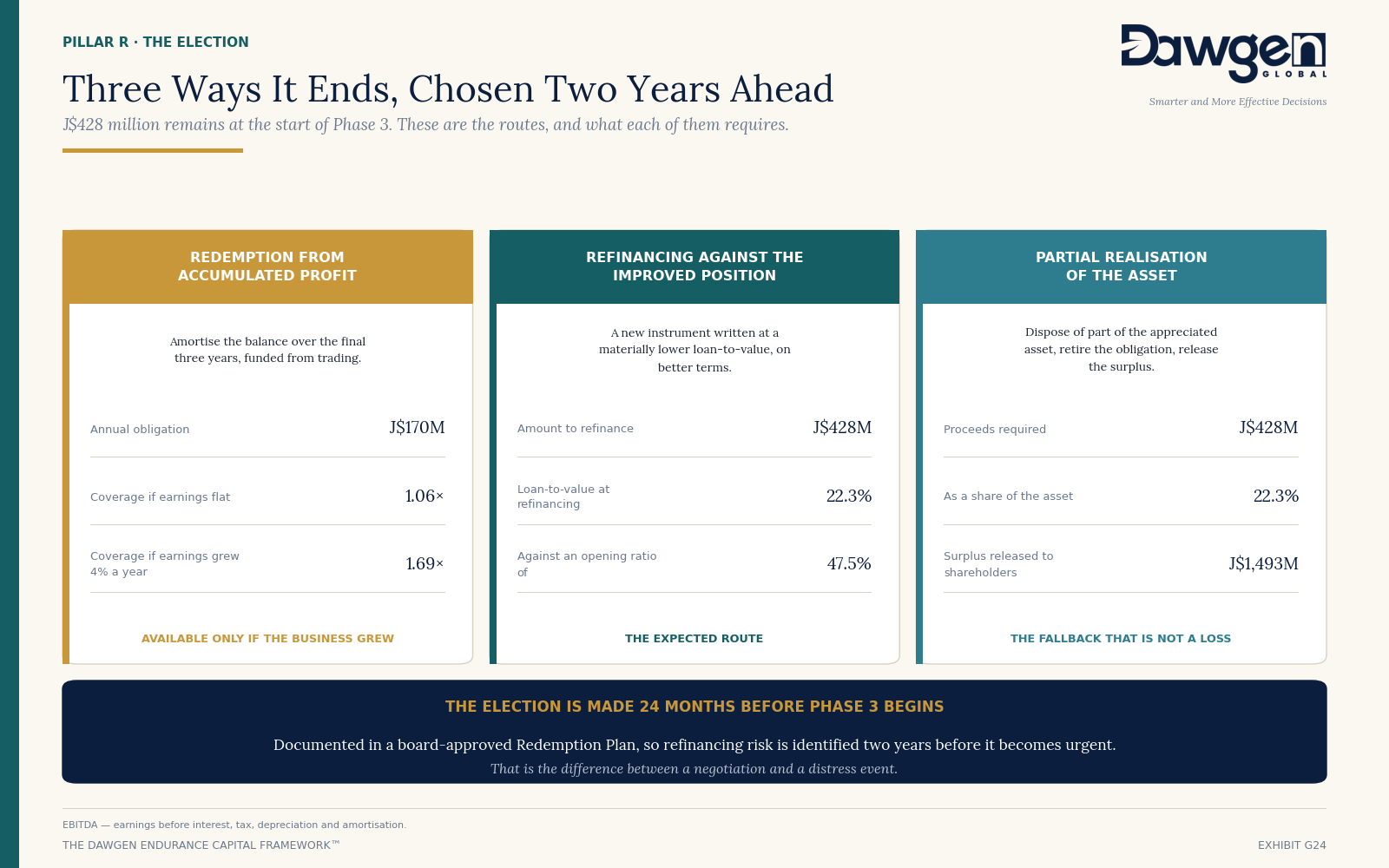
Four hundred and twenty-eight million dollars remains. There are three routes, and they are not equally comfortable.
Redemption from accumulated profit
Amortise the balance over the final three years out of trading. Level annual service on J$428 million at 9.5 per cent over three years is J$170 million.
On the earnings the deferral itself builds — J$301 million at year twelve on an eighteen per cent reinvestment return — that is coverage of 1.77 times. Sound, and funded by the structure rather than by a forecast.
The figure that matters more, though, is what happens when the build disappoints. If the capital returns only half what was planned, earnings reach J$236 million and coverage is 1.38 times. If it is largely unproductive, J$205 million and 1.20 times. And in the extreme case where twelve years of reinvestment produced nothing whatever — earnings flat at the day the instrument was written — coverage is 1.06 times: thin, but still payable.
The amortisation route holds even where the growth it was supposed to fund did not happen at all. That is the margin the deferral buys, and it is why the other two routes are options rather than rescues.
Refinancing against the improved position
Write a new instrument for J$428 million against an asset now worth J$1.92 billion. That is a loan-to-value ratio of 22.3 per cent, against an opening ratio of 47.5.
This is the expected route and it should be said plainly rather than treated as a fallback. Refinancing at twenty-two per cent loan-to-value, on a seasoned asset with twelve years of documented covenant compliance behind it, is among the most routine transactions in any credit market. The company is not approaching the market as a supplicant. It is approaching with the strongest credit profile it has ever had.
Partial realisation
Dispose of part of the appreciated asset, retire the obligation, and release the surplus. The J$428 million required represents 22.3 per cent of the asset’s value at that point, leaving roughly J$1.49 billion of value in shareholders’ hands.
This is conventionally described as the fallback, and the framing is worth resisting. A company that entered with a J$1.2 billion asset and J$570 million of debt exits debt-free with J$1.49 billion of asset value, having had twelve years of growth capital in the meantime.
The plan is re-cut every year

A twelve-year build is not a forecast made once and checked at the end. Under the framework it is re-cut annually against what actually happened, and the discipline that makes this possible is the same reporting the covenants already require.
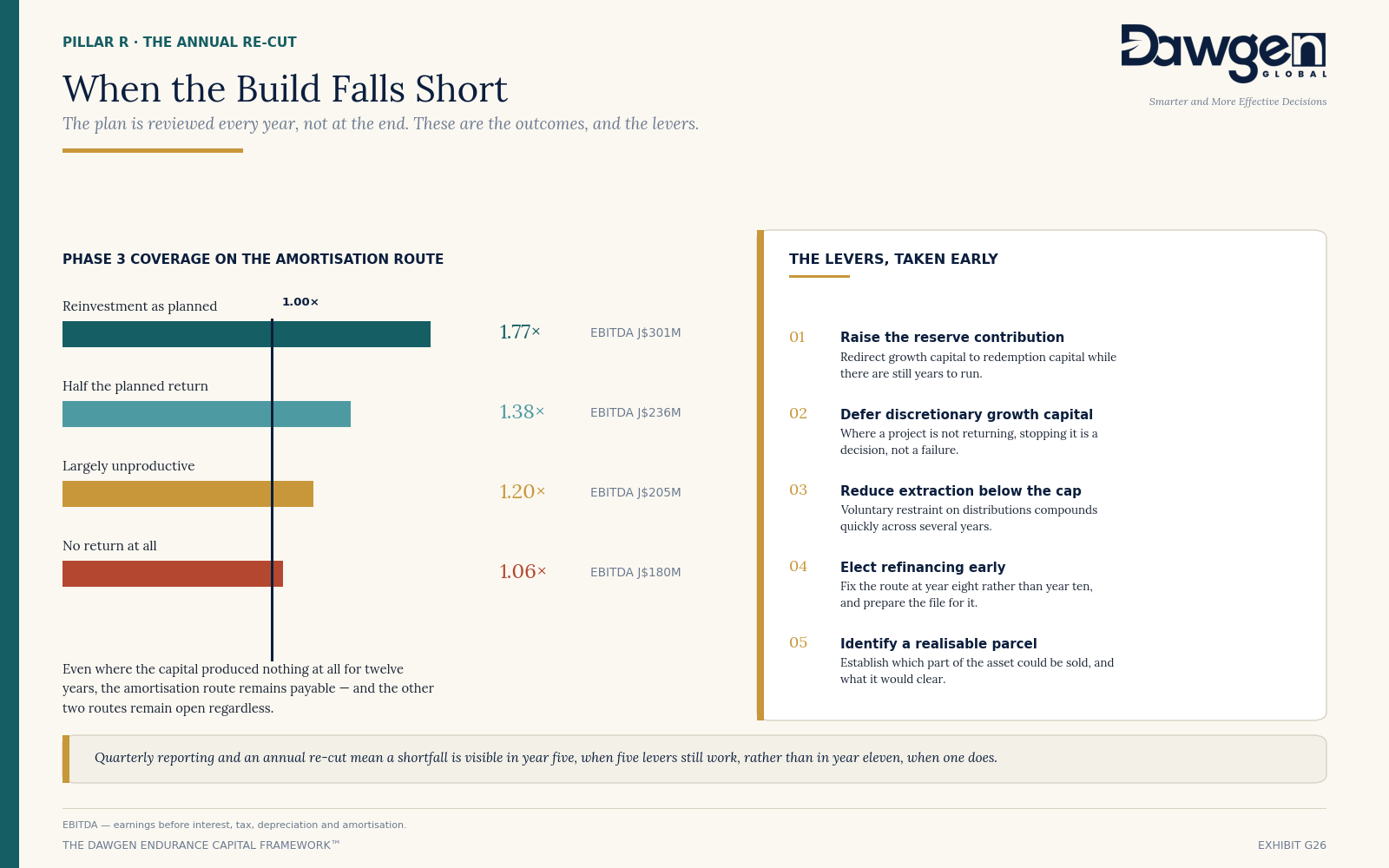
Each year the board reviews four things against the plan: earnings delivered against the build projection, the return earned on capital deployed in the prior year, the reserve position against its schedule, and loan-to-value on a current valuation. Where the projection was met, nothing changes. Where it was missed, the question is not whether to react but which lever to pull.
Five are available, and their usefulness declines sharply with time. Raising the reserve contribution redirects growth capital to redemption capital while there are still years for it to accumulate. Deferring discretionary growth expenditure on a project that is not returning is a decision rather than an admission. Voluntary restraint on extraction below the cap compounds quickly across several years. Electing refinancing early fixes the route and allows the file to be prepared properly. And identifying which parcel of the asset could be realised, and what it would clear, converts the third route from a theory into a costed option.
A shortfall identified in year five has five levers available. The same shortfall identified in year eleven has one, and it is the one with the least favourable terms.
This is the practical answer to the objection that the structure defers a problem. It defers the payment. It does not defer the monitoring, and it does not defer the decision — which is why the Redemption Plan is required twenty-four months before Phase 3 rather than at its threshold.
And if the reserve was never built
The reserve is funded from retained profit, and a company that has spent years with its distribution gates closed — or that simply had a poor decade — may arrive at year twelve with far less than the target, or with nothing at all.
This is the case worth examining honestly, because it is the one that actually happens.
With no reserve, the full J$570 million requires refinancing at year twelve. Against an asset worth J$1.92 billion that is a loan-to-value ratio of 29.7 per cent. It is a worse position than 22.3 per cent, and it is still a comfortably financeable one — materially better, in fact, than the 47.5 per cent at which the original instrument was written.
The company that failed entirely to save is refinancing at a lower loan-to-value ratio than the one at which it originally borrowed. That is what an appreciating asset and a flat principal balance do over twelve years, and it is why the structure is robust to the reserve mechanism underperforming.
What the missing reserve costs is optionality rather than solvency. The company with a full reserve has three routes available; the company with none has one. That is a real reduction in bargaining position at the point of refinancing, and it will show up in the coupon. But it is not a cliff.
Where this argument stops
Three conditions have to hold for any of the above, and a reader is entitled to have them stated rather than buried.
The asset must actually appreciate. Everything in the glidepath rests on nominal appreciation over twelve years. The framework tests this before the instrument is written — the qualifying asset test requires evidence of value retention in real terms across at least one full economic cycle, and the position is then stressed by a twenty-five per cent reduction in assessed value. But a prolonged property decline across the whole tenor would leave the position materially worse than described, and no covenant structure prevents that.
A refinancing market has to exist at year twelve. Refinancing at 22 or even 30 per cent loan-to-value is routine in a functioning market. It is not routine in a market that has closed. The reserve, the elected plan and the partial realisation route exist precisely because the market cannot be assumed — but a company relying wholly on refinancing has taken a market view whether it says so or not.
The retained cash has to be deployed, not merely retained. The compounding above assumes the money left in the business is put to work at a return. A company that defers principal and then holds the cash idle, or spends it on assets that do not earn, gets the cash flow relief without the growth — and arrives at Phase 3 on the 1.06 times case rather than the 1.77 times one. The instrument still works there, but it has not done what it was raised to do, and the annual re-cut exists to make that visible by year five rather than year eleven.
None of these is a reason to prefer a seven-year amortising facility, which faces all three on a compressed timetable with no reserve, no glidepath and no elected plan. They are reasons to size conservatively and elect early.
Where to start
- For any long-dated facility you hold or are considering, write down what has to be true at maturity for it to be retired, and by which of the three routes.
- Model the amortisation route on flat earnings, not on your growth case. If it fails there, it is a refinancing structure and should be planned as one from year one.
- Calculate what a reserve contribution would have to be to reach a quarter of principal by the start of the final third, and test it against your retention policy. In most cases the figure is smaller than expected.
- Fix the date on which the redemption decision must be taken, and put it in the board calendar. Two years before, not two quarters.
The framework, and the hundred-point Endurance Readiness Score™ that accompanies it, set out the full method.
Interest-only is not repayment-never. It is repayment arranged so that the year of repayment is chosen rather than arriving, and so that the company reaches it stronger than it began.
This concludes the Endurance Capital Series. The first article, A Seven-Year Loan Against a Thirty-Year Asset, sets out the framework in full.
| Client acceptance and conflict of interest
Every request for Dawgen Global services is subject to the firm’s standard client acceptance and continuance procedures before any engagement is accepted. Those procedures include an independence assessment and a conflict-of-interest check across the firm and its member practices. Where a conflict is identified that cannot be managed by safeguards, the engagement is declined. |
The Dawgen Endurance Capital Framework™ is proprietary to Dawgen Global and is reviewed and updated periodically; readers should ensure they are working from the current version. All figures are illustrative, constructed to demonstrate the methodology, and not drawn from any client engagement. Appreciation and refinancing assumptions are stated for illustration and are not forecasts. This article addresses patterns observed across private company advisory engagements; it does not comment on any listed issuer or specific client and does not constitute investment advice or an invitation to invest.
About Dawgen Global
Dawgen Global is an independent, integrated multidisciplinary professional services firm headquartered at Dawgen Towers, 47-49 Trinidad Terrace, Kingston 5, Jamaica, serving more than 15 territories across the Caribbean. Founded and led by Dr. Dawkins Brown, Executive Chairman, the firm is independent and not affiliated with any international network. It delivers a full suite of professional services under one roof: audit and assurance; tax advisory; IT and digital transformation; risk management; cybersecurity; actuarial and insurance regulatory advisory; HR advisory; mergers and acquisitions; corporate recovery; business advisory and strategy; accounting BPO and virtual CFO services; and legal process outsourcing.
The proposition is simple: big-firm capability without the big-firm price. Dawgen Global’s integrated approach is built for the specific complexities and opportunities of the Caribbean market, helping organizations make sharper, better-informed decisions that drive measurable progress.
To explore a partnership, reach out:
- Website: dawgen.global
- Email: info@dawgen.global
- WhatsApp (Global): +1 555-795-9071
- Caribbean offices: +1 876-929-3670 | +1 876-926-5210


