

Most owner-managed companies are under-financed by their own accounting. The remuneration policy that saves tax also makes the business look smaller than it is — and lenders price what they can see.
The Endurance Capital Series, Part Five · The Dawgen Endurance Capital Framework™
An owner is told that his company can raise three hundred and seventy-five million dollars. The figure is arrived at properly, from audited accounts, by someone competent. It is also wrong by seventy-six million.
Nothing has been concealed and nothing has been misstated. The accounts are accurate. The problem is that they were prepared to answer a different question — what the company earned last year, after everything it actually paid — and capacity turns on a question they were never asked: what the company would earn if every payment to the people who own it were struck at the rate a stranger would charge.
In owner-managed companies those two numbers are almost never the same, and the gap runs in the direction most owners do not expect. The business is usually stronger than its own accounts make it look.
This is not an accounting failure and it is nobody’s error. Remuneration in a company owned by the people who run it is set for a mixture of reasons — tax efficiency, family circumstance, what the founder took last year, what feels defensible. Almost none of those reasons is “what this role would cost in the market”, and there is no reason they should be. But a lender assessing how much debt the business can service is looking at the earnings that survive those payments, and pricing what it can see.
The framework this pillar belongs to
Normalised earnings capacity is the second pillar of a framework built to solve a particular problem, and the problem is worth stating for readers meeting it here for the first time.
Across Jamaica and the wider Caribbean, enterprises are built from sweat equity and personal savings, and then grown on borrowed money that was never designed for the purpose to which it is put. A company borrows to build a warehouse, a plant or a piece of land that will produce economic value for thirty years or more. It repays that money in five to seven, because five to seven years is what a commercial bank funded by short deposits can prudently write. The repayment schedule bears no relationship to the life of the thing it financed, or to the maturity of the earnings that must service it. It reflects the maturity of the lender’s deposit book. And the security is most often the founder’s residential home, because that is the only titled property with clean unencumbered value the company can offer.
When profit falls by half — a lost customer, a currency move, a storm season — the obligation does not fall by half. It does not fall at all. A solvent enterprise is liquidated by its capital structure rather than by its operations, and the founder loses the business and the house together.
Endurance Capital™ is the alternative: long-dated capital, secured on a qualifying appreciating asset, serviced by interest alone through a defined growth phase, sized so that interest remains covered after a fifty per cent decline in earnings, and conditioned on a binding compact governing what leaves the business for the life of the instrument.
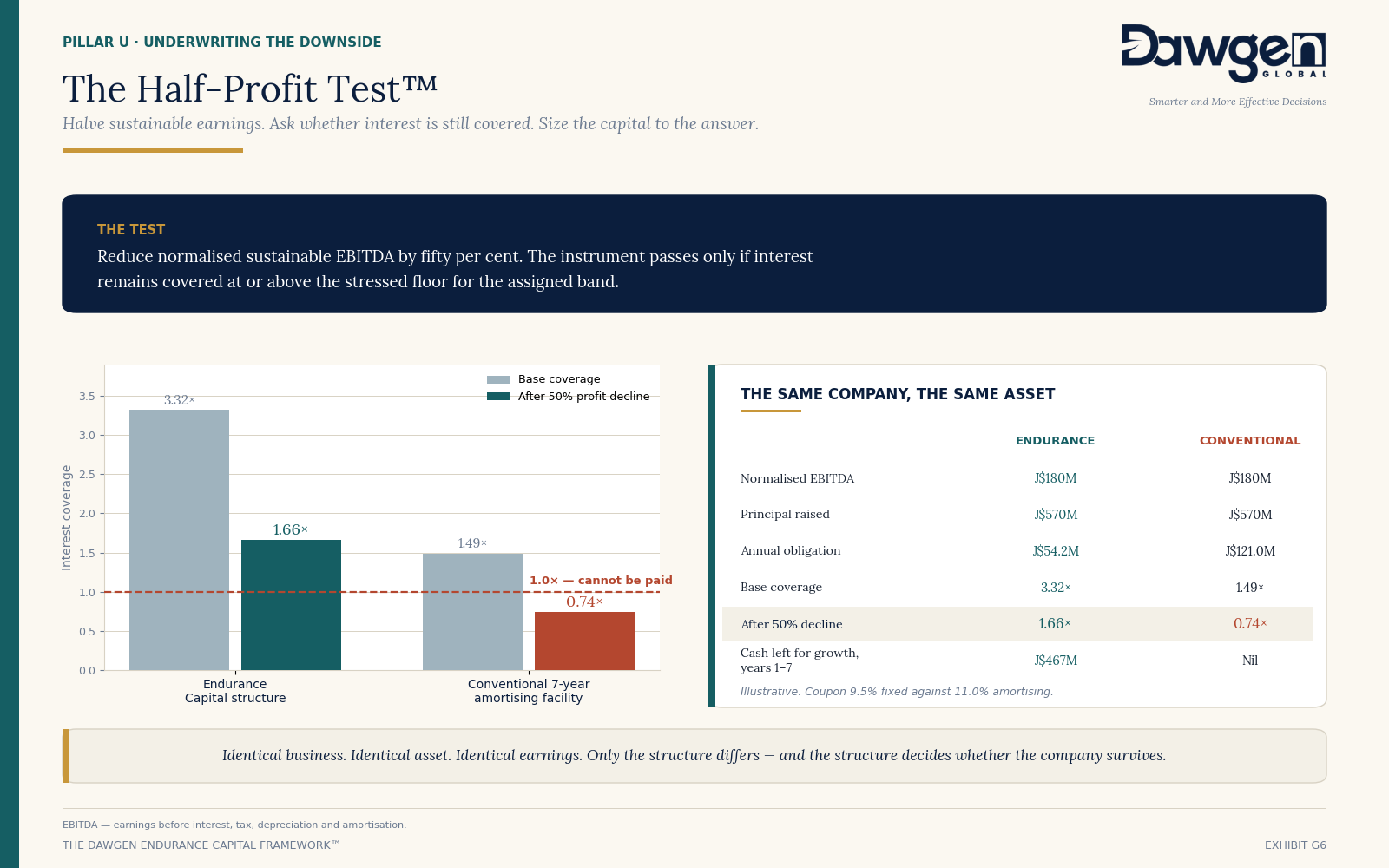
The arithmetic is worth seeing once. Take a composite distributor with normalised earnings before interest, tax, depreciation and amortisation (EBITDA) of J$180 million and a commercial property independently valued at J$1.2 billion, needing J$570 million to expand. Raised conventionally — seven years, amortising, at 11 per cent — annual debt service is about J$121 million, which is coverage of 1.49 times. Halve the earnings and coverage is 0.74 times: arithmetically impossible.
Raised as endurance capital — fifteen years against the same property, interest only for twelve — the annual obligation is J$54.2 million. Coverage today is 3.32 times, and after the same halving it is 1.66 times. The company pays its interest and keeps trading.
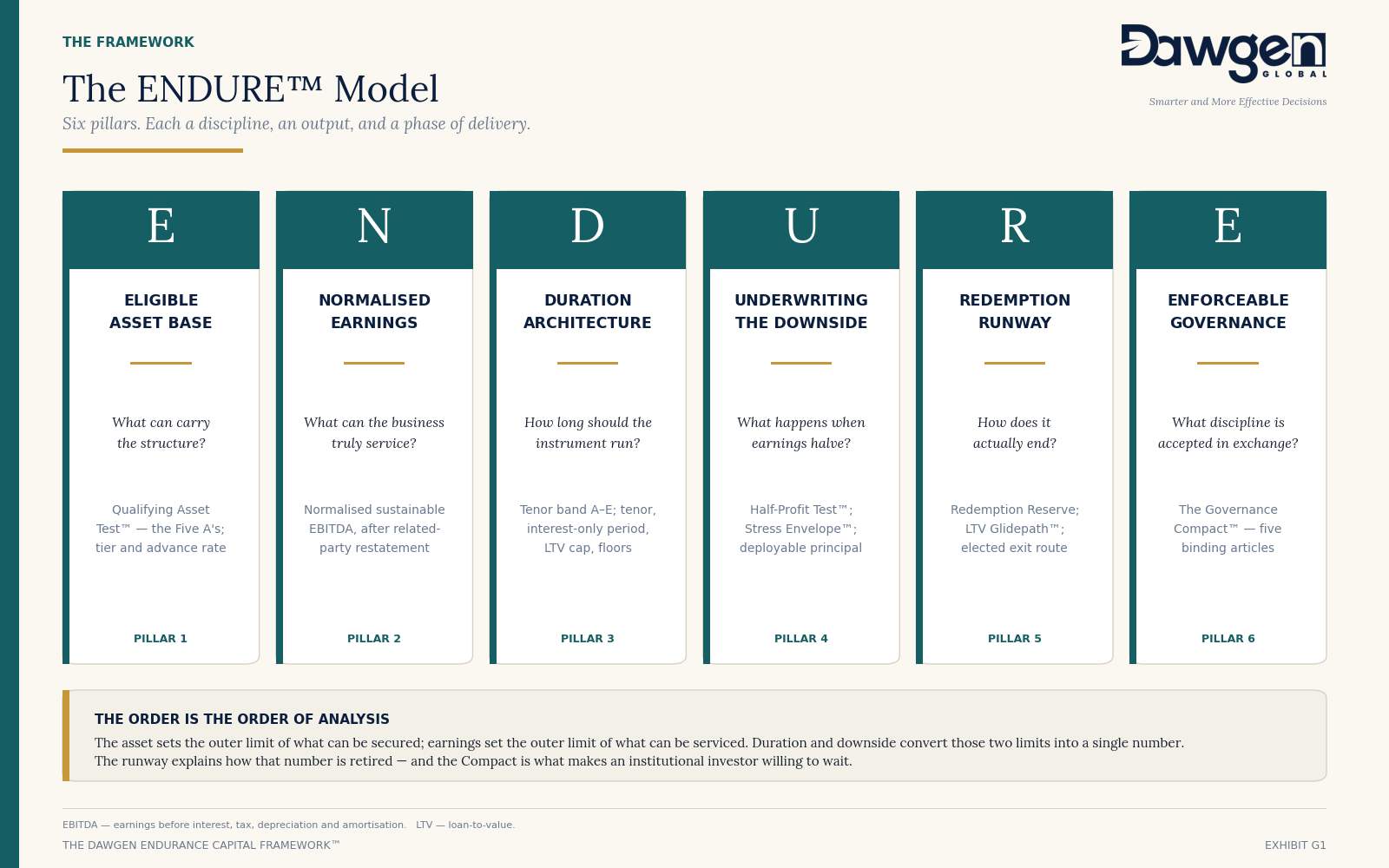
The framework that produces this is organised as six pillars, under the acronym ENDURE: the eligible asset base, normalised earnings capacity, duration architecture, underwriting the downside, the redemption runway, and an enforceable governance compact.
Every coverage ratio in the framework is expressed against normalised sustainable earnings, and nothing else. Get that figure wrong and every number downstream is wrong with it — the tenor band, the sizing, the stress results and the covenant thresholds all rest on it. It is the single most consequential figure in the whole exercise, and in an owner-managed company it is never simply lifted off the accounts.
Why reported earnings are not capacity
Financial statements are prepared to a standard, for a purpose, and they do that job well. The purpose is to report faithfully what occurred. Capacity assessment asks something else: what would recur, sustainably, under an ownership arrangement that a third party could step into.
The distinction matters because a great many payments in an owner-managed company are simultaneously genuine costs and discretionary allocations. The founder’s salary is a real payment, properly recorded, fully deductible — and also a number he chose. The rent to the family partnership is a real obligation under a real lease — and also a rate the family set on both sides of the table. Neither is improper. Both are facts about the ownership arrangement rather than facts about the business.
A buyer of the business would not inherit those payments. Nor would a lender relying on the business to service an instrument for fifteen years. Both are entitled to ask what the trading operation earns, separately from what its owners have chosen to take out of it.
That is the whole of the normalisation exercise. It is not an attempt to make the numbers look better, and it does not always do so — four of the eight standard adjustments run downward, and in a company with concentrated revenue or heavy maintenance capital expenditure they can dominate. The exercise is an attempt to make the numbers comparable, so that a company can be assessed on the same basis as any other.
The adjustments, in both directions
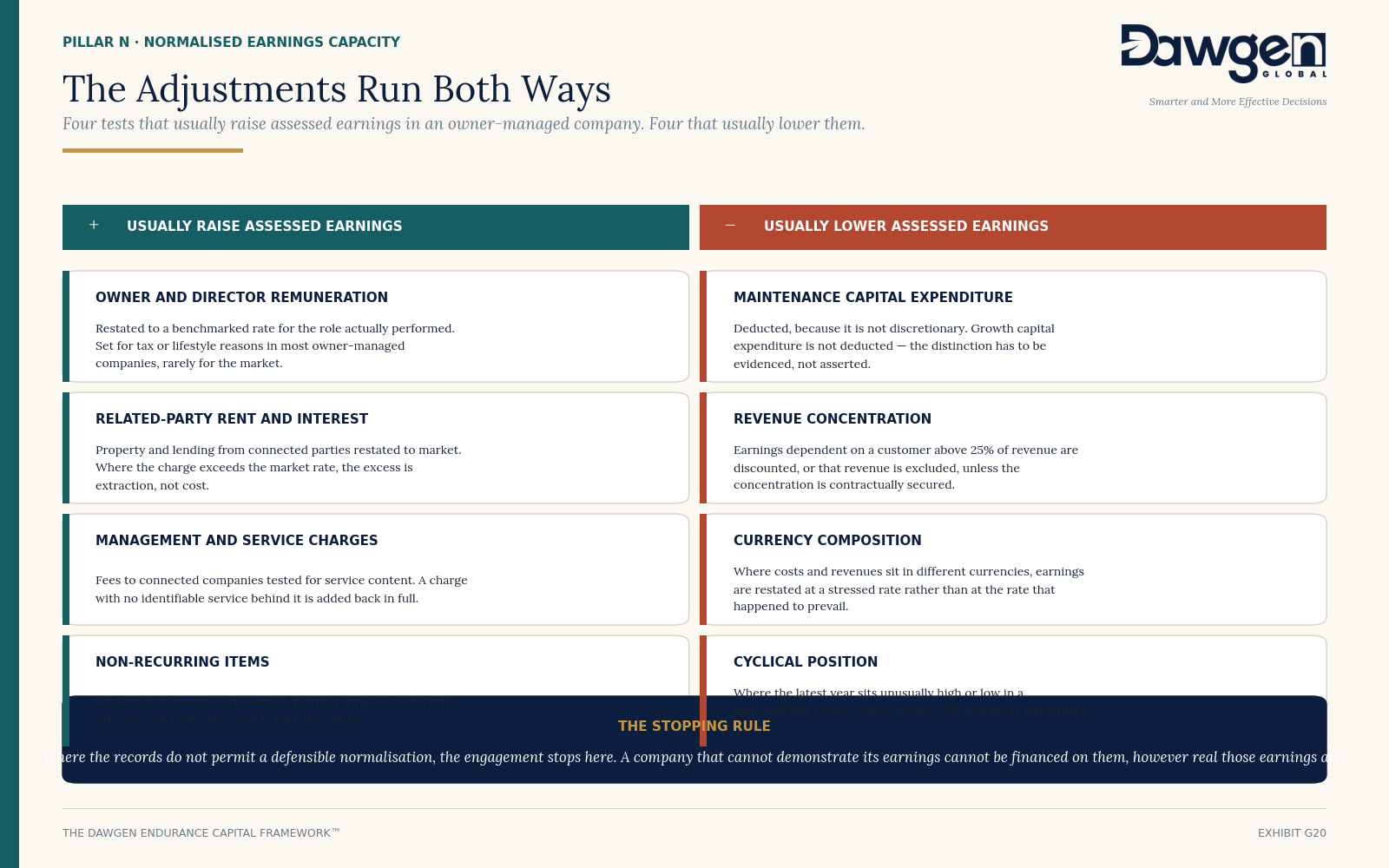
Four tests typically raise assessed earnings in an owner-managed company. Four typically lower them. All eight are applied in every case, and the order is fixed so that the result cannot be shaped by choosing where to stop.
Owner and director remuneration. Restated to a benchmarked rate for the role actually performed — not for the person, and not for the shareholding. Where a founder is genuinely running the operation, the benchmark is what an experienced managing director of a business that size would command, and the adjustment is often small. Where a founder has stepped back and drawn the same amount, the adjustment is large. Where several family members are on payroll in roles that would not otherwise exist, the adjustment is larger still, and it is usually the most uncomfortable conversation in the engagement.
Related-party rent and interest. Property let to the company by a connected partnership, and lending advanced by the family, restated to market. Where the charge exceeds the market rate, the excess is extraction rather than cost and is added back. Where it sits below market — which happens, particularly with rent — the adjustment runs the other way and reduces assessed earnings, because a lender cannot rely on a below-market arrangement continuing for fifteen years.
Management and service charges. Fees to connected companies are tested for service content. Where an identifiable service is provided by identifiable people, the charge stands at a benchmarked rate. Where the charge has no service behind it, it is added back in full. This is the adjustment most likely to be disputed and the easiest to settle, because the evidence either exists or it does not.
Non-recurring items. Settlements, insurance recoveries, restructuring costs, disposal gains and losses, and the effects of one-off events are removed in both directions. The test is not whether an item was unusual but whether it will recur.
Then the four that run the other way.
Maintenance capital expenditure. Deducted, because it is not discretionary. A company that must spend to stand still has less capacity than its earnings before that spending suggest. The distinction between maintenance and growth capital expenditure has to be evidenced rather than asserted, and where it cannot be, the whole of the spend is treated as maintenance.
Revenue concentration. Earnings dependent on a single customer above a quarter of revenue are discounted, or that revenue is excluded from the base, unless the concentration is secured by a contract of appropriate tenure. This is the adjustment that most often decides whether a company is financeable at all, and it is rarely the one owners anticipate.
Currency composition. Where costs sit in United States dollars and revenues do not, or the reverse, earnings are restated at a stressed rate rather than at the rate that happened to prevail at the year end. A company whose margin depends on the exchange rate holding is a company whose margin is an exchange rate position.
Cyclical position. Where the most recent year sits unusually high or low within a demonstrable cycle, a three-to-five year average is substituted. The burden here runs against optimism: a good year is presumed to be a good year until a cycle is demonstrated.
The bridge, worked
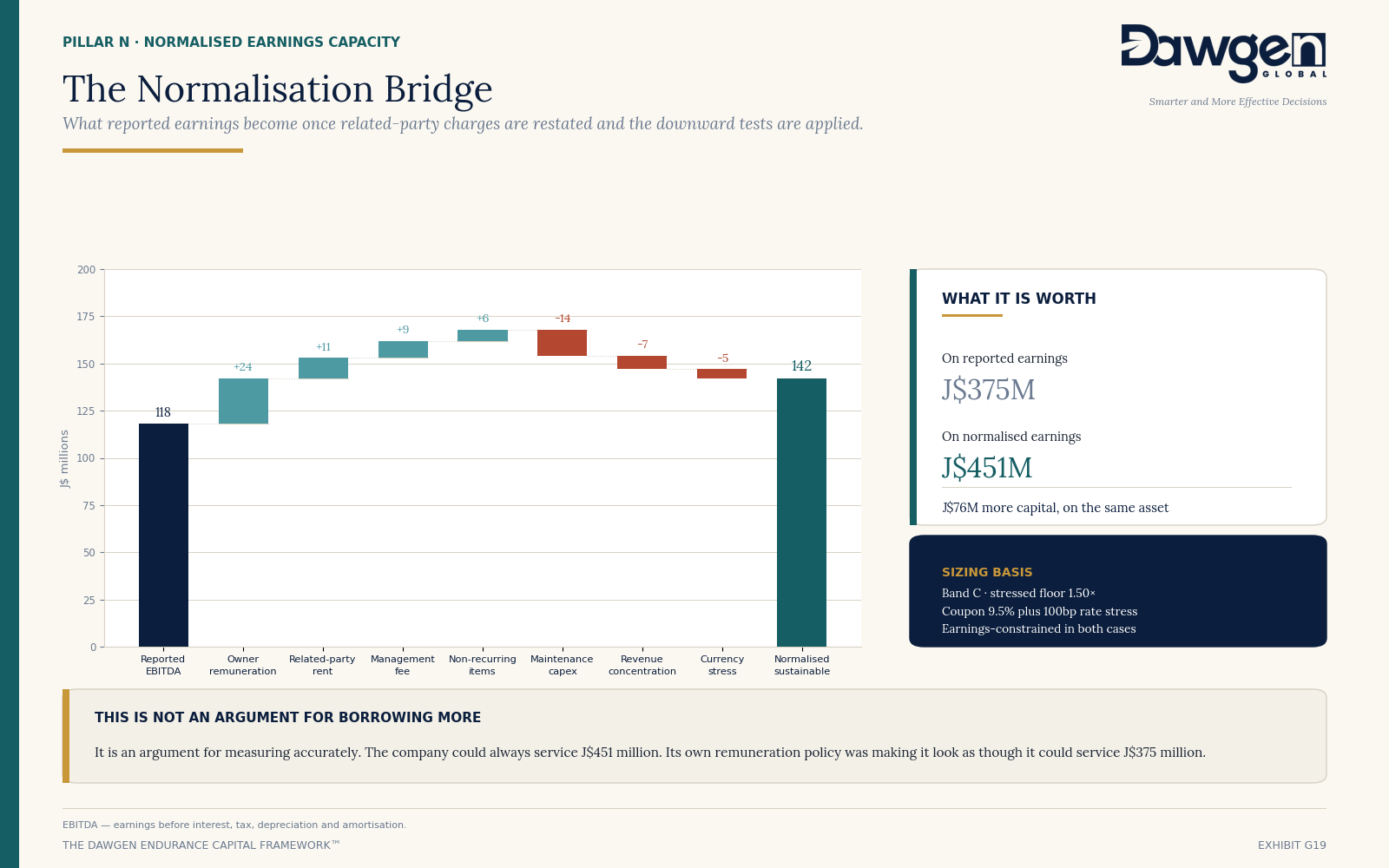
The composite company reports earnings before interest, tax, depreciation and amortisation of one hundred and eighteen million dollars. The upward adjustments come to fifty million: twenty-four on owner remuneration, where the founder draws roughly twice the benchmarked rate for the role; eleven on rent to a family partnership charging about double the market rate for the premises; nine on a management fee with no identifiable service behind it; and six for a non-recurring legal settlement.
The downward adjustments come to twenty-six million: fourteen for maintenance capital expenditure, seven for a customer representing thirty-one per cent of revenue on no contract of any length, and five for a cost base partly denominated in United States dollars against wholly local revenue.
Normalised sustainable earnings are one hundred and forty-two million dollars — twenty per cent above the reported figure.
| What that is worth in capital
Sized on the reported figure, against a Band C stressed floor of 1.50 times and a coupon of 9.5 per cent with a 100 basis point rate stress, the company supports J$375 million. Sized on the normalised figure, it supports J$451 million — seventy-six million more, secured on exactly the same asset, with no change whatever to the business. |
The company could always service four hundred and fifty-one million. Its own remuneration policy was making it look as though it could service three hundred and seventy-five.
This is not an argument for borrowing more. It is an argument for measuring accurately, and then deciding. An owner who learns that his capacity is a fifth larger than he believed may reasonably conclude that he still does not want to use it. What he should not do is discover the figure from a lender who has computed it and not told him.
The question every owner asks next

The reaction is consistent, and it arrives within about a minute: does restating my remuneration mean I have been paying myself wrongly, and does this create a tax problem?
Two things need separating, because they are genuinely different and conflating them causes unnecessary alarm.
The normalisation itself is analytical, not a restatement. Nothing is re-filed. No return is amended. The exercise produces a schedule showing what earnings would be on an arm’s length basis, for the purpose of assessing debt capacity, and it sits alongside the statutory accounts rather than replacing them. The accounts continue to report what was actually paid, because that is what they are for.
But the exercise can surface an exposure that already existed. Where related-party charges are materially away from market, there may be a transfer pricing or deductibility question that was there before anybody thought about raising capital, and would have been there whether or not they did. The normalisation does not create that exposure. It finds it.
That is uncomfortable, and it is also the argument for doing the exercise early and privately rather than late and in front of a counterparty. An exposure identified in your own boardroom can be assessed, quantified and where necessary corrected on a considered timetable. The same exposure identified during diligence becomes a price adjustment, a delay, or a withdrawal.
| A boundary worth stating
Whether any particular related-party arrangement is defensible for tax purposes is a question of tax law and of the facts of the arrangement. It is not settled by the normalisation schedule, and this article does not attempt to settle it. What the framework does is identify where the arrangements sit relative to market, so that the question can be asked of the right adviser at a time of the company’s choosing. |
Where the exercise stops
There is a case in which none of the above can be done, and the framework is explicit about it because the alternative is worse for everybody.
Where the quality of the underlying records does not permit a defensible normalisation, the engagement stops at this pillar. A company that cannot demonstrate its earnings cannot be financed on them, however real those earnings are.
The commonest version is not fraud and not incompetence. It is a company where payments to connected parties are posted across a dozen expense lines with nothing identifying them as related, where the distinction between maintenance and growth capital expenditure was never recorded because nobody needed it, and where management accounts are produced twice a year rather than monthly. The earnings are real. The evidence is not assembled.
That company is not turned away. It is referred to a reporting remediation, which is a matter of months rather than years, and which is worth doing on its own terms. But it does not proceed to structuring in the meantime, because a capacity figure that cannot be defended in year seven is worse than no figure at all — it is a covenant nobody can test.
What to do before anyone asks
Benchmark your own role, honestly. What would it cost to hire someone to do what you actually do now — not what you did ten years ago? For most founders the honest answer is uncomfortable in one direction or the other, and both directions are useful to know.
Get the related-party arrangements onto a market footing, or know the gap. A market rent supported by a valuer’s letter, a management agreement with identifiable service content, and a loan on documented commercial terms cost very little to put in place and remove the largest single source of adjustment. Where that is not practical, at least quantify the gap, so it is not discovered by somebody else.
Separate maintenance from growth capital expenditure in the ledger. A single additional code, applied prospectively, converts an argument into a fact. It costs nothing and it is worth several million dollars of assessed capacity in most companies of any size.
Flag related parties in the chart of accounts. The same flag that makes the extraction covenant computable makes the normalisation computable. It is the highest-return piece of financial housekeeping available to an owner-managed company, and it takes an afternoon.
None of this requires a transaction, an adviser or a decision to raise capital. All of it improves the quality of what the board sees, whether or not the company ever issues a long-dated instrument.
Where to start
- Take last year’s earnings before interest, tax, depreciation and amortisation and list every payment made to you, your family and any company or partnership connected to you.
- For each, write down what an unconnected party would have charged. The difference, in either direction, is your adjustment.
- Then apply the four downward tests: maintenance capital expenditure, customer concentration above a quarter of revenue, currency mismatch, and whether last year was a normal year.
- The figure you are left with is the one every ratio in a financing will be measured against. It is also, in most owner-managed companies, the first honest picture of the trading operation the board has seen.
The framework, and the hundred-point Endurance Readiness Score™ that accompanies it, set out the full method — the qualifying asset test, the tenor bands, the sizing rule and the governance compact that conditions the whole structure. But this pillar can be worked through with a spreadsheet and an honest afternoon, and it is the one that most often changes what an owner believes about his own company.
This is the fifth article in the Endurance Capital Series. The first, A Seven-Year Loan Against a Thirty-Year Asset, sets out the framework in full.
| Client acceptance and conflict of interest
Every request for Dawgen Global services is subject to the firm’s standard client acceptance and continuance procedures before any engagement is accepted. Those procedures include an independence assessment and a conflict-of-interest check across the firm and its member practices. Where a conflict is identified that cannot be managed by safeguards, the engagement is declined. |
The Dawgen Endurance Capital Framework™ is proprietary to Dawgen Global. All figures in this article are illustrative and constructed to demonstrate the methodology. They are not drawn from any client engagement and do not represent market pricing. Nothing in this article constitutes tax, legal or investment advice; whether any particular related-party arrangement is defensible for tax purposes depends on the facts and on the law of the relevant jurisdiction.
About Dawgen Global
Dawgen Global is an independent, integrated multidisciplinary professional services firm headquartered at Dawgen Towers, 47-49 Trinidad Terrace, Kingston 5, Jamaica, serving more than 15 territories across the Caribbean. Founded and led by Dr. Dawkins Brown, Executive Chairman, the firm is independent and not affiliated with any international network. It delivers a full suite of professional services under one roof: audit and assurance; tax advisory; IT and digital transformation; risk management; cybersecurity; actuarial and insurance regulatory advisory; HR advisory; mergers and acquisitions; corporate recovery; business advisory and strategy; accounting BPO and virtual CFO services; and legal process outsourcing.
The proposition is simple: big-firm capability without the big-firm price. Dawgen Global’s integrated approach is built for the specific complexities and opportunities of the Caribbean market, helping organizations make sharper, better-informed decisions that drive measurable progress.
To explore a partnership, reach out:
- Website: dawgen.global
- Email: info@dawgen.global
- WhatsApp (Global): +1 555-795-9071
- Caribbean offices: +1 876-929-3670 | +1 876-926-5210


