Executive Summary
An annual cyber assessment is a photograph of a moving object. It is taken with care, framed well, and true at the shutter’s click — and the object keeps moving the moment the photographer leaves. Systems change weekly; vendors change quietly; threats change daily; people join, move and leave every month. Every discipline this series has described — the assurance map, the integrated audit, technical validation, the resilience rehearsal, verified closure — delivers its full value only when it stops being an annual event and becomes an operating rhythm. That rhythm has a name: continuous assurance, and it is the destination the previous ten articles have been walking toward.
This capstone article of the series’ operating model makes the case and shows the mechanics. It explains why the annual model structurally fails a modern environment — the eleven dark months, the decay of evidence, the external audiences who now ask “as of when?” It defines what continuous assurance actually is — an orchestrated set of cadences, not a tool purchase — and lays out the operating calendar in practice: what runs continuously, what runs quarterly, what runs annually, and what is triggered by change. It is candid about economics, honest about the maturity path — no organisation should attempt to run before it walks — and closes with the standing-confidence test: eight questions that reveal whether your organisation’s cyber confidence is a condition or a memory.
The Eleven Dark Months: Why the Annual Model Fails
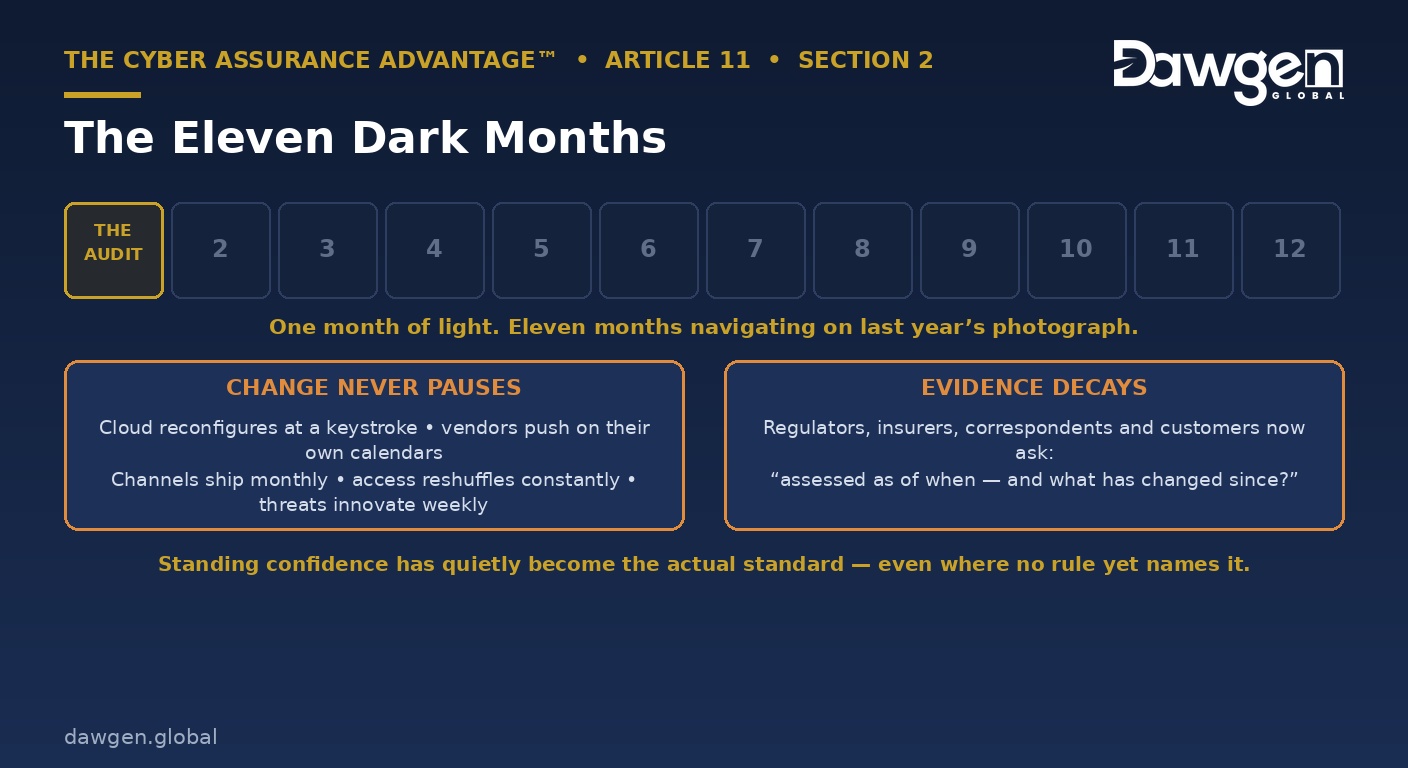
The annual model made sense in the world that built it: systems changed on project timelines, infrastructure lived in one server room, and an assessment’s conclusions could reasonably hold for a year. None of those conditions survives contact with a modern Caribbean organisation. Cloud services reconfigure at a keystroke; providers push changes on their own calendars; digital channels ship features monthly; staff turnover reshuffles access constantly; and the threat landscape — as the ransomware article showed — innovates on a business cycle measured in weeks. Against that velocity, an annual assessment leaves eleven dark months in which the organisation is navigating on last year’s photograph.
The failure has a second face: evidence decay. Article 2 identified time as one of the three boundaries of any assurance artefact, and the external audiences this series has catalogued have learned the same lesson. The correspondent bank’s questionnaire, the insurer’s renewal, the regulator’s examination and the enterprise customer’s due diligence increasingly ask not merely “have you been assessed?” but “as of when — and what has changed since?” An organisation whose freshest independent evidence is ten months old answers those questions from weakness, whatever the assessment said. Standing confidence — evidence that is always reasonably current — has quietly become the actual standard, even where no rule yet names it.
There is a quieter arithmetic problem as well: the annual model is hardest on precisely the findings that matter most. A weakness born the week after the assessment lives unexamined for a year — the longest possible exposure window — while the modest issues found during the engagement receive all the attention. Attackers, who do not consult audit calendars, are statistically far more likely to meet the former than the latter. An assurance model whose blind spot is largest for the newest risks has its telescope pointed backwards.
What Continuous Assurance Actually Is — and Is Not
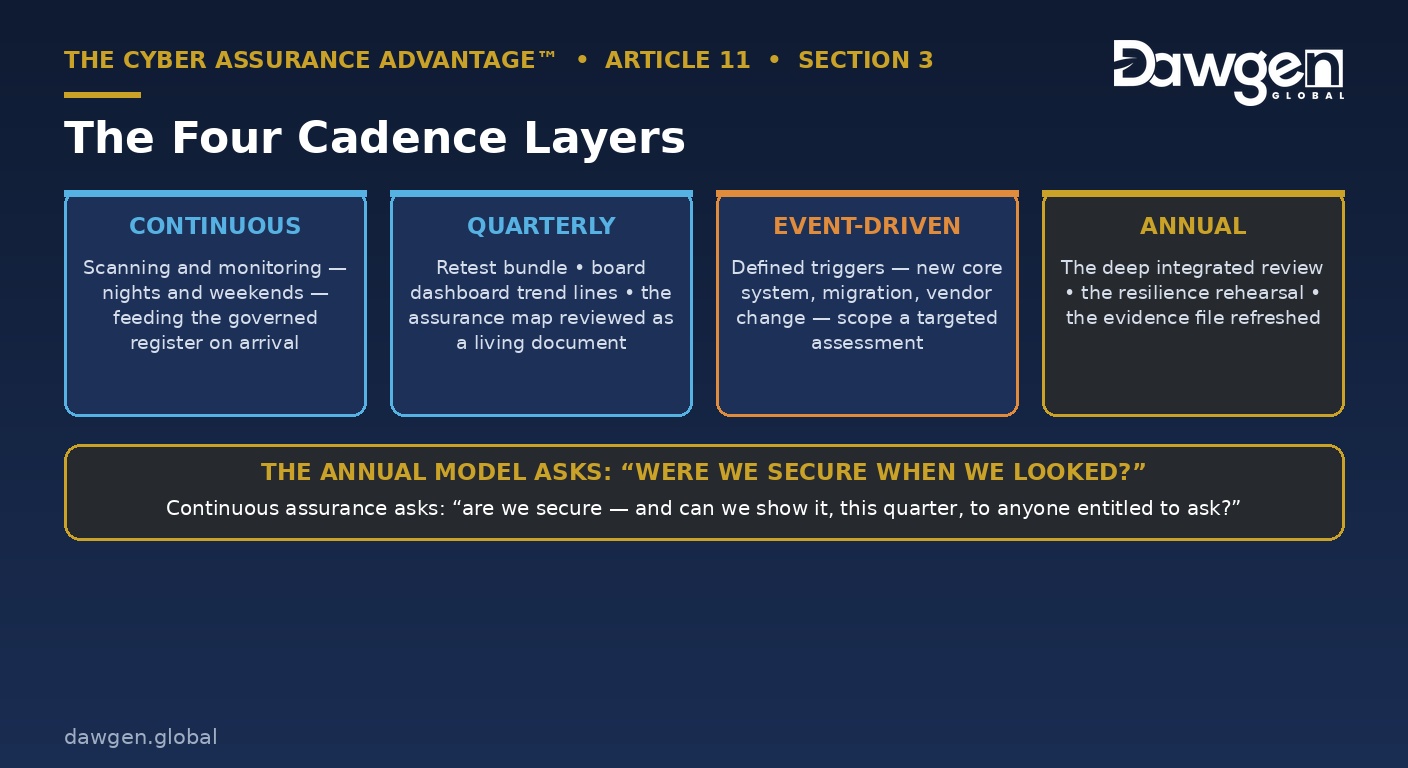
Continuous assurance is not a product, a dashboard subscription or an around-the-clock monitoring contract, though it may use all three. It is an operating programme in which the disciplines of this series run on orchestrated cadences, each at the frequency its subject demands. Four layers do the work. The continuous layer: automated scanning and security monitoring — the hygiene of Article 6 and the quiet-phase detection of Article 7 — feeding findings into the governed register of Article 10 as they arise, not at year-end. The quarterly layer: the retest cycle verifying closures, the board dashboard of Article 3 refreshed with aging, closure and repeat-finding metrics, and the assurance map of Article 2 reviewed as the living document it was always meant to be. The event-driven layer: defined triggers — a new core system, a cloud migration, a major vendor change, a significant incident anywhere in the sector — that automatically scope a targeted assessment, because the attack surface changed and the evidence should change with it. And the annual layer, which does not disappear but sharpens: the deep integrated review of Article 4 aimed at the highest-loss scenario, the resilience rehearsal of Article 7, and the refresh of the evidence file of Article 8.
| THE DEFINING SHIFT
The annual model asks: “were we secure when we looked?” Continuous assurance asks: “are we secure — and can we show it, this quarter, to anyone entitled to ask?” The first is a photograph. The second is a pulse. |
The Operating Rhythm in Practice
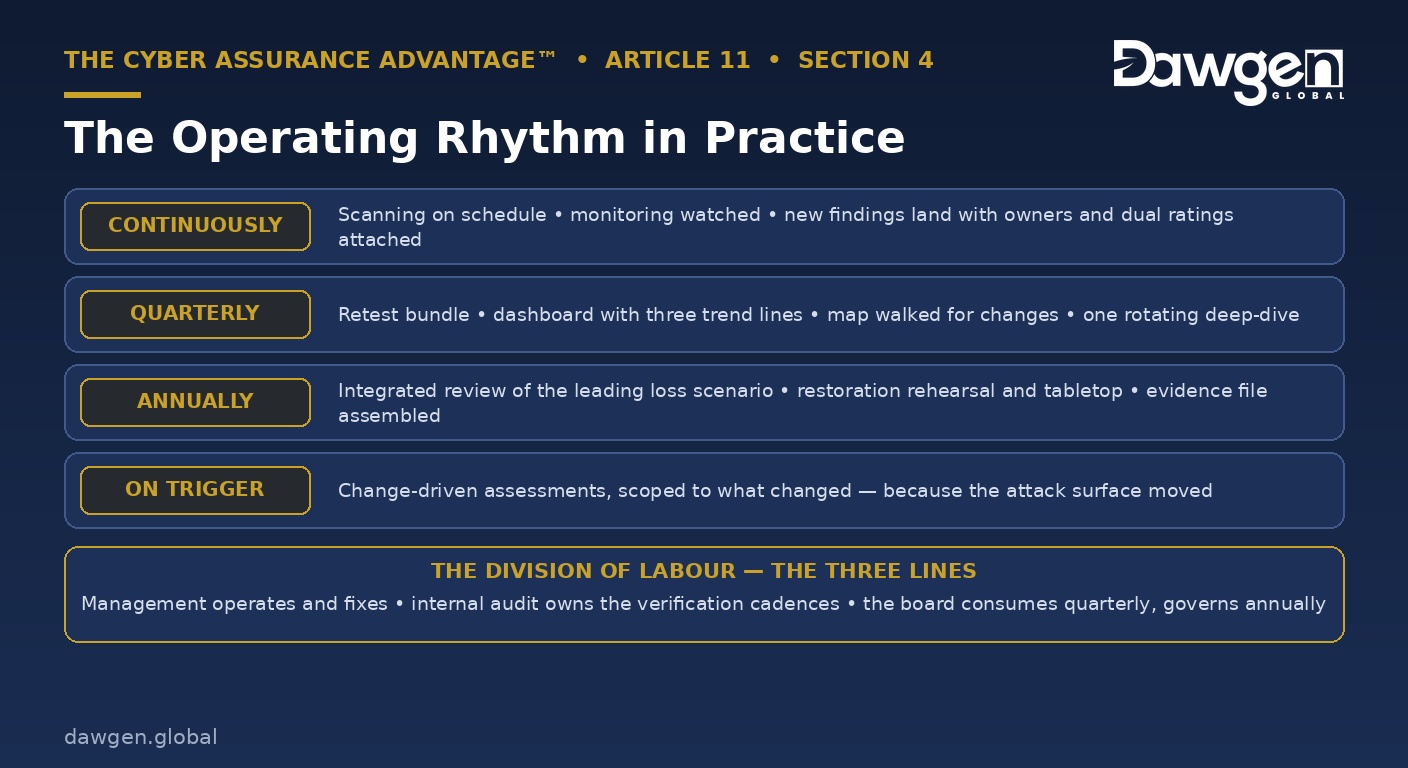
On the calendar, the programme is less exotic than the name suggests. Continuously: scanning runs on schedule, monitoring watches — including nights and weekends — and new findings land in the register with owners and dual ratings attached on arrival. Quarterly: the retest bundle verifies closures; the dashboard goes to the committee with its three trend lines — aging, verified-closure rate, repeat-finding rate; the assurance map is walked for changes; and one rotating deep-dive examines a control domain in depth, so that over a year the estate is covered without an annual big bang. Annually: the integrated review of the leading loss scenario, the restoration rehearsal and tabletop, the Topical Requirement conformance check for the internal audit function, and the assembly of the refreshed evidence file. On trigger: the change-driven assessments, scoped to what changed.
The division of labour follows the three lines this series has used throughout. Management and its providers operate the continuous layer and fix what it finds. Internal audit — in-house or co-sourced under its direction — owns the quarterly verification rhythm and the annual deep review, conformant to the standard of Article 5. The board consumes quarterly and governs annually, exactly as Article 3 prescribed. For most Caribbean organisations the honest resourcing answer is the partnership model of Article 4: the rhythm designed once, run jointly, with specialist depth engaged at the cadences that need it rather than salaried year-round.
What It Costs — and What It Replaces
The candid economics deserve daylight, because “continuous” sounds expensive and usually is not — once the comparison is honest. The episodic model’s true cost is rarely just the annual assessment: it is the assessment plus the emergency engagements when a customer questionnaire lands unanswered, plus the crash remediation after findings accumulate unattended, plus the incident costs that earlier detection would have shrunk, plus the premium loading when insurers price uncertainty. Continuous assurance redistributes much of that spend into a level rhythm — and buys three dividends the episodic model cannot: findings caught while they are small and cheap; evidence that is always current, so every questionnaire, renewal and examination is answered from the standing file rather than by a scramble; and trend lines — the closure and repeat-finding metrics of Article 10 — that let a board see improvement rather than take it on faith.
There is also a scaling truth that favours the region’s realities: cadence can flex where budgets are lean. A smaller organisation might run the continuous layer, a half-year verification cycle and the annual review; a systemic institution runs the full quarterly rhythm with monthly elements. The architecture is the same; only the tempo changes — the calibration principle of Article 9, applied to time.
Crawl, Walk, Run: The Honest Maturity Path
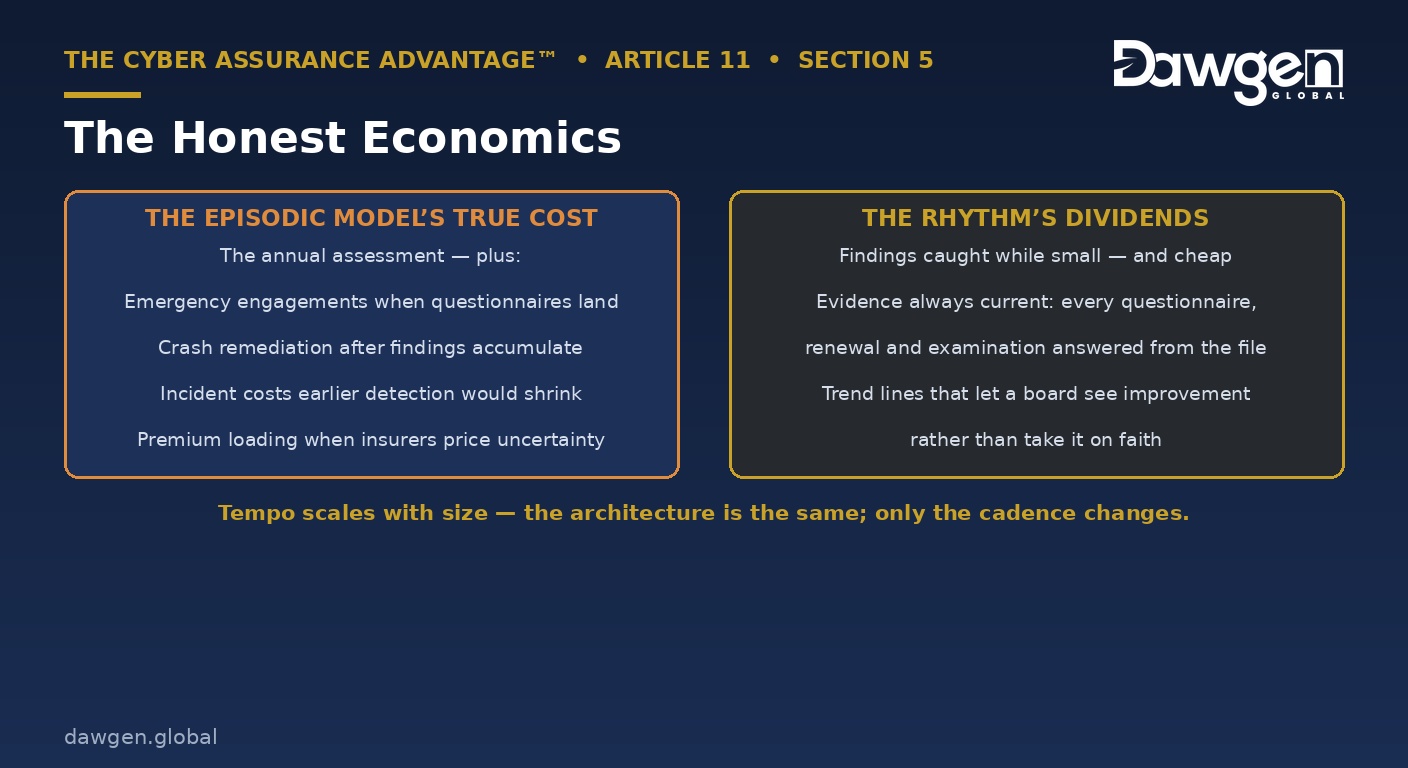
No organisation should attempt continuous assurance as its first act; the rhythm presumes foundations. Year one is the crawl — the foundations this series has specified: the diagnostic and the assurance map, the closure engine of Article 10 with its register and retest discipline, the board dashboard, and one full integrated review. Year two is the walk: the quarterly rhythm instituted — retest bundles, dashboard trend lines, map reviews, the rotating deep-dive — with event triggers defined even if rarely fired. Year three is the run: the continuous layer fully fed into governance, triggers operating in practice, and the evidence file maintained as a standing asset rather than an annual assembly. Organisations that attempt the run first buy tooling that streams findings into an ungoverned void — continuous noise, not continuous assurance. The sequence is the strategy.
The path also pays early. The crawl year is not a waiting room: the register alone typically halves the noise within two quarters by forcing dual ratings onto everything; the first dashboard usually prompts the board’s most productive cyber conversation to date; and the evidence-dating exercise below has a way of unlocking budget faster than any strategy paper, because nothing argues for a rhythm like discovering that the freshest independent evidence in the building predates the last two system changes.
Starting the Shift: Five Steps This Quarter
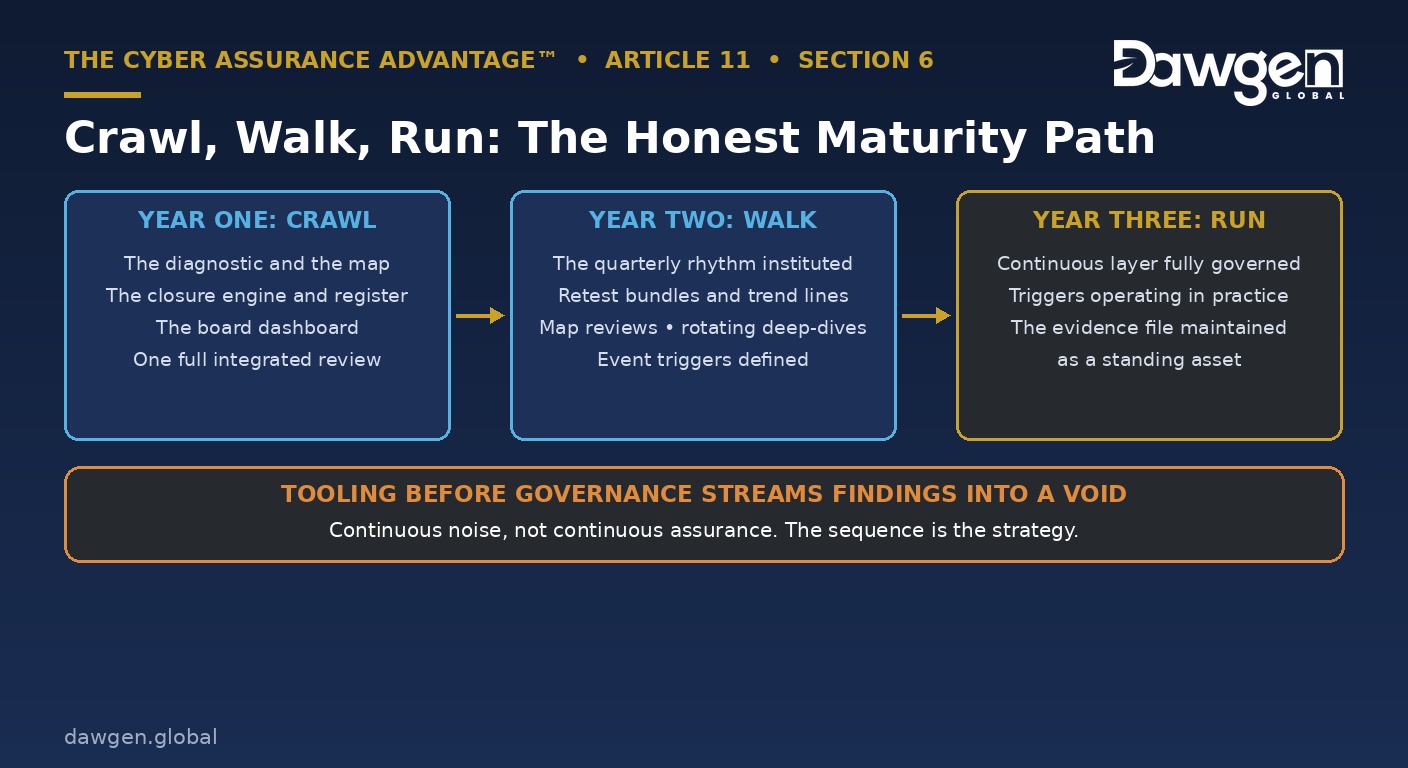
- Date your evidence. List every piece of independent cyber evidence the organisation holds and its age. The exercise takes an afternoon and usually settles the argument by itself.
- Stand up the register and the dashboard. The closure engine of Article 10 and the three trend lines — the governance chassis every later cadence bolts onto.
- Set the quarterly rhythm on the calendar now. Retest bundle, dashboard, map review — dated for the next four quarters, with owners, before enthusiasm fades.
- Define the event triggers. The five or six changes that will automatically scope an assessment — agreed with the board, written down, assigned.
- Design the target rhythm with a partner. Crawl-walk-run mapped to your size, sector and budget — so each year’s spend builds the next year’s capability instead of repeating last year’s photograph.
The Dawgen Global Perspective
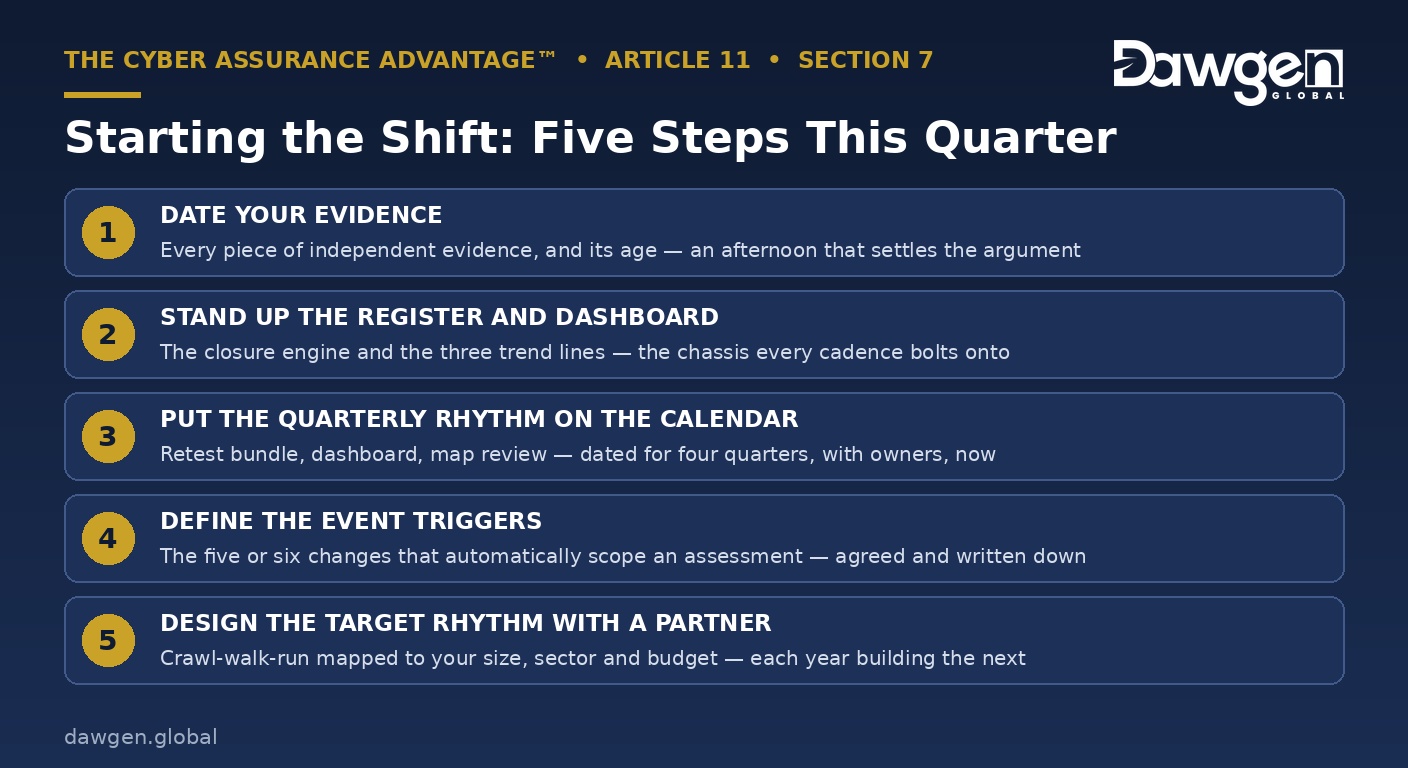
Dawgen Global’s conviction, after everything this series has argued, is that continuous assurance is simply what taking the first ten articles seriously looks like in practice. A board that has adopted Know–Ask–Verify cannot verify from a ten-month-old photograph. An assurance map is only a map while it is current. A closure engine only compounds if it runs on a rhythm. The firm’s continuous assurance programmes are built as partnerships on exactly the architecture described here — the four cadence layers, designed once and operated jointly, calibrated by sector and scaled by tempo, with the standing evidence file as the deliverable that answers every regulator, correspondent, insurer and customer from strength.
One article remains in this series’ launch arc. It brings the whole framework home to the question every reader has been entitled to ask since Article 1: where, precisely, does an organisation begin — and what should the first ninety days look like? The final article answers it with the complete roadmap.
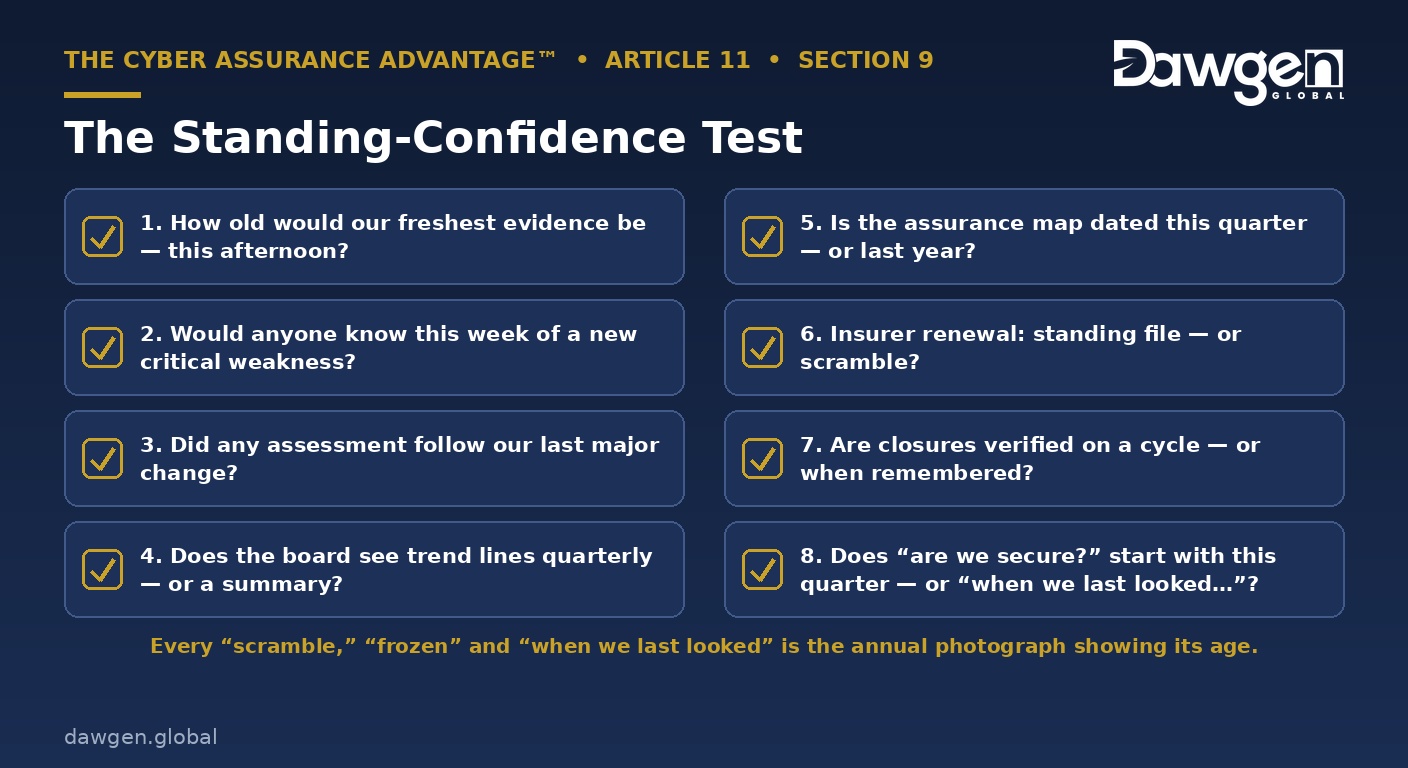
The Standing-Confidence Test: Eight Questions
- If your largest customer requested current security evidence this afternoon, how old would your freshest independent evidence be?
- Would anyone in your organisation know, this week, if a critical new weakness appeared on an internet-facing system?
- When a major system or vendor changed in the past year, did any assessment follow — or did the evidence stay frozen?
- Does your board see closure and repeat-finding trend lines quarterly — or an annual summary?
- Is your assurance map a living document with a last-reviewed date this quarter — or an artefact of the last assessment?
- Could your insurer’s renewal questionnaire be answered from a standing file — or would it trigger a scramble?
- Are closures verified on a scheduled cycle — or when someone remembers?
- If asked “are you secure?”, does your honest answer begin with evidence from this quarter — or with “when we last looked…”?
Every “scramble,” “frozen” and “when we last looked” is the annual photograph showing its age — and each converts to standing confidence with the rhythm this article describes.
Frequently Asked Questions
Is continuous assurance just another name for a SOC or managed detection service?
No — monitoring is one input to the continuous layer, not the programme. A SOC watches for attacks; continuous assurance governs whether controls are designed, operating, tested, remediated and evidenced — on cadences a board can rely on. An organisation can have excellent monitoring and no assurance at all.
Can a mid-sized Caribbean organisation genuinely afford this?
Tempo scales with size: the architecture is identical whether the verification cycle runs quarterly or half-yearly. Counted honestly — against emergency engagements, crash remediation, questionnaire scrambles and incident exposure — the level rhythm is frequently comparable in cost and superior in every outcome that matters.
Does continuous assurance replace the annual deep assessment?
It repositions it. The annual integrated review remains the programme’s deepest act — aimed at the leading loss scenario, feeding the refreshed evidence file — but it stops pretending to carry the whole year alone. The photograph still gets taken; it is simply no longer the only time anyone looks.
Where does internal audit fit in a continuous model?
At the centre: the function — in-house or co-sourced under its direction — owns the verification cadences, conformant to the Topical Requirement of Article 5, and reports the trend lines to the committee. Continuous assurance does not bypass internal audit; it is the most complete expression of its mandate this series has described.
Move From Cybersecurity Assumptions to Independent Cyber Assurance
Dawgen Global combines cyber governance, risk-based internal audit, penetration testing, resilience assessment and remediation validation to help Caribbean organisations determine whether their cybersecurity controls are properly designed and operating effectively. To design the operating rhythm that fits your organisation’s size, sector and tempo — and to date your evidence honestly as the first step — request a confidential continuous assurance design discussion.
About Dawgen Global
Dawgen Global is an independent, integrated multidisciplinary professional services firm headquartered at 47 Trinidad Terrace, New Kingston, Jamaica, serving more than 15 territories across the Caribbean. Founded and led by Dr. Dawkins Brown, Executive Chairman, the firm is independent and not affiliated with any international network. It delivers a full suite of professional services under one roof: audit and assurance; tax advisory; IT and digital transformation; risk management; cybersecurity; actuarial and insurance regulatory advisory; HR advisory; mergers and acquisitions; corporate recovery; business advisory and strategy; accounting BPO and virtual CFO services; and legal process outsourcing.
The proposition is simple: big-firm capability without the big-firm price. Dawgen Global’s integrated approach is built for the specific complexities and opportunities of the Caribbean market, helping organizations make sharper, better-informed decisions that drive measurable progress.
To explore a partnership, reach out:
- Website: dawgen.global
- Email: [email protected]
- WhatsApp (Global): +1 555-795-9071
- Caribbean offices: +1 876-665-5926 | +1 876-929-3670 | +1 876-926-5210


