Why high-impact sectors need stronger controls before AI becomes operational risk
EXECUTIVE SUMMARY
Artificial intelligence is entering the sectors where trust matters most — banking, insurance, government, healthcare, and critical infrastructure. These industries share one defining feature: their decisions directly affect people, markets, critical services, public trust, and national resilience, which is why AI governance in regulated environments must be stronger, more structured, and more evidence-based than in ordinary productivity use cases. This article — the seventh in Dawgen Global’s AI Governance & Assurance Series — marks the point where the series turns from disciplines to sectors. It applies the controls built across the first six articles to the four sector groups where failure costs the most, sets out ten common control expectations for all regulated organizations, and closes with a practical roadmap and the one question each sector’s board should ask this quarter. The more consequential the decision, the stronger the governance must be.
AI is entering the sectors where trust matters most
Financial institutions are using AI for fraud detection, credit analysis, customer engagement, compliance monitoring, treasury support, investment research, and operational automation. Public sector bodies are exploring AI to improve service delivery, document processing, citizen engagement, tax administration, procurement, and regulatory oversight. Healthcare providers are considering AI for patient administration, diagnostics support, scheduling, medical documentation, claims review, and resource planning. Utilities are assessing AI for asset management, outage prediction, customer service, billing analysis, and operational resilience.
These sectors have one thing in common: their decisions can directly affect people, markets, critical services, public trust, regulatory compliance, and national resilience.
This is why AI governance in regulated industries must be stronger, more structured, and more evidence-based than in ordinary low-risk productivity use cases.
This article is the seventh in our AI Governance & Assurance Series — and it marks a turn. The first six articles built the disciplines: converged cyber-AI controls, agent guardrails, independent assurance, continuous validation, evidence trails, and third-party AI risk. This article applies those disciplines where the stakes are highest. In regulated industries, the disciplines are not best practice. They are the licence to operate.
AI risk is amplified in regulated environments
AI risk is not uniform. A generative AI tool used to draft an internal memo is not the same as an AI model used to assess creditworthiness, prioritize healthcare cases, monitor suspicious transactions, allocate public benefits, detect utility faults, or support regulatory filings.
In regulated industries, AI failures may create serious consequences:
- Incorrect customer decisions; unfair or biased outcomes
- Data privacy breaches and cybersecurity incidents
- Regulatory non-compliance and consumer protection failures
- Weak audit trails and financial misstatement
- Operational disruption and public confidence damage
- Legal exposure and reputational harm
For this reason, regulated organizations cannot treat AI adoption as a purely digital transformation initiative. AI must be integrated into the enterprise risk management, internal control, compliance, cybersecurity, data governance, privacy, and assurance framework.
The governance question has changed
Many organizations initially ask: “How can AI improve efficiency?” Regulated organizations must also ask:
- Can the AI system be explained, and can its output be validated?
- Can management evidence how decisions are made?
- Can customers, regulators, auditors, and boards understand the control framework?
- Can the organization prevent unauthorized data exposure?
- Can human oversight intervene before harm occurs?
- Can the AI system be monitored continuously?
- Can the organization respond quickly if the AI system fails?
These questions are not theoretical. They determine whether AI adoption is defensible.
Financial services: AI governance as a risk and compliance imperative
Financial services institutions face some of the most immediate AI governance challenges because AI can influence lending, fraud detection, anti-money laundering monitoring, customer communication, investment analysis, insurance underwriting, operational resilience, and financial reporting.
Key risks include model bias, inaccurate risk scoring, customer harm, weak explainability, data leakage, cyberattack, regulatory breach, and overreliance on automated recommendations.
Financial institutions should therefore establish strong controls around:
- AI model governance; credit and lending decision oversight
- Customer fairness and conduct risk; fraud and AML model validation
- Cybersecurity monitoring; data privacy and confidentiality
- Third-party AI vendor risk; audit logging and evidence trails
- Human review of high-impact decisions; board and risk committee reporting
For financial institutions, AI governance should not sit outside the risk management framework. It should connect directly to operational risk, model risk management, compliance, internal audit, cybersecurity, and enterprise governance.
Across the Caribbean, the supervisory direction is unmistakable: regional central banks and financial services commissions are sharpening expectations around technology risk, cyber resilience, outsourcing, and operational continuity — and AI-enabled models will increasingly fall within that perimeter. For insurers in particular, AI in underwriting, pricing, and reserving raises model-validation questions where actuarial and governance disciplines meet — an area where Dawgen Global’s Actuarial & Insurance Regulatory Advisory Division works alongside our AI assurance team.
Public sector: AI governance as a trust and accountability issue
The public sector has a unique obligation to protect fairness, transparency, due process, and public confidence. AI may help government agencies improve speed, efficiency, citizen service, tax administration, document processing, procurement, policy analysis, and regulatory supervision. However, public sector AI also carries heightened accountability risks.
When government uses AI, citizens must be protected from opaque, unfair, inaccurate, or poorly governed automated processes.
Key public sector AI governance priorities include:
- Clear accountability for AI-assisted decisions; transparency over AI use in public services
- Protection of citizen data; bias and fairness testing
- Human review of consequential decisions; procurement controls for AI vendors
- Cybersecurity and resilience controls; auditability of AI-supported decisions
- Legal and regulatory compliance; public communication and trust management
Public sector organizations should be especially careful where AI affects eligibility, enforcement, licensing, benefits, tax matters, citizen records, policing support, procurement decisions, or regulatory outcomes.
In Jamaica, the accountability architecture already exists: the Data Protection Act binds public authorities processing citizen data, and public bodies carry audit-committee and accountability obligations under the Public Bodies Management and Accountability Act. AI-assisted decisions will be examined through both lenses. In government, AI governance is not only about efficiency. It is about legitimacy.
Healthcare: AI governance as a patient safety and privacy requirement
Healthcare organizations handle highly sensitive data and make decisions that may affect patient safety, treatment pathways, care quality, resource allocation, insurance claims, and clinical administration.
AI can support healthcare transformation, but unmanaged AI risk can lead to inaccurate outputs, privacy breaches, biased recommendations, overreliance by staff, weak documentation, and patient harm.
Healthcare AI governance should focus on:
- Patient data protection; clinical validation of AI-supported outputs
- Human oversight by qualified professionals; clear limits on AI use in clinical decisions
- Vendor and platform due diligence; cybersecurity of connected systems
- Documentation and evidence trails; bias testing and patient fairness
- Incident response for AI-related harm; board and clinical governance reporting
The regional data protection dimension is acute here: health information is sensitive personal data under Jamaica’s Data Protection Act, attracting the highest standard of care — an AI tool that processes patient records is operating in the most protected category the law recognizes.
Healthcare organizations should be clear that AI supports professional judgment; it does not replace professional accountability.
Utilities and critical infrastructure: AI governance as resilience protection
Utilities and critical infrastructure providers are increasingly exploring AI for predictive maintenance, demand forecasting, outage management, billing analytics, customer service, asset monitoring, cybersecurity, and operational optimization.
These use cases may affect service continuity, public safety, customer billing, infrastructure reliability, and national resilience.
AI governance for utilities should therefore prioritize:
- Operational resilience; cybersecurity of AI-connected systems
- Data integrity from sensors and operational technology
- Model reliability for forecasting and asset management
- Human approval for high-impact operational actions
- Vendor and cloud platform risk management; incident response and continuity planning
- Audit trails for AI-supported operational decisions; regulatory reporting controls
- Board-level oversight of AI-enabled infrastructure risk
In the Caribbean, this is not an abstract discipline. In a region exposed to hurricanes and extreme weather, AI-supported outage prediction, asset management, and demand forecasting are national-resilience functions — and a model that drifts quietly during the year is discovered loudly in a storm. For critical services, AI errors can scale quickly. Governance must therefore be designed around safety, continuity, and rapid containment.
Common control expectations across regulated sectors
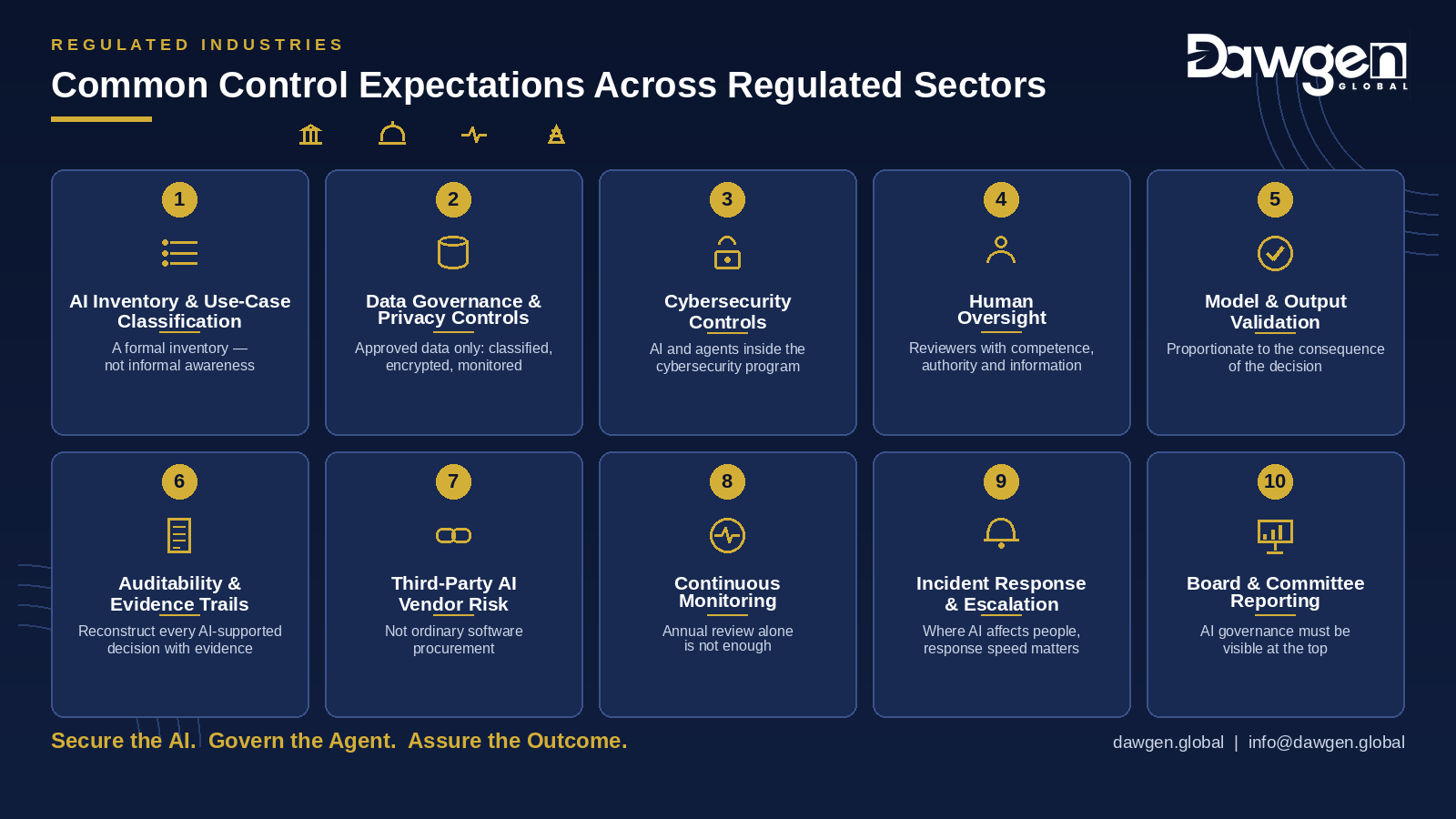
Although each regulated industry has specific requirements, several AI control expectations are common across all high-impact sectors — and each connects to a discipline established earlier in this series.
1. AI inventory and use-case classification
Organizations must know where AI is being used. Each AI use case should be documented, owned, classified by risk level, and reviewed periodically. A regulated organization cannot govern AI through informal awareness. It needs a formal inventory.
2. Data governance and privacy controls
AI systems should only use approved data sources. Sensitive personal, customer, patient, financial, operational, legal, and confidential data must be protected through classification, access controls, retention rules, encryption, and monitoring.
3. Cybersecurity controls
AI systems and agents must be included in the cybersecurity program. This includes identity management, access controls, API security, prompt injection protection, monitoring, vulnerability management, incident response, and third-party security review. Where autonomous agents operate in regulated processes, the guardrail disciplines of Dawgen Global’s D-AGENTICA™ methodology apply with particular force.
4. Human oversight
High-impact AI decisions should include meaningful human oversight. Reviewers must have the competence, authority, and information required to challenge AI outputs. Human oversight should not be a ceremonial approval step.
5. Model and output validation
AI outputs should be tested before and after deployment. Regulated organizations should monitor accuracy, drift, bias, reliability, completeness, and consistency. Validation should be proportionate to the consequence of the decision.
6. Auditability and evidence trails
Organizations must be able to reconstruct AI-supported decisions. Evidence should capture inputs, prompts, data sources, system versions, outputs, reviews, approvals, exceptions, and final actions — the ten components of the AI evidence trail framework we set out in article five. Without auditability, regulated organizations may struggle to satisfy regulators, auditors, customers, citizens, patients, or courts.
7. Third-party AI vendor risk management
AI vendors should be assessed for security, privacy, transparency, resilience, data use, subcontractors, model updates, incident reporting, audit rights, and contractual accountability — the ten dimensions of the third-party AI risk framework in article six. Vendor AI risk cannot be treated as ordinary software procurement.
8. Continuous monitoring
AI risk changes over time. Regulated organizations need ongoing monitoring of performance, security events, access rights, data exposure, output quality, exceptions, and incidents — the living-control philosophy of Dawgen Global’s TRUST360™ approach. Annual review alone is not enough.
9. Incident response and escalation
Organizations should define AI incidents, escalation thresholds, containment procedures, communication protocols, legal review, evidence preservation, and remediation steps. Where AI can affect customers, citizens, patients, financial markets, or critical services, response speed matters.
10. Board and committee reporting
Boards, audit committees, risk committees, technology committees, and executive management should receive regular reporting on AI adoption, risk, controls, incidents, regulatory exposure, and assurance findings. AI governance must be visible at the top.
The role of internal audit and independent assurance
Internal audit has a major role to play in regulated AI environments. It should evaluate whether AI governance arrangements are designed effectively and operating as intended.
However, AI assurance often requires multidisciplinary expertise. Internal audit may need support from IT audit, cybersecurity, data protection, legal, compliance, actuarial, risk advisory, sector specialists, and external assurance providers — a co-sourced model that pairs the in-house team with specialist skills.
A strong AI assurance review should assess governance and accountability, AI inventory completeness, risk classification methodology, policy compliance, cybersecurity controls, data governance and privacy, vendor risk management, model and output validation, human oversight, auditability and evidence trails, incident response readiness, and board reporting.
Independent assurance gives boards and regulators confidence that AI adoption is not creating uncontrolled exposure.
Sector-specific AI governance roadmap
Dawgen Global recommends a practical roadmap for regulated organizations. First, identify all AI use cases, including informal generative AI use and vendor-embedded AI. Second, classify each use case based on impact, data sensitivity, regulatory exposure, autonomy, and potential harm. Third, design a control framework proportionate to the risk. Fourth, implement monitoring, audit trails, human review, and cybersecurity controls. Fifth, provide board-level reporting and independent assurance.
This roadmap allows organizations to move from fragmented AI adoption to controlled AI transformation.
One question per sector
If your board asks nothing else about AI this quarter, ask the question that fits your sector:
- Banks and credit unions: Can we evidence to our regulator how every AI-influenced credit, AML, or fraud decision was made?
- Insurers: Have our AI-supported underwriting, pricing, and reserving models been independently validated — actuarially and for governance?
- Public bodies: If a citizen challenges an AI-assisted decision, can we reconstruct it and show it was fair, lawful, and human-reviewed?
- Healthcare providers: Does every AI tool touching patient data or care decisions have clinical validation and qualified human oversight?
- Utilities: If our AI-driven forecasting or outage models fail during a crisis, how quickly would we know — and who takes over?
If management cannot answer with evidence, the sector-specific governance gap is now visible — and addressable.
Why early action matters
The organizations that act early will have a significant advantage. They will be able to innovate with greater confidence, satisfy regulatory expectations, protect stakeholders, and scale AI responsibly.
Organizations that delay may find that AI use has already spread across departments, vendors, platforms, and workflows before controls are in place. At that point, remediation becomes more difficult, more expensive, and more disruptive.
AI governance is easier to design before deployment than after failure.
“Regulated industries cannot afford invisible AI risk. Where decisions affect customers, citizens, patients, markets, or critical services, AI must be governed with the same seriousness as cybersecurity, financial reporting, and operational resilience.”
— Dr. Dawkins Brown, Executive Chairman, Dawgen Global
How Dawgen Global can help
Dawgen Global supports regulated organizations across the Caribbean and globally in designing secure, governed, auditable, and assurance-ready AI systems. Our integrated multidisciplinary model brings together cybersecurity, IT audit, internal audit, external audit, actuarial, risk advisory, data protection, compliance, and board advisory expertise — big firm capabilities, Caribbean understanding.
A practical engagement pathway:
- Assess — Sector-Specific AI Governance Roadmap; AI Governance & Cyber Risk Readiness Assessment; AI Assurance Readiness Review; AI Inventory and Risk Classification; AI Vendor Risk Assessment
- Design — AI Policy, Procedure, and Control Framework Development; Agentic AI Guardrails Design; AI Cybersecurity and Data Protection Review; AI Auditability and Evidence Trail Design; Board and Executive AI Risk Briefings
- Assure continuously — Continuous AI Control Monitoring under TRUST360™; Independent AI Assurance Reviews; Internal Audit Support and Co-Sourcing for AI Systems
Take the first step
Is your organization in financial services, public sector, healthcare, utilities, telecommunications, education, insurance, or another regulated industry using AI without a sector-specific governance framework?
Dawgen Global can help you assess exposure, design practical controls, strengthen cybersecurity, build audit trails, and provide independent AI assurance.
Secure the AI. Govern the Agent. Assure the Outcome.
Contact Dawgen Global today to request a Sector-Specific AI Governance and Compliance Roadmap.
Email: [email protected] | Web: dawgen.global
About Dawgen Global
Dawgen Global is an independent, integrated multidisciplinary professional services firm headquartered at 47 Trinidad Terrace, New Kingston, Jamaica, serving more than 15 territories across the Caribbean. Founded and led by Dr. Dawkins Brown, Executive Chairman, the firm is independent and not affiliated with any international network. It delivers a full suite of professional services under one roof: audit and assurance; tax advisory; IT and digital transformation; risk management; cybersecurity; actuarial and insurance regulatory advisory; HR advisory; mergers and acquisitions; corporate recovery; business advisory and strategy; accounting BPO and virtual CFO services; and legal process outsourcing.
The proposition is simple: big-firm capability without the big-firm price. Dawgen Global’s integrated approach is built for the specific complexities and opportunities of the Caribbean market, helping organizations make sharper, better-informed decisions that drive measurable progress.
To explore a partnership, reach out:
- Website: dawgen.global
- Email: [email protected]
- WhatsApp (Global): +1 555-795-9071
- Caribbean offices: +1 876-665-5926 | +1 876-929-3670 | +1 876-926-5210


