How organizations can move from periodic control checks to real-time confidence in AI
EXECUTIVE SUMMARY
For decades, periodic reviews — annual audits, quarterly risk assessments, scheduled compliance checks — have formed the backbone of the traditional assurance model. For artificial intelligence, that model is no longer sufficient. AI systems are dynamic: data changes, models are updated, vendors adjust platforms, agents gain access to new workflows. An AI system that was acceptable at implementation may become unreliable, insecure, or non-compliant over time — and the real danger is that AI may fail quietly, repeatedly, and at scale before management becomes aware. This article — the fourth in Dawgen Global’s AI Governance & Assurance Series — makes the case for continuous validation, identifies the ten areas of AI control that demand ongoing monitoring under Dawgen Global’s TRUST360™ continuous-governance approach, and gives boards the questions that shift oversight from AI enthusiasm to AI accountability.
The assurance model built for a slower world
For decades, organizations have relied on periodic reviews to assess technology, cybersecurity, compliance, internal controls, and operational risk. Annual audits, quarterly risk reviews, periodic access reviews, and scheduled compliance assessments have formed the backbone of the traditional assurance model.
That model is still useful. But for artificial intelligence, it is no longer sufficient.
AI systems are dynamic. Data changes. Prompts change. Models are updated. Vendors adjust platforms. Users discover new ways to interact with tools. Threat actors develop new attack methods. AI agents gain access to new workflows. Business conditions evolve.
This means an AI system that was acceptable at implementation may become unreliable, insecure, biased, inaccurate, non-compliant, or poorly controlled over time.
The new governance requirement is clear: AI systems require continuous validation, not merely periodic review.
This is where our series arrives at its operating discipline. In article one, we argued that cybersecurity and AI governance are becoming one control narrative. In article two, we asked who is controlling the autonomous worker. In article three, we set out how boards obtain independent assurance over AI. Continuous validation is what makes all three durable — because controls that were tested once are not controls that are working now.
Why AI risk does not stand still
Traditional systems are usually governed through defined configurations, user access controls, change management, logs, and periodic testing. While those systems can change, many changes are deliberate, documented, and approved through formal technology processes.
AI systems behave differently. An AI model may perform well on one data set but deteriorate when business conditions change. A generative AI tool may produce different outputs depending on prompt phrasing. An AI agent may interact with multiple systems and create unexpected outcomes. A vendor may update an underlying model without the organization fully understanding the impact. Employees may use AI tools in ways that were never formally approved.
This creates a moving risk profile. The risk is not simply that AI may fail. The risk is that AI may fail quietly, repeatedly, and at scale before management becomes aware.
For Caribbean organizations, the regulatory clock reinforces the operational one. Jamaica’s Data Protection Act imposes security and breach obligations that operate continuously — a data controller cannot satisfy them with an annual check. Financial-sector regulators across the region are sharpening expectations around operational resilience and technology risk, which presume ongoing monitoring. And BPO and shared-services operators increasingly face client contracts that demand real-time control evidence, not last year’s review report.
The limitation of annual AI reviews
A once-per-year AI governance review may confirm that policies exist, roles are assigned, and some controls are documented. But it may not reveal whether AI outputs remain accurate today, whether users are following approved procedures this week, or whether an AI agent exceeded its authority yesterday.
Annual reviews often answer historical questions:
- Was a policy approved?
- Was a system reviewed?
- Was a risk assessment completed?
- Were users trained?
- Was a vendor assessed?
Continuous validation answers operational questions:
- Is the AI system still performing within tolerance?
- Are outputs being reviewed where required?
- Has the model drifted?
- Are users entering sensitive data into unauthorized tools?
- Are AI agents acting within approved permissions?
- Are exceptions being escalated?
- Are cyber threats targeting AI workflows?
- Is management receiving timely visibility?
For AI, the second set of questions is increasingly more important.
Continuous validation defined
Continuous validation is the ongoing process of testing, monitoring, reviewing, and evidencing whether AI systems remain secure, reliable, accurate, compliant, ethical, and aligned with business objectives.
It does not mean that every AI output must be manually reviewed. Rather, it means that organizations establish control routines, automated checks, performance indicators, exception reports, audit logs, and governance dashboards that provide timely assurance over AI behavior.
This is the essence of Dawgen Global’s TRUST360™ philosophy: governance as a living operating model rather than a static policy document — a continuous cycle of controls, monitoring, evidence, accountability, and independent assurance. Applied to AI, TRUST360™ helps management identify risk early, correct weaknesses quickly, and provide boards and stakeholders with evidence-based confidence.
The ten areas AI control must continuously validate
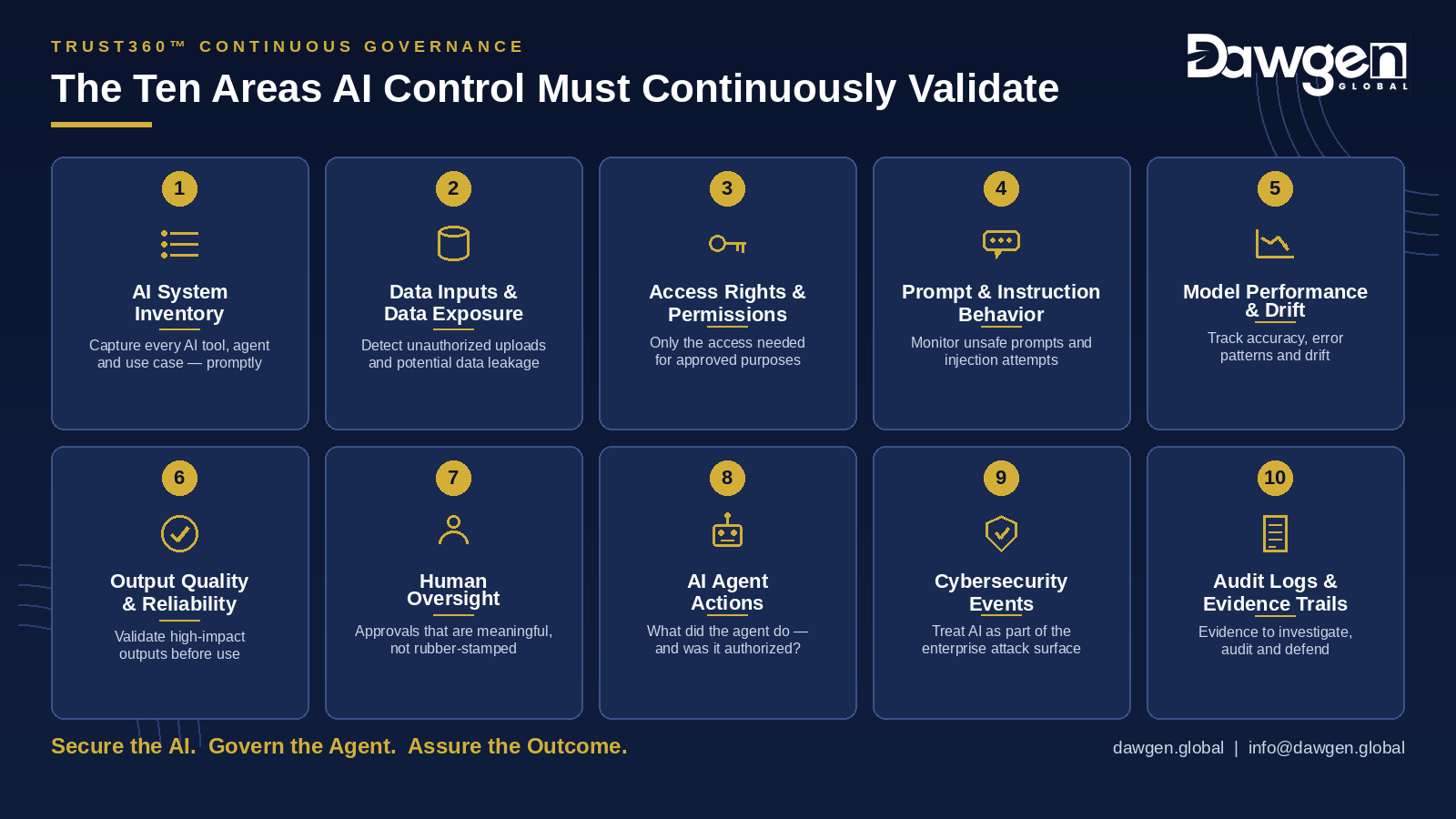
Under the TRUST360™ approach, Dawgen Global recommends that organizations continuously validate ten critical areas of AI control.
1. AI system inventory
Management should maintain an up-to-date inventory of AI systems, tools, agents, models, vendors, and use cases. New AI deployments should be captured promptly, and unauthorized or informal AI use should be identified. Without an accurate inventory, AI governance becomes guesswork.
2. Data inputs and data exposure
AI systems must be monitored for the type of data they access, process, store, or transmit. Sensitive, confidential, personal, financial, legal, customer, employee, and regulated data should be subject to clear restrictions. Continuous validation should detect inappropriate data usage, unauthorized uploads, excessive data access, and potential data leakage — a live obligation for any organization accountable under Jamaica’s Data Protection Act.
3. Access rights and permissions
AI tools and AI agents should operate under controlled identities and defined permissions. Access rights should be reviewed regularly, especially for agents connected to enterprise systems. Validation should confirm that AI systems have only the access needed for approved purposes.
4. Prompt and instruction behavior
For generative AI, prompts and instructions can shape risk. Poorly controlled prompts may expose data, generate misleading outputs, bypass policy, or manipulate system behavior. Organizations should monitor high-risk prompt patterns, unsafe instructions, prompt injection attempts, and unauthorized use of AI tools.
5. Model performance and drift
AI models may lose accuracy as conditions change. This is known as model drift. A model that performed well during testing may later produce weak, biased, or unreliable outcomes. Continuous validation should track performance indicators, accuracy rates, error patterns, exception volumes, and changes in output quality.
6. Output quality and reliability
AI outputs should be assessed based on their risk level. Low-risk outputs may require light review, while high-impact outputs may need formal validation before use. Organizations should monitor whether AI outputs are accurate, complete, relevant, consistent, explainable, and aligned with approved policy.
7. Human oversight
Human-in-the-loop controls must be tested in practice. It is not enough to state that humans review AI outputs. Organizations must confirm that reviews are meaningful, documented, timely, and performed by competent personnel. Continuous validation should identify whether approvals are being bypassed, rushed, or treated as rubber-stamp exercises.
8. AI agent actions
AI agents require special attention because they can act across systems and workflows. Validation should monitor tool calls, system interactions, data retrieval, approvals, exceptions, and escalation events — the monitoring disciplines built into Dawgen Global’s D-AGENTICA™ methodology for responsible agentic AI adoption. Organizations should be able to answer: what did the agent do, why did it do it, and was it authorized?
9. Cybersecurity events
AI systems should be integrated into cybersecurity monitoring. Threats such as prompt injection, data poisoning, model abuse, credential misuse, insecure APIs, and unauthorized integrations must be identified and escalated. Cybersecurity teams should treat AI systems as part of the enterprise attack surface.
10. Audit logs and evidence trails
Continuous validation depends on evidence. Logs should capture key AI activities, including inputs, outputs, approvals, access events, system interactions, exceptions, and changes. Without evidence trails, management may not be able to investigate incidents, satisfy regulators, support audits, or defend decisions.
Building a continuous AI control monitoring framework
A practical continuous AI validation program should include the following components:
- AI risk register and AI control library
- Defined risk appetite and thresholds
- Automated monitoring where possible; manual review routines for high-risk areas
- Exception reporting and root-cause analysis
- Management dashboards and board reporting
- Independent assurance testing
The framework should be proportionate. Not every AI use case requires the same level of monitoring. A low-risk internal drafting tool does not require the same controls as an AI system supporting financial reporting, lending decisions, medical triage, cybersecurity response, or regulatory compliance.
The principle is simple: the higher the impact, the stronger the validation.
The role of management dashboards
Dashboards are essential because AI risk is too dynamic to be managed only through policy documents and periodic reports. A useful AI governance dashboard — of the kind Dawgen Global designs for management and boards — may track:
- Number of AI systems in use and high-risk AI use cases
- Unapproved AI tools detected; AI incidents and near misses
- Data exposure alerts and access exceptions
- Model performance indicators and output validation results
- Human approval exceptions and vendor changes
- Cybersecurity alerts involving AI systems; open remediation actions
These dashboards allow management to move from reactive governance to active oversight — and give audit committees a recurring, evidence-based view of AI risk between meetings.
Why internal audit must evolve
Internal audit has traditionally provided periodic assurance. In the AI era, internal audit must increasingly evaluate whether management has established ongoing monitoring and validation.
This does not mean internal audit should become responsible for operating AI controls. That responsibility remains with management. But internal audit should assess whether continuous validation is properly designed, operating effectively, and producing reliable evidence.
Internal audit may also use data analytics and AI-enabled audit techniques to monitor AI-related controls more frequently. For many Caribbean organizations, the fastest route to this capability is a co-sourced model — pairing the in-house team with specialist AI, cyber, and data skills from an external provider. The future of AI assurance will combine periodic independent reviews with continuous control monitoring.
The board’s continuous validation questions
Boards and audit committees should ask management:
- Do we have a complete inventory of AI systems and AI use cases?
- Which AI systems are high risk?
- How do we know AI outputs remain reliable?
- How are AI agents monitored?
- What data can AI tools access?
- Are cyber threats to AI systems included in security monitoring?
- What exceptions have occurred, and how quickly are AI incidents escalated?
- What assurance has been performed over AI controls?
- Are we receiving the right metrics to oversee AI risk?
These questions help shift board oversight from general AI enthusiasm to disciplined AI accountability.
Continuous validation as a competitive advantage
Many organizations view controls as a defensive requirement. In AI, strong controls can become a competitive advantage.
Organizations that continuously validate AI systems can innovate with greater confidence. They can scale AI more safely. They can satisfy customers, regulators, boards, investors, and business partners. They can detect problems early and respond before small failures become major incidents. For Caribbean firms competing for international clients — particularly in financial services and BPO — demonstrable continuous AI control is fast becoming a commercial differentiator, not just a compliance posture.
In contrast, organizations that rely only on annual reviews may discover AI failures too late. AI governance must therefore become an operating discipline, not a compliance checklist.
“AI risk is dynamic. A control framework that only looks backward once a year cannot provide confidence over systems that learn, change, interact, and act every day. Continuous validation is the foundation of trustworthy AI.”
— Dr. Dawkins Brown, Executive Chairman, Dawgen Global
How Dawgen Global can help
Dawgen Global supports organizations across the Caribbean and globally in designing practical AI governance, cybersecurity, and assurance frameworks under the TRUST360™ continuous-governance approach — big firm capabilities, Caribbean understanding.
A practical engagement pathway:
- Assess — Continuous AI Control Monitoring Assessment; AI Governance & Cyber Risk Readiness Assessment; AI Audit Logging and Evidence Trail Assessment
- Design — Continuous AI Control Monitoring Framework Design; AI Risk Register and Control Library Development; AI Dashboard and Board Reporting Design; Model Drift and Output Validation Framework; AI Incident Response and Escalation Protocols
- Assure continuously — AI Agent Monitoring and Guardrails Review under D-AGENTICA™; AI Cybersecurity Monitoring Review; Independent AI Assurance Review; internal audit co-sourcing for AI systems
Take the first step
Is your organization relying on annual reviews to govern AI systems that change every day? Dawgen Global can help you build a continuous validation framework that strengthens governance, cybersecurity, auditability, and board confidence.
Secure the AI. Govern the Agent. Assure the Outcome.
Contact Dawgen Global today to request a Continuous AI Control Monitoring Assessment.
Email: [email protected] | Web: dawgen.global
About Dawgen Global
Dawgen Global is an independent, integrated multidisciplinary professional services firm headquartered at 47 Trinidad Terrace, New Kingston, Jamaica, serving more than 15 territories across the Caribbean. Founded and led by Dr. Dawkins Brown, Executive Chairman, the firm is independent and not affiliated with any international network. It delivers a full suite of professional services under one roof: audit and assurance; tax advisory; IT and digital transformation; risk management; cybersecurity; actuarial and insurance regulatory advisory; HR advisory; mergers and acquisitions; corporate recovery; business advisory and strategy; accounting BPO and virtual CFO services; and legal process outsourcing.
The proposition is simple: big-firm capability without the big-firm price. Dawgen Global’s integrated approach is built for the specific complexities and opportunities of the Caribbean market, helping organizations make sharper, better-informed decisions that drive measurable progress.
To explore a partnership, reach out:
- Website: dawgen.global
- Email: [email protected]
- WhatsApp (Global): +1 555-795-9071
- Caribbean offices: +1 876-665-5926 | +1 876-929-3670 | +1 876-926-5210


