The board risk report has one job — to help the board decide. Most reports, however thick with data, fail at it: backward-looking, overwhelming, and ending in information rather than a decision. Here is how to rebuild it.
In the last article I argued that everything a board oversees ultimately reduces to evidence, and that the organisations which thrive are the ones that keep that evidence always-ready rather than scrambling for it. But evidence and data are raw material, not the finished product. There is a final, decisive step that most organisations get wrong: turning all that data into something the board can actually act on. That step happens — or fails to happen — in a single document: the board risk report. And in my experience, however thick with data it may be, the typical board risk report fails at the one thing it exists to do.
What the report is for
Let us be clear about that one thing. The board risk report exists to help the board decide — to direct its attention, allocate resources, challenge management where needed, and discharge its duty of oversight. Its purpose is to drive decisions, not to document activity. That distinction sounds obvious, and yet it is precisely where most reports go wrong, because most are built to record that work was done rather than to enable a choice to be made.
Why most risk reports fail
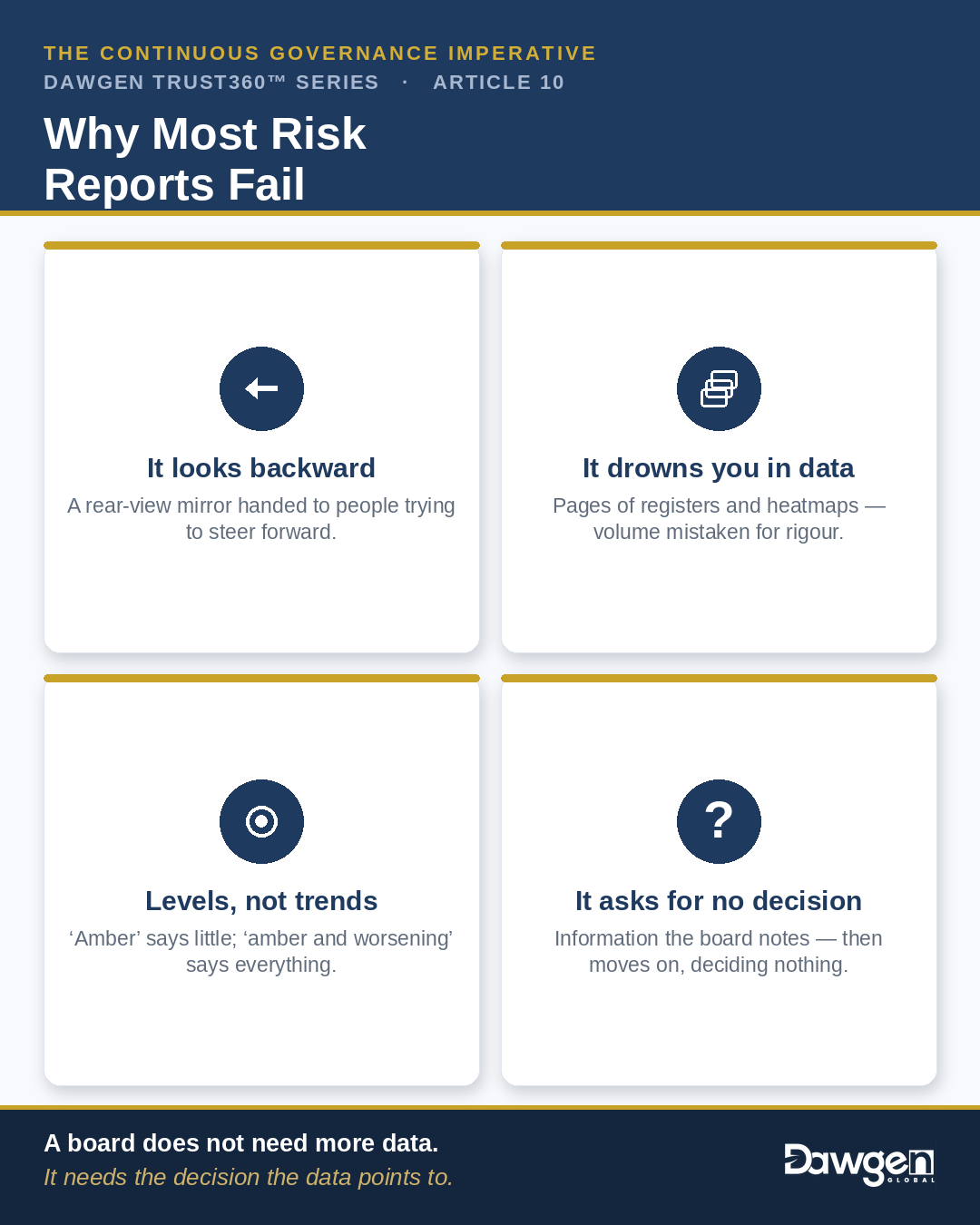
Consider how the typical board risk report fails, in four familiar ways.
It looks backward. The standard report is a description of what happened last quarter or last year — a rear-view mirror handed to people trying to steer. By the time the board reads it, the risks it describes have already moved. Directors are asked to govern the future using a picture of the past.
It drowns the board in data. Page after page of risk registers, heatmaps, key indicators and red-amber-green statuses — volume mistaken for rigour. Somewhere in all of it is the thing that matters, but the board cannot find the signal for the noise. More data is not more insight; often it is less.
It shows levels, not trends. A risk reported as “amber” tells a board almost nothing. The same risk reported as “amber, and worsening for three consecutive quarters” tells it almost everything. Boards are routinely shown where a risk sits today and almost never where it is heading — and direction is exactly what governance needs.
It does not connect to a decision. Most reports end in information: here is the status, here are the numbers. They do not end in a decision the board must make. So the board notes the report, thanks the presenter, and moves on. Information that asks nothing of the reader changes nothing.
A board does not need more data. It needs the decision the data is pointing to.
The deeper problem
Underneath these four failures is a single design flaw: the report is built for the producer, not the consumer. It is written by the risk or assurance function, often to demonstrate that the function has done its job thoroughly — and thoroughness, expressed as volume, quietly becomes the goal. But the board is not the auditor of the risk function; it is the decision-maker. A report optimised to prove diligence is a different artifact from one optimised to enable a decision, and most boards are handed the first when they need the second.
What a reinvented report looks like
So what would a board risk report look like if we rebuilt it around the decision rather than the data? It would have a handful of characteristics, and none of them is exotic.
Forward-looking. Leading with what is emerging, what is changing, and what is likely to land next quarter — rather than cataloguing what already happened.
Trend-based. Showing every significant risk with its trajectory — improving, stable or worsening — because direction matters more than position.
Exception-based. Spending the board’s scarce attention on what has changed and what needs a decision, not reciting the things that are stable and fine.
Decision-oriented. Pairing each significant item with the choice it puts to the board: here is what has changed, here is what we recommend, here is what we need from you.
Current. Drawn from continuous monitoring, so that it reflects the position now — not a cutoff several weeks before the meeting.
Notice that this is a shorter report, not a longer one. It distils rather than accumulates. It respects the board’s time by doing the hard work of turning data into judgement before the meeting, rather than outsourcing that work to directors during it.
Why this requires continuous monitoring
There is a reason this kind of report is rare, and it is not a lack of will. You simply cannot produce a forward-looking, trend-based, current report from a backward-looking, point-in-time process. If risk data is gathered once a quarter in a scramble before the meeting, the best you can produce is a snapshot of the past. A report that shows trajectory and reflects the present moment can only come from monitoring that runs continuously underneath it. The reinvented report, in other words, is not merely a better template — it is the natural output of the continuous governance model this series has been describing. It is where six domains of continuous monitoring finally become a single board-level view.
The board’s share of the responsibility
Boards are not merely victims of bad reports; they commission them, accept them, and thereby perpetuate them. A board that tolerates a data dump will keep receiving one. Directors can change the report by changing their questions. Instead of “noting” the risk report, a board can ask of it: What decision does this want from us? Which of these risks is getting worse, and how fast? What has changed since we last met? What is coming that we should prepare for now? A board that asks those questions consistently will find the report reshaping itself to answer them.
The Caribbean dimension
This matters with particular force for Caribbean boards. Many of our directors serve on several boards at once, with limited time and a great deal to oversee, and many of our organisations have inherited risk-reporting templates designed for far larger entities — heavy, compliance-driven and backward-looking. The result is directors who are simultaneously overwhelmed and underinformed: buried in pages, yet unable to answer the simple question of which risks are moving and what to do about them. A leaner, sharper, decision-oriented report is not a luxury for the Caribbean board; it is what makes effective oversight possible across six fast-moving domains in the hours a director actually has.
What good looks like
This is the unified-oversight discipline at the centre of Dawgen TRUST360™ — taking continuous monitoring across all six governance domains and distilling it into a single, forward-looking, decision-ready board view each quarter: what changed, where it is heading, and what the board is being asked to decide. The goal is to let the board spend its time governing rather than decoding.
A test for your next meeting
So here is the test, and it is one you can apply at your very next meeting. When you finish reading your board risk report, ask yourself a single question: did this help me decide something, or did it merely inform me that things happened? If it is the latter — and for most boards, most of the time, it is — then understand that it is the report, and not the board, that needs to change. The data was never the deliverable. The decision always was.
About the author
Dr. Dawkins Brown is Executive Chairman and Founder of Dawgen Global, an independent, integrated multidisciplinary professional services firm operating across the Caribbean, and Founding Editor of Caribbean Boardroom Perspectives.
Continue the conversation: dawgen.global · [email protected]
Next in the series — Article 11: “The Governance Maturity Journey: From Reactive to Continuous.”
About Dawgen Global
Dawgen Global is an independent, integrated multidisciplinary professional services firm headquartered at 47 Trinidad Terrace, New Kingston, Jamaica, serving more than 15 territories across the Caribbean. Founded and led by Dr. Dawkins Brown, Executive Chairman, the firm is independent and not affiliated with any international network. It delivers a full suite of professional services under one roof: audit and assurance; tax advisory; IT and digital transformation; risk management; cybersecurity; actuarial and insurance regulatory advisory; HR advisory; mergers and acquisitions; corporate recovery; business advisory and strategy; accounting BPO and virtual CFO services; and legal process outsourcing.
The proposition is simple: big-firm capability without the big-firm price. Dawgen Global’s integrated approach is built for the specific complexities and opportunities of the Caribbean market, helping organizations make sharper, better-informed decisions that drive measurable progress.
To explore a partnership, reach out:
- Website: dawgen.global
- Email: [email protected]
- WhatsApp (Global): +1 555-795-9071
- Caribbean offices: +1 876-665-5926 | +1 876-929-3670 | +1 876-926-5210


