
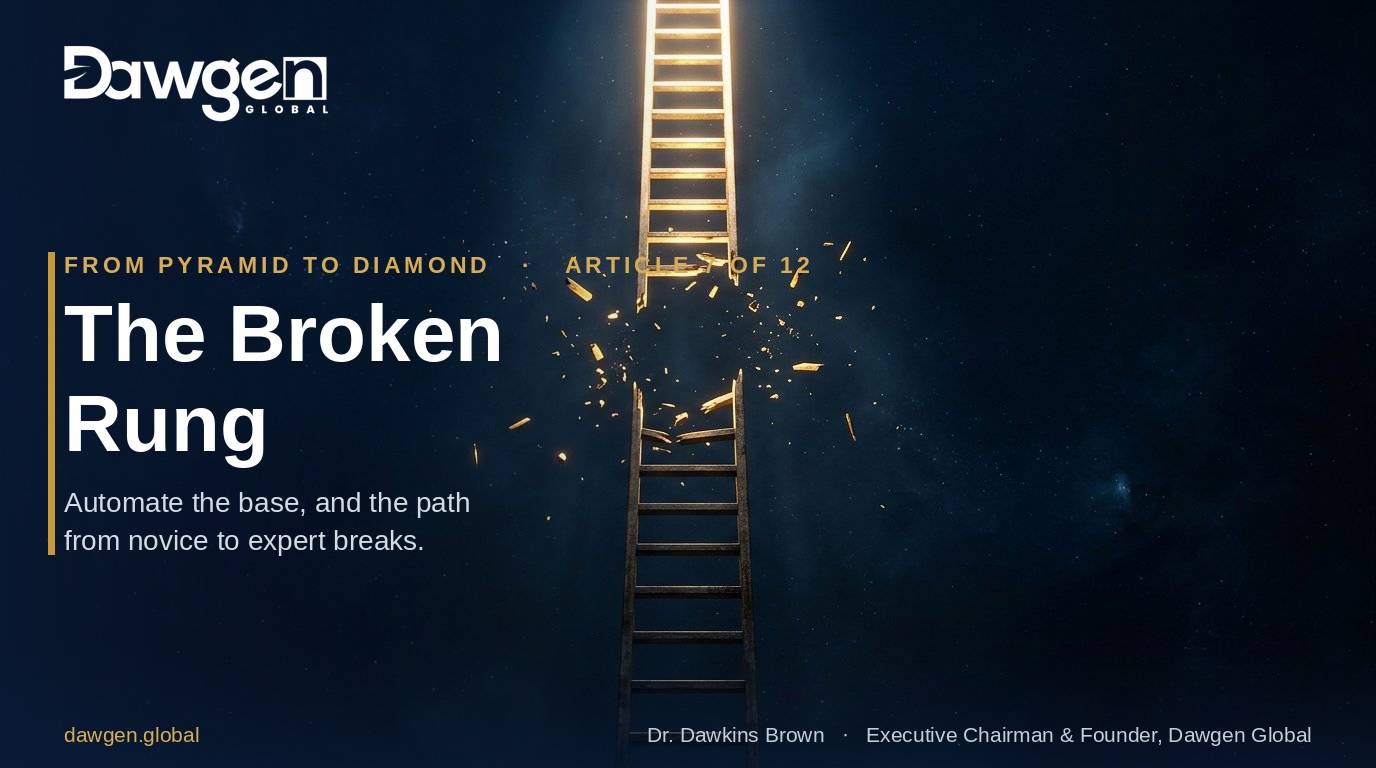
The diamond carries a danger we have deferred until now. Remove the routine work at the base, and you remove the path that turned novices into experts. This is the hardest problem in the whole transition — and the one that decides whether the diamond lasts.
PART III · THE HARD IMPLICATIONS
The question we have been deferring
Across this series we have diagnosed the cracking pyramid and described the diamond that replaces it: a lean, augmented base; a deep, empowered middle; a focused apex. It is an appealing picture. But it contains a danger we have so far set aside, and it is time to confront it directly. If the diamond depends on a deep middle of experienced professionals exercising judgment, where does that experienced middle come from? In the pyramid, the answer was obvious — it came up through the base. Remove or automate that base, and a quietly catastrophic question appears: how does anyone become experienced at all?
This is the broken rung. It is the hardest implication of the entire shift from pyramid to diamond, and the reason so many organizations that begin the transition end up, years later, as hourglasses instead.
The pyramid was a talent factory
We have treated the pyramid’s wide base as an economic engine — a layer of leveraged junior hours that generated profit. But the base was always doing a second job, one rarely valued on any balance sheet: it was a talent factory. The routine work at the bottom was how people learned. By doing volumes of basic tasks under supervision — reviewing, reconciling, drafting, testing, correcting and being corrected — juniors slowly accumulated the pattern recognition, context and instinct that eventually became professional judgment. The base was not only where the firm made money; it was where the firm made experts.
That dual role is the heart of the problem. The very work most attractive to automate — the routine, repeatable, high-volume tasks at the base — is precisely the work through which the next generation learned its craft. We are, in other words, tempted to automate away the bottom rungs of the ladder that every current expert once climbed.
The base was not only where the firm made its money. It was where the firm made its experts.
Where the ladder breaks
Picture the path from novice to expert as a ladder. In the pyramid, the rungs were continuous: a steady progression of increasingly demanding work carried people from their first day to genuine expertise. Automating the base does not simply make the bottom of the ladder smaller — it removes the lower-middle rungs entirely. The lean, augmented base no longer generates the volume of formative work that turned beginners into seasoned professionals. The destination — the experienced middle — still exists and is more valuable than ever. But the route to it is severed.
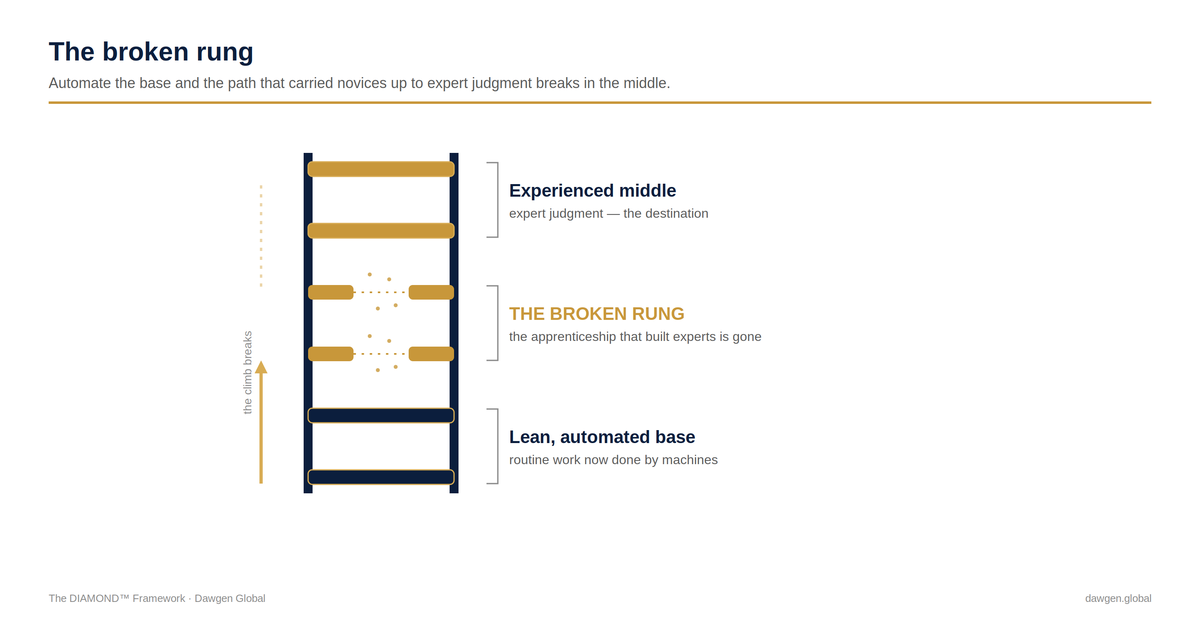
The broken rung: the experienced middle remains the destination, but the apprenticeship that led to it has been removed.
This is what makes the broken rung so insidious. It is not that the firm has fewer juniors; it is that the mechanism by which juniors became experts has quietly disappeared. The people already in the middle are fine. The problem is everyone who was supposed to follow them.
A time-bomb with a long fuse
The cruelty of the broken rung is its timing. Automate the base today and the effects are invisible for years. The existing experienced middle keeps working; clients are served; the savings from a leaner base flow straight to the bottom line. By every short-term measure, the organization looks more efficient and more profitable. Nothing appears to be wrong.

The damage surfaces only when the current middle begins to retire, move on, or simply prove too thin for the work — and there is no seasoned next generation ready to replace it, because the pipeline that would have produced them was switched off years earlier. By the time the symptom appears, the cause is a decade in the past and nearly impossible to reverse quickly, because experience cannot be manufactured on demand. This is the precise mechanism by which a firm that set out to build a diamond wakes up to find it has built an hourglass: a protected apex, a hollowing middle, and nothing rising from below.
Why Nurture is the hardest dimension
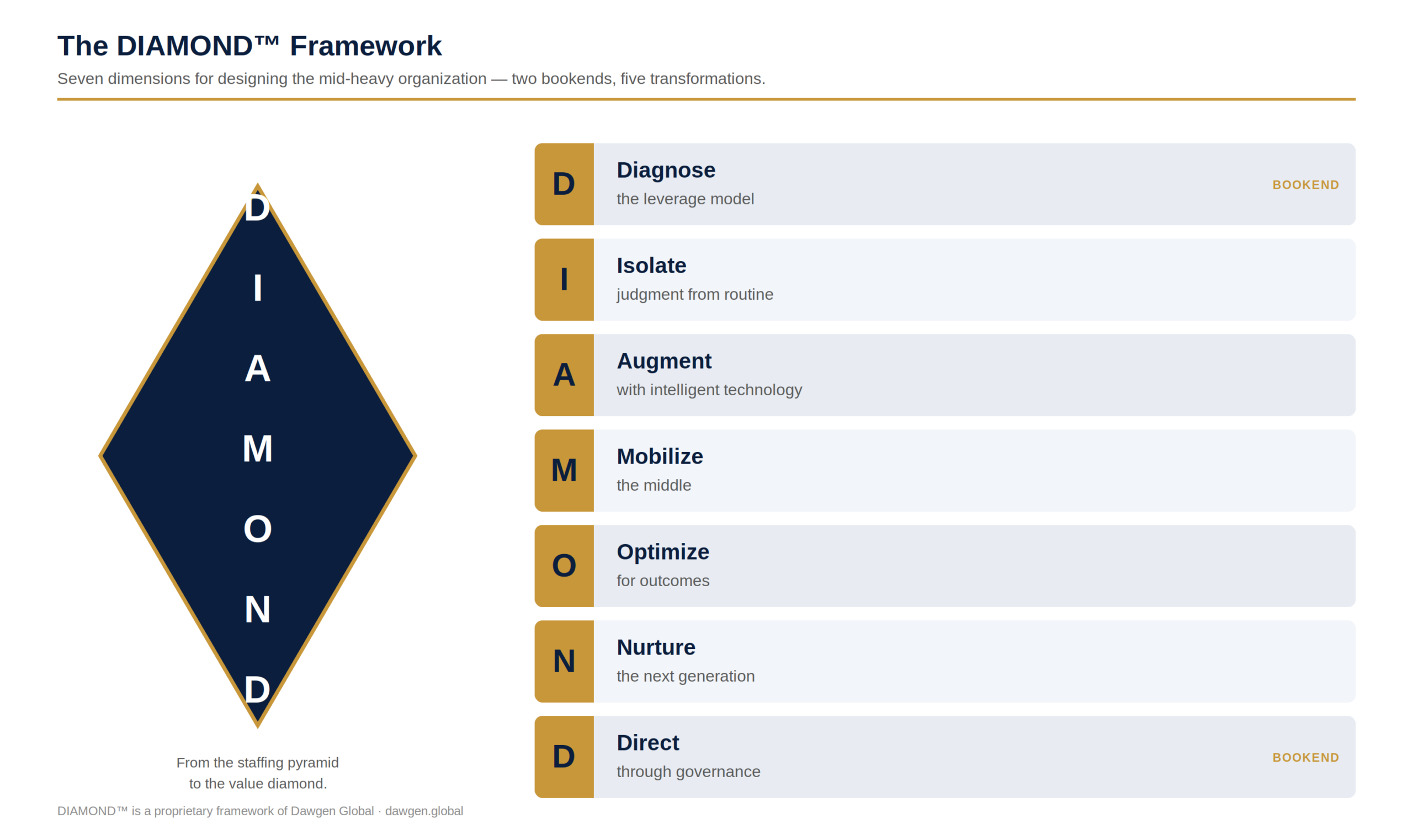
In the DIAMOND™ Framework, the work of rebuilding the path to expertise is the dimension we call Nurture — and it is the hardest of them all for a simple, structural reason: it has the longest lead time and the most deferred payoff. Augmenting the base produces savings this quarter. Mobilizing the middle improves performance this year.
Nurturing the next generation costs money and effort now for a benefit that may not be visible for five or ten years — and only becomes visible as a catastrophe if it is neglected. Every incentive pushes leaders to defer it. That is exactly why it is the dimension most likely to be quietly dropped, and the one that most decisively separates organizations that endure from those that simply optimize themselves into fragility.
Not just a firm problem
It is worth lifting our eyes from any single organization. If an entire profession automates its base at the same time — as is now happening across audit, law, finance, software and beyond — then the broken rung becomes a sector-wide and economy-wide problem. A whole generation of would-be experts may find the traditional on-ramp to their professions closed, and entire fields may face a shortage of seasoned judgment a decade from now. The broken rung is not only a question of organizational design; it is one of the defining workforce challenges of the automation era.
Why this matters acutely for the Caribbean
For most of the world the broken rung is a serious risk. For the Caribbean it is acute, because our talent pipeline is already thin and already leaky. We train fewer professionals to begin with, and a significant share of those we do train migrate in search of opportunity — often at exactly the mid-career stage when they would have become the experienced middle. A region in that position can least afford to sever the remaining path from novice to expert. If the broken rung goes unaddressed here, the regional shortage of seasoned judgment will not arrive in a decade; it will arrive sooner and bite harder. Conversely, the Caribbean organizations that solve it — that deliberately rebuild the route to expertise — will hold a profound advantage in a region where experienced judgment is the scarcest resource of all.
Naming the broken rung is not a counsel of despair. It is the necessary first step toward fixing it. The next article turns from the problem to the answer — how to rebuild apprenticeship and develop genuine expertise without the wide pyramid base that used to do it for us, almost by accident.
Where will your next generation of experts come from?
| Protect your pipeline with Dawgen Global
Automating routine work is easy to justify — the savings are immediate and visible. The hidden cost is the apprenticeship that work used to provide. Organizations that don’t replace it find, years later, that their experienced middle has no one ready to follow it. Dawgen Global helps boards and executive teams across the Caribbean see the broken rung before it bites — and rebuild a deliberate path from novice to expert that no longer depends on a wide pyramid base. Through the DIAMOND™ Organizational Diagnostic, our advisors assess the health of your talent pipeline, surface the gap between your base and your experienced middle, and design a practical development and succession strategy — drawing on our integrated capabilities in HR Advisory, Business Advisory & Strategy, and Risk Management. Request a confidential conversation: info@dawgen.global · dawgen.global |
Dawgen Global — Independent. Integrated. Multidisciplinary.
This article is part of “From Pyramid to Diamond,” a Dawgen Global thought leadership series built on the proprietary DIAMOND™ Framework. Dr. Dawkins Brown is Executive Chairman and Founder of Dawgen Global.
© 2026 Dawgen Global. DIAMOND™ is a proprietary framework of Dawgen Global. dawgen.global | info@dawgen.global
About Dawgen Global
Dawgen Global is an independent, integrated multidisciplinary professional services firm headquartered at Dawgen Towers, 47-49 Trinidad Terrace, Kingston 5, Jamaica, serving more than 15 territories across the Caribbean. Founded and led by Dr. Dawkins Brown, Executive Chairman, the firm is independent and not affiliated with any international network. It delivers a full suite of professional services under one roof: audit and assurance; tax advisory; IT and digital transformation; risk management; cybersecurity; actuarial and insurance regulatory advisory; HR advisory; mergers and acquisitions; corporate recovery; business advisory and strategy; accounting BPO and virtual CFO services; and legal process outsourcing.
The proposition is simple: big-firm capability without the big-firm price. Dawgen Global’s integrated approach is built for the specific complexities and opportunities of the Caribbean market, helping organizations make sharper, better-informed decisions that drive measurable progress.
To explore a partnership, reach out:
- Website: dawgen.global
- Email: info@dawgen.global
- WhatsApp (Global): +1 555-795-9071
- Caribbean offices: +1 876-929-3670 | +1 876-926-5210


