
If the middle is the engine, what happens to the top? The diamond demands a smaller apex, a flatter hierarchy, and a deliberate redistribution of authority into the core.
PART II · THE NEW SHAPE
What happens to the top
This series has defined the diamond and established its empowered middle as the new engine of value. That raises an obvious and uncomfortable question for the people who run organizations: if the middle is now the engine, what happens to the top? The honest answer is that the apex changes more than any other part of the structure — not by disappearing, but by becoming narrower, flatter and far less the centre of everything. The diamond does not simply add value in the middle; it redistributes authority away from a concentrated peak.
The pyramid’s apex: where everything converged
In the pyramid, the apex was the point to which everything flowed. Decisions travelled up a tall hierarchy to a small group at the top, who held the relationships, owned the risk, controlled the economics, and served as the firm’s principal repository of judgment. The structure was designed to funnel — work, information and authority all moved upward, and the apex was where they converged. That made sense when judgment was scarce and concentrated at the top, and when a wide, inexperienced base genuinely needed close direction from above.
But the diamond rests on the opposite premise. Judgment is no longer concentrated only at the apex; it has been pushed down and outward into a deep, capable middle. Once that is true, a structure that still funnels every decision to the top becomes a bottleneck rather than a safeguard. The apex that was the pyramid’s greatest strength becomes the diamond’s greatest constraint if it is left unchanged.
The apex that was the pyramid’s greatest strength becomes the diamond’s greatest constraint if it is left unchanged.
The diamond’s apex: focused, not absent
A narrower apex is not an absent one. The point of narrowing the top is not to weaken leadership but to focus it on what only the top can do: stewardship of the whole, the most senior relationships, the allocation of capital, the highest-stakes risk, and the culture and standards that hold the organization together. Everything that does not genuinely require the apex should sit below it. The discipline is subtraction — deciding what leadership should stop doing so that it can do the few things that truly need its altitude.
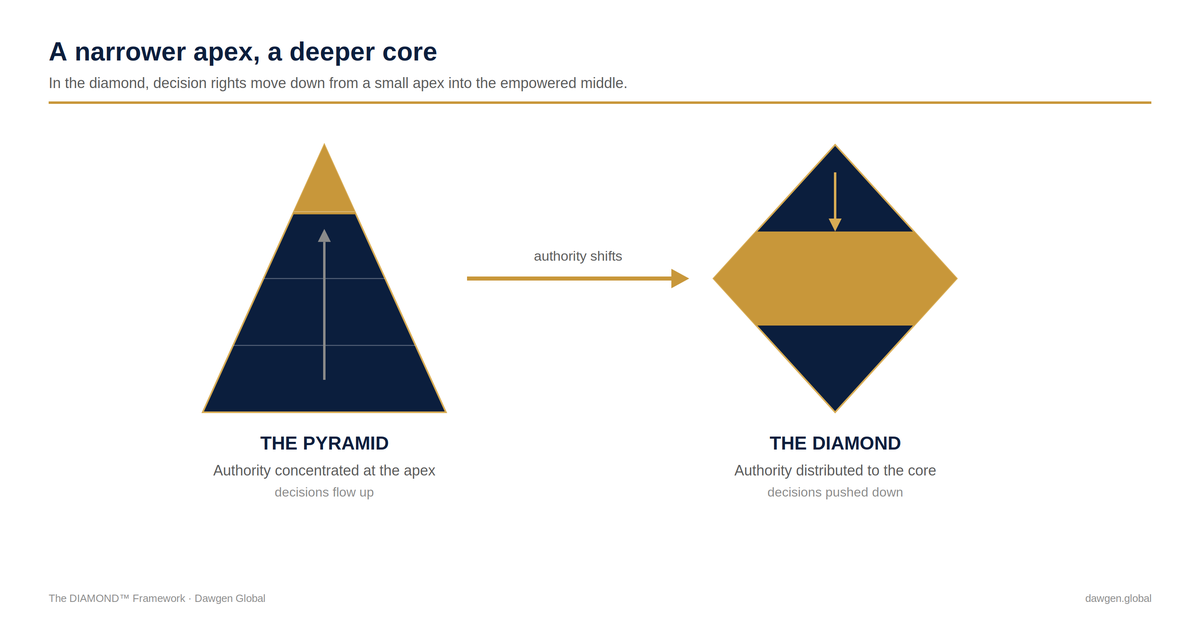
In the diamond, decision rights move down from a small apex into the empowered core.
Decision rights move down
The defining governance move of the diamond is the migration of decision rights downward. In the pyramid, authority was hoarded at the top and lent downward sparingly; in the diamond, authority is located where the judgment and the client relationship actually sit — in the empowered middle. This means widening spans of authority, flattening the layers between the apex and the work, and giving the core real ownership of decisions rather than the right to recommend them upward.
Two consequences follow. The hierarchy gets shorter — fewer layers stand between the people doing the judgment work and the point of final accountability. And the nature of leadership changes — from directing the work to setting the conditions in which a capable middle can exercise judgment well. Leaders in a diamond spend less time approving and more time enabling: defining guardrails, building capability, and stepping in only where altitude genuinely adds value.
Why this is the hardest change to make
Of all the shifts in the transition, redistributing authority is the one most likely to stall — not for technical reasons but for human ones. Decision rights are power, and power is rarely surrendered comfortably. For many senior leaders, identity and reward have been built on being the person decisions flow to; a flatter structure asks them to find their value in enabling others to decide. That is a genuine and underestimated difficulty, and pretending otherwise is why so many “empowerment” initiatives quietly fail while the real decisions keep migrating back to the top.
This is why the diamond cannot be reached by exhortation. Pushing authority down has to be designed and governed deliberately — decision rights defined explicitly, spans widened on purpose, and leaders held to the discipline of not reabsorbing what they have delegated. In the DIAMOND™ Framework this is the work of the final dimension, Direct: governing the transition rather than hoping it happens, and redesigning the architecture of authority instead of leaving it to drift back to old habits.
A caution against over-flattening
There is an opposite failure worth naming. A narrower apex is not no apex, and a flatter hierarchy is not the absence of structure. Organizations that over-correct — stripping out leadership and coordination in the name of empowerment — trade a bottleneck for a vacuum, where accountability blurs and no one owns the whole. The goal is calibration, not demolition: an apex small enough not to bottleneck the middle, but substantial enough to steward the organization, hold standards, and make the genuinely top-level calls. The diamond balances distributed authority with clear accountability; it does not abolish the second in pursuit of the first.
Partnership economics on the horizon
Redistributing authority inevitably raises the question of reward. If the middle now carries the value and holds real decision rights, the economics built for a leverage pyramid — in which the apex captured the lion’s share — come under pressure too. That is a substantial subject in its own right, and a later article in this series takes it up directly. For now it is enough to note that authority and reward cannot drift apart for long: a structure that gives the middle the work and the decisions but not a fair share of the value will not hold.
Why this matters for the Caribbean
Concentration of authority is a familiar feature of many Caribbean organizations — founder-led firms, family enterprises and institutions where decisions have long converged on a single trusted figure or a small group at the top. That concentration was often a strength in earlier stages of growth. But it becomes a ceiling as organizations scale and as capable mid-career professionals look for real authority rather than a long wait for it. For regional leaders, distributing decision rights is partly a cultural shift — and precisely because it is uncommon, the organizations that make it well will stand out in their ability to retain talent, move faster, and outlast the tenure of any single leader.
With the apex redefined, the shape of the diamond is complete: a lean augmented base, a deep empowered middle, a focused apex, and authority distributed to match. Part II has described the new shape. Part III turns to its hardest implications — beginning with the question that keeps leaders awake: if we stop hiring and developing at the base, where do tomorrow’s experts come from?
Where do decisions really get made in your organization?
| Redesign authority with Dawgen Global
In many organizations, authority is still trapped at the top — a tall hierarchy funnelling decisions upward, long after the judgment and the client relationships have moved into the middle. The result is a bottleneck that slows the organization and frustrates its most capable people. Dawgen Global helps boards and executive teams across the Caribbean redesign decision rights, spans of authority and governance for a mid-heavy organization — distributing authority deliberately while keeping accountability clear. Through the DIAMOND™ Organizational Diagnostic, our advisors map where decisions are really made today and design a governance model that pushes authority to where the judgment sits — drawing on our integrated capabilities in Business Advisory & Strategy, Corporate Governance, HR Advisory, and Risk Management. Request a confidential conversation: info@dawgen.global · dawgen.global |
Dawgen Global — Independent. Integrated. Multidisciplinary.
This article is part of “From Pyramid to Diamond,” a Dawgen Global thought leadership series built on the proprietary DIAMOND™ Framework. Dr. Dawkins Brown is Executive Chairman and Founder of Dawgen Global.
© 2026 Dawgen Global. DIAMOND™ is a proprietary framework of Dawgen Global. dawgen.global | info@dawgen.global
About Dawgen Global
Dawgen Global is an independent, integrated multidisciplinary professional services firm headquartered at Dawgen Towers, 47-49 Trinidad Terrace, Kingston 5, Jamaica, serving more than 15 territories across the Caribbean. Founded and led by Dr. Dawkins Brown, Executive Chairman, the firm is independent and not affiliated with any international network. It delivers a full suite of professional services under one roof: audit and assurance; tax advisory; IT and digital transformation; risk management; cybersecurity; actuarial and insurance regulatory advisory; HR advisory; mergers and acquisitions; corporate recovery; business advisory and strategy; accounting BPO and virtual CFO services; and legal process outsourcing.
The proposition is simple: big-firm capability without the big-firm price. Dawgen Global’s integrated approach is built for the specific complexities and opportunities of the Caribbean market, helping organizations make sharper, better-informed decisions that drive measurable progress.
To explore a partnership, reach out:
- Website: dawgen.global
- Email: info@dawgen.global
- WhatsApp (Global): +1 555-795-9071
- Caribbean offices: +1 876-929-3670 | +1 876-926-5210


