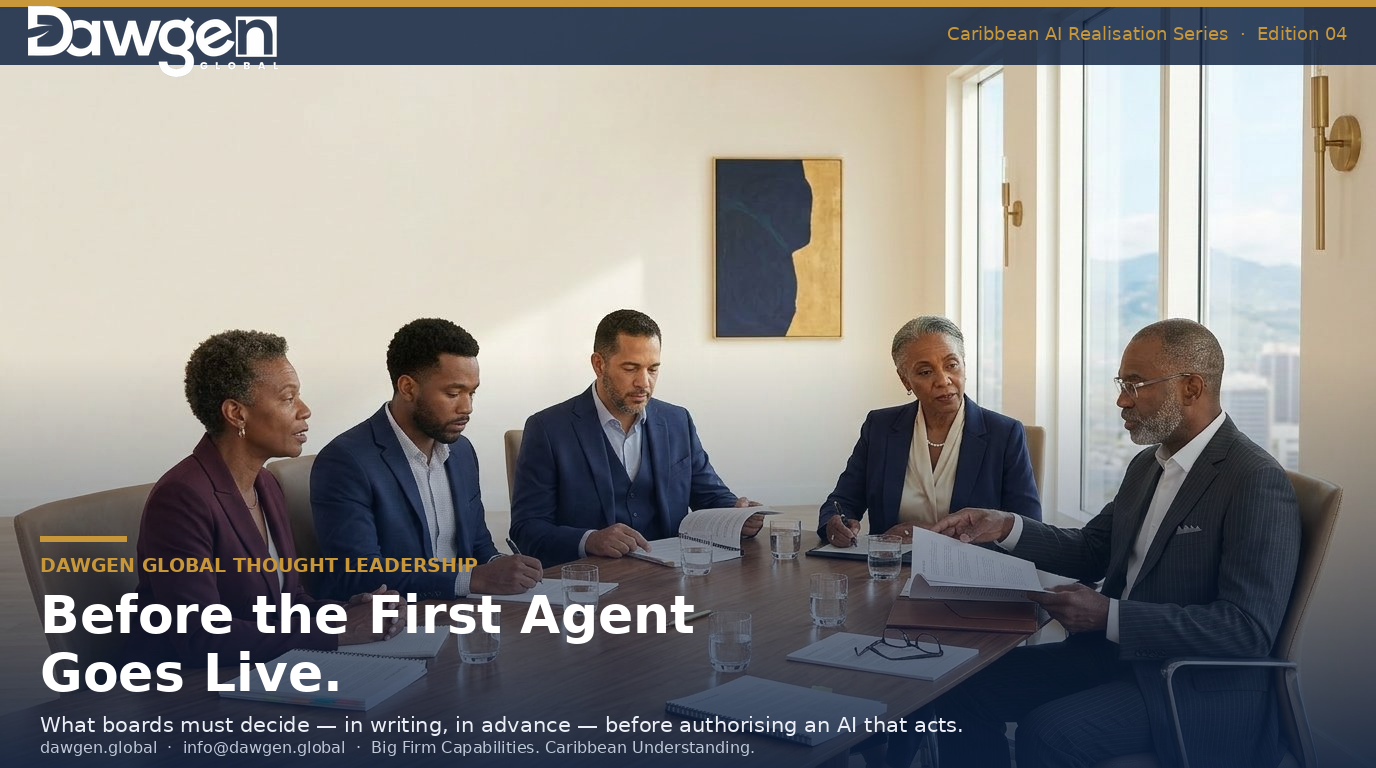
There is a meaningful difference between AI that recommends and AI that acts. Most Caribbean boards have not yet drawn it.
This is the fourth paper in Dawgen Global’s Caribbean AI Realisation Series. Edition 01 set out the discipline for a first AI pilot. Edition 02 named the five use cases worth funding first. Edition 03 took up the question of what comes next — wave two — and pre‑trailed this paper as one of the harder questions waiting on the other side of a successful first pilot.
Agentic AI is the topic those questions point toward. The conferences are full of it. The platform announcements have arrived. Vendor decks across every Caribbean industry now contain at least one slide depicting an autonomous agent. Most Caribbean boards we work with have begun to wonder whether they should be authorising one — and very few have a vocabulary precise enough to answer that question carefully.
This paper supplies that vocabulary. It distinguishes advisory AI from agentic AI in terms a board can act on. It introduces a four‑tier authority ladder for thinking about how much autonomy a Caribbean enterprise should actually delegate to a software system. It sets out six governance additions that Caribbean boards should require before any agent moves above the first tier. And it ends, as the earlier editions have, with the five questions a director should ask before authorising the first agent — and the reasons each of those questions matters more in the agentic case than in the advisory one.
As in the previous editions, this paper is deliberately vendor‑neutral. The platform, the model, the orchestration layer, and the agent framework are all downstream decisions that Dawgen Global makes with each client through our curated network of global partners and vendors. The decisions this paper is about are the ones the board has to make first.
| “The single most consequential question a Caribbean board will face in the next thirty‑six months is not whether to deploy agentic AI. It is how much authority to give it, and whose name appears on the line when it acts.”
— Dr. Dawkins Brown, Executive Chairman, Dawgen Global |
- Advisory AI and agentic AI: the distinction that matters
In Edition 01 we argued that the most common cause of failed Caribbean AI pilots was not the technology but the failure to define the use case precisely. In Edition 04 we make a related argument: the most common cause of governance gaps in agentic AI initiatives is the failure to distinguish, in writing, between two species of AI that the board may be authorising at the same time.
Advisory AI recommends an action. A human decides whether to take it. The AI is an input to a decision, not the decision itself. Every one of the five use cases in Edition 02 — KYC and AML acceleration, revenue management, citizen service triage, predictive maintenance, internal audit and document review — is, when properly governed, advisory AI. The model surfaces a finding, a price, a triage recommendation, a maintenance alert, or an exception, and a named human reviews it, approves it, declines it, or escalates it.
Agentic AI decides and executes the action. The human is informed afterwards — or, in higher‑autonomy designs, only on exception. The AI does not propose an outcome and wait for human ratification; it produces the outcome and the human reviews the audit trail. That difference looks small in a slide. In an operating environment, it is the entire question.
| Dimension | Advisory AI | Agentic AI |
| What it does | Recommends an action; a human decides whether to take it. | Decides and executes the action; a human is informed afterwards (or, in higher‑autonomy designs, only on exception). |
| Accountability locus | The decision‑maker remains the human. The AI is an input. | The decision‑maker is the system, operating within authority delegated by the human owner. Accountability does not transfer; it is held in advance. |
| Reversibility of action | High. The human can decline, modify, or escalate before any action is taken. | Variable, and often lower. Some actions — a wire transfer, a customer message, a published notice — cannot be unwound. |
| Governance demand | Manageable with the six controls described in Edition 01. | Materially higher. The six controls are necessary but not sufficient. |
| Failure signature | A bad recommendation is filtered by the human reviewer; the loss is contained. | A bad action is taken at machine speed and scale before any human sees it. |
| Typical first venue | Wave one. The five use cases in Edition 02. | Wave two and beyond. Only after the readiness scorecard in Edition 03 is fully met. |
| Boardroom takeaway
If a vendor pitch or an internal proposal moves easily between the words “AI tool,” “assistant,” “agent,” and “autonomous system” without distinguishing them, the proposal is not yet specific enough to authorise. The first useful act of agentic‑AI governance is to demand that the proposal be re‑written in terms the board can map to advisory or agentic, and to one of the four tiers below. |
- The Dawgen Global Authority Ladder: four tiers of agent autonomy
Once an organisation accepts that “agentic” is not a single category but a spectrum, the next step is to be specific about where on that spectrum any individual deployment sits. The four‑tier ladder below is the framework Dawgen Global uses in Caribbean engagements to give boards a shared vocabulary and a shared scrutiny standard.
| Tier | What the agent is authorised to do | Board scrutiny |
| T1
Read |
The agent observes, summarises, and reports. It takes no action that affects any system, customer, employee, regulator, or counterparty. This is genuinely low‑risk and a sensible first deployment. | Standard |
| T2
Draft |
The agent prepares actions — a draft response, a draft journal entry, a draft case decision — that a named human must approve before any external effect. The agent works at scale; the human remains the decision‑maker. | Elevated |
| T3
Act within limits |
The agent acts directly, but only within written, board‑approved limits: monetary thresholds, customer‑segment restrictions, time‑of‑day or volume limits, action types. Anything outside the limits escalates to a human. This is the threshold where wave‑two readiness becomes essential. | High |
| T4
Act with discretion |
The agent exercises judgement within a broader remit, without case‑by‑case limits. The board’s control sits in the design of the remit, the audit trail, and the kill‑switch — not in the individual decision. This is the tier most Caribbean boards should not be authorising in 2026. | Not recommended |
Why the ladder matters
Most published descriptions of agentic systems collapse Tiers 1 and 2 into “not really agentic” and treat Tiers 3 and 4 as the same thing. That collapse is convenient for vendor marketing and unhelpful for board governance. From the board’s perspective, the most important distinction is the one between Tier 2 and Tier 3 — because that is the line at which the system stops asking permission and starts taking action. Everything in this paper that follows is concerned with that line.
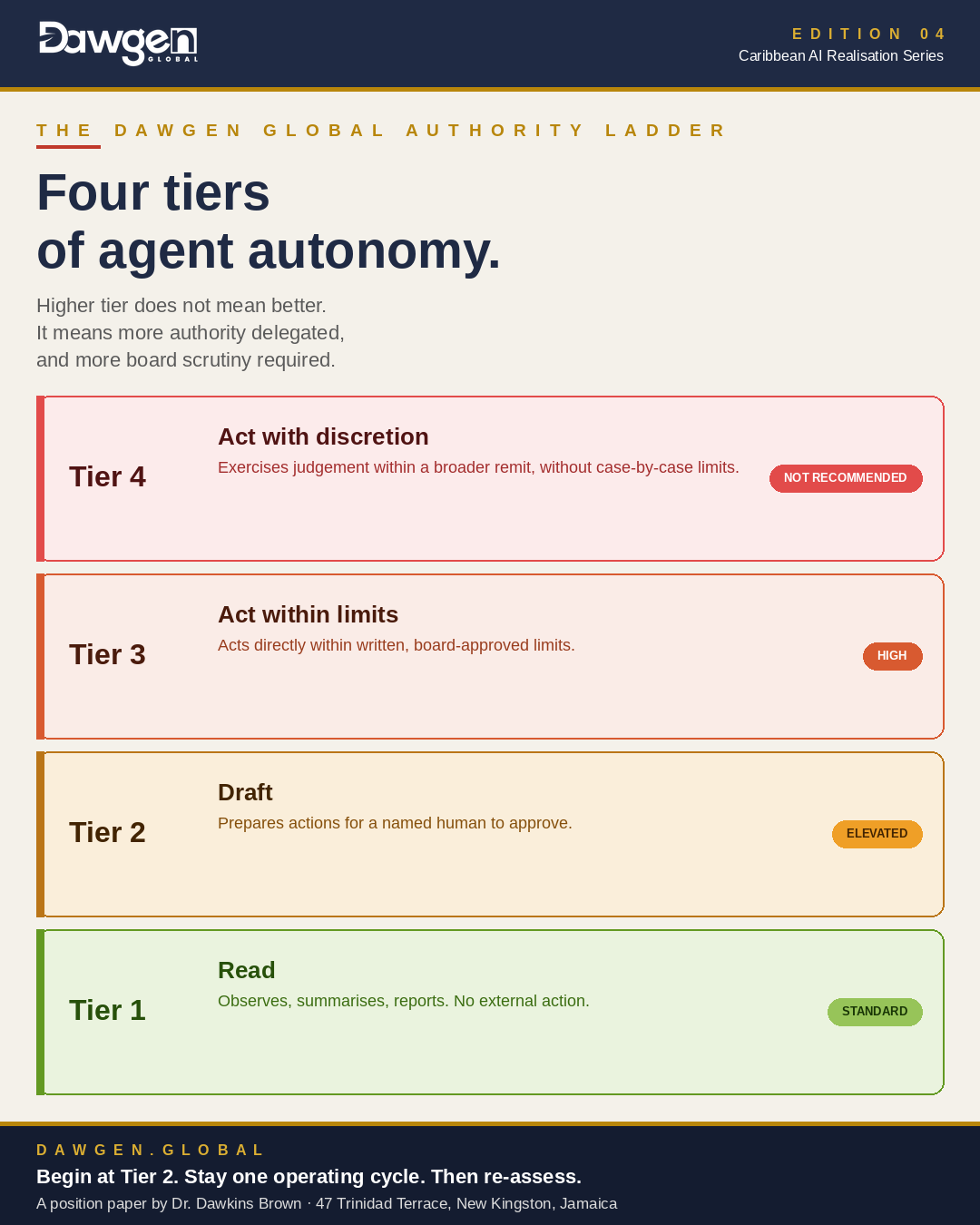
| “A Tier 1 deployment is governance practice. A Tier 4 deployment, in 2026, is a governance experiment. The right place to begin is Tier 2.”
— The Dawgen Global Authority Ladder Principle |
- Six governance additions for agentic deployments
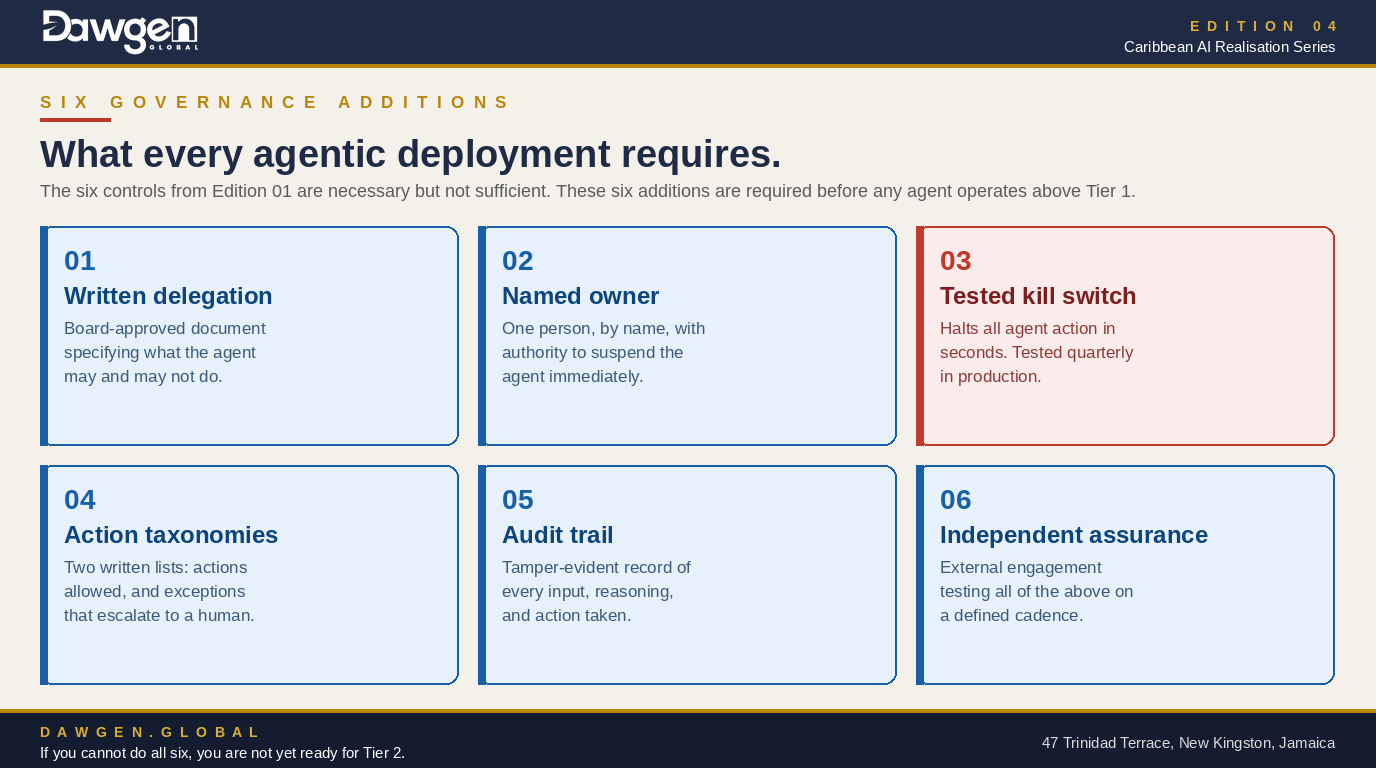
The six controls described in Edition 01 — AI policy, model inventory, data classification, human‑in‑the‑loop checkpoints, bias and explainability standards, and vendor due diligence — are the foundation. For advisory AI they are sufficient. For agentic AI, they are necessary but not sufficient. Six additions are required before any agentic deployment moves above Tier 1.
3.1 A written delegation of authority
Every agent that operates at Tier 2 or above must do so under a written delegation of authority approved by the board, the audit committee, or a sub‑committee with explicit mandate. The delegation specifies what the agent may do, what it may not do, the monetary and operational limits within which it operates, and the conditions under which the delegation is suspended. Without this document, the agent has no legal or governance standing within the enterprise.
3.2 A named human owner with the power to stop
Every agent has a single named owner — a person, not a function — with explicit authority to suspend the agent immediately, without further approval, on suspicion of malfunction, drift, or misuse. This person must be senior enough that suspending the agent will not cost them their job, and operational enough to recognise when suspension is the right call. The combination is not always easy to staff, and the difficulty is the point: if no one in the organisation meets both tests, the agent should not yet be deployed.
3.3 A real, tested kill switch
Every agent must have a documented, tested mechanism to halt all of its actions within a defined response time — measured in seconds for high‑consequence systems, in minutes for lower‑consequence ones. The kill switch must be tested in production conditions at least quarterly, and the test must be observed by internal audit. A kill switch that has never been tested is not a kill switch; it is a wish.
3.4 Pre‑approved action and exception taxonomies
Every agent operates against two written lists: the list of actions it is authorised to take, and the list of exceptions that require escalation to a human. Both lists must be approved in writing before deployment, reviewed at fixed intervals, and amended only through a documented change process. The most dangerous failure mode of an agentic system is not the action it was authorised to take and got wrong; it is the action it was not explicitly authorised to take and did anyway.
3.5 An immutable, board‑accessible audit trail
Every agentic action must produce an audit record that includes the inputs the agent observed, the reasoning it followed (to the extent the architecture permits), the action it took, and the outcome it produced. The audit trail must be tamper‑evident and accessible to internal audit, the board, and external assurance providers on request. This is not a software feature; it is a governance requirement. If the platform does not provide it, the platform is not yet ready for Caribbean enterprise deployment.
3.6 Independent assurance on a defined cadence
Every agent at Tier 2 or above is subject to an independent assurance engagement at a defined cadence — typically annual for Tier 2, semi‑annual for Tier 3, and continuous for any organisation that elects to operate at Tier 4. The assurance engagement tests the delegation, the controls, the kill switch, the action and exception taxonomies, and the audit trail. It is an external check on the internal governance, and it is the mechanism through which the board can defend its authorisation when a regulator, a correspondent bank, or an external auditor asks how the enterprise knows the agent is behaving.
| If you cannot do all six, you are not yet ready for Tier 2
These six additions are not optional and they are not sequenced. They are simultaneous. An organisation that cannot stand up all six on day one for its first agent is an organisation that should remain at Tier 1 — reading, summarising, reporting — until it can. The cost of waiting is the appearance of caution. The cost of proceeding without them is the appearance of negligence. |
- Where Caribbean enterprises should actually begin
Caribbean boards reading this paper will fall into three groups. The first group has not yet completed a successful wave‑one advisory AI pilot. For this group, the right answer to agentic AI is the same as the right answer to most strategic questions raised before the foundation is in place: not yet. Return to Edition 01 and Edition 02. The path to responsible agentic deployment runs through wave one.
The second group has completed a successful wave‑one initiative, has not yet authorised wave two, and is now being approached by vendors with agentic propositions. For this group, the right next step is to complete the wave‑two readiness scorecard from Edition 03 before considering any agent at Tier 2 or above. If readiness is not met, the right wave‑two choice is another advisory pilot, not a first agent. Patience earns optionality. Haste forecloses it.
The third group has completed wave one, met the readiness scorecard, and is genuinely in a position to authorise an agentic deployment. For this group, Dawgen Global’s recommendation is unambiguous: begin at Tier 2, in a contained operational domain, under all six governance additions, with a deliberate intention to stay at Tier 2 for at least one full operating cycle before considering any move to Tier 3. The pace of agentic adoption is being driven by the technology supply side. The pace of agentic governance has to be set by the board.
| “The Caribbean enterprises that will end this decade with the strongest agentic capability are not the ones that deployed first. They are the ones that governed best.”
— Dr. Dawkins Brown, Executive Chairman, Dawgen Global |
- Five questions a director should ask before authorising the first agent
As in Editions 01, 02, and 03, the discipline of authorisation matters more than the discipline of selection. The five questions below are the ones Dawgen Global recommends every Caribbean board ask before approving any agentic deployment above Tier 1.
- Which tier on the authority ladder is this agent being authorised at, who decided the tier, and on what evidence — and is there a written record of that decision that an external assurer could inspect today?
- Has the delegation of authority been written, approved, and signed before deployment — specifying what the agent may do, what it may not do, and the conditions under which the delegation is suspended?
- Who, by name, can stop this agent within minutes — and have they been told, in writing, that they have that authority and the obligation to use it?
- Has the kill switch been tested in production conditions, has internal audit observed the test, and when is the next scheduled test?
- If this agent causes a material loss, a regulatory breach, a customer harm, or a reputational incident, do we know today how we will explain to the regulator and to the board how it happened — and have we documented that explanation framework in advance?
| The fifth question is the most important
Pre‑mortem governance — documenting in advance how the organisation would respond if the agent failed — is the single most useful exercise a Caribbean board can perform before authorising a Tier 2 agent. It surfaces gaps that no readiness checklist will identify on its own. It also creates the artefact the regulator, the correspondent bank, the external auditor, or the news desk will eventually ask for. Producing it after the fact is far harder than producing it before. |
- Where the series goes from here
Editions 01 through 04 of this series have built, in sequence, the discipline for the first AI pilot, the use cases worth funding first, the framework for wave two, and the vocabulary for agentic AI. The series is now broad enough to cover the strategic questions Caribbean boards face in the AI realisation journey — and specific enough that each edition speaks to a decision a board is actually making.
Future editions will take up the questions readers of these four papers continue to raise with us. What does workforce transition look like when wave two becomes wave three and beyond, and how should Caribbean boards think about the human side of agentic adoption? What does the integrated, independent advisory model look like when AI moves from being a project the firm advises on to a capability the firm and the client share? What does responsible Caribbean AI governance look like in full detail — the governance playbook that complements this paper’s six additions with the broader twelve‑ to eighteen‑control architecture that wave‑three organisations will eventually need?
As always, each future edition will follow the same discipline as the four already published: Caribbean‑first, vendor‑neutral, board‑grade, and grounded in the engagements Dawgen Global runs every week with clients across the region.
- How Dawgen Global delivers the first‑agent engagement
An agentic deployment engagement carries the same structural discipline as the ninety‑day phased approach set out in Edition 01, but the substance of each phase is more demanding and the cadence is typically longer. The discovery phase opens with the authority ladder, the delegation, and the readiness review rather than with a use‑case workshop. The governance phase reaches further into model risk, internal audit, external assurance, and — where relevant — prudential regulatory engagement. The build phase contemplates kill‑switch testing, taxonomy documentation, and audit‑trail architecture as deliverables of the engagement, not afterthoughts. The validation phase tests against the board’s written delegation, the six additions, and the questions a regulator or external auditor would actually ask.
Because Dawgen Global is an independent, integrated multidisciplinary professional services firm, the disciplines we bring to an agentic engagement combine naturally. Risk Management leads on delegation design and model risk. Audit & Assurance leads on the assurance architecture and the kill‑switch testing protocols. IT & Digital Transformation leads on platform selection — through our curated network of global partners and vendors — and on the audit‑trail architecture. Cybersecurity addresses the elevated attack surface an agent creates, including the new category of agent‑specific threats that did not exist for advisory systems. Legal Process Outsourcing addresses the contractual and regulatory dimensions of the delegation. HR Advisory takes up the workforce implications where the agent materially changes job design. The technology and platform layer is selected to fit the client’s circumstances — not the other way around. The structural separation between the independent advisor and the technology partner, which we have argued for in every edition of this series, is most important in the agentic case.
| Talk to us
Dawgen Global offers a complimentary, three‑hour Agentic AI Readiness Briefing for Caribbean enterprises considering their first agent. The briefing walks the board through the advisory‑versus‑agentic distinction, the four‑tier authority ladder, the six governance additions, and the pre‑mortem framework — and concludes with a written briefing the board can use to authorise, defer, or decline the next phase of investment. To arrange a briefing, write to [email protected] or contact our New Kingston office at 47 Trinidad Terrace. |
About the author
Dr. Dawkins Brown is the Executive Chairman and Founder of Dawgen Global, an independent, integrated multidisciplinary professional services firm headquartered in New Kingston, Jamaica and operating across the Caribbean region. He is the author of the Caribbean Boardroom Perspectives newsletter, the D·AGENTICA™ series on Caribbean AI adoption, and the DAGAF™ series on digital asset governance and assurance.
This thought leadership paper is published for general information only and does not constitute legal, tax, audit, regulatory, or investment advice. The authority ladder, governance additions, and director’s questions described above are illustrative of Dawgen Global’s advisory methodology and should be adapted to the specific circumstances, regulatory environment, and risk appetite of each client. Independent professional advice should be obtained before acting on any matter discussed in this paper. © 2026 Dawgen Global. All rights reserved.
About Dawgen Global
“Embrace BIG FIRM capabilities without the big firm price at Dawgen Global, your committed partner in carving a pathway to continual progress in the vibrant Caribbean region. Our integrated, multidisciplinary approach is finely tuned to address the unique intricacies and lucrative prospects that the region has to offer. Offering a rich array of services, including audit, accounting, tax, IT, HR, risk management, and more, we facilitate smarter and more effective decisions that set the stage for unprecedented triumphs. Let’s collaborate and craft a future where every decision is a steppingstone to greater success. Reach out to explore a partnership that promises not just growth but a future beaming with opportunities and achievements.
 Email: [email protected]
  Visit: Dawgen Global Website

 WhatsApp Global Number : +1 555-795-9071
Caribbean Office: +1876-6655926 / 876-9293670/876-9265210  WhatsApp Global: +1 5557959071
USA Office: 855-354-2447
Join hands with Dawgen Global. Together, let’s venture into a future brimming with opportunities and achievements


