
Your first AI pilot worked. The board has signed off. Now the harder question: what do you fund second — and how do you know your organisation is actually ready for it?
Wave one taught the organisation to walk. Wave two asks whether it can run.
This is the third paper in Dawgen Global’s Caribbean AI Realisation Series, and it answers a promise made at the close of Edition 02: that we would return to the question of what comes after a successful first AI pilot — and how a Caribbean board should know its organisation is actually ready for the next step.
Most of the AI discussion that reaches our advisory practice is still about getting the first pilot right. Edition 01 set out the discipline. Edition 02 named the five use cases worth funding first. By the time an organisation arrives at this paper, it has typically done the hard work: chosen well, governed properly, produced evidence the board accepts, and absorbed the operating-model change without disruption. The temptation now is to move faster, broader, and more visibly. The risk now is that the very confidence wave one created becomes the source of wave two’s failure.
This paper is written for the organisations that have earned the right to ask “what next?” — and for the boards that have to authorise the answer. As in the earlier editions, it is deliberately vendor‑neutral. Dawgen Global’s role is to advise on the use case, the governance, and the path to scale; the technology mix is selected with our clients through our curated network of global partners and vendors, downstream of the strategic decisions this paper is about.
| “Wave two does not fail because organisations attempt too much. It fails because they assume the discipline that worked at small scale will hold at larger scale — without re‑testing it.”
— Dr. Dawkins Brown, Executive Chairman, Dawgen Global |
- Why wave two is harder than wave one (even when it looks easier)
There is a counter‑intuitive pattern we observe in nearly every successful Caribbean AI programme. The first pilot is approached with caution: the use case is scoped narrowly, the governance is built deliberately, the success metrics are debated in writing, and the post‑mortem is honest. The result is usually a measured, defensible win.
The second initiative is often approached with conviction. The board has seen the first paper. The CEO has the credibility. The technology team has the muscle memory. The vendor relationships are warm. Everything that was effortful the first time feels lighter the second time — and that lightness is the problem.
Wave two is harder than wave one in four specific ways, and recognising each is the first step in surviving it.
1.1 The use case is no longer obviously the right one
Wave one chose itself. The five use cases in Edition 02 — KYC and AML acceleration, revenue management, citizen service triage, predictive maintenance, internal audit and document review — are well‑trodden, well‑governed, and well‑understood. Wave two has no such default list. Boards now have to choose between deepening what worked, widening into a new function, or stepping up to a more ambitious use case. None of these is wrong. They are different bets with different risk profiles.
1.2 The governance assumptions that worked at small scale begin to strain
A human‑in‑the‑loop checkpoint that worked for two reviewers in compliance becomes harder to sustain across forty reviewers in three jurisdictions. A model‑risk control that was easy to monitor when the model handled three hundred cases a week becomes harder when it handles thirty thousand. Wave‑one governance was correct in shape. Wave two requires governance that is correct at scale — and the gap between the two is not small.
1.3 The operating‑model change becomes structural
Wave one is, in most cases, an adjustment to how work gets done inside a single team. Wave two often touches multiple teams, multiple functions, and multiple supervisors. It begins to affect performance management, job design, training programmes, and — occasionally — collective bargaining arrangements. The change is no longer just about software adoption. It is about the shape of the organisation.
1.4 External scrutiny escalates
A first pilot can be invisible to regulators, correspondent banks, ratings agencies, and external auditors. A second initiative, particularly one that touches financial reporting, customer treatment, or systemic risk, is increasingly visible to all of them. The same controls that satisfied a one‑off engagement may be tested against external assurance standards the organisation has not yet met.
| Boardroom takeaway
If wave two is being authorised with the same intensity of debate that wave one received — or less — the board is under‑weighting the risk. The cost of getting wave two wrong is higher than the cost of getting wave one wrong, because the audience for the failure is larger. |
- The Dawgen Global Wave‑Two Readiness Scorecard
Before authorising any wave‑two initiative, Dawgen Global recommends that Caribbean boards complete a structured readiness assessment. The five dimensions below are the ones we work through with every client preparing for wave two. None of them is optional. If any one of them is rated weak, the right answer is not to delay wave two indefinitely — it is to invest specifically in the weak dimension until it is no longer weak.
| Readiness Dimension | What “Ready” Looks Like |
| 01
Wave One Evidence |
At least one AI pilot has reached production, demonstrated measurable business value against pre-agreed metrics, and operated without incident long enough to satisfy internal audit and the relevant risk committee. |
| 02
Governance Maturity |
A documented AI policy is in force, a model inventory exists with risk tiering, and human-in-the-loop checkpoints have been tested under real operating conditions — not just designed in PowerPoint. |
| 03
Data Discipline |
The data the wave-two use case will depend on is identifiable, accessible, classified for residency and protection, and supported by a steward who can answer for its lineage and quality. |
| 04
Operating-Model Literacy |
The business owners affected by the wave-two initiative can describe what their workflow looks like after deployment, who decides what, and where human override sits — in their own words, not the vendor’s. |
| 05
Board Confidence |
The board has received and accepted at least one written, evidenced report on wave-one performance, has approved a written AI strategy, and has appointed a named director or committee accountable for AI oversight. |
The scorecard is deliberately demanding. An organisation that can answer “yes, with evidence” to all five dimensions is ready for wave two on any of the three paths described below. An organisation that can answer yes to fewer than three is not ready for wave two — it is ready for a second wave‑one initiative, and that distinction matters. The most common error we encounter is treating a second wave‑one pilot as if it were a wave‑two initiative, and applying ambition that the readiness base cannot yet support.
| “A second cautious pilot is not a failure of ambition. It is a sign of self‑knowledge — and self‑knowledge is the scarcest resource in an enterprise AI programme.”
— The Dawgen Global Wave‑Two Principle |
- Three paths through wave two: deepen, widen, or step up
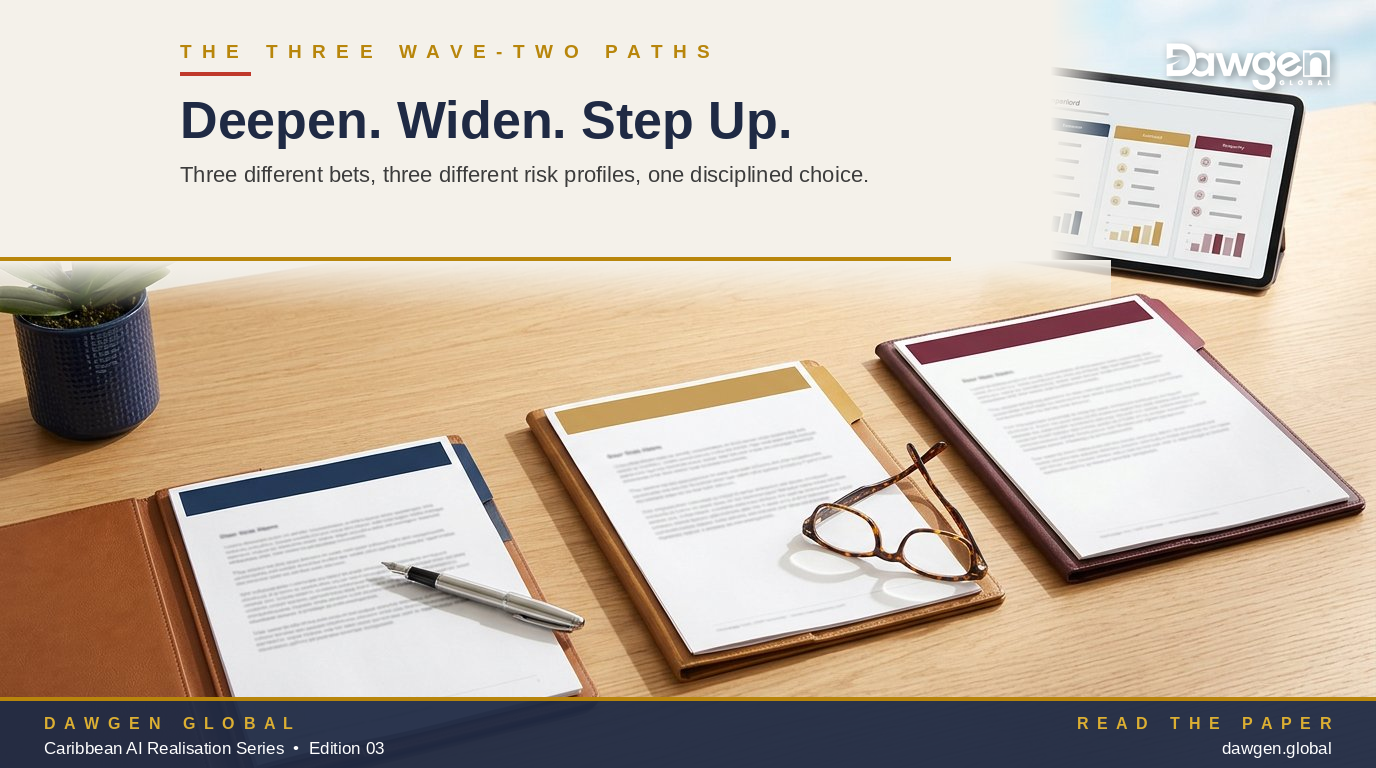
Organisations that have completed the readiness scorecard and emerged ready then face a choice. There are essentially three paths through wave two, each suited to different organisational circumstances. Most boards we work with intuit a preference quickly; the value of naming the three paths explicitly is that it surfaces the trade‑offs the intuition is making.
| Path | Deepen | Widen | Step Up |
| What it does | Extends the proven wave-one use case into adjacent workflows or new business units. | Applies the wave-one playbook to a different first-wave use case in another function. | Moves to a more complex use case — multi-system integration, agentic capability, or revenue-facing application. |
| Risk profile | Lowest. Same patterns, governed by the same controls already tested. | Medium. New subject matter, but the engagement discipline is familiar. | Highest. New patterns, new controls required, new operating-model exposure. |
| Time to value | 60–90 days. | 90‑120 days. | 4‑9 months, typically. |
| Best for | Organisations whose wave one delivered strong but narrow value — and where adjacent value is visible. | Organisations building a portfolio of governed pilots across multiple functions. | Organisations with full wave-one maturity and a board with appetite for a higher-visibility initiative. |
Deepen — extend the proven into the adjacent
The deepen path applies the wave‑one engagement to closely adjacent workflows or business units. A KYC acceleration pilot that proved itself on retail customer onboarding extends to commercial customer onboarding, or to enhanced due diligence on a sub‑segment of correspondent relationships. A predictive‑maintenance pilot proven on one asset class extends to the next asset class. The governance is the same. The data discipline is the same. The operating‑model change is incremental. For boards new to wave two, this is the lowest‑regret path.
Widen — apply the playbook to a new function
The widen path takes the engagement discipline that produced wave‑one success and applies it, deliberately and from scratch, to a different first‑wave use case in another function. An internal audit pilot is followed by a revenue‑management pilot in a different business unit. A citizen‑service triage pilot is followed by a predictive‑maintenance pilot in an infrastructure subsidiary. The technical work feels new, but the methodology is familiar. This path builds a portfolio of governed pilots, which over time becomes the foundation of an enterprise AI capability rather than a collection of point solutions.
Step up — take on a more complex use case
The step‑up path moves the organisation toward a more ambitious initiative: a multi‑system integration, a revenue‑facing application, or a targeted agentic capability where the AI takes a defined set of actions on the enterprise’s behalf. This path is where most of the conference and trade‑press energy is focused, and it is where the largest value can be created. It is also where governance, change‑management, and operating‑model demands are highest. We recommend it only to organisations that have completed the readiness scorecard with strong marks across all five dimensions, and where the board has appetite for the elevated scrutiny that comes with a higher‑visibility initiative.
| Choosing between the three
If wave one delivered strong but narrow value, deepen. If wave one delivered narrow value and the board wants a portfolio rather than a point solution, widen. Step up only when the readiness scorecard supports it — and when the board has decided, in writing, that the elevated scrutiny is worth the elevated value. |
- What changes in governance between wave one and wave two
Wave‑one governance, done properly, is designed to make a small initiative defensible. Wave‑two governance is designed to make a larger or more visible initiative defensible at scale, and the difference shows up in six specific places.
- The AI policy that was approved at board level for wave one needs to be re‑read against the wave‑two use case, with explicit attention to permitted purposes, prohibited purposes, and the escalation path for novel ones.
- The model inventory that listed one or two pilots needs to evolve into a working register with risk tiering, owner accountability, review cadence, and a clear distinction between models that inform decisions and models that take actions.
- Human‑in‑the‑loop checkpoints that worked at pilot volume must be re‑designed for production volume — which often means a different operating model, not just a larger team applying the same approach.
- Data classification, residency, and cross‑border processing decisions taken for wave one need to be re‑tested against wave‑two flows, particularly where the new use case touches customer, employee, or supervisory data.
- Vendor and third‑party due diligence, including contractual audit rights and exit provisions, must be extended to any new platform, model, or integration partner the wave‑two engagement introduces.
- Internal audit’s coverage of AI needs to formalise: from a one‑off assurance engagement on wave one to a recurring item on the audit plan, with appropriate skills and access in the audit function.
| “The single most useful thing a Caribbean board can do between wave one and wave two is commission an independent review of the wave‑one governance against the specific demands of the wave‑two use case. The cost is small. The clarity it produces is disproportionate.”
— Dr. Dawkins Brown, Executive Chairman, Dawgen Global |
- Five questions a director should ask before authorising wave two
As in Editions 01 and 02, the discipline of authorisation matters more than the discipline of selection. The five questions below are the ones Dawgen Global recommends every Caribbean board ask before approving any wave‑two initiative.
- Has the wave‑one initiative produced written, independent confirmation that it met the success metrics the board agreed to at the start — and has internal audit signed off on the governance and control performance?
- Has the wave‑two readiness scorecard been completed with evidence against each of the five dimensions, and has the board reviewed the result rather than the executive summary of the result?
- Which of the three paths — deepen, widen, or step up — has been chosen, and is the choice consistent with the readiness score and the board’s appetite for external scrutiny?
- What specifically changes in the AI policy, model inventory, governance controls, and internal audit coverage as a result of this initiative — and have those changes been approved before the build begins, not afterwards?
- If the initiative does not deliver against its success metrics, who decides to stop or pivot — and on what evidence — and is that decision authority recorded in writing today rather than discovered during the crisis?
| The hardest question is the last one
Wave‑one pilots are easy to pause because they are small. Wave‑two initiatives are harder to pause because they have organisational momentum, vendor commitments, and reputational signal attached. Deciding the off‑ramp before the on‑ramp is built is one of the most valuable acts of governance a Caribbean board can perform. |
- Where the Caribbean AI Realisation Series goes from here
Editions 01, 02, and 03 of this series have set out the foundation of what Dawgen Global believes a Caribbean enterprise AI programme should look like: discipline at the start, the right use case in the middle, and a structured path through wave two when the time comes. The series is not finished.
Future editions will take up the questions readers of these three papers have already started asking us. What does responsible Caribbean AI governance look like in full detail, beyond the six controls we have referred to so far? What does agentic AI — systems that take action rather than recommend it — mean for Caribbean boards, and how should the governance differ from advisory AI? How should Caribbean enterprises think about workforce transition as wave two becomes wave three and beyond? And what does an integrated, independent advisory model look like when AI moves from being a project the firm advises on to a capability the firm and the client share?
Each of these editions will follow the same discipline as the three already published: Caribbean‑first, vendor‑neutral, board‑grade, and grounded in the engagements Dawgen Global runs every week with clients across the region.
- How Dawgen Global delivers the wave‑two engagement
A wave‑two engagement carries the same structural shape as the ninety‑day phased engagement set out in Edition 01 — discover and define, design and govern, build and pilot, validate and scale — but the substance of each phase is more demanding. The discovery phase opens with the readiness scorecard rather than ending with one. The governance phase reaches further into model risk, internal audit, and external assurance. The build phase contemplates a production deployment from the outset rather than treating production as a future problem. The validation phase tests against the board’s wave‑two success metrics, the regulator’s expectations, and the firm’s own assurance standards.
Because Dawgen Global is an independent, integrated multidisciplinary professional services firm, the disciplines we bring to a wave‑two engagement scale naturally with it. Risk Management deepens into model‑risk governance. Audit & Assurance moves from advisory comfort to formal assurance. IT & Digital Transformation handles production architecture. Cybersecurity addresses the larger attack surface a scaled system creates. HR Advisory takes up workforce transition where the operating model changes materially. The technology layer is delivered through our curated network of global partners and vendors, selected to fit each client’s wave‑two circumstances. The structural separation between the independent advisor and the technology partner — which we have argued for in every edition of this series — is, in our view, even more important in wave two than in wave one.
| Talk to us
Dawgen Global offers a complimentary, two‑hour Wave‑Two Readiness Review for Caribbean enterprises that have completed at least one successful AI pilot and are considering their next initiative. The review walks the board through the five‑dimension readiness scorecard, identifies the path — deepen, widen, or step up — most consistent with the organisation’s readiness, and concludes with a written briefing the board can use to authorise the next phase of investment. To arrange a review, write to [email protected] or contact our New Kingston office at 47 Trinidad Terrace. |
About the author
Dr. Dawkins Brown is the Executive Chairman and Founder of Dawgen Global, an independent, integrated multidisciplinary professional services firm headquartered in New Kingston, Jamaica and operating across the Caribbean region. He is the author of the Caribbean Boardroom Perspectives newsletter, the D·AGENTICA™ series on Caribbean AI adoption, and the DAGAF™ series on digital asset governance and assurance.
This thought leadership paper is published for general information only and does not constitute legal, tax, audit, regulatory, or investment advice. The readiness dimensions, paths, and governance recommendations described above are illustrative of Dawgen Global’s advisory methodology and should be adapted to the specific circumstances, regulatory environment, and risk appetite of each client. Independent professional advice should be obtained before acting on any matter discussed in this paper. © 2026 Dawgen Global. All rights reserved.
About Dawgen Global
“Embrace BIG FIRM capabilities without the big firm price at Dawgen Global, your committed partner in carving a pathway to continual progress in the vibrant Caribbean region. Our integrated, multidisciplinary approach is finely tuned to address the unique intricacies and lucrative prospects that the region has to offer. Offering a rich array of services, including audit, accounting, tax, IT, HR, risk management, and more, we facilitate smarter and more effective decisions that set the stage for unprecedented triumphs. Let’s collaborate and craft a future where every decision is a steppingstone to greater success. Reach out to explore a partnership that promises not just growth but a future beaming with opportunities and achievements.
 Email: [email protected]
  Visit: Dawgen Global Website

 WhatsApp Global Number : +1 555-795-9071
Caribbean Office: +1876-6655926 / 876-9293670/876-9265210  WhatsApp Global: +1 5557959071
USA Office: 855-354-2447
Join hands with Dawgen Global. Together, let’s venture into a future brimming with opportunities and achievements


