Executive Summary
The Caribbean is operating in a more uncertain business environment than at any point in recent memory. Economic volatility, inflationary pressure, geopolitical disruption, cybersecurity threats, climate-related shocks, foreign exchange pressure, supply chain fragility, talent shortages, and accelerating technological change are all reshaping the landscape in which businesses, investors, regulators, and boards must operate.
In this environment, governance can no longer be treated as a compliance exercise or a box-ticking function. Governance is now a strategic capability. Strong boards, disciplined risk management, and a culture of resilience are becoming essential to business survival, investor confidence, long-term value creation, and sustainable growth.
A recent World Economic Forum report on the future of venture capital underscores the importance of governance, institutional discipline, talent, and ecosystem readiness in enabling businesses to scale, attract investment, and navigate uncertainty. While the report is centered on global innovation finance, its lessons are highly relevant for the Caribbean. Businesses do not scale, attract capital, or sustain performance on ambition alone. They do so through sound governance, credible oversight, risk discipline, and strategic resilience.
Dawgen Global believes that in the Caribbean context, boards must evolve from ceremonial oversight bodies into active enablers of resilience, accountability, and strategic foresight. At the same time, companies of all sizes—whether family businesses, SMEs, scale-ups, private companies, or larger corporate groups—must strengthen governance structures so that they are better prepared for shocks and better positioned to seize opportunity.
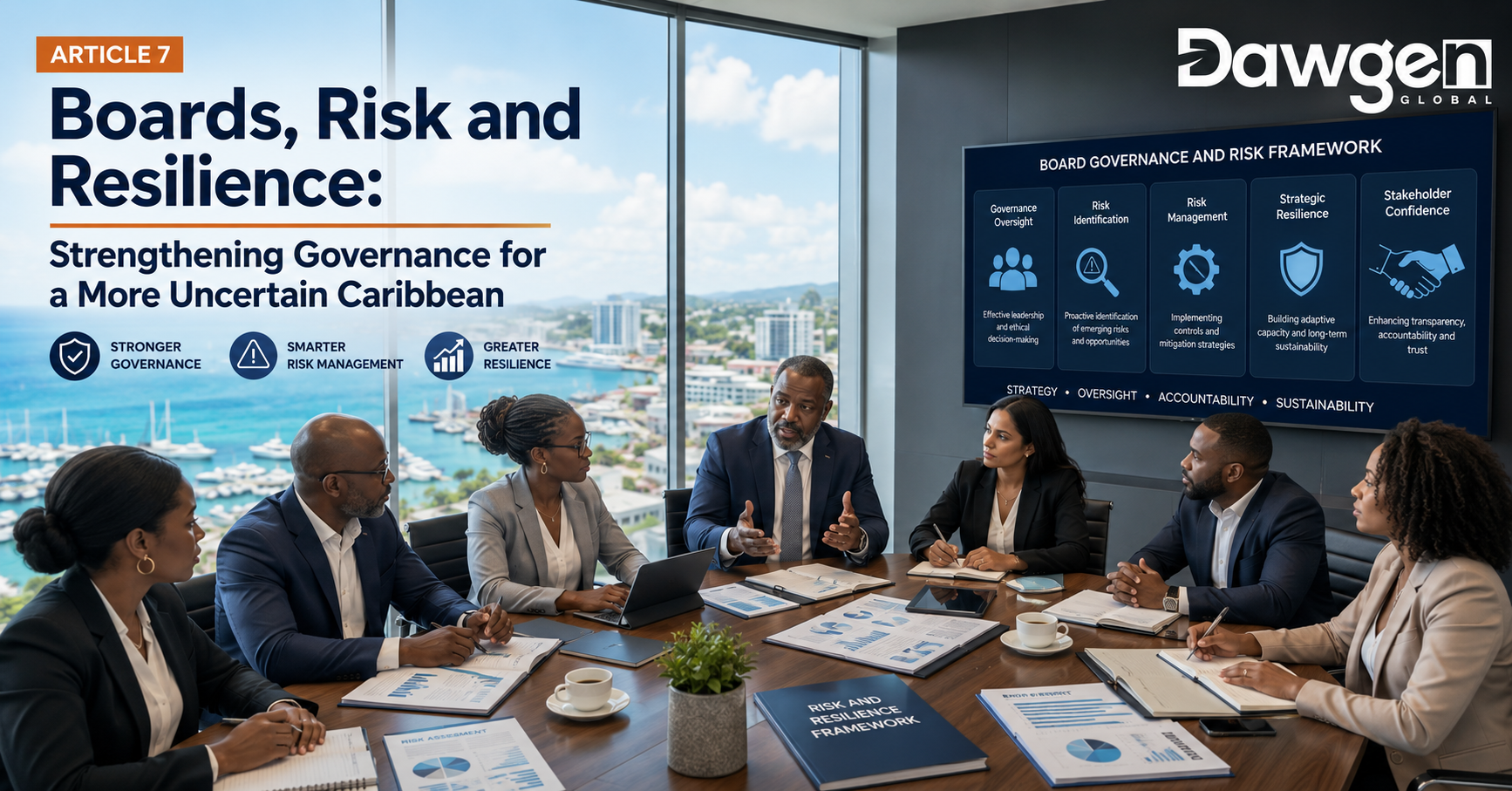
This article explores why governance matters more than ever, how boards should respond to uncertainty, what risk resilience should look like in Caribbean businesses, and how Dawgen Global can help organizations strengthen governance for a more uncertain future.
1. Why Governance Matters More in Today’s Caribbean Environment
Caribbean businesses operate in a region of opportunity, but also one of significant complexity. Many organizations face a combination of structural and emerging risks, including:
- Economic slowdown or uneven growth
- Inflation and interest rate pressure
- Currency volatility
- Climate change and extreme weather events
- Cybersecurity breaches and digital fraud
- Regulatory changes
- Tax compliance pressure
- Supply chain disruption
- Reputational risk in a digital media environment
- Leadership succession gaps
- Talent migration and skills shortages
- Technology disruption, including AI adoption risks
- Political and geopolitical uncertainty
These issues affect not only large organizations. SMEs, family-owned businesses, startups, scale-ups, regulated firms, nonprofits, and public-interest entities all face growing pressure to improve decision-making and oversight.
In such an environment, weak governance becomes costly.
Poor governance may result in:
- Slow or unclear decision-making
- Weak accountability
- Inadequate risk monitoring
- Poor financial oversight
- Conflict-of-interest issues
- Lack of preparedness for crisis events
- Investor mistrust
- Regulatory breaches
- Unclear succession planning
- Strategy drift
- Reputational damage
Good governance, by contrast, improves organizational stability, strengthens confidence, supports strategy, and enables leadership teams to respond more effectively to uncertainty.
2. Boards Must Shift from Oversight Alone to Strategic Resilience
Traditionally, many boards have been viewed primarily as oversight bodies. Their role was often framed around monitoring management, approving budgets, reviewing financial statements, and ensuring compliance with legal obligations.
Those functions remain important. But they are no longer sufficient.
In a more uncertain operating environment, boards must also contribute to:
- Strategic foresight
- Risk anticipation
- Crisis preparedness
- Leadership accountability
- Capital allocation discipline
- Technology and AI oversight
- Stakeholder trust
- Talent and succession planning
- Business continuity
- Long-term resilience
A resilient board is not passive. It asks hard questions, challenges assumptions, evaluates risk scenarios, and ensures the organization has the capabilities needed to adapt.
Boards should now be asking:
- What are the top risks facing the organization over the next 12–36 months?
- Are we prepared for a cyber incident or operational disruption?
- How exposed are we to foreign exchange, inflation, or financing pressure?
- Do we have sufficient management depth if a key leader exits?
- Are we governing technology and AI use appropriately?
- How robust are our internal controls and financial reporting?
- Are we receiving timely, decision-useful management information?
- Do our risk practices align with our strategy?
- Do we have an effective crisis management and business continuity plan?
- Are we prepared for climate-related or operational shocks?
These are no longer niche governance questions. They are board essentials.
3. Governance Is Not Only for Large Companies
One of the most common misconceptions in the Caribbean business landscape is that formal governance is mainly for listed companies, banks, insurers, or large enterprises.
That view is outdated.
Strong governance matters for:
Family businesses
Family businesses often face concentrated ownership, succession risks, related-party decision-making, and tension between family interests and business needs.
SMEs
Small and medium-sized enterprises may be highly founder-dependent and vulnerable to operational or financial shocks.
Startups and scale-ups
Growth businesses seeking investment need governance credibility, board discipline, and risk transparency.
Professional service firms
Advisory and service-based firms depend on trust, ethics, quality control, and reputational resilience.
Nonprofits and mission-driven organizations
These organizations must manage governance, donor confidence, accountability, and sustainability.
Larger private companies
Private companies need governance to support capital raising, expansion, valuation, risk management, and succession planning.
Governance should not be viewed as bureaucracy. It should be seen as infrastructure for sound decisions.
4. The Link Between Governance and Investor Confidence
Investors do not invest in financial projections alone. They invest in trust.
Whether the investor is a bank, pension fund, private equity firm, family office, development finance institution, or strategic buyer, one of the most important questions is: Can this organization be trusted to govern risk, make sound decisions, and protect capital?
Good governance supports investor confidence by demonstrating:
- Clear ownership and oversight
- Reliable financial reporting
- Internal control discipline
- Accountability for management
- Transparency in decision-making
- Ethical leadership
- Risk awareness
- Board effectiveness
- Succession planning
- Strategic clarity
Weak governance increases uncertainty. That uncertainty often translates into lower valuation, more intrusive investor conditions, delayed transactions, or outright rejection.
Dawgen Global believes that governance readiness should be a core part of investor readiness. A company that wants to raise capital or attract strategic partners should be able to show that its board, governance framework, and risk processes are fit for purpose.
5. What a Strong Caribbean Board Should Look Like
An effective board is not defined only by prestige or status. It is defined by relevance, competence, independence of thought, and the ability to guide the organization through complexity.
A strong board should demonstrate:
1. Appropriate skills mix
The board should include members with relevant expertise in finance, strategy, industry knowledge, governance, risk, law, technology, and people leadership.
2. Independence of thought
Even in owner-led or family-owned businesses, boards should include individuals who can challenge management constructively and objectively.
3. Clarity of role
The board should understand what it governs, what management executes, and how authority is delegated.
4. Regular, meaningful information flow
Board packs should contain concise, timely, decision-useful information—not just historical summaries.
5. Focus on strategy and risk
Board agendas should not be consumed entirely by routine matters. Time should be allocated to forward-looking issues.
6. Strong chairmanship
The board chair plays a critical role in setting tone, managing discussion, encouraging challenge, and ensuring governance quality.
7. Performance evaluation
Boards should periodically assess their effectiveness, composition, and gaps.
8. Ethical culture
Governance is not just structure. It is also tone, conduct, values, and accountability.
6. Risk Governance Must Be Strengthened
Risk management is often misunderstood as a technical or compliance function. In reality, risk governance is central to strategic resilience.
Risk governance means that the board and leadership understand:
- What the organization’s major risks are
- How those risks are being monitored
- Who is responsible for managing them
- What controls exist
- How risk affects strategy
- What escalation processes apply
- What contingency plans are in place
For Caribbean organizations, key risk categories may include:
Financial risk
Cash flow pressure, liquidity risk, debt servicing pressure, inflation, foreign exchange exposure, and profitability strain.
Operational risk
Process failure, supply chain interruptions, service delivery breakdown, or internal control weaknesses.
Cybersecurity and technology risk
Phishing, fraud, ransomware, data breaches, third-party tech failures, and poor governance of AI and digital tools.
Regulatory and compliance risk
Tax exposure, industry regulation, anti-money laundering requirements, data protection obligations, and reporting compliance.
Strategic risk
Poor market positioning, failed expansion, weak innovation, or inability to respond to competitive disruption.
People risk
Talent shortages, succession gaps, cultural issues, and leadership concentration risk.
Climate and environmental risk
Storm disruption, flooding, insurance availability, operational shutdown, and long-term resilience planning.
Reputational risk
Brand damage, social media backlash, customer dissatisfaction, ethical misconduct, or governance failures.
Boards do not need to manage every risk directly. But they do need to ensure that a sound risk governance framework is in place.
7. Resilience Is a Governance Outcome
Resilience is often discussed as if it were an operational issue alone. But true resilience is shaped at the governance level.
A resilient organization is one that can:
- Absorb shocks
- Maintain critical operations
- Adapt quickly
- Protect stakeholders
- Recover effectively
- Learn from disruption
- Reposition strategically
Governance enables resilience by ensuring:
- Roles and responsibilities are clear
- Risk monitoring is active
- Crisis escalation protocols exist
- Management is accountable
- Financial oversight is strong
- Strategic decisions are disciplined
- Continuity planning is in place
- The board is engaged in scenario thinking
Resilience is not only about surviving disasters. It is about being capable of navigating uncertainty while continuing to create value.
In the Caribbean, that resilience mindset is especially important because of the region’s exposure to climate events, global shocks, and market concentration risks.
8. Crisis Preparedness Is Now a Board-Level Duty
Many organizations have experienced some form of disruption in recent years—whether from hurricanes, pandemics, cyberattacks, economic slowdowns, or sudden regulatory change.
Yet some boards still do not treat crisis preparedness as a standing governance priority.
Boards should ensure that management has prepared for:
- Business continuity interruptions
- Disaster recovery events
- Cybersecurity incidents
- Key-person absence
- Financial distress scenarios
- Regulatory intervention
- Reputational crises
- Data loss or system failure
- Major legal disputes
- Supply chain breakdowns
A board should not wait for a crisis to discover that:
- There is no response protocol
- Roles are unclear
- Communication lines are weak
- Data backups are inadequate
- Decision-making is too slow
- Leadership succession is uncertain
Scenario planning, tabletop exercises, crisis communication protocols, and continuity planning are becoming increasingly important tools of good governance.
9. Governance and AI Oversight
Artificial intelligence is already changing how organizations operate. Businesses are adopting AI for customer service, analytics, reporting, workflow automation, risk detection, marketing, finance, and decision support.
This creates new governance questions.
Boards must now consider:
- What AI tools are being used in the business?
- Are staff using public AI tools appropriately?
- Is sensitive data protected?
- Are AI-generated outputs reviewed by humans?
- Do we have an AI acceptable-use policy?
- Are there cybersecurity or privacy implications?
- Are there regulatory or ethical issues?
- Could AI create reputational risk if misused?
AI governance is not just a technology issue. It is a board issue.
Companies that fail to govern AI well may face data leakage, poor decision-making, intellectual property risks, customer mistrust, or compliance exposure.
Dawgen Global believes that boards must begin including AI governance within their wider governance, risk, and resilience framework.
10. Succession Planning Is a Core Governance Priority
Many Caribbean businesses remain highly dependent on one founder, owner-manager, senior executive, or key professional. That dependency creates vulnerability.
Succession planning is therefore not optional.
Boards and business owners should consider:
- Who could step into key leadership roles if needed?
- Is management depth sufficient?
- Is knowledge concentrated in one person?
- Are next-generation leaders being developed?
- Does the organization have emergency succession plans?
- Is ownership succession aligned with governance and business needs?
This is particularly important for family businesses, closely held companies, and founder-led firms where leadership and ownership are closely intertwined.
A company may have a profitable business model and a strong market presence, yet still be fragile if succession has not been addressed.
Good governance turns succession from a sensitive afterthought into a strategic priority.
11. Governance in Family Businesses
Family businesses are central to many Caribbean economies. They often combine entrepreneurship, long-term commitment, and deep market knowledge. But they also face distinctive governance risks.
Common issues include:
- Blurred lines between family and business decisions
- Informal decision-making
- Succession tension
- Unequal involvement among family members
- Related-party transactions
- Conflicts between active and non-active owners
- Lack of independent oversight
- Unclear dividend policy
- Emotional decision-making in high-stakes situations
Good governance can help family businesses preserve value while managing complexity.
Useful tools include:
- Family constitutions
- Shareholder agreements
- Independent board members
- Advisory boards
- Formal succession plans
- Role definitions
- Conflict-of-interest policies
- Performance-based leadership structures
For family enterprises, governance is not anti-family. It is a structure that helps protect both the family and the business.
12. Governance Reporting Must Improve
Many boards cannot govern effectively if the information they receive is weak, delayed, or overly operational.
Strong governance depends on strong reporting.
Boards should receive regular reporting on:
- Financial performance
- Cash flow and liquidity
- Key risks
- Compliance issues
- Strategic initiatives
- Operational performance
- Cybersecurity and technology issues
- Internal control matters
- Human capital issues
- Litigation or dispute exposure
- ESG or sustainability issues where relevant
- Crisis preparedness and resilience indicators
The goal is not more paper. The goal is better insight.
Board reporting should be timely, relevant, clear, and focused on decision-making—not simply data accumulation.
13. Practical Steps Organizations Can Take Now
Organizations across the Caribbean do not need to wait for a crisis or investor demand to improve governance. They can begin now.
Recommended actions include:
- Review board composition and skills gaps.
- Clarify governance roles and delegated authority.
- Conduct a board effectiveness assessment.
- Strengthen management reporting to the board.
- Establish or update a formal risk register.
- Review internal controls and accountability structures.
- Develop or test business continuity and crisis response plans.
- Assess cybersecurity and AI governance readiness.
- Review succession planning for key leadership roles.
- Formalize governance policies for conflicts, ethics, and oversight.
- Consider adding independent directors or advisors.
- Ensure board agendas include strategy and resilience topics.
- Align governance with investor expectations and growth ambitions.
- Review family-business governance where applicable.
- Seek external advice to strengthen governance frameworks.
Incremental steps can significantly improve resilience over time.
14. How Dawgen Global Can Help
Dawgen Global supports boards, business owners, family enterprises, private companies, investors, and institutions in strengthening governance, risk oversight, and resilience.
Our services include:
- Governance reviews
- Board advisory services
- Board effectiveness assessments
- Risk governance frameworks
- Enterprise risk management support
- Business continuity and resilience planning
- Internal control reviews
- Audit and assurance
- Financial reporting advisory
- Investor readiness assessments
- Succession planning support
- Family business advisory
- AI governance advisory
- Cybersecurity risk advisory
- Compliance and legal advisory
- Strategic planning facilitation
- Business valuation and transaction support
- Leadership and business coaching
Dawgen Global’s integrated model allows us to connect governance, strategy, finance, risk, technology, compliance, and people issues into one coherent advisory solution.
Conclusion: Strong Governance Is a Competitive Advantage
The Caribbean’s future will be shaped not only by entrepreneurship and opportunity, but also by how well organizations govern risk and build resilience.
In a more uncertain environment, governance is not a back-office concern. It is a strategic necessity. Boards must become more engaged, more informed, more forward-looking, and more willing to challenge assumptions. Organizations must strengthen oversight, risk management, succession, reporting, and crisis preparedness. Businesses that do so will be better positioned to protect value, inspire investor confidence, navigate disruption, and pursue sustainable growth.
Dawgen Global believes that strong governance is now a competitive advantage.
Organizations that build strong boards, smarter risk management, and greater resilience will not only survive uncertainty. They will be better equipped to lead through it.
Next Step:
Is your board, business, family enterprise, or organization ready to strengthen governance, improve risk oversight, and build resilience for a more uncertain future?
Request a proposal from Dawgen Global today.
📧 Email: [email protected]
🌐 Contact Form: https://www.dawgen.global/contact-us/
📞 Caribbean: 876-9293670 | 876-9293870
📞 💬 WhatsApp Global: +1 555 795 9071
At Dawgen Global, we help you make smarter and more effective decisions. Let’s have a conversation.
About Dawgen Global
“Embrace BIG FIRM capabilities without the big firm price at Dawgen Global, your committed partner in carving a pathway to continual progress in the vibrant Caribbean region. Our integrated, multidisciplinary approach is finely tuned to address the unique intricacies and lucrative prospects that the region has to offer. Offering a rich array of services, including audit, accounting, tax, IT, HR, risk management, and more, we facilitate smarter and more effective decisions that set the stage for unprecedented triumphs. Let’s collaborate and craft a future where every decision is a steppingstone to greater success. Reach out to explore a partnership that promises not just growth but a future beaming with opportunities and achievements.
 Email: [email protected]
  Visit: Dawgen Global Website

 WhatsApp Global Number : +1 555-795-9071
Caribbean Office: +1876-6655926 / 876-9293670/876-9265210  WhatsApp Global: +1 5557959071
USA Office: 855-354-2447
Join hands with Dawgen Global. Together, let’s venture into a future brimming with opportunities and achievements


