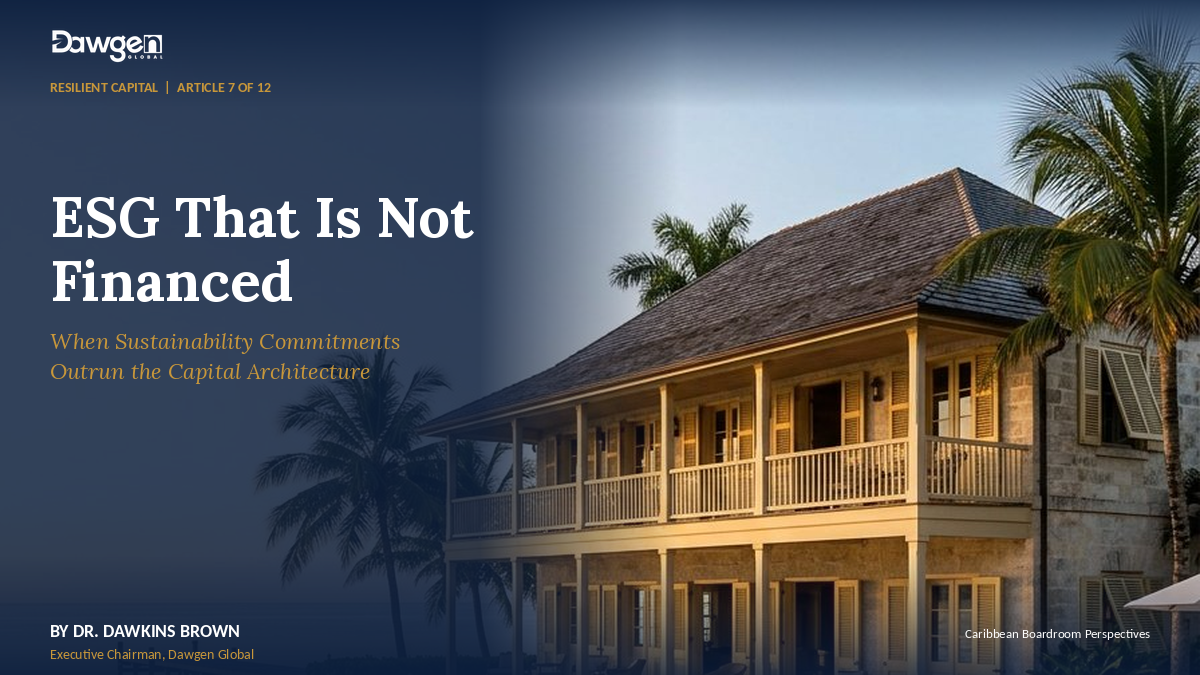
Reserve Bay Hospitality Group — the name is composite, the events are real — is a Caribbean integrated hospitality enterprise I have spent considerable time advising. The group operates four properties across two territories: a five-hundred-and-twenty-room flagship resort on a Jamaican north-coast site, a smaller boutique sister property at one hundred and forty rooms on the same coast, a three-hundred-room family resort property in Barbados, and a recently acquired ninety-room boutique property on the south coast of the same island. Total room inventory of approximately one thousand and fifty keys. Annual revenue in the range of US$112 million. Adjusted EBITDA of approximately US$22 million. The group is well-managed by a competent third-generation family management team supported by a credible board including independent directors, has strong relationships with international tour operators, and is regarded across the regional industry as one of the better-run mid-market hospitality groups in the Caribbean.
In November 2024, Reserve Bay’s marketing department launched what it described as the group’s flagship sustainability platform — a three-pillar public commitment programme covering carbon neutrality across owned operations by 2030, complete elimination of single-use plastics across all four properties by end of 2027, and a coral-reef-and-coastal-ecosystem protection programme spanning the marine areas adjacent to the three properties with reef-fronted operations. The launch produced exactly the marketing response the team had hoped for: trade-press coverage, two travel-industry sustainability awards, a meaningful uplift in bookings from European source markets where sustainability credentials carry purchase weight, and a positive reception from the group’s lender relationships. The board endorsed the platform unanimously.
In March 2026 — sixteen months after the launch, four years before the most aggressive of the three commitments would come due — Reserve Bay’s chief financial officer asked the advisory team a direct question. The question was not whether the commitments were the right commitments. The question was not whether the marketing platform had been worth the investment. The question was whether the capital architecture of the group, as it currently existed, could actually deliver the commitments the marketing platform had publicly made. The CFO’s intuition was that the answer was no. The advisory work that followed confirmed the intuition, and quantified it more sharply than any participant in the discussion had expected.
This article is about that quantification. It is also about a deeper structural insight that the Reserve Bay engagement crystallised, and that I now believe is one of the most consequential observations the Dawgen Resilient Capital Structure Framework has produced. The insight is that the gap between Caribbean enterprises’ public sustainability commitments and the capital architecture that would fund them does not require a separate diagnostic tool to surface. The five tools already published in this series — the Concentration Diagnostic Matrix™, the Maturity Wall Heat-Map™, the Capital Resilience Index™, the Covenant Stress Heat-Map™, and the Liquidity Layering Stack™ — already produce, when applied to the ESG capital question with discipline, an unusually clear picture of where the gap is, how large it is, and what would close it. Pillar 6 is not a separate diagnostic problem. Pillar 6 is what the existing diagnostics see when they are pointed at the ESG capital question.
| THE QUIET PATTERN
Most Caribbean enterprises publishing sustainability commitments in 2024 and 2025 did so without a parallel exercise to determine whether the capital architecture of the enterprise could fund the commitments. The exercises that did occur were typically led by sustainability and marketing functions, not by treasury, and produced commitment language calibrated against aspiration rather than against capital. The result is a regional pattern in which the public commitments and the capital architecture have, with very little planning to the contrary, ended up running on substantially different timelines. |
What Pillar 6 Actually Measures
Pillar 6 of the Dawgen Resilient Capital Structure Framework — ESG Integration — is the structural alignment between the enterprise’s stated environmental, social, and governance commitments and the capital architecture that would actually deliver those commitments under realistic operating conditions. The pillar is not about whether the commitments are the right commitments. The pillar is not about whether the commitments are well-marketed. The pillar is about whether the capital required to deliver the commitments has been identified, sourced, and integrated into the enterprise’s existing capital architecture in a way that does not stress the other pillars beyond what the enterprise is structurally able to absorb.
The conventional approach to ESG commitment management in Caribbean enterprise — where structured approach exists at all — is to treat the commitments as a strategic, brand, or compliance matter that sits inside the office of the CEO, the chief sustainability officer, the chief marketing officer, or some combination of the three. Capital implications are addressed, where they are addressed, through annual capex budgeting, project-by-project, with the implicit expectation that each project’s capital can be sourced through the existing financing relationships at the time the project is initiated. The ESG commitments and the capital architecture are managed in parallel rather than in integration, and the assumption that capital will be available when needed is rarely tested in advance against the cumulative quantum of capital the full set of commitments will require.
The structural problem with this approach is that ESG commitments, by their nature, are cumulative rather than episodic. A commitment to carbon neutrality by 2030 does not mean one capital expenditure in 2029. It means a sequence of capital expenditures over five to eight years — equipment replacement, renewable generation, building envelope upgrades, fleet transition, supplier-chain redesign — which together produce a capital requirement that is structurally larger than any single year’s project capex. A commitment to single-use plastic elimination is not a one-time procurement decision. It is a sustained substitution programme requiring inventory write-downs of replaced consumables, premium pricing on substitute materials, supplier-relationship redesign, and operational training, all sustained over a multi-year transition window. A coral reef and coastal ecosystem programme is not an annual donation. It is a long-duration funding commitment with measurement, reporting, and renewal obligations that themselves require capital. The cumulative quantum is the structural risk. The cumulative quantum is what the existing diagnostics surface when they are turned on the ESG capital question with discipline.
| THE COMMITMENT VERSUS THE CAPITAL
An ESG commitment is a public statement about a future state of the enterprise. ESG capital is the architecture of resources that will move the enterprise from its current state to that future state. The two are different artifacts. They are managed by different people. They sit in different parts of the organisation. They are reported to different audiences. The structural risk is that the commitment is calibrated against ambition, and the capital is calibrated against budget, and the two calibrations have no formal relationship. Pillar 6 is the discipline of forcing the relationship into existence. |
Why This Matters Now in the Caribbean
The Caribbean ESG environment of 2026 produces a set of pressures on regional enterprise that the public conversation about ESG commitments has, in our experience, not yet fully absorbed. The pressures are real, they are accelerating, and they are structurally different from the pressures the same enterprises faced when many of these commitments were first published. The pressures fall into four categories, each of which converts an aspirational commitment into an operational obligation with a capital footprint.
The first pressure is the increasing specificity of disclosure obligations. The IFRS Sustainability Disclosure Standards (S1 and S2), the European Union’s Corporate Sustainability Reporting Directive in its third year of phased application, the United States Securities and Exchange Commission’s climate-related disclosure rules in their second year of effect, and several Caribbean jurisdictions’ adoption of ISSB-aligned reporting requirements together mean that regional enterprises with operations or supply-chain exposure into these jurisdictions are now subject to specific, quantitative, audit-grade reporting on ESG metrics. A commitment that was, in 2022, an aspirational marketing claim is, in 2026, a reportable metric subject to assurance review. The capital required to deliver the metric, and the capital required to measure and report the metric, have both moved from optional to mandatory.
The second pressure is the increasing weight that international tour operators, institutional buyers, and large procurement programmes place on supplier ESG credentials in their own supply-chain due diligence processes. A Caribbean hospitality group that has committed to coral reef protection is, in 2026, not merely making a marketing claim. It is making a representation that flows through to the contractual relationships its tour operator partners have with their own end-market customers. A regional manufacturer that has committed to lower-carbon production processes is making a representation that flows through to the carbon-border-adjustment-mechanism reporting its export customers must produce. The commitments are increasingly part of the contractual fabric of the underlying revenue relationships, not merely part of the brand.
The third pressure is the meaningful expansion of regional sustainability-linked financing in the period from 2023 to 2026. Caribbean sovereigns have issued green bonds, blue bonds, and debt-for-nature swaps at unprecedented volumes — Belize’s debt-for-nature transactions, Barbados’s blue economy financing, Bahamas’s coral reef facilities, Jamaica’s catastrophe-linked instruments — and the corporate ESG-linked debt market has expanded in parallel. Caribbean enterprises that engage with this financing market access pricing benefits and term structure benefits that are real and material; enterprises that do not engage either accept higher cost of capital or rely on conventional financing in an environment where conventional financing is itself increasingly assessed on ESG criteria. The financing-side incentives now favour enterprises whose ESG commitments are matched by ESG capital architecture, and disfavour enterprises whose commitments stand alone.
The fourth pressure is the most consequential and the least discussed. The pressure is reputational asymmetry. An enterprise that publishes a sustainability commitment in 2024 and visibly fails to deliver against it in 2030 will face reputational consequences materially worse than an enterprise that never made the commitment in the first place. The asymmetry is structural rather than fair: making the commitment created an expectation, and the failure to deliver against the expectation is a more visible failure than the absence of any commitment would have been. This means that the capital required to deliver against published commitments is not optional capital. It is capital the enterprise has committed itself to deploying, whether or not the deployment was contemplated in the financing architecture at the time of the commitment, and whether or not the financing architecture is currently capable of producing the capital.
The Integration Insight
This is the article in the Resilient Capital Series where the framework’s design philosophy becomes visible. Articles 2 through 6 have introduced six proprietary diagnostic tools, each addressing a specific structural pillar of the DRCS-F™. The tools have been presented sequentially, each with its own composite anchor and its own deployment methodology. A reader following the series might reasonably conclude that each new pillar will require its own new tool, and that Pillar 6 will require an eighth proprietary diagnostic addressing ESG capital integration.
The argument of this article is that the conclusion is wrong. The five tools already published — the Concentration Diagnostic Matrix™ (Article 2), the Maturity Wall Heat-Map™ (Article 3), the Capital Resilience Index™ (Article 4), the Covenant Stress Heat-Map™ (Article 5), and the Liquidity Layering Stack™ (Article 6) — together produce a substantially more rigorous diagnostic of the ESG capital question than any standalone ESG diagnostic the regional advisory market currently produces. The framework’s value at this point in the series is not the addition of further tools. The framework’s value is the demonstration that the existing tools, properly applied, already cover the territory that ESG-specific tools claim to cover, and cover it with the discipline of capital architecture rather than the looseness of sustainability scoring.
This is a strategic position as well as a methodological one. The regional advisory market in 2026 is over-toolified on ESG. Every major consulting firm has its own ESG framework, ESG scorecard, ESG diagnostic, and ESG benchmarking output. The proliferation has produced fatigue rather than clarity in the boards we work with. The argument the DRCS-F™ makes is that the ESG question, properly understood, is not a separate scoring exercise. It is a capital architecture question. And capital architecture is what the existing tools already address.
| THE STRATEGIC FRAME
There are two ways an advisory framework can demonstrate its strength. The first is to keep adding new tools, signalling intellectual breadth through proliferation. The second is to demonstrate that the existing tools already cover what they need to cover, signalling intellectual coherence through restraint. The DRCS-F™ chooses the second. Pillar 6 is the article where the choice becomes visible. |
The Reserve Bay Engagement
Returning to Reserve Bay Hospitality Group. The advisory engagement that followed the CFO’s question in March 2026 was structured around a single deliverable: an integrated diagnostic showing how each of the four primary DRCS-F™ tools rendered the ESG capital question for the Reserve Bay group specifically. The deliverable did not introduce any new framework element. It simply applied the existing framework to the question the CFO had asked, and produced four distinct outputs that, taken together, constituted the full diagnostic answer.
The first step was to scope the capital requirement. The advisory team worked with the Reserve Bay sustainability team and external technical advisors to produce a defensible estimate of the cumulative capital required to deliver against the three published commitments over the period from 2026 to 2030. The estimate came in at approximately US$28 million across the three commitment streams — US$19 million for the carbon neutrality programme (renewable generation, energy efficiency, fleet transition, building envelope), US$5.5 million for the single-use plastic elimination programme (substitution capex, premium pricing on substitute consumables, supplier redesign), and US$3.5 million for the reef and ecosystem programme (long-term funding commitment, monitoring infrastructure, scientific partnership). The US$28 million estimate had not previously been produced inside Reserve Bay; the commitments had been published without a quantified capital requirement.
Once the cumulative requirement was scoped, the four DRCS-F™ tools were each applied to test how the requirement would interact with the existing capital architecture. The four outputs that resulted were the diagnostic answer.
Output One — The Capital Resilience Index™ Applied
The CRI™, introduced in Article 4, measures the survival horizon of the enterprise under sustained absence of operating revenue. Reserve Bay’s CRI™ at the start of the engagement was 142 days — a Level 3 Adequate rating, modestly ahead of the regional hospitality median but well short of best-in-class. The diagnostic question for ESG integration was: how does the CRI™ change when US$28 million of incremental capex is added to the obligation profile over the four-year transition window without a corresponding increase in liquidity capacity?
The recalculated CRI™ produced an answer the Reserve Bay board had not anticipated. With the ESG capex added to the existing obligation profile and held within the existing liquidity architecture, the group’s CRI™ degraded from 142 days to 88 days — a fall from Level 3 Adequate to Level 2 Exposed. The capital required to deliver the published commitments, in the absence of a parallel programme to enlarge the liquidity architecture, would convert Reserve Bay from an adequately resilient hospitality group to a structurally exposed one. The CRI™ output was not an ESG output in any conventional sense. It was a capital resilience output. But it answered the ESG capital integration question more directly than any standalone ESG diagnostic could have.
Output Two — The Maturity Wall Heat-Map™ Applied
The Maturity Wall Heat-Map™, introduced in Article 3, surfaces concentration risk in the maturity profile of the enterprise’s outstanding debt. Reserve Bay’s existing Maturity Wall, before the ESG integration analysis, showed a moderately concentrated profile with US$32 million of senior debt maturing in a fourteen-month window in 2027–2028. The diagnostic question for ESG integration was: how does the maturity profile change when US$28 million of additional capex is funded — under each of three plausible financing approaches — and how do those approaches interact with the existing maturity wall?
The three financing approaches tested produced three different Heat-Map outputs. Approach one, funding the ESG capex through extension of the existing senior facility at the 2027–2028 refinancing window, would have produced a Maturity Wall with US$60 million concentrated in the same fourteen-month window — a substantial structural worsening of an already-concentrated profile. Approach two, funding the ESG capex through a separate sustainability-linked term facility with a longer tenor, would have left the existing maturity wall unchanged but added a new tranche at 2031–2033 with its own concentration profile. Approach three, splitting the ESG capex between a sustainability-linked facility and an asset-backed renewable energy facility tied to the on-property solar installations, would have produced the most diversified Maturity Wall of the three options. The Maturity Wall Heat-Map™ did not measure ESG; it measured the maturity profile. But it surfaced, with unusual clarity, that the financing structure chosen for the ESG capex would itself be a Pillar 2 decision with consequences for the broader resilience architecture.
Output Three — The Covenant Stress Heat-Map™ Applied
The Covenant Stress Heat-Map™, introduced in Article 5, surfaces structural pressure on the enterprise’s covenant architecture under defined stress scenarios. Reserve Bay’s existing Heat-Map showed a moderately diffuse pattern with two Red cells and three Amber cells across the standard five-scenario coverage. The diagnostic question for ESG integration was: how does the Heat-Map change when US$28 million of additional debt is added — and, separately, how does the introduction of sustainability-linked covenants in the new financing interact with the existing covenant architecture?
The recalculated Heat-Map produced two distinct findings. The first finding was that the leverage covenant on the existing senior term loan, currently registering Amber under the standard scenarios, would degrade to Red across three of the five scenarios with the additional ESG-related debt added to the balance sheet, regardless of the specific structure chosen. This was a quantum problem: the additional US$28 million in obligations, however financed, expanded the leverage ratio meaningfully under stress. The second finding was that the introduction of sustainability-linked covenants in the new financing — which the favoured financing structure would have included — produced a previously unseen covenant exposure under the operating scenarios. A sustainability-linked covenant calibrated against the published commitments would have, on Reserve Bay’s actual operating data, registered Critical under two of the five scenarios because the published commitments were themselves more aggressive than the operating data would support under stress. The covenant architecture would, in other words, have converted the ESG ambition into a binding contractual obligation with operating-level penalties for under-delivery. The Covenant Stress Heat-Map™ did not measure ESG; it measured covenant pressure. But it surfaced that the ESG financing decision would itself become a Pillar 4 decision with structural implications.
Output Four — The Liquidity Layering Stack™ Applied
The Liquidity Layering Stack™, introduced in Article 6, surfaces the architecture of the enterprise’s multi-tier liquidity position. Reserve Bay’s existing Stack at the start of the engagement passed the Depth Test marginally and failed the Separation Test on two of the five separation hazards. The diagnostic question for ESG integration was: what does the addition of a multi-year ESG capital programme do to the Stack — and is the Stack architecture currently capable of absorbing the additional draw on liquidity that the programme will require?
The recalculated Stack output produced the most actionable finding of the four. The ESG capital programme, by its nature, would extract liquidity from the operating cash and committed-line tiers in a sustained pattern over four to five years rather than in episodic capex events. Reserve Bay’s existing Stack — Tier 1 cash of US$8 million, a single committed line of US$15 million, no Tier 3 contingent facility, an under-developed Tier 4 reserve facility, and no Tier 5 contingent equity — was structurally unsuited to a sustained four-year liquidity draw of the magnitude the ESG programme would require. The Stack architecture would either need to be substantially rebuilt — adding a Tier 3 contingent facility, formalising the Tier 4 reserve, identifying credible Tier 5 contingent equity — or the ESG programme would need to be paced differently than the published commitments implied. The Liquidity Layering Stack™ did not measure ESG; it measured liquidity layering. But it surfaced, with unusual practical clarity, what the architectural rebuild would actually need to look like.
The Integrated Finding
Taken individually, each of the four diagnostic outputs above is consequential. The Reserve Bay CRI™ degrading from Level 3 to Level 2 is consequential. The Maturity Wall concentration depending on the financing structure is consequential. The covenant exposure under sustainability-linked structures is consequential. The Stack architecture being structurally unsuited to a sustained four-year liquidity draw is consequential. Any one of the four would, in isolation, justify a substantial board-level conversation about the relationship between the published commitments and the capital architecture.
Taken together, the four outputs constitute the diagnostic answer to the question the Reserve Bay CFO asked in March 2026. The capital architecture of Reserve Bay, as it currently existed, could not deliver the commitments the marketing platform had publicly made — not because any one tool produced a fatal finding, but because all four tools produced findings that, when integrated, demonstrated structural mismatch across the resilience architecture. The mismatch was not addressable through any single intervention. The mismatch required a coordinated programme touching liquidity layering, maturity profile, covenant architecture, and overall capital resilience.
The Reserve Bay board’s response to the integrated diagnostic was, in our experience, the response a serious board produces when confronted with this kind of finding. The board did not abandon the published commitments. The board did not modify the published commitments. The board did, however, commission an eighteen-month integrated capital architecture rebuild — Tier 3 contingent facility procured, Tier 4 reserve facility formalised, sustainability-linked term financing structured with covenant calibration tested against actual operating data, maturity profile diversified through the financing structure choice, equity cure rights expanded across the senior covenant package — and produced, by month eighteen, a recalculated DRCS-F™ output in which the published commitments and the capital architecture were once again aligned. The CRI™ recovered from 88 days back to 154 days. The Maturity Wall registered three discrete concentration zones rather than a single concentrated wall. The Covenant Stress Heat-Map™ moved from a starting position of two Red cells under stress to one Red cell. The Liquidity Layering Stack™ passed the Separation Test on four of five hazards. The published commitments were unchanged, but the capital architecture supporting the commitments was substantially different from the architecture that had existed when the commitments were made.
| THE STANDARD
A serious Caribbean board, in 2026, has integrated the ESG capital question into its existing capital architecture diagnostics rather than managing it as a separate exercise. The board has tested its published commitments against the CRI™, against the Maturity Wall Heat-Map™, against the Covenant Stress Heat-Map™, and against the Liquidity Layering Stack™. The board knows where the integrated outputs produce mismatch with the architecture, and it has a named-owner remediation plan for each mismatch. That is the standard. The exercise is governance work, and it can begin at the next audit committee meeting. |
The General Pattern
The Reserve Bay engagement illustrates a diagnostic pattern that, in our advisory experience, is broadly applicable across Caribbean enterprise. The pattern is that ESG capital integration questions, when tested through the existing DRCS-F™ tools, almost always surface findings on at least three of the four primary diagnostics. The Capital Resilience Index degrades meaningfully under the addition of cumulative ESG capex. The Maturity Wall is sensitive to the financing structure chosen for the ESG capex. The Covenant Stress Heat-Map surfaces both quantum exposure (more debt produces more covenant pressure under stress) and structure exposure (sustainability-linked covenants introduce new failure modes). The Liquidity Layering Stack surfaces the sustained-draw architecture problem that conventional event-based liquidity planning is structurally unsuited to address.
This is, in our experience, a stable pattern. We have run the integrated diagnostic on enough Caribbean enterprises by 2026 to be reasonably confident that the pattern is structural rather than coincidental. The diagnostic is also instructive in what it does not surface: the Concentration Diagnostic Matrix™ from Article 2, which addresses the distribution of capital sources across counterparty, currency, instrument, geography, and structure dimensions, is the one tool of the five that typically does not produce a major ESG-relevant finding. The reason is that ESG integration affects the quantum and timing of capital but typically does not, in itself, produce concentration risk. This negative finding is itself useful: it indicates that the framework is doing its work, distinguishing the dimensions of capital architecture that ESG integration affects from the dimensions it does not.
The Standing Pillar 6 Discipline
There is a specific quarterly governance discipline that the DRCS-F™ recommends for Pillar 6, parallel to the disciplines established for the other pillars. We call it walking the integration. The discipline is straightforward. At each audit committee meeting, the most current DRCS-F™ diagnostic outputs — the CRI™, the Maturity Wall, the Covenant Stress Heat-Map™, the Liquidity Layering Stack™ — are reviewed not as four separate exhibits but as four projections of the same underlying capital architecture, each capable of revealing a different facet of the ESG integration question. The committee asks one specific question for each tool: has the published ESG commitment set, against the current capital architecture, produced a deterioration in this diagnostic since the previous quarter.
If the answer to all four questions is no, the integration is holding. If the answer to one of the four is yes, the integration is under selective pressure and a specific intervention can be designed. If the answer to two or more of the four is yes, the integration has degraded and a coordinated rebuild — like the Reserve Bay rebuild described above — is the appropriate response. The discipline is governance work, not technical work. The technical work has already been done in the production of the underlying diagnostics. The discipline is ensuring that the diagnostics are read together, with the ESG integration question explicitly in mind, rather than reviewed in isolation.
There are three specific questions any Caribbean board director should be willing to ask, and to keep asking, in the context of Pillar 6 oversight. The first is whether the enterprise has a quantified capital requirement for each published ESG commitment, at appropriate confidence level, and whether that requirement is reconciled with the cumulative capex programme. The second is whether the four primary DRCS-F™ diagnostics have been recalculated with the ESG capital programme integrated into the obligation profile, and what the recalculated outputs show. The third is whether the financing structure proposed for the ESG capex has itself been tested through the diagnostics — the Maturity Wall implications, the covenant implications, the liquidity implications. None of these three questions is technically difficult. All three should produce uncomfortable conversation in the typical Caribbean boardroom in 2026, and the discomfort is the early warning that the integration work is needed.
Pillar 6 in the Resilience Architecture
Pillar 6 — ESG Integration — is the structural complement to Pillars 2, 3, 4, 5, and 7 that the previous articles in this series examined. Where Pillar 7 asks how the threads of the capital structure are distributed and Pillar 2 asks when those threads come due and Pillar 3 asks how long the structure can withstand sustained absence of revenue and Pillar 4 asks what the lenders will do under pressure and Pillar 5 asks how the enterprise’s liquidity is layered, Pillar 6 asks whether the public commitments the enterprise has made are aligned with the capital architecture that the other five pillars describe. The pillar is not separate from the others. The pillar is the integration question that the others, taken together, answer.
This article is also the article in the series where the framework’s deeper organising principle becomes visible. The DRCS-F™ is not a collection of ten independent diagnostics. The DRCS-F™ is an integrated architecture in which each pillar interacts with the others, in which a stress event in one pillar propagates through the others, and in which the resilience of the enterprise depends on the coherence of the architecture as a whole rather than on the independent strength of any one pillar. Articles 2 through 6 introduced the diagnostic tools that allow each pillar to be assessed individually. Article 7 introduces the integration discipline that allows the assessments to be read together. Articles 8 through 12 will return to the pillar-by-pillar treatment, but with the integration insight now established.
From Commitment to Capital
The published ESG commitments of the typical Caribbean enterprise in 2026 were, in the main, made in good faith. They reflected genuine ambition, genuine engagement with regional sustainability challenges, and genuine recognition of the changing expectations the enterprise faces from customers, investors, regulators, and the communities in which it operates. The commitments were not strategic theatre. The problem the Reserve Bay engagement surfaces is not a problem of insincerity. The problem is a problem of architecture: the commitments were made through one set of organisational processes, and the capital that would deliver them was managed through a different set of organisational processes, and the two sets of processes were not formally integrated.
The discipline of Pillar 6 is the discipline of forcing the integration into existence. The discipline does not require new commitments. The discipline does not require backing away from existing commitments. The discipline requires that the capital implications of the existing commitments be made visible — through the existing DRCS-F™ tools, applied with discipline — and that the gaps between the commitments and the capital be closed through the same capital-architecture interventions that the framework has been describing throughout this series. The work is not separate ESG work. The work is capital architecture work, applied to a category of obligations that has expanded into a category the architecture must now be designed to absorb.
In our advisory experience, the proportion of Caribbean enterprises with material published ESG commitments whose existing DRCS-F™ diagnostics, integrated with the cumulative capital implications of those commitments, would produce findings in two or more of the four primary tools exceeds three-quarters. This is not a statement about the quality of the commitments. It is a statement about the gap between the commitments and the architecture. The window in which the gap can be closed proactively, through coordinated capital architecture work, is open today. The discipline of running the integration is the discipline of keeping the window open. That is the work, and like all the other work in this series, it begins at the next board meeting.
| YOUR SEVENTH ADVISORY ACTION
Before the next audit committee meeting, ask the chief sustainability officer and the chief financial officer to produce, jointly, a single document showing each material published ESG commitment, the quantified capital required to deliver it, and a recalculation of each of the four primary DRCS-F™ diagnostics with the cumulative capital implications integrated. The four recalculated outputs are your enterprise’s first integrated Pillar 6 diagnostic. If two or more of the four show meaningful deterioration, the next agenda item is the coordinated remediation roadmap. |
ENGAGE DAWGEN GLOBAL CORPORATE ADVISORY
Three Ways to Begin
If this article has prompted a serious question about your enterprise’s capital structure resilience, the next move is rarely a financing transaction. It is a conversation. Dawgen Global Corporate Advisory works with Caribbean boards, CFOs, founders and family business principals to translate the DRCS-F™ into a structured programme — sized to the enterprise, calibrated to the sector, and grounded in the disciplines that distinguished Jamaica’s sovereign architecture under Hurricane Melissa. There are three ways to begin, depending on where the enterprise stands today.
| PATHWAY 1 RECOMMENDED FOR MOST ENTERPRISES
The Capital Resilience Diagnostic™ A scoped, structured engagement that produces an investor-grade view of your capital structure resilience — and a board-ready roadmap to strengthen it. What you receive: → Capital Structure Resilience Report with your current Capital Resilience Rating™ (Levels 1–5) → 50-point Capital Resilience Index™ score across all ten pillars → Designed Liquidity Layering Stack™ with named providers and tested activation conditions → Covenant Stress Heat-Map™ under base, downside and severe scenarios → Recovery Velocity Score™ benchmarked against your sector → Capital Source Mix Wheel™ with current vs. target diversification roadmap → Boardroom Reporting Pack ready for the next board or audit committee meeting Engagement profile: Typically 4–6 weeks. Led by senior Dawgen Global advisory partners. Scoped to enterprise size. Outputs delivered to the board, not buried in management. To begin: Email [email protected] with the subject line “DRCS-F Diagnostic — [Company Name]”. A senior advisor will respond within one business day. |
| PATHWAY 2 FOR BOARDS NOT YET CONVINCED
The DRCS-F™ Boardroom Briefing A 60-minute structured briefing delivered to your board or audit committee, in person or virtually, by a senior Dawgen Global advisory partner. The briefing walks the board through: → The post-Melissa landscape and what it implies for the enterprise’s specific sector → A live walk-through of the ten DRCS-F™ pillars against the enterprise’s known risk profile → Three to five board-level questions that should be on the next audit committee agenda → An indicative Capital Resilience Rating™ band based on what is publicly observable about the enterprise Engagement profile: 60 minutes. Complimentary for qualifying boards (mid-market and listed enterprises in the Caribbean). Outputs include a 4-page board memorandum. To request: Email [email protected] with the subject line “Boardroom Briefing Request — [Company Name]”. |
| PATHWAY 3 FOR PRACTITIONERS AND SELF-DIRECTED READERS
Request the Framework Receive the full DRCS-F™ Framework Edition 1.0 — 60+ pages, ten pillars, five proprietary tools, six sector playbooks, and the implementation roadmap. Most useful for: → CFOs and treasurers conducting their own self-diagnostic ahead of a board conversation → Lenders, investors and DFIs benchmarking Caribbean borrower resilience → Sector associations, business chambers and policy institutions seeking a diagnostic tool → Family business principals preparing for a generational transition To request: Email [email protected] with the subject line “DRCS-F Edition 1.0 Request — [Your Role / Organisation]”. |
About the Series, the Author, and Dawgen Global
About This Series
“Resilient Capital: The Caribbean Capital Structure Imperative” is a twelve-article flagship series by Dawgen Global, published through Caribbean Boardroom Perspectives and The Caribbean Advisory Brief on LinkedIn, the Dawgen Global blog, and partner channels across the region. The series is anchored on the Dawgen Resilient Capital Structure Framework™ (DRCS-F™), Edition 1.0, May 2026.
About the Author
Dr. Dawkins Brown is the Executive Chairman and Founder of Dawgen Global. With Big Four heritage and decades of regional advisory experience, Dr. Brown leads Dawgen Global’s strategic positioning across audit, tax, advisory, ESG, governance, cybersecurity, and digital transformation services. He writes the weekly Caribbean Boardroom Perspectives newsletter on LinkedIn.
About Dawgen Global
Dawgen Global is an independent, integrated multidisciplinary firm offering Audit & Assurance, Tax Advisory, IT & Digital Transformation, Risk Management, Cybersecurity, HR Advisory, M&A, Corporate Recovery, Business Advisory, Accounting BPO and Virtual CFO services, and Legal Process Outsourcing. The firm’s tagline — Big Firm Capabilities. Caribbean Understanding. — captures both its global standards and its regional grounding. Dawgen Global is not affiliated with any international audit network.
© 2026 Dawgen Global Group. All rights reserved.
DRCS-F™, Liquidity Layering Stack™, Covenant Stress Heat-Map™, Capital Resilience Index™, Maturity Wall Heat-Map™, Refinancing Lead-Time Calculator™, Concentration Diagnostic Matrix™, Capital Resilience Rating™ and related framework elements are trademarks of Dawgen Global Group.
About Dawgen Global
“Embrace BIG FIRM capabilities without the big firm price at Dawgen Global, your committed partner in carving a pathway to continual progress in the vibrant Caribbean region. Our integrated, multidisciplinary approach is finely tuned to address the unique intricacies and lucrative prospects that the region has to offer. Offering a rich array of services, including audit, accounting, tax, IT, HR, risk management, and more, we facilitate smarter and more effective decisions that set the stage for unprecedented triumphs. Let’s collaborate and craft a future where every decision is a steppingstone to greater success. Reach out to explore a partnership that promises not just growth but a future beaming with opportunities and achievements.
 Email: [email protected]
  Visit: Dawgen Global Website

 WhatsApp Global Number : +1 555-795-9071
Caribbean Office: +1876-6655926 / 876-9293670/876-9265210  WhatsApp Global: +1 5557959071
USA Office: 855-354-2447
Join hands with Dawgen Global. Together, let’s venture into a future brimming with opportunities and achievements


