
Editor’s Note
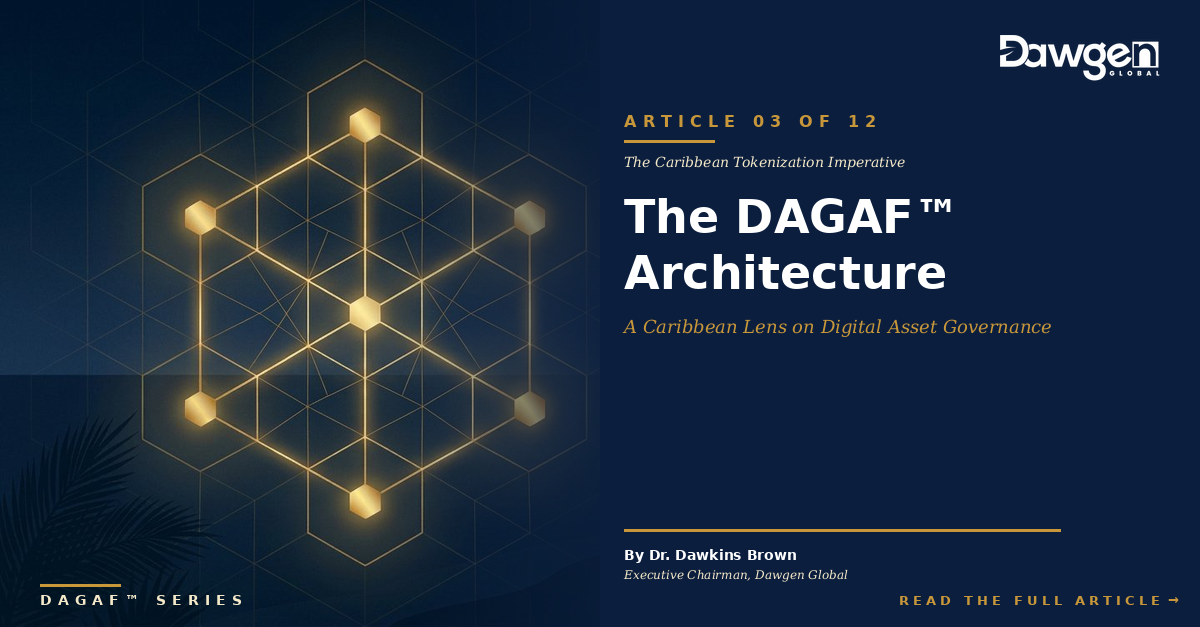
This is the third article in a twelve-part Dawgen Global series introducing DAGAF™ — the Digital Asset Governance & Assurance Framework — the Caribbean’s first integrated framework for the governance, assurance, tax, and risk management of tokenized real-world assets. Article 1 set out the inflection-point argument and the case for Caribbean engagement. Article 2 mapped the three foreign regulatory regimes that are setting the institutional rulebook. This article sets out the architecture of DAGAF™ itself — its six design principles, its seven pillars, and its five-level maturity model — and explains why a Caribbean-anchored framework was necessary in the first place.
Why Another Framework, and Why a Caribbean One
The fair question to ask of any new framework is whether it is necessary. The international professional services firms have done substantive work on tokenization governance over the past three years. PwC’s Scale Tokenisation Programme. Deloitte’s 300-point digital asset risk assessment tool. EY’s tokenized securities curriculum and tokenized fund operating standards. KPMG’s regulatory analysis of GENIUS, CLARITY, and MiCA. The Big Four collectively employ globally what may be the largest concentration of tokenization-aware professional staff anywhere outside the major banks themselves. Specialist firms have added depth: Zoniqx’s zProtocol architecture, Chainalysis’s compliance toolkits, Fireblocks’s institutional custody framework, Galaxy Digital’s tokenization advisory practice. Standards bodies have moved: the International Token Standardisation Association’s foundational work, the Bank for International Settlements’ Project Agorà deliverables, the OECD’s Crypto-Asset Reporting Framework. The intellectual capital available to a board considering tokenization is, in absolute terms, considerable.
So why DAGAF™. The answer is not that the existing work is wrong. Most of it is excellent within the assumptions on which it was built. The answer is that the assumptions on which most of it was built are not Caribbean assumptions. The frameworks the international firms have published presume scale we have only in pockets, single-jurisdiction regulatory regimes where we operate across more than fifteen territorial regimes, deep capital markets where ours are shallow and concentrated, and asset profiles that differ materially from the use cases that matter most in our region. Imported wholesale, these frameworks address Caribbean realities incompletely. They are calibrated for tokenized US Treasuries; the Caribbean institutional question is rarely tokenized US Treasuries. They are calibrated for tokenized listed equities; the Caribbean institutional question is rarely tokenized listed equities. They are calibrated for the institutional environments that produced them, which are not the environment in which Caribbean fiduciaries actually operate.
The Caribbean institutional environment has its own distinct features, and any framework that aspires to serve it must be calibrated for those features. The region operates across CARICOM, the OECS, and the broader Caribbean Community in fifteen-plus regulatory regimes simultaneously. Caribbean financial institutions are smaller in scale than their global counterparts but no less subject to fiduciary expectations, audit standards, and supervisory scrutiny. Caribbean enterprises depend heavily on cross-border counterparties — custodians, fund administrators, exchanges, banking partners — most of them regulated under foreign frameworks. Caribbean tokenization use cases concentrate around resort and commercial real estate, tourism receivables, sovereign and infrastructure debt, credit union member shares, and carbon and blue-economy assets — a profile that does not map neatly onto the use cases the international frameworks were designed around. Caribbean supervisory capacity is materially smaller than that of major jurisdictions, which means that supervisory dialogue, where it occurs, must be unusually substantive.
DAGAF™ was built specifically to fit those features. It does not invent new substantive standards — it would be irresponsible to do so when International Standards on Auditing, IFRS, the COSO Internal Control framework, ISO/IEC 27001, the Financial Action Task Force standards, and the Basel Committee’s positions on crypto-asset exposures already do excellent foundational work. What DAGAF™ does is apply those standards through a Caribbean lens — with explicit attention to regional regulatory plurality, institutional scale, fiduciary norms, and use case concentration. It is a framework calibrated for the work Caribbean boards, audit committees, regulators, and engagement teams actually do, in the institutional environment they actually operate in.
| “We do not need another global framework imported wholesale. We need a regionally-anchored approach that respects scale, regulatory plurality, and the dual reality that our markets are simultaneously emerging in tokenization adoption and mature in fiduciary expectations.” | ||
| PART I
The Six Design Principles |
||
DAGAF™ was built against six explicit design principles. Each one represents a substantive choice, and each one has consequences for how the framework operates in practice. Practitioners who understand these principles will use the framework better than those who do not.
Principle 1 — Governance precedes technology
DAGAF™ presumes that tokenization decisions clear governance and assurance gates before technology selection. Boards are not asked to choose a blockchain platform first and adapt their governance around it. They are asked to approve a use case, document the legal characterisation, establish the custody architecture, secure the assurance plan, and define the disclosure framework before the technology layer is finalised. The principle reflects a hard-won lesson from the 2022–23 crypto restructuring: organisations that subordinated fiduciary obligation to platform features paid disproportionately. The principle also reflects a positive observation: when governance leads, technology selection becomes substantially easier because the requirements are already explicit.
Principle 2 — Anchored in international standards
DAGAF™ is built on the substantive standards that audit firms, banks, regulators, and rating agencies already use. Pillar 4 (Audit & Assurance) is anchored in International Standards on Auditing as issued by the IAASB, in IFRS as issued by the IASB, and in International Standards on Assurance Engagements ISAE 3000 and ISAE 3402 as relevant. Pillar 5 (Cyber, Custody & Operational Risk) is anchored in ISO/IEC 27001 and supplementary cybersecurity standards. Pillar 2 (Regulatory & Legal Compliance) reflects FATF Recommendations and CFATF guidance. Pillar 1 (Governance & Board Oversight) draws on the OECD Principles of Corporate Governance and on the Caribbean corporate governance codes maintained by the JSE, ECSE, and the relevant securities regulators. The framework adds Caribbean calibration; it does not replace the substantive standards on which institutional finance has long been built.
Principle 3 — Caribbean institutional realism
DAGAF™ is calibrated for Caribbean institutional scale. It does not assume the dedicated digital asset teams, billions in compliance technology spend, or millions in compliance technology spend that global frameworks presume. It assumes qualified audit committees, competent finance functions, and a willingness to engage qualified external advisers — the Caribbean institutional baseline. It directs effort to the activities that produce the highest marginal supervisory and assurance value at the scale the region actually operates at, and it explicitly de-emphasises activities that produce limited value in our institutional environment.
Principle 4 — Multi-jurisdictional applicability
DAGAF™ is designed for application across CARICOM jurisdictions. Where pillar treatment depends on jurisdiction-specific law (most obviously in Pillars 2 and 3), the framework directs the user to obtain qualified local advice while providing a structural lens that holds across territories. The framework recognises explicitly that Jamaica, Barbados, Trinidad and Tobago, the OECS, the Bahamas, Belize, Bermuda, Cayman, and the British Virgin Islands each present distinct features within a shared regional supervisory tradition.
Principle 5 — Conservatism without paralysis
The framework is conservative — but it is built to enable institutional engagement with tokenization, not to discourage it. The DAGAF™ maturity model recognises that progression from awareness to optimised practice is normal and expected. The framework rewards staged, controlled progression — not perpetual abstention. The conservatism is in the substantive standards: ISA-anchored audit, IFRS classification rigour, sound custody and key management, KYC/AML controls, and transparent investor disclosure. The conservatism is not a counsel of inaction.
Principle 6 — Public interest alignment
DAGAF™ takes the position that tokenization in the Caribbean must align with public interest considerations — financial stability, consumer protection, AML/CFT/CPF compliance, fair markets, informed investors, accessible recourse. The framework is not neutral on the question of whether tokenization should serve broader regional development, financial inclusion, or capital market deepening priorities. It assumes those priorities matter, and it embeds them through Pillar 6 (Investor & Market Conduct) and Pillar 7 (Strategic Use Case Selection). A framework that ignores public interest considerations is a framework calibrated for a different region than the Caribbean.
| PART II
The Seven Pillars at a Glance |
The seven pillars of DAGAF™ are not silos. They are interlocking, with explicit dependencies and feedback loops. Pillar 7 (Strategic Use Case Selection) initiates and gates every tokenization initiative. Pillar 1 (Governance & Board Oversight) provides the authority and accountability under which the initiative proceeds. Pillars 2, 3, and 6 establish the external obligations the initiative must satisfy. Pillars 4 and 5 establish the internal control and assurance environment within which the initiative operates. Substantive engagement with one pillar without engagement with the others produces a partial framework only — and partial frameworks are the proximate cause of most of the tokenization governance failures of the recent past.
The table below sets out each of the seven pillars with its substantive scope. Subsequent articles in this series will treat each pillar in detail: Article 4 on Pillar 1 (Boards, Fiduciaries, and the Tokenized Balance Sheet); Article 5 on Pillar 3 (Tokenization and the Caribbean Tax Code); Article 6 on Pillar 4 (Auditing the Token); and Article 7 on Pillar 5 (Custody, Keys, and Cyber).
TABLE 1 — THE SEVEN DAGAF™ PILLARS
| # | Pillar | Substantive scope |
| PILLAR
1 |
Governance & Board Oversight | Board-level approval, fiduciary obligation, policy framework, audit-committee oversight, director education, and governance reporting cadence for tokenization initiatives. |
| PILLAR
2 |
Regulatory & Legal Compliance | Securities, banking, payments, AML/CFT/CPF compliance across CARICOM and counterparty jurisdictions; cross-border regulatory exposure mapping; counterparty due diligence. |
| PILLAR
3 |
Tax Treatment & Reporting | Corporate income tax, GCT/VAT, withholding, transfer pricing, and reporting positions for tokenized instruments; CARF and FATCA implications; tax position memoranda. |
| PILLAR
4 |
Audit & Assurance | ISA-anchored audit approach, IFRS classification rigour for tokenized assets and liabilities, ISAE 3000/3402 attestation engagements, proof-of-reserves, smart-contract review. |
| PILLAR
5 |
Cyber, Custody & Operational Risk | Key management, custody architecture (qualified custodian, hybrid, self), smart-contract risk, oracle integrity, third-party concentration, operational resilience. |
| PILLAR
6 |
Investor & Market Conduct | KYC/AML controls at onboarding, accredited investor frameworks, secondary market integrity, conflicts management, complaints handling, transparent disclosure. |
| PILLAR
7 |
Strategic Use Case Selection | Disciplined identification of which assets to tokenize, in which jurisdiction, on which infrastructure; benefit–risk justification; alignment with the entity’s strategic position and competitive economics. |
Source: Dawgen Global, DAGAF™ White Paper (First Edition, 2026), Section 4.
| PILLAR 7 IS THE GATE
The most common pattern in tokenization governance failures is that an initiative clears the technology and the operational layers but never properly clears the strategic use case selection. The asset gets tokenized because tokenization is fashionable, not because tokenization solves a strategic problem at acceptable risk-adjusted return. DAGAF™ puts Strategic Use Case Selection as Pillar 7 deliberately — it is the gate that activates all the preceding pillars. An initiative that cannot articulate, defensibly, why this asset, in this jurisdiction, on this infrastructure, for this investor base, should not pass through to the rest of the framework. |
||
| PART III
The Five-Level Maturity Model |
||
Across each of the seven pillars, DAGAF™ defines five maturity levels: Level 1 — Unaware, Level 2 — Aware, Level 3 — Defined, Level 4 — Managed, and Level 5 — Optimised. The five levels apply uniformly across the seven pillars, producing thirty-five assessment dimensions in total. The model is intended for direct use by boards, audit committees, internal audit functions, regulators, and engagement teams.
| LEVEL
1 Unaware |
LEVEL
2 Aware |
LEVEL
3 Defined |
LEVEL
4 Managed |
LEVEL
5 Optimised |
Level 1 — Unaware
The organisation has not engaged with the pillar in the tokenization context. No policy, control, awareness, or assurance exists. This is the default position for most Caribbean entities today — not because the entities are deficient, but because tokenization has not yet entered the active institutional question set. Assessment at Level 1 is informational rather than critical. It establishes a baseline.
Level 2 — Aware
Senior management and the board have been briefed on the pillar in the tokenization context. Initial documentation may exist (a discussion paper, an executive memo) but is not embedded in policy or terms of reference. Knowledge resides with one or two individuals rather than institutional process. No board-approved tokenization policy. Level 2 is appropriate as a pause-point for organisations that have decided not to move forward into active tokenization initiatives in the short term — but that nonetheless need awareness against the day the question reopens.
Level 3 — Defined
The pillar is operationalised. A board-approved policy exists. Documented terms of reference. Director education in place. Conflicts management procedures address tokenization-specific exposures. Level 3 is the appropriate target for organisations that have decided to engage with tokenization on a structured basis but are not yet executing initiatives at scale. It is the foundation for Pilot-stage work under the DAGAF™ engagement methodology.
Level 4 — Managed
Active oversight at scale: at least quarterly reporting; documented review of regulatory developments, assurance findings, and material incidents; periodic refresh of policy and director education; demonstrable evidence of board challenge and decision-making on tokenization matters. Level 4 is appropriate for organisations executing tokenization initiatives at material scale. It is the supervisory expectation for any regulated financial institution moving from Pilot to Programme.
Level 5 — Optimised
The organisation operates at institutional benchmark: it contributes to industry governance dialogue; it engages directly with regulators on framework development; tokenization governance is integrated with broader enterprise governance; periodic external review of governance arrangements is performed and acted upon. Level 5 is appropriate for the small set of institutions that aspire to be regional reference points on tokenization governance — a position that becomes more rather than less valuable as the regional framework develops.
| USING THE MATURITY MODEL
Each of the 35 dimensions is assessed against documentary evidence. Self-assessment without supporting documentation typically inflates scores. Conservative scoring assigns the lower level unless full evidence supports the higher level. Pillar-level scores aggregate the dimensions within that pillar; an overall organisational score should be presented as a profile across pillars rather than a single number, since pillar-level differences are usually material. Initial assessment establishes baseline; reassessment at least annually thereafter is recommended for entities with active tokenization programmes; reassessment on material change to scope or risk environment is mandatory. |
||
| PART IV
How DAGAF™ Connects to Caribbean Practice |
||
A framework is only as useful as the work it supports. DAGAF™ connects to Caribbean practice through three principal channels.
Channel 1 — Board and audit-committee deliberation
Caribbean boards considering tokenization initiatives, or considering whether to permit existing initiatives to continue, can use DAGAF™ as the structural reference for their deliberation. The seven pillars give the audit committee a complete agenda. The maturity model gives the board a defensible benchmarking tool. The combination converts what would otherwise be unstructured discussion into structured fiduciary review. Several Caribbean boards are already using the framework in this way — typically following an initial DAGAF™ Maturity Diagnostic that establishes a baseline and identifies the priority gaps.
Channel 2 — Engagement architecture
Dawgen Global’s tokenization advisory engagements are organised under DAGAF™. The four-phase engagement methodology — Diagnostic, Design, Pilot, Programme — maps each engagement type to one or more of the seven pillars. The DAGAF™ Maturity Diagnostic, the DAGAF™ Board Briefing, the Tokenization Tax Position Memorandum, the Audit Readiness Review, the Tokenization Operational Risk Assessment, the Sectoral Feasibility Studies, the Regulatory Engagement Support, and the Public-Sector Tokenization Policy Advisory all sit within DAGAF™ and produce deliverables structured to its taxonomy. The framework is the engagement architecture — not a marketing wrapper around it.
Channel 3 — Regulatory and policy dialogue
Caribbean regulators and policy makers can use DAGAF™ as a structural reference for supervisory dialogue, for the design of regional Virtual Asset Business Regulations, and for the assessment of supervisory capacity requirements. Section 7 of the DAGAF™ White Paper offers seven principles for Caribbean regulators — not as prescription but as substantive contribution to a regional dialogue that the Eastern Caribbean Central Bank, the FSC Jamaica, the Bank of Jamaica, and the various ECCU and CARICOM-level institutions are advancing in their own ways. The framework is offered, deliberately, in the spirit of contribution rather than commercial extraction.
| “DAGAF™ is the engagement architecture. It is not a marketing wrapper around it.” |
The Connective Tissue of the Series
The eleven articles that follow this one work through DAGAF™ in detail. Article 4 examines Pillar 1 — Boards, Fiduciaries, and the Tokenized Balance Sheet. Article 5 examines Pillar 3 — Tokenization and the Caribbean Tax Code. Article 6 examines Pillar 4 — Auditing the Token. Article 7 examines Pillar 5 — Custody, Keys, and Cyber. Articles 8 through 10 work through the principal Caribbean use cases under the framework: tokenized resort real estate, credit union member share digitisation, and family office tokenized alternatives. Article 11 examines sovereign debt and infrastructure tokenization. Article 12 closes the series with a 24-month roadmap from pilot through programme.
Each subsequent article will refer back to this article as the architectural anchor. Each will assume readers have at least passing familiarity with the seven pillars and the five-level maturity model. Each will deepen one or more dimensions of the framework rather than re-establish it from first principles. The series is designed to be read in sequence — though each article is also intended to stand alone as a substantive treatment of its specific topic.
The framework will evolve. Subsequent editions of the White Paper will reflect that evolution. The fundamental architecture — seven pillars, five maturity levels, thirty-five assessment dimensions — is built to be stable. The substantive content within each cell of the matrix will continue to develop as the regional regulatory environment matures, as Caribbean tokenization use cases proliferate, and as the supervisory and assurance practices around them sharpen. Dawgen Global commits to maintaining DAGAF™ as a current, substantive, regionally-anchored reference — and to engaging openly with practitioners, regulators, multilaterals, and academic institutions whose work shapes the field.
Caribbean enterprises that wish to engage with DAGAF™ in a structured way have several entry points. The standard entry point is the DAGAF™ Maturity Diagnostic — a 4 to 6 week engagement producing a baseline maturity assessment across all seven pillars, a prioritised gap register, and a recommended progression roadmap. The DAGAF™ Board Briefing offers a focused 1 to 2 day intensive for directors. Specific advisory engagements address individual pillars: tokenization tax position memoranda, audit readiness reviews, custody architecture reviews, regulatory engagement support. Caribbean regulators and policy makers have a separate engagement track for substantive policy dialogue.
| “The framework is offered, deliberately, in the spirit of contribution rather than commercial extraction.” |
Article 4 — examining Pillar 1, Boards, Fiduciaries, and the Tokenized Balance Sheet — will publish in the next edition. The full DAGAF™ White Paper, on which this article and the rest of the series are based, is available now.
|
ABOUT THE AUTHOR
Dr. Dawkins Brown is the Executive Chairman and Founder of Dawgen Global, an independent integrated multidisciplinary professional services firm headquartered in Kingston, Jamaica, operating across the Caribbean. The firm advises Caribbean enterprises, regulators, and public-sector institutions on audit and assurance, tax, risk management, cybersecurity, IT and digital transformation, corporate recovery, M&A, business advisory and strategy, accounting outsourcing, and human capital. Dr. Brown is the architect of DAGAF™ and is the Founding Editor of Caribbean Boardroom Perspectives.
ABOUT THIS SERIES
The Caribbean Tokenization Imperative is a 12-article series introducing the DAGAF™ framework. Article 1 set out the inflection-point argument and the case for Caribbean engagement. Article 2 mapped the three foreign regulatory regimes that are setting the institutional rulebook. This article (Article 3) sets out the architecture of DAGAF™ itself. Article 4 — Boards, Fiduciaries, and the Tokenized Balance Sheet — will publish in the next edition. Subsequent articles will treat each DAGAF™ pillar in turn, examine principal Caribbean use cases, and conclude with a 24-month implementation roadmap. The full DAGAF™ White Paper is available on request.
© 2026 Dawgen Global. All rights reserved. DAGAF™ is a proprietary framework of Dawgen Global.
About Dawgen Global
“Embrace BIG FIRM capabilities without the big firm price at Dawgen Global, your committed partner in carving a pathway to continual progress in the vibrant Caribbean region. Our integrated, multidisciplinary approach is finely tuned to address the unique intricacies and lucrative prospects that the region has to offer. Offering a rich array of services, including audit, accounting, tax, IT, HR, risk management, and more, we facilitate smarter and more effective decisions that set the stage for unprecedented triumphs. Let’s collaborate and craft a future where every decision is a steppingstone to greater success. Reach out to explore a partnership that promises not just growth but a future beaming with opportunities and achievements.
 Email: info@dawgen.global
  Visit: Dawgen Global Website

 WhatsApp Global Number : +1 555-795-9071
Caribbean Office: +1876-6655926 / 876-9293670/876-9265210  WhatsApp Global: +1 5557959071
USA Office: 855-354-2447
Join hands with Dawgen Global. Together, let’s venture into a future brimming with opportunities and achievements
Related service: Explore how we can help →



