
A Minority Investment Built to Protect the Operator’s Runway
A profitable Caribbean fintech platform was ready to raise institutional capital for the first time. Its founders did not want to sell the business, dilute their strategic control, or commit to an exit timeline that did not match their ambitions. The engagement described in this Standard designed and negotiated a minority stake transaction that gave the investor real protection and the operator meaningful runway — and did so without either side conceding the core of what it had come to the table to preserve.
1. The Signal
A subtle but important shift has occurred in how Caribbean fintech operators and their capital partners approach each other. Ten years ago, a profitable regional platform raising outside capital was, in practice, raising from family-office equity or a strategic corporate investor. Today, a third category has emerged — institutional regional private equity and select diaspora capital — with a specific appetite for minority stakes in cash-generative Caribbean technology and financial services businesses. This new category brings governance expectations, reporting cadences, and exit assumptions that Caribbean founders are encountering for the first time.
The hypothetical subject of this Standard is a founder-led Caribbean fintech platform operating in the payments and merchant-services segment, with a mid seven-figure revenue run-rate, two-digit month-on-month growth, and a board that had reached the point where the next chapter — regional expansion, regulatory authorisation in two additional jurisdictions, and a capacity investment in the platform itself — required external capital. The founders did not wish to sell. They wished to partner. The engagement described here designed and negotiated the partnership.
2. The Context
The transaction opened in a carefully specified posture. Five contextual conditions shaped the engagement.
Founder-majority retention was non-negotiable
The founders were clear that they would not transact if the outcome left them as minority shareholders of their own business. The brief to the advisors was to structure a transaction in which the founders retained majority ownership and operational control, with the institutional investor taking a meaningful but clearly minority position.
The investor required governance appropriate to its position
The candidate investor — a regional institutional capital partner with a track record in Caribbean financial services — required governance rights proportionate to its investment: a board seat, reserved-matter consent on a specified list of corporate actions, information rights consistent with institutional reporting standards, and agreed performance metrics. None of these requirements was unusual. All of them were new to the founders, who had never operated with an institutional shareholder on the register.
The business was mid-growth, not mid-stage
A common error in fintech transactions is to price and structure a profitable regional operator using the vocabulary of early-stage venture investing. The platform was not a seed-stage proposition. It was a scaling, cash-generative business whose closest valuation comparables were mid-market regional financial services operators, not pre-revenue technology startups. The transaction architecture needed to reflect that distinction.
Regulatory perimeter extended across multiple jurisdictions
The platform operated under regulatory permissions in its home jurisdiction and was in the early stages of seeking authorisation in two additional Caribbean territories. The transaction itself would require regulatory notification in the home jurisdiction and would need to avoid creating structures that prejudiced the pending applications elsewhere. Regulatory counsel was engaged in parallel to the commercial negotiation.
Exit expectations required active alignment
The institutional investor operated on a defined fund cycle and would eventually require liquidity. The founders had no desire to commit to a hard exit date. The transaction needed to balance these two legitimate requirements through a carefully designed liquidity architecture rather than through a rigid exit clause that either side would later wish to renegotiate.
3. The Approach
MERIDIAN™ structured the mandate across three workstreams that ran partly in parallel and gated sequentially at the points that mattered most to the decision discipline.
Each workstream produced a dedicated negotiating memo that the founders could read, challenge, and approve before the position was tabled with the investor. The founders were never presented with a term sheet they had not already considered, piece by piece, with their advisors.
4. The Work
Valuation and structure (weeks 1–4)
The first four weeks resolved two linked questions: at what enterprise value did the transaction make sense, and in what form should the institutional investor’s stake be held? The valuation work anchored to three methodologies — a discounted cash flow projection built on the platform’s own management forecast and a set of stress tests, a comparable-transaction analysis drawing on regional financial services precedent, and a revenue-multiple sanity check grounded in publicly disclosed fintech transactions across a peer set. The range produced by the three methodologies was narrower than the founders had feared and materially higher than the first indication received from the investor earlier in the year.
The instrument question was resolved in favour of a convertible preferred equity structure with a clearly specified liquidation preference and a conversion mechanic that aligned the investor’s economics with long-term equity appreciation. This structure avoided the twin traps of straight common equity (which would have under-protected the investor on downside scenarios) and aggressive participating preferred structures with ratchets (which would have materially damaged the founders’ economics under moderately successful outcomes).
Governance and protections (weeks 3–8)
The governance workstream took longer and required more drafting iterations than any other element of the transaction. Six versions of the reserved-matter list were exchanged before a final version was agreed. The founders’ initial instinct was to minimise the reserved-matter list to preserve operational freedom. The investor’s initial position included a long reserved-matter list reflecting a standard institutional template. The final list reflected a carefully negotiated middle position — short enough to avoid constant investor consent requirements on ordinary-course operations, long enough to protect the investor on genuinely strategic matters such as material acquisitions, new equity issuance, leverage above defined thresholds, and changes to the company’s regulatory perimeter.
Board composition was resolved at five members: two founder nominees, one investor nominee, and two independent non-executive directors agreed jointly. The independent directors were not a compromise position but a deliberate choice — the founders had identified professionalised governance as one of the strategic benefits of accepting institutional capital, and the independent directors would serve that objective.
Liquidity and exit (weeks 6–12)
The liquidity architecture was the most conceptually demanding part of the transaction. The founders did not want an IPO commitment, a forced-sale exit clause, or a put option that would crystallise an obligation to repurchase the investor’s stake. The investor needed a credible pathway to eventual liquidity.
The architecture settled on three mechanisms layered in sequence. First, a right of first offer in favour of the company and the founders, activating after year five, allowing either to match the investor’s best third-party offer. Second, a structured sale-process right, activating after year seven, allowing the investor to require the company to run a formal sale process — with the founders retaining the right to bid in that process alongside external parties. Third, a tag-along right on any founder sale above a defined threshold, protecting the investor from a scenario in which the founders sold out and left the investor behind. The combination gave the investor a credible exit pathway without requiring the founders to concede strategic control of the timing.
Closing (weeks 12–14)
The final fortnight moved from agreed heads of terms to executed long-form documentation, regulatory notification, and completion. The transaction closed on schedule with no material last-minute re-trade on either side. The absence of last-minute re-trade was itself a measure of the earlier work: when the term sheet has been negotiated with care, long-form documentation rarely produces surprises.
5. The Solution
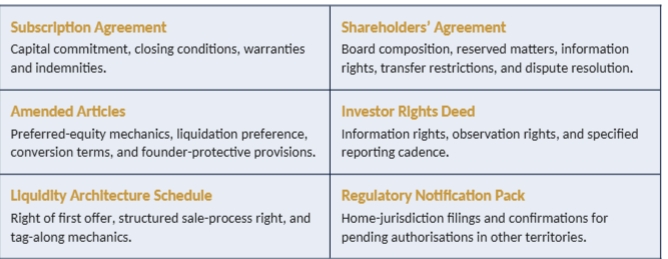
The executed transaction comprised six governance-grade documents — each of which was designed to serve the relationship well beyond completion day.
| Subscription Agreement
Capital commitment, closing conditions, warranties and indemnities. |
Shareholders’ Agreement
Board composition, reserved matters, information rights, transfer restrictions, and dispute resolution. |
| Amended Articles
Preferred-equity mechanics, liquidation preference, conversion terms, and founder-protective provisions. |
Investor Rights Deed
Information rights, observation rights, and specified reporting cadence. |
| Liquidity Architecture Schedule
Right of first offer, structured sale-process right, and tag-along mechanics. |
Regulatory Notification Pack
Home-jurisdiction filings and confirmations for pending authorisations in other territories. |
The shareholders’ agreement in particular was drafted as a working document for the governance life of the relationship, not as a transactional artifact to be filed. Its clarity on information rights, meeting cadence, and reserved-matter thresholds has, since completion, meaningfully reduced the friction of the ongoing relationship between founders and investor.
6. The Effect
The transaction’s visible effect was the capital itself — and the capital was used, as contemplated, to fund regional regulatory expansion and platform capacity investment. The less visible but more durable effects were three.
First, the founders learned to operate with an institutional shareholder on the register. Board papers, monthly management reporting, and quarterly reviews became part of the operating cadence. These disciplines are the hidden value of a well-structured first institutional round: the business becomes easier to manage at scale because the operating rhythms are already in place before the scale arrives.
Second, the professionalisation of governance attracted further talent. Two of the platform’s most important post-transaction hires — a Chief Financial Officer with regional financial services experience, and a Head of Compliance with regulatory track record — explicitly cited the quality of the governance architecture as a factor in their decision to join. Institutional capital had changed what the platform was capable of recruiting.
Third, the relationship with the investor evolved, over the eighteen months following completion, into a genuine strategic partnership. The investor’s board nominee surfaced two acquisition opportunities the founders would not otherwise have seen, and introduced the company to three regional corporate relationships that opened commercial doors. Minority institutional capital, well chosen and well structured, delivers more than money.
7. The Transferable Lesson
Founder-led Caribbean businesses considering their first institutional round often approach the conversation as a negotiation about price. It is not. It is a negotiation about governance. The question of enterprise value is almost always resolvable inside a narrow range. The question of governance rights, protective mechanics, and liquidity architecture determines how the relationship will feel every week for the next seven years.
The single most transferable lesson from this mandate is that Caribbean founders should engage advisors not to argue about price but to construct the governance architecture within which the price is agreed. Price is the visible line on the term sheet. Governance is everything else — and it is governance that determines whether minority institutional capital is a source of strategic acceleration or a source of ongoing friction.
Take the next step with Dawgen Global
| THE SIGNAL
Your business is ready for its first institutional round, and you are determined to retain majority ownership and operational control, but the governance architecture of the transaction has not yet been designed. THE OFFER A MERIDIAN™ minority-round advisory engagement, structured across three gated workstreams, delivers valuation defence, governance architecture, and liquidity mechanics that protect the operator’s runway while giving the investor real protection — typically within twelve to sixteen weeks. THE CHANNEL Email [email protected]
|
About Dawgen Global
“Embrace BIG FIRM capabilities without the big firm price at Dawgen Global, your committed partner in carving a pathway to continual progress in the vibrant Caribbean region. Our integrated, multidisciplinary approach is finely tuned to address the unique intricacies and lucrative prospects that the region has to offer. Offering a rich array of services, including audit, accounting, tax, IT, HR, risk management, and more, we facilitate smarter and more effective decisions that set the stage for unprecedented triumphs. Let’s collaborate and craft a future where every decision is a steppingstone to greater success. Reach out to explore a partnership that promises not just growth but a future beaming with opportunities and achievements.
 Email: [email protected]
  Visit: Dawgen Global Website

 WhatsApp Global Number : +1 555-795-9071
Caribbean Office: +1876-6655926 / 876-9293670/876-9265210  WhatsApp Global: +1 5557959071
USA Office: 855-354-2447
Join hands with Dawgen Global. Together, let’s venture into a future brimming with opportunities and achievements


