
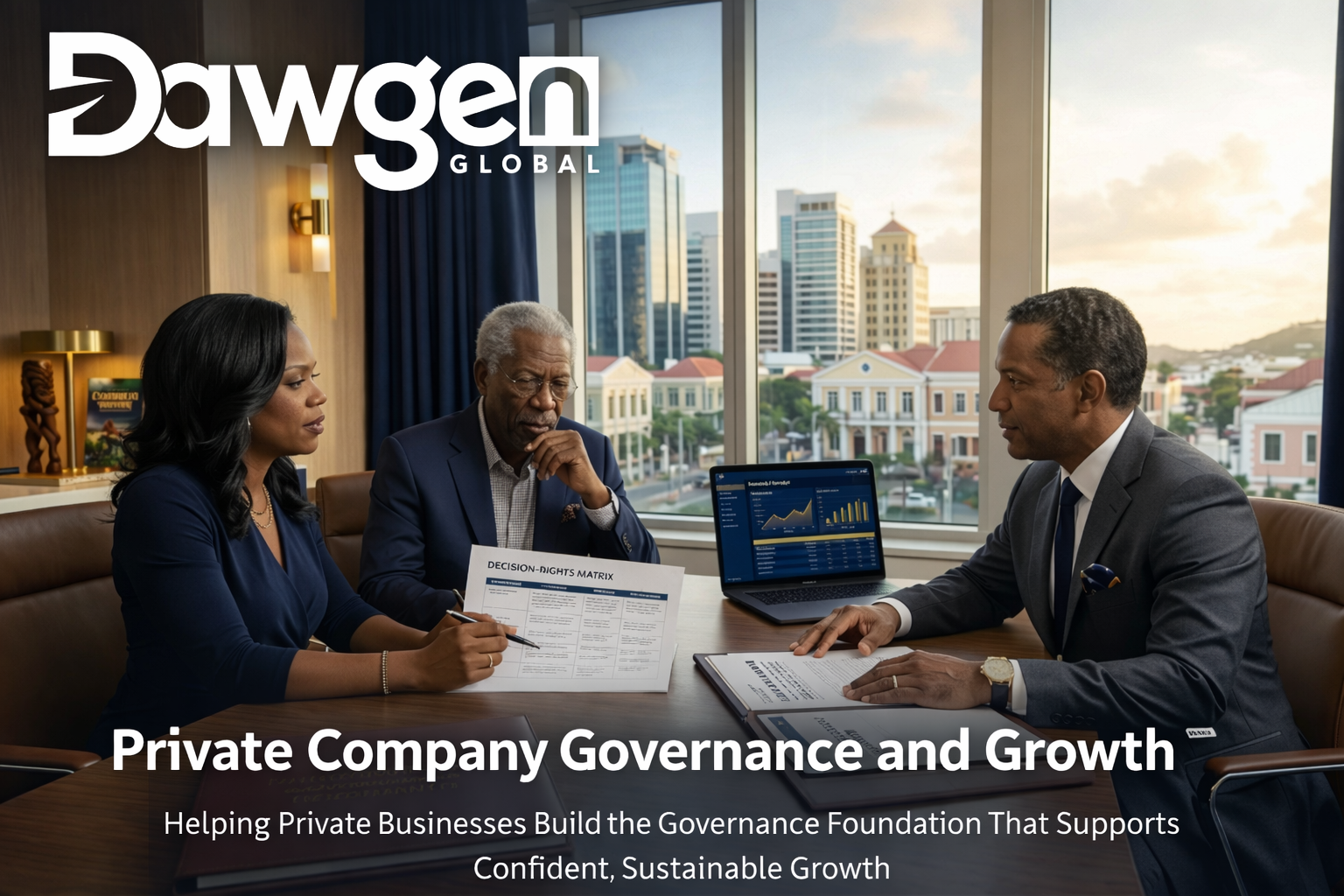
Helping Private Businesses Build the Governance Foundation That Supports Confident, Sustainable Growth
Executive Summary
Many private companies are built on entrepreneurial energy, speed of decision-making, strong personal relationships, and deep founder conviction. These qualities help businesses gain early traction and navigate uncertainty with agility. But as a private company grows, the same informality that once powered progress begins to generate risk. Decisions remain concentrated in too few hands. Reporting fails to keep pace with complexity. Roles and responsibilities blur. Family, shareholder, and management interests begin to diverge. Growth continues — but without the governance framework needed to sustain it.
This is why governance matters for private companies just as much as it matters for public ones — even if the structure and intensity differ. Good governance is not bureaucracy for its own sake. It is the mechanism through which better decisions are made, accountability is enforced, oversight is exercised, information is put to use, and competing interests are managed. For private companies navigating expansion, succession challenges, financing needs, shareholder complexity, or operational strain, governance is often the missing link between commercial ambition and long-term resilience.
Dawgen Global’s Private Company Governance and Growth Toolkit is designed to help private businesses strengthen that foundation. The service assesses governance maturity, clarifies leadership and decision structures, improves board or advisory practices, strengthens reporting to owners and management, and helps businesses build the governance discipline needed to support sustainable growth. It recognizes that private companies do not need a public-company governance model. What they need is a practical, proportionate framework that matches their stage, ownership structure, and strategic ambitions — and makes them harder to break as they scale.
This article explores why governance is so frequently undervalued in private business, and why that undervaluation tends to become costly over time. It explains how companies often outgrow their informal leadership models without recognizing it — and how weak governance quietly affects everything from operational control and shareholder alignment to financing readiness and succession planning. It also challenges the common assumption that governance slows entrepreneurial businesses down, when effective governance typically improves agility by reducing confusion, conflict, and avoidable risk.
The central argument is straightforward: private companies should treat governance as a growth enabler, not a compliance burden. A stronger governance framework supports better financial visibility, more disciplined decisions, clearer ownership expectations, and more credible engagement with lenders, investors, and external stakeholders. It reduces internal friction by clarifying how major issues are reviewed, escalated, and resolved — before they become crises.
If your business is growing in complexity but your governance hasn’t kept pace, Dawgen Global’s Private Company Governance and Growth Toolkit can help. Reach out directly at [email protected] to start the conversation.
Private Companies Need Governance Too: Growth Becomes Risky Without It
Governance is often discussed as though it belongs exclusively to large listed companies, regulated institutions, or multinational groups with formal boards and compliance obligations. In that framing, governance can appear remote from the reality of private businesses — particularly entrepreneurial firms built through speed, instinct, personal leadership, and deep founder involvement. Many owners associate governance with board packs, procedural formality, committee structures, and administrative overhead. As a result, governance is frequently treated as something that can wait: until the business is much larger, closer to a capital event, or subject to more demanding regulatory requirements.
That view is understandable. It is also one of the primary reasons private companies experience avoidable strain as they grow.
Governance is not a public-company concept. It is the discipline through which decisions are made, authority is exercised, information is reviewed, accountability is enforced, and competing interests are managed inside any organization. Every company has governance — formal or informal. The real question is whether the governance model in place is strong enough for the stage of business the company has now reached.
The Informality Trap
In the early life of a private company, informality is often genuinely efficient. The founder or a small ownership group is deeply involved in operations. Decisions are made quickly. Information flows directly. There are few layers, and strong personal oversight fills the gaps that formal structure would otherwise occupy. In that environment, governance may seem unnecessary — the owner feels close enough to everything that formal mechanisms appear redundant.
The problem is that businesses rarely stay that simple. Growth changes the operating reality in fundamental ways. New people join at every level. Functions become more specialized. Cash flow becomes more material to stakeholder decisions. Customer and supplier relationships grow in complexity. Regulatory exposure may increase. Debt or investor expectations may become more significant. Strategic decisions carry larger financial consequences. Ownership interests may evolve — especially in family-run or multi-shareholder businesses. A business that once functioned effectively on direct personal control gradually becomes too complex for that model to remain adequate. And yet many companies continue operating as though the earlier stage never ended.
This is where governance gaps begin to emerge — and they rarely announce themselves dramatically at first. They appear as recurring confusion over who has authority to approve major expenditures. As disagreements between shareholders and management about strategic direction. As delayed or incomplete performance reporting. As inconsistent follow-through on key decisions. As increasing dependence on the founder to resolve every material issue personally. In family-owned businesses, governance gaps often surface at the intersection of business decisions and family relationships. In owner-managed companies, they may appear as strategic issues trapped perpetually in the operational agenda, with no structured forum for reflection, challenge, or forward planning.
These are not organizational irritants. They are risk factors — and they compound over time.
The Real Cost of Weak Governance
When governance is inadequate, important decisions are made without sufficient information or challenge. Risks are not escalated appropriately. Owners hold different assumptions about the future of the business but have no formal forum in which to surface and resolve them. Reporting is too limited to support meaningful oversight. Succession is deferred because responsibilities and decision rights remain unclear. Financing conversations become harder because external stakeholders — lenders, investors, partners — want confidence in management discipline and information quality that the business cannot easily demonstrate.
The accumulated cost of weak governance is often invisible until it is not. A dispute among shareholders that might have been managed earlier through clear governance protocols becomes a serious conflict. A leadership succession that might have been planned becomes a crisis. A financing opportunity that might have been seized requires months of remedial work on reporting and structure before a credible proposal can be tabled. Weak governance does not always produce acute failure. More often, it quietly limits what the company can achieve — and how confidently it can pursue it.
Governance as a Growth Enabler
One of the most persistent misconceptions is that governance slows entrepreneurial companies down. In reality, poor governance creates the very delays, frustrations, and conflicts that owners most want to avoid. When roles are unclear, decisions stall. When reporting is inconsistent, management lacks the confidence to act. When shareholder expectations are misaligned, strategic moves become contentious. When authority is concentrated too narrowly, routine matters escalate unnecessarily while strategic issues compete for attention that is already exhausted.
Good governance does not add layers. It removes friction. It clarifies who decides what, how decisions are informed, and what information is reviewed regularly. A private company with stronger governance is typically better able to manage expansion — not because it has more bureaucracy, but because it has more disciplined decision structures, more reliable reporting, and clearer accountability. Leadership spends less time resolving ambiguity and more time acting on priorities. Owners gain better visibility into performance and risk. The business becomes easier to steer because there is a more deliberate operating rhythm behind how oversight actually works.
Management Information and Decision Rights
Two governance dimensions deserve particular emphasis in private companies: management information and decision rights.
Many private companies have some form of reporting, but it is rarely designed to support governance effectively. Financial information may exist but arrive too late to be actionable. Operational data may be available but not structured for strategic review. Shareholders may receive updates, but not with the consistency or depth needed for meaningful oversight. Management meetings frequently focus on immediate operational issues while longer-term questions — capital allocation, risk exposure, market strategy, leadership capacity, succession — are addressed only intermittently, if at all. A stronger governance framework creates a more deliberate information environment: one in which leadership and owners can review the business with regularity, clarity, and appropriate depth.
Decision rights are equally important. As companies grow, informal assumptions about authority become progressively more dangerous. Who can approve significant borrowing? Who authorizes major capital expenditure? Who decides on new business lines, material hiring, dividend policy, litigation strategy, or related-party transactions? What matters require shareholder consent, and what sits properly with management? If these questions are unresolved, the organization is exposed not only to poor decision-making but to conflict — often not because stakeholders disagree with an outcome, but because they were never clear on how the decision should have been made in the first place.
Shareholders, Families, and Succession
In businesses with multiple shareholders — whether family members, business partners, or investor groups — governance becomes essential to maintaining alignment. As the company grows, the interests of stakeholders may not remain synchronized. Some shareholders may prioritize expansion. Others may prioritize dividends. Some may be deeply involved in management. Others may be passive owners who nonetheless want visibility and protection. Without governance structures that clarify reporting rights, decision thresholds, dispute resolution mechanisms, and oversight expectations, misunderstandings harden into governance failures that damage the company itself.
Family businesses face this challenge with particular intensity. Family ownership can bring continuity, loyalty, and genuine long-term commitment — but it can also blur the boundary between family relationships and corporate decision-making. Questions of succession, leadership capability, compensation, role clarity, and control become emotionally charged when they are not addressed through a structured framework. Governance in such businesses is not about removing the family character of the firm. It is about protecting the business from avoidable damage while helping the family engage with ownership responsibilities more constructively and more sustainably.
Succession is perhaps the most compelling reason any private company should invest in better governance. Many businesses depend heavily on a founder or small leadership group whose judgment and relationships have been central to the company’s success. That dependence is understandable — but it becomes a structural vulnerability when there is no clear plan for leadership transition, authority transfer, or continuity of oversight. Governance reduces that vulnerability by clarifying roles, building management reporting discipline, and creating forums for strategic matters to be addressed beyond the personality of any single individual. A business serious about lasting beyond its founding leadership needs governance that supports continuity — not as a distant aspiration, but as an active organizational discipline.
External Credibility
As private companies seek financing, investment, strategic partnerships, or acquisition opportunities, counterparties look beyond revenue figures. They want to understand how the business is governed. Is reporting credible and timely? Are decisions disciplined? Is there evidence of structured strategic oversight? Are risks reviewed meaningfully? Is the authority structure clear and documented? A company with weak governance may perform commercially but faces more questions, more caution, and frequently lower confidence from external stakeholders. Strong governance therefore improves not only internal control but market credibility — and can be a decisive factor in whether an opportunity is pursued or lost.
The Toolkit: A Practical Path to Stronger Governance
Dawgen Global’s Private Company Governance and Growth Toolkit is designed for private businesses that recognize their governance has not kept pace with their growth. It is not a public-company governance transplant. It is a tailored, proportionate approach for private enterprises that want more structure and clarity without sacrificing commercial agility.
Assessment: Understanding Where You Are
The engagement begins by developing an accurate picture of how the business actually operates at a governance level — not how the founding documents say it should operate, but how decisions are genuinely made, how oversight is exercised in practice, and where the friction points are.
Key questions at this stage include: How are major decisions made, and by whom? What reporting is provided to management and owners — and is it timely and decision-useful? Is there an effective board or advisory structure? Where do responsibilities overlap or sit in ambiguity? Are strategic discussions happening in a structured way, or only reactively under pressure? Is there alignment among owners about the direction of the business? Are succession or continuity risks visible and being actively managed?
These questions reveal whether the current governance arrangement is still genuinely serving the company or whether it has been quietly outgrown.
Gap Identification: Understanding Why There Is Friction
Once the current model is mapped, gaps become identifiable with greater precision. In some businesses, the primary issue is weak management reporting. In others, it is the absence of formal oversight over strategic issues. In others, governance is complicated by ownership dynamics, informal delegations of authority, or a lack of clarity around shareholder expectations and rights.
A structured diagnostic separates the real root causes from the surface-level symptoms — and creates the foundation for improvements that will actually hold.
Practical Improvements: Building What the Business Needs
The final stage is designing and implementing governance mechanisms proportionate to the specific business. This does not require elaborate or heavy-handed structures. It requires mechanisms that fit. Improvements may include a more disciplined board or advisory meeting rhythm that creates structured time for strategic oversight; redesigned reporting packs that give owners and directors more decision-useful information on a consistent schedule; a clearly documented decision-rights matrix that removes ambiguity about authority; governance documentation that makes oversight visible and auditable; a risk review process embedded in the regular management cycle; and a framework for succession and continuity discussions that ensures leadership transition is planned rather than reactive.
In family or multi-shareholder businesses, improvements typically also involve establishing clearer boundaries between ownership matters and management matters — reducing the personal strain that governance ambiguity tends to generate over time.
None of these improvements needs to be elaborate to be effective. What matters is alignment between the governance model and the current reality of the business.
The Caribbean Context
For Caribbean private companies, these issues carry particular urgency. Many businesses across the region are navigating expansion into new markets, generational ownership transitions, growing financing requirements, regional diversification, intensifying competition, and more demanding regulatory environments — often simultaneously. In that context, governance is no longer a luxury reserved for large corporations. It is a practical necessity for any business that wants to scale responsibly, attract confidence from external stakeholders, and maintain cohesion as complexity rises.
Caribbean private companies also face governance challenges shaped by regional dynamics: close-knit ownership structures, the intersection of family and business decision-making, smaller professional talent pools for independent oversight, and limited precedent for structured governance in founder-led enterprises. Dawgen Global understands these realities. The Private Company Governance and Growth Toolkit is designed not as a theoretical framework imported from another context, but as a practical, regionally grounded intervention that works within the realities of Caribbean private business.
Conclusion
The most successful private companies are rarely those that wait until pressure forces them to professionalize. They are the ones that recognize, ahead of that pressure, that stronger oversight, clearer reporting, and more disciplined decision structures are part of sustainable growth — not obstacles to it.
Growth changes the rules of management. What worked when the business was smaller may not be adequate when the stakes are higher, the ownership landscape is broader, and the operating model is more complex. Informality can feel efficient, but beyond a certain threshold it becomes a source of fragility. Governance converts a growing business into a more durable one — not by making it more corporate in a constraining sense, but by making it more intentional, more resilient, and more capable of handling scale.
Private companies serious about sustainable growth cannot afford to treat governance as an optional consideration. It is a strategic foundation. The question is not whether your business needs better governance. The question is whether you address that need before the gaps create consequences — or after.
Take the Next Step
Is your business growing faster than your governance?
Dawgen Global’s Private Company Governance and Growth Toolkit helps private businesses assess their governance maturity, identify where oversight and decision-making are under strain, and implement practical improvements that support confident, sustainable growth.
Whether you are navigating ownership complexity, preparing for financing, managing succession, or simply recognizing that the business has outgrown its informal operating model — we can help you build the governance foundation it needs.
Contact us today to arrange a confidential conversation: [email protected]
About Dawgen Global
“Embrace BIG FIRM capabilities without the big firm price at Dawgen Global, your committed partner in carving a pathway to continual progress in the vibrant Caribbean region. Our integrated, multidisciplinary approach is finely tuned to address the unique intricacies and lucrative prospects that the region has to offer. Offering a rich array of services, including audit, accounting, tax, IT, HR, risk management, and more, we facilitate smarter and more effective decisions that set the stage for unprecedented triumphs. Let’s collaborate and craft a future where every decision is a steppingstone to greater success. Reach out to explore a partnership that promises not just growth but a future beaming with opportunities and achievements.
 Email: [email protected]
  Visit: Dawgen Global Website

 WhatsApp Global Number : +1 555-795-9071
Caribbean Office: +1876-6655926 / 876-9293670/876-9265210  WhatsApp Global: +1 5557959071
USA Office: 855-354-2447
Join hands with Dawgen Global. Together, let’s venture into a future brimming with opportunities and achievements


