
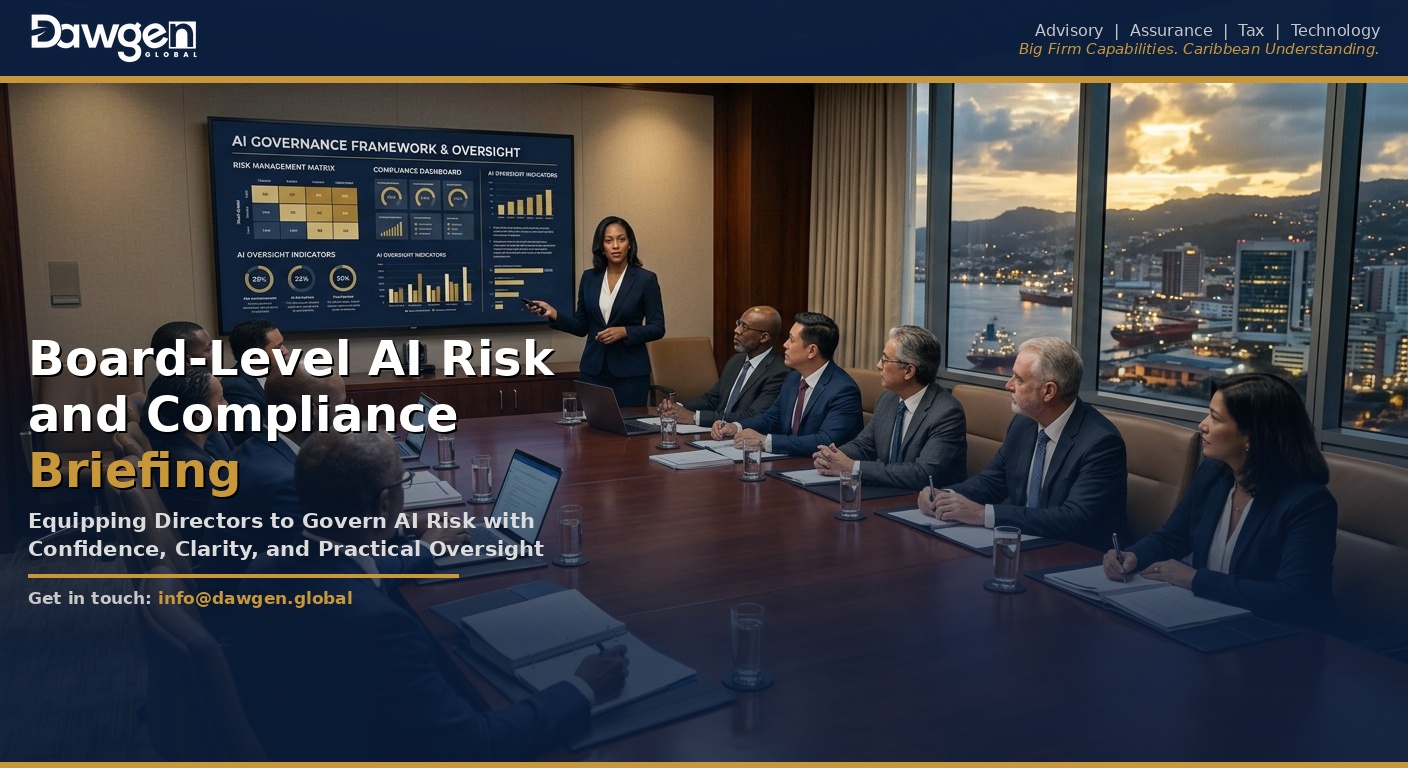
Equipping Directors to Govern AI Risk with Confidence, Clarity, and Practical Oversight
Executive Summary
Artificial intelligence is no longer a narrow technology topic that can be delegated to IT departments, innovation units, or external vendors and left there. It is now a board-level governance issue — because it directly affects strategy, risk, compliance, reputation, internal control, data governance, cyber exposure, workforce conduct, and stakeholder trust. As organizations adopt AI more actively across operations, finance, customer engagement, reporting, analysis, and decision support, boards are increasingly expected to understand not only the opportunity AI presents, but the governance responsibilities that accompany it.
That expectation is growing for a clear reason: AI creates value, but it also creates concentrated risk when adopted without sufficient oversight. Organizations may be using AI tools in ways that expose sensitive data, generate inaccurate outputs, introduce bias into consequential decisions, weaken accountability structures, or create regulatory and reputational vulnerabilities that no one has formally assessed. In many businesses, adoption is already moving faster than governance. Management teams are experimenting enthusiastically. Staff are using generative tools informally. Vendors are embedding AI functionality into core software without always making the implications visible. And boards — in too many cases — have only limited visibility into what is being used, where the risks sit, and whether the organization’s oversight framework is keeping pace.
This is a serious governance gap. Boards are not expected to become engineers or data scientists — but they are expected to exercise oversight over material business risks and significant strategic developments. AI now falls squarely within that responsibility. Directors need to understand the nature of AI-related risk, the questions they should be pressing management on, the controls that should exist, and the ways AI intersects with confidentiality, cyber resilience, legal exposure, operational integrity, and business strategy. Without that line of sight, boards are reacting to incidents rather than governing proactively.
Dawgen Global’s Board-Level AI Risk and Compliance Briefing is designed to close that gap. The service provides a focused, practical briefing on the AI risk landscape, governance expectations, compliance considerations, oversight duties, and strategic implications of AI adoption. It equips directors with the insight needed to ask sharper questions, evaluate management readiness more rigorously, and integrate AI into the board’s risk and governance agenda with greater confidence and greater precision.
This article explains why boards can no longer afford to remain passive about AI. It explores how AI is reshaping governance expectations, why informal adoption creates dangerous oversight blind spots, and how directors can move from broad awareness to disciplined supervision. It also challenges the common assumption that AI oversight is primarily a future concern — when many organizations are already materially exposed through current employee use, vendor deployment, and evolving business processes that no one has adequately mapped or governed.
The argument is direct: board oversight of AI should not be reactive, symbolic, or superficial. It should be practical, risk-based, and aligned with the organization’s strategy and governance maturity. Boards that engage early are better positioned to support responsible innovation, challenge management constructively, and protect the organization from exposures that are entirely avoidable with the right oversight structures in place.
If your board needs a clear, practical framework for governing AI risk — not abstract theory, but actionable oversight — contact Dawgen Global at [email protected] today.
Boards Cannot Afford to Be Passive About AI Risk
For many boards, artificial intelligence entered the governance conversation as a distant strategic theme — a topic for innovation sessions, future-of-work discussions, or broad market commentary about technological disruption. Directors heard that AI would transform industries and reshape competition, but for a time it still felt like something approaching from the horizon rather than something embedded in present-day governance responsibilities.
That is no longer the case. AI is a current oversight issue — not a future one.
Employees are already using generative AI tools to draft documents, summarize information, conduct research, generate code, analyze data, and support customer interaction. Vendors are embedding AI functionality into core business software, sometimes without explicit notification. Management teams are evaluating AI-enabled automation, predictive tools, digital assistants, and new workflow models. In some organizations, AI adoption is deliberate and structured. In many others, it is informal, uneven, and only partially visible to senior leadership. In either case, the board can no longer treat AI as a peripheral matter. It is shaping how risk is created, how decisions are made, how data is used, and how trust is maintained — right now, across the organization.
Why Passivity Is Dangerous
Passivity is dangerous because AI does not wait for governance to catch up. Adoption spreads through convenience and perceived usefulness — one employee at a time, one department at a time, one vendor feature update at a time. A staff member uses a public tool to improve personal efficiency. A department adopts an AI-enabled platform because the feature is already embedded in existing software. A manager relies on AI-generated summaries to accelerate work under deadline pressure. A vendor assures the organization that its AI capabilities are improving service quality.
Each of these steps may appear unremarkable in isolation. Collectively, they can create a material governance problem. Sensitive information may be exposed to third-party systems. Outputs may be inaccurate in ways that are not immediately visible. Accountability may become diffuse and hard to trace. Data may be processed in ways the organization does not fully understand. Decision-making may become influenced by systems that no one has classified, assessed, or governed. The board becomes accountable for risk it has not been equipped to supervise.
This is the fundamental challenge of AI governance: exposure accumulates faster than oversight typically develops, unless boards are deliberate about closing that gap early.
The Governance Responsibility Is Already Here
Boards exist to oversee material business risk and support sound strategic direction. AI now intersects with both of those responsibilities at once — and across multiple dimensions simultaneously.
AI touches data governance, cyber security, legal exposure, privacy, ethics, operational resilience, third-party risk, internal control, workforce conduct, and corporate reputation. It does not sit neatly in one risk category. A board that is not engaging with AI as a governance issue may be leaving large areas of enterprise risk insufficiently supervised — not because the risk is invisible, but because no one at board level has asked the right questions.
One reason some boards remain hesitant is the perception that AI is too technical for director-level engagement. There is a partial truth in that — boards are not expected to design AI models or evaluate code-level architecture. But technical complexity has never been a reason to defer governance responsibility. Boards regularly oversee cyber security, complex financial reporting systems, regulatory compliance, data protection frameworks, and operational safety — all of which involve significant technical depth. AI should be approached in precisely the same way. The board’s role is not to master every underlying mechanism. It is to ensure that the organization has appropriate governance, controls, accountability, reporting, and risk management in place.
That distinction makes board engagement practical. Directors do not need to understand how a machine learning model is trained. They do need to understand whether management knows where AI is being used, whether high-risk use cases have been identified and assessed, whether data inputs are appropriately controlled, whether outputs are subject to human review, whether legal and compliance implications have been properly evaluated, and whether the organization’s risk appetite has been explicitly considered. The board’s responsibility is to oversee management’s handling of AI — not to replace management in its technical execution.
Six Reasons Boards Must Engage Now
1. Strategic Relevance
AI is already affecting business models, productivity assumptions, competitive positioning, and customer expectations. An organization that ignores AI may miss significant opportunities. An organization that adopts it recklessly may damage trust or create avoidable risk. Either way, the board must have enough oversight to evaluate whether AI use is genuinely aligned with strategy. Is AI being pursued because it supports clear business goals, or because management feels pressure to follow a market trend? Are the intended use cases proportionate and well-defined? Strategy without governance is weak. Governance without strategic awareness is incomplete. The board needs both.
2. Data Exposure
AI systems depend on prompts, documents, datasets, and patterns of usage that can create serious confidentiality, privacy, and security concerns. Employees may not fully appreciate what should and should not be entered into external tools. Vendors may provide AI functionality without giving management a sufficiently transparent picture of how data is processed, stored, or reused. Data risk is already a major governance concern. AI can amplify it rapidly and in ways that are difficult to detect after the fact. Directors should expect management to explain clearly what controls exist around sensitive information, approved tools, vendor oversight, and employee use.
3. Output Reliability
AI-generated outputs can be polished and persuasive while still being inaccurate, incomplete, or materially misleading. This creates a subtle but serious risk: the apparent quality of the language can mask substantive weaknesses in the underlying content. If management or staff are using AI outputs in reporting, analysis, regulatory submissions, customer communications, compliance support, or decision-making without appropriate validation, the organization is exposed in ways that may not surface until the consequences are significant. Boards should be asking how outputs are reviewed before they are relied upon, and where management believes the greatest risk of overreliance currently sits.
4. Accountability Gaps
One of the most common governance failures in emerging technology adoption is the absence of clear ownership. AI cuts across IT, legal, compliance, risk, HR, operations, finance, and business units. If no one is clearly accountable for oversight, policy development, risk assessment, incident escalation, and reporting, adoption becomes fragmented. The board should be satisfied that executive accountability is clearly established, responsibilities are properly allocated across functions, and AI-related matters are flowing through appropriate governance channels with sufficient frequency and depth.
5. Regulatory and Legal Exposure
Even where specific AI legislation is still developing, organizations are already exposed through existing legal and regulatory frameworks. Privacy obligations, confidentiality duties, sector-specific compliance requirements, consumer protection principles, recordkeeping obligations, employment law considerations, intellectual property concerns, and directors’ general oversight duties may all be directly relevant. A board does not need to wait for a specialized AI statute to recognize that unmanaged AI adoption can generate regulatory and legal consequences. Management should be able to demonstrate that it has mapped the compliance perimeter and identified where legal review is required.
6. Reputational Risk
Trust can be damaged rapidly if an organization is seen as careless in how it uses AI. A problematic customer interaction, a data mishandling incident, an inaccurate automated output, or a visible failure of governance can affect stakeholder confidence in ways that are disproportionate to the underlying operational event. This is especially acute for organizations whose business model depends on trust, professional judgment, confidentiality, or public credibility. Boards should not treat reputational exposure as secondary to operational efficiency. In many cases, it is the reputational dimension that transforms an internal control weakness into a strategic-level crisis.
The Blind Spot Problem: Informal Adoption
One of the most significant AI governance challenges facing organizations today is not a large, formally approved AI project. It is the accumulation of decentralized, informal, everyday usage that no one has fully mapped.
Staff members use AI tools for drafting, summarization, translation, coding, analytics, and external communications — independently, across different functions, without coordinated oversight. Different teams experiment in parallel. Third-party platforms introduce AI-enabled features automatically through software updates. None of this necessarily indicates irresponsible behavior. But it does mean that board oversight cannot focus only on officially sanctioned innovation initiatives. The actual exposure is broader, more diffuse, and often less visible than the official picture suggests.
This requires structured reporting. Boards cannot oversee what they cannot see. Management should be developing a reporting framework that gives directors meaningful visibility into AI use across the organization, risk classification, policy development, control maturity, incident escalation, and material implementation decisions. A board that receives only vague assurances that “AI is on the agenda” is not receiving the level of information necessary for genuine supervision.
The Questions Boards Should Be Asking
Effective AI oversight does not require technical expertise. It requires disciplined governance questions — asked consistently and followed up with genuine expectation of substantive answers:
Where is AI currently being used across the organization, and how complete is that picture? Which use cases carry the highest risk and why? What tools are approved, and what restrictions govern their use? What categories of data are prohibited from external AI systems? Who holds executive accountability for AI governance? What training has been provided to staff, and how is compliance monitored? How are AI-generated outputs validated before they are relied upon? What role do legal and compliance functions play in reviewing AI deployment decisions? How is third-party AI risk being identified and assessed? What reporting reaches the executive team and the board — and how often?
These are not technical questions. They are governance fundamentals that any director can and should be asking.
Integrating AI into the Board’s Governance Framework
One of the more consequential mistakes boards make is treating AI oversight as a stand-alone topic that sits outside the normal governance architecture. AI oversight should be integrated into existing governance structures — not quarantined as a special subject.
It should feature within risk committee discussions, cyber and technology oversight, compliance review cycles, data governance frameworks, internal control conversations, strategy sessions, and, where relevant, audit committee reporting. Artificial separation between AI and the broader risk and governance agenda can create precisely the blind spots that boards are trying to avoid. AI is not a separate issue. It is a dimension of almost every significant governance issue the organization already faces.
The Dawgen Global Board-Level AI Risk and Compliance Briefing
Boards are increasingly aware that AI matters. But awareness is not the same as readiness — and it is not the same as governance.
Dawgen Global’s Board-Level AI Risk and Compliance Briefing provides a focused, practical engagement designed specifically for directors and senior leadership. It translates AI from a broad market trend into a concrete, actionable governance agenda. It equips boards with a clear understanding of how AI intersects with the board’s specific governance responsibilities, a structured view of the AI risk landscape most relevant to the organization’s sector, size, and operating model, a practical framework for evaluating management’s AI readiness and oversight maturity, a set of governance questions calibrated to drive meaningful accountability from management, guidance on how AI oversight should be integrated into existing board and committee structures, and clarity on the compliance and legal perimeter around current and planned AI adoption.
The briefing is especially valuable because it creates a common governance language at board level. Directors bring different levels of familiarity with AI to the conversation — some enthusiastic, some cautious, some focused primarily on compliance and cyber exposure. A structured briefing aligns the board around the real governance issues rather than leaving discussion fragmented, technically uneven, or dependent on external headlines.
It also supports management. In some organizations, executives are already grappling with AI adoption challenges but have not yet brought the board fully into the conversation. In others, the board is asking broad questions but management has not yet developed a coherent reporting and governance approach. The briefing helps bridge that gap — clarifying expectations on both sides and creating the conditions for more disciplined, more productive engagement.
Good governance does not only reduce downside risk. It creates strategic confidence. When boards understand the AI governance perimeter more clearly, they are better able to support thoughtful innovation — challenging poorly structured initiatives while encouraging practical opportunity. They help ensure that AI adoption remains aligned with the organization’s values, risk appetite, and long-term objectives. Governance becomes an enabler of responsible innovation, not a constraint on it.
The Caribbean Context
For Caribbean organizations, the governance imperative around AI is both urgent and underappreciated. Many businesses across the region are already encountering AI through productivity tools, software vendor updates, and evolving employee behavior — even where no formal AI program exists. At the same time, governance capacity may still be developing, and board agendas are often crowded with immediate commercial pressures, making it easy for AI oversight to remain underdeveloped.
The professional services firms, financial institutions, family businesses, mid-market companies, and regulated entities that form the backbone of Caribbean economies operate in environments where trust, confidentiality, and professional judgment are central to their commercial model. In those environments, AI-related governance failures carry outsized consequences. The reputational, legal, and operational risks are not abstract — they are immediate.
Dawgen Global understands these dynamics. The Board-Level AI Risk and Compliance Briefing is designed to deliver practical, regionally grounded governance insight that works within the realities of Caribbean business — not a theoretical framework imported from another context.
Conclusion
The core message is direct and important. AI may be enabled by technology, but it is governed through leadership. Boards cannot outsource that responsibility, and they cannot afford to remain passive while AI becomes progressively more embedded in the organization’s operations, decisions, and commercial relationships.
A passive board assumes management is handling AI appropriately — until a problem reveals otherwise. An engaged board asks earlier questions, expects clearer reporting, and creates the conditions for more responsible and more confident adoption. That difference matters. It determines whether AI becomes a controlled strategic capability or an unmanaged source of risk.
The organizations that manage AI well will not necessarily be those that move fastest. They will be those that combine purposeful adoption with disciplined governance — and boards that understand their role in making that combination work.
Take the Next Step: Equip Your Board to Govern AI Confidently
Is your board equipped to govern AI risk — or still trying to catch up with it?
Dawgen Global’s Board-Level AI Risk and Compliance Briefing gives directors and senior leadership a practical, business-focused framework for AI oversight. Whether your organization is in the early stages of AI adoption, already dealing with informal usage across the business, or preparing for a more structured AI program — your board needs the right governance tools now, not after the first incident.
We help boards move from passive awareness to active, informed oversight.
The briefing covers the AI risk landscape relevant to your sector and operating model, governance and compliance responsibilities, the questions your board should be asking management, how to integrate AI into your existing governance structures, and a practical framework for evaluating management’s AI readiness.
Contact us today to arrange your Board-Level AI Risk and Compliance Briefing:
Don’t wait for an AI-related incident to force the conversation. The right time to govern AI is before the risk becomes visible — and that time is now.
About Dawgen Global
“Embrace BIG FIRM capabilities without the big firm price at Dawgen Global, your committed partner in carving a pathway to continual progress in the vibrant Caribbean region. Our integrated, multidisciplinary approach is finely tuned to address the unique intricacies and lucrative prospects that the region has to offer. Offering a rich array of services, including audit, accounting, tax, IT, HR, risk management, and more, we facilitate smarter and more effective decisions that set the stage for unprecedented triumphs. Let’s collaborate and craft a future where every decision is a steppingstone to greater success. Reach out to explore a partnership that promises not just growth but a future beaming with opportunities and achievements.
 Email: [email protected]
  Visit: Dawgen Global Website

 WhatsApp Global Number : +1 555-795-9071
Caribbean Office: +1876-6655926 / 876-9293670/876-9265210  WhatsApp Global: +1 5557959071
USA Office: 855-354-2447
Join hands with Dawgen Global. Together, let’s venture into a future brimming with opportunities and achievements


