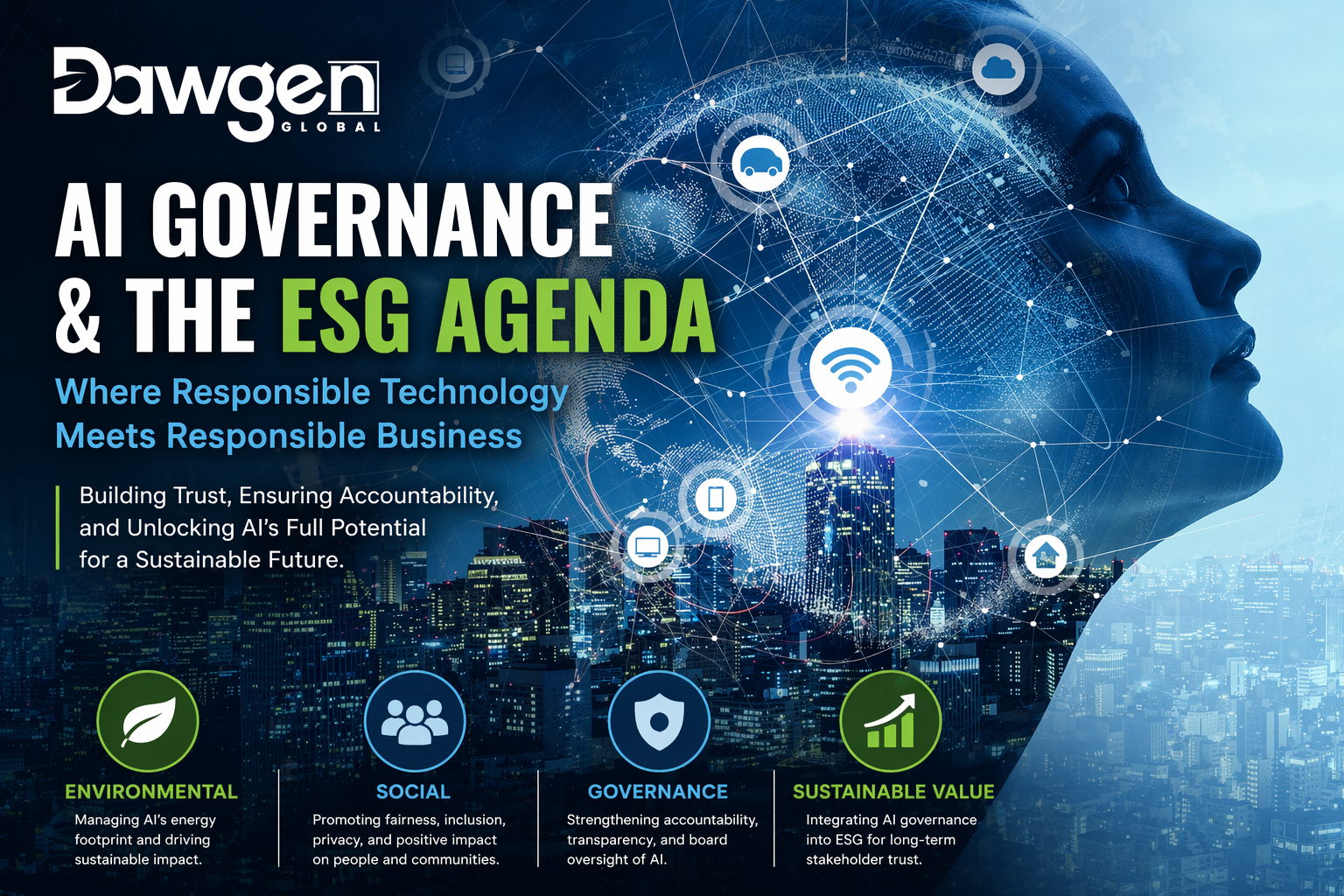
The Convergence of Two Governance Imperatives
ESG — Environmental, Social, and Governance — has become the dominant framework through which Caribbean boards, institutional investors, and regulatory bodies assess corporate responsibility and long-term value creation. AI governance, by contrast, is a newer and less institutionalised framework, still being built out in most organisations. The insight that drives this article is that these two frameworks are not separate — they are deeply intertwined, and treating them in isolation produces weaker governance on both fronts.
AI systems have material ESG implications across all three dimensions. They carry significant environmental footprints (the energy consumption of large language models and data centres is substantial). They have profound social impacts — on employment, financial inclusion, privacy, and the fair treatment of individuals. And they raise foundational governance questions about accountability, transparency, and board oversight. An organisation that pursues ESG excellence while maintaining opaque, ungoverned AI systems has a material blind spot in its responsible business practices.
AI and the Environmental Dimension
The environmental impact of AI is increasingly significant and increasingly scrutinised. Training large AI models requires enormous computational resources, consuming electricity at rates that dwarf conventional IT operations. Caribbean enterprises that have made carbon reduction commitments must account for the energy footprint of their AI infrastructure in their emissions reporting.
Beyond energy consumption, AI can also be a powerful environmental management tool — optimising energy use in facilities, improving logistics efficiency, enabling predictive maintenance that reduces waste, and supporting climate risk modelling. AI governance frameworks should ensure that the environmental costs and benefits of AI deployment are explicitly assessed and reported within the ESG framework.
AI and the Social Dimension
The social implications of enterprise AI are extensive and, in the Caribbean context, particularly consequential. They include:
| Social Dimension | AI Governance Implication |
| Employment Impact | AI-driven automation affects Caribbean workers disproportionately in sectors like customer service, logistics, and financial processing. Responsible AI governance includes workforce transition planning and transparency about AI-driven employment changes. |
| Financial Inclusion | AI credit and underwriting models can deepen financial exclusion if not governed for fairness. Conversely, well-governed AI can extend financial services to underserved populations. The governance choice determines the outcome. |
| Privacy and Data Rights | AI systems consume vast quantities of personal data. Caribbean enterprises must govern AI data use in alignment with data protection law and with genuine respect for individual privacy rights. |
| Community Impact | AI deployed in public-facing applications — healthcare triage, housing assessments, educational placements — has direct community welfare implications. Governance must include structured community impact assessment. |
AI and the Governance Dimension
At its core, AI governance is an expression of corporate governance discipline. The same principles that underpin good corporate governance — accountability, transparency, fairness, independence of oversight — are the principles that effective AI governance requires. This means that AI governance quality is a legitimate and important ESG governance metric.
Institutional investors and ESG rating agencies are beginning to incorporate AI governance into their assessments. Caribbean enterprises seeking international capital or maintaining relationships with ESG-sensitive institutional investors should be prepared for increasing scrutiny of their AI governance practices. Questions that investors are beginning to ask include:
- Does the board have defined oversight responsibility for AI governance?
- Has the enterprise conducted and published an AI ethics or impact assessment?
- Is there a named executive accountable for AI governance?
- Has the enterprise engaged an independent party to assess its AI governance framework?
- Are AI-related risks disclosed in the enterprise’s risk reporting?
Integrating AI Governance into ESG Reporting
Caribbean enterprises that are developing or maturing their ESG reporting frameworks should explicitly integrate AI governance disclosures. Dawgen Global’s DESGAF™ ESG Assurance Framework provides a structured approach to AI-related ESG disclosure, aligned with the GRI Standards and ISSB sustainability disclosure frameworks. Key disclosure areas include:
- AI governance framework description: the policies, structures, and accountability mechanisms in place
- High-risk AI inventory: a description of the high-risk AI applications in use and the governance controls applied
- AI fairness and bias management: the enterprise’s approach to assessing and managing discriminatory AI outcomes
- AI-related incidents: material AI system failures or adverse outcomes during the reporting period and the remedial actions taken
- AI and workforce: the enterprise’s approach to managing the employment impacts of AI deployment
| Caribbean boards that understand AI governance as an ESG imperative — not just a technology compliance requirement — will build governance frameworks that are more durable, more defensible, and more genuinely aligned with the long-term interests of their stakeholders. |
Next in the Series — Article 10: Building the AI-Ready Board: Governance Capability for the Intelligence Age
About Dawgen Global
“Embrace BIG FIRM capabilities without the big firm price at Dawgen Global, your committed partner in carving a pathway to continual progress in the vibrant Caribbean region. Our integrated, multidisciplinary approach is finely tuned to address the unique intricacies and lucrative prospects that the region has to offer. Offering a rich array of services, including audit, accounting, tax, IT, HR, risk management, and more, we facilitate smarter and more effective decisions that set the stage for unprecedented triumphs. Let’s collaborate and craft a future where every decision is a steppingstone to greater success. Reach out to explore a partnership that promises not just growth but a future beaming with opportunities and achievements.
 Email: [email protected]
  Visit: Dawgen Global Website

 WhatsApp Global Number : +1 555-795-9071
Caribbean Office: +1876-6655926 / 876-9293670/876-9265210  WhatsApp Global: +1 5557959071
USA Office: 855-354-2447
Join hands with Dawgen Global. Together, let’s venture into a future brimming with opportunities and achievements


