Caribbean organisations are in a talent retention crisis — but most are responding to it with the wrong tools. Salary increases alone do not retain the employees most worth keeping. This article sets out the evidence base for what drives Caribbean talent attrition, maps the seven retention drivers that the region’s highest-performing organisations have mastered, quantifies the true cost of getting it wrong, and shows how the PEOPLE360°™ Engagement & Culture pillar operationalises retention as a strategic, measurable outcome rather than an HR aspiration.
The Talent Crisis the Caribbean Cannot Afford to Ignore
Every Caribbean business leader has felt it. The high performer who resigns for a role in Canada. The technically skilled specialist recruited away by a multinational. The middle manager who leaves — not for more money, but because they could not see where their career was going. The graduate trainee, three years into a development programme, who accepts a visa and boards a flight.
These are not isolated incidents. They are symptoms of a structural talent crisis that the International Labour Organization estimates is removing between 30 and 40 percent of the Caribbean’s tertiary-educated workforce from the regional labour market each decade. The brain drain is not a future risk. It is an active, compounding drain on the organisational capability of every Caribbean enterprise that has not built a deliberate, structured response to it.
The instinctive response — matching salary — is necessary but not sufficient. Salary is a hygiene factor in retention. It prevents departure in the short term when it falls materially below market. But for the employees most worth keeping — the high performers, the specialists, the emerging leaders — compensation is rarely the primary driver of the decision to leave. Research consistently shows that the primary drivers are developmental, relational, and cultural: the absence of growth opportunity, the quality of the direct manager, the visibility of a future within the organisation, and the sense of purpose and recognition that determines whether a talented person chooses to invest their discretionary effort in your enterprise or quietly begin their search for somewhere that will value it more.
Understanding this distinction — between the hygiene factors that prevent departure and the motivational factors that create genuine commitment — is the foundation of an effective Caribbean talent retention strategy.
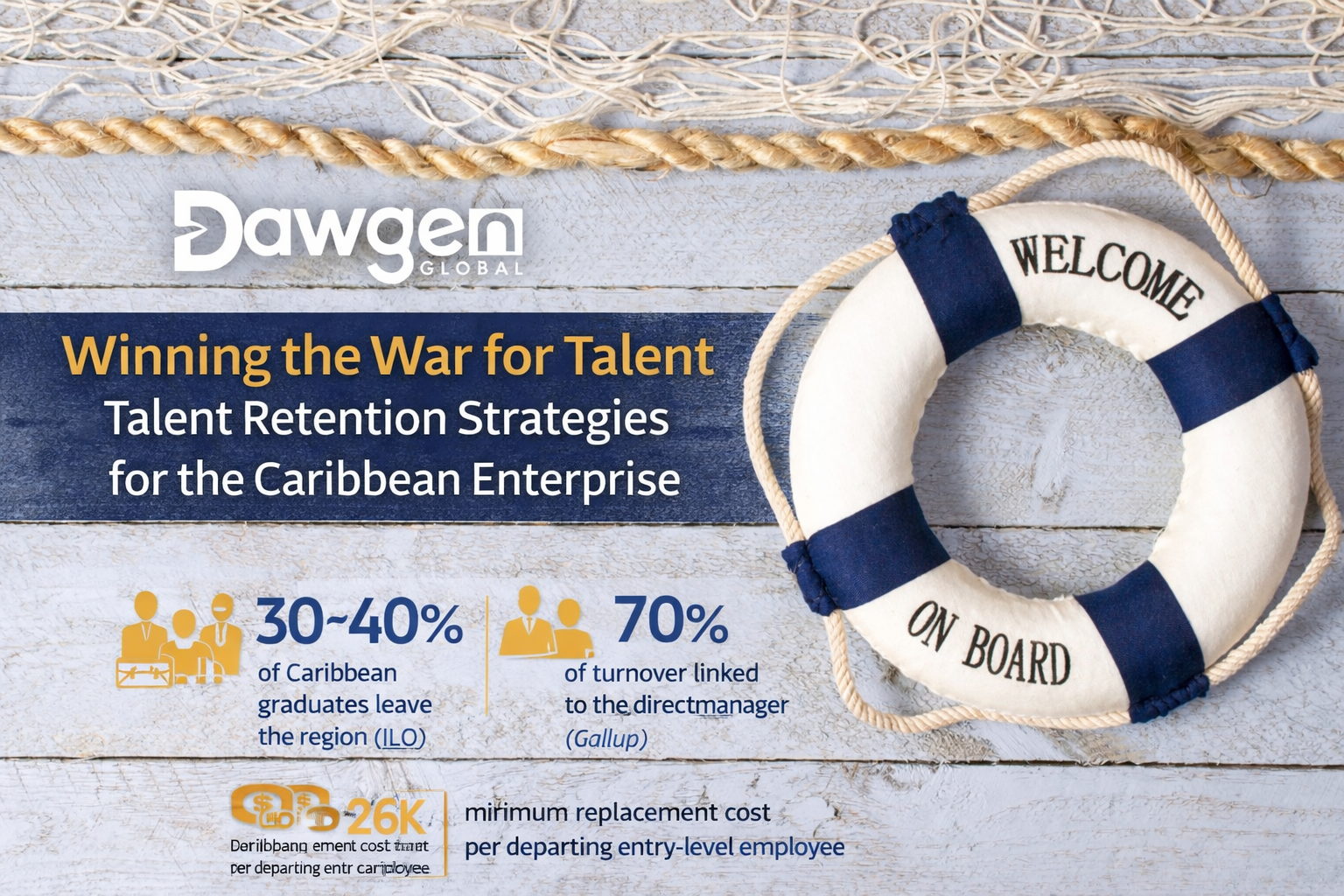
30–40% of tertiary-educated Caribbean workers leave the region each decade (ILO)
70% of voluntary turnover is linked directly to the quality of the direct manager (Gallup)
USD 26k minimum replacement cost per departing entry-level employee in the Caribbean
The True Cost of Losing a Caribbean Employee
Before any discussion of retention strategy, Caribbean leaders need to be confronted with the full cost of the status quo. The cost of voluntary attrition is consistently underestimated — not because leaders are unaware that turnover is expensive, but because the costs are distributed across multiple functions and time periods in ways that make the total difficult to see on a single page.
The table below builds the full replacement cost per departing employee for a Caribbean organisation, across two role bands. The figures reflect Dawgen Global’s regional cost benchmarking and publicly available HR cost research, adjusted for Caribbean labour market conditions.
Cost Element (per departing employee) Entry–Mid Level Senior / Specialist Recruitment advertising & agency fees USD 1,500 USD 8,000 Management time on recruitment process USD 3,000 USD 12,000 Onboarding & induction investment USD 2,500 USD 6,000 Productivity ramp-up period (lost output) USD 8,000 USD 35,000 Knowledge transfer & institutional memory USD 5,000 USD 25,000 Team morale & remaining staff productivity USD 4,000 USD 15,000 Client / stakeholder relationship disruption USD 2,000 USD 20,000 TOTAL REPLACEMENT COST PER DEPARTURE USD 26,000 USD 121,000 As % of annual salary (avg. USD 30k / USD 85k) 87% 142%
For a 100-person Caribbean organisation with a 15% annual voluntary turnover rate — typical for the region — these figures translate to between USD 390,000 and USD 1.8 million in annual replacement costs, depending on role mix. Even at the conservative end, this is a cost that dwarfs the investment required to build a structured retention programme.
The more insidious cost is the one that does not appear in the table: the institutional knowledge, the client relationships, the team culture, and the organisational capability that leave with each departing employee and that cannot be replaced by any recruitment process, however well designed.
THE RETENTION PREMIUM A structured retention improvement of 5 percentage points — reducing voluntary turnover from 15% to 10% in a 100-person Caribbean organisation — saves between USD 130,000 and USD 600,000 annually in direct replacement costs alone, before accounting for the productivity, culture, and capability gains that come with a more stable workforce.
What Caribbean Employees Are Actually Leaving For
Exit interviews, when they are conducted at all in Caribbean organisations, are frequently superficial. Departing employees cite ‘better opportunity’ or ‘career development’ because these are socially acceptable reasons for leaving — and because the organisation has rarely created an environment in which the real reasons can be safely articulated.
A more rigorous analysis of Caribbean attrition — drawing on structured exit interview data, employee engagement surveys, and academic research on the regional labour market — reveals a more nuanced picture. The primary drivers of voluntary departure for high-performing Caribbean employees fall into five categories, in approximate order of frequency:
- Absence of Visible Career Progression
The most consistent driver of departure among high-performing Caribbean employees is the inability to see a credible path forward within the organisation. This is not simply a desire for promotion. It is a need for transparency about how advancement decisions are made, what the criteria for progression are, and whether the organisation is genuinely invested in developing the individual for a future role. Organisations that promote based on tenure, personal relationships, or opaque criteria lose their most ambitious employees to organisations that are clearer about what development and advancement look like.
- Manager Quality
Gallup’s research is unequivocal: 70% of variance in employee engagement is attributable to the direct manager. In the Caribbean context, where formal management training has historically been limited and where technical expertise is frequently mistaken for leadership capability, poor management is endemic — and its retention consequences are severe. Employees do not leave organisations. They leave managers. And in the Caribbean, where the talent pool is shallow and the international options are real, the cost of a poor manager is not merely disengagement. It is departure.
- Compensation Below Market
Salary is not the primary driver of departure for high performers, but it is a necessary condition for retention. Organisations that allow compensation to drift materially below market — particularly without the compensating benefits of development opportunity, manager quality, and organisational culture — create the conditions for departure. The risk is amplified in the Caribbean by the ready availability of international salary benchmarks and by the active recruitment of Caribbean talent by Canadian, British, and American employers who are transparent about their compensation packages.
- Limited Flexibility and Autonomy
The post-pandemic recalibration of work has hit Caribbean organisations with particular force. Professionals who experienced remote and hybrid working arrangements during the pandemic — and who demonstrated that their productivity was maintained or improved — are increasingly unwilling to accept a return to inflexible, presentee-oriented work cultures. Organisations that have not adapted their work design to reflect this shift are losing employees who have internationalised their comparison set and who can now access roles in London, Toronto, and Miami from a Kingston or Port of Spain living room.
- Absence of Recognition and Purpose
Caribbean employees — particularly the millennial and Generation Z cohorts that now constitute the majority of the regional workforce — place a premium on working for organisations whose values they share and whose impact they can feel connected to. Organisations that communicate purpose clearly, that recognise individual and team contribution consistently, and that create a cultural environment in which employees feel seen and valued retain talent at significantly higher rates than those that do not. The research is consistent: organisations in the top quartile for employee recognition experience 31% lower voluntary turnover than those in the bottom quartile (Gallup).
The Seven Retention Drivers: A PEOPLE360°™ Framework
Effective talent retention in the Caribbean is not a single initiative. It is a system — one that addresses the full range of factors that determine whether a talented employee chooses to stay, contribute, and grow within an organisation. The PEOPLE360°™ Framework operationalises retention across seven evidence-based drivers, each mapped to a specific framework pillar and a measurable intervention.
Retention Driver PEOPLE360°™ Intervention Evidence Base Framework Pillar Compensation & Benefits Market benchmarking, pay equity audit 28% reduction in pay-driven attrition Operations & Compliance Career Development L&D pathways, promotion transparency 43% higher retention in development cohorts Learning & Development Manager Quality Manager capability training, 360° feedback 70% of turnover linked to direct manager Performance Systems Recognition & Purpose Structured recognition, values alignment 31% lower voluntary turnover (Gallup) Engagement & Culture Flexible Work Design Role flexibility audit, remote/hybrid policy 54% of employees cite flexibility as key People Strategy Succession Visibility Talent mapping, succession communications 60% higher retention of high-potentials People Strategy Exit Intelligence Structured exit interviews, trend analysis Identifies systemic issues before they spread 360° Value Delivery
The framework is designed to be implemented in sequence. Compensation and compliance foundations must be established before developmental and cultural initiatives can deliver their full impact. An organisation that invests in purpose and recognition programmes without first ensuring that compensation is market-competitive and that managers have the tools to lead effectively will see limited return from the cultural investment.
Five High-Impact Retention Strategies for Caribbean Organisations
Within the broader framework, five strategies consistently deliver the highest return on retention investment in the Caribbean context. They are not the only strategies — but they are the ones that Dawgen Global’s regional advisory experience identifies as the most frequently underprioritised and the most impactful when properly implemented.
Strategy 1: Build Transparent Career Architecture
The most powerful retention tool available to Caribbean organisations costs nothing in direct expenditure and is adopted by very few. Career architecture — a documented, communicated framework that maps role levels, progression criteria, competency expectations, and development pathways across the organisation — gives ambitious employees the visibility they need to commit to a future within the enterprise rather than seeking it elsewhere.
Implementation requires: defining role levels and the competency expectations at each; establishing clear, objective criteria for progression decisions; communicating those criteria consistently and transparently; and creating development plans for every employee that connect their current role to a credible future within the organisation. Organisations that do this retain their high performers at materially higher rates — not because the career is guaranteed, but because the path is visible and the commitment is demonstrated.
Strategy 2: Invest Directly in Manager Quality
If 70% of turnover is driven by manager quality, then manager development is the single highest-return retention investment available to Caribbean organisations. Yet most Caribbean organisations provide managers with almost no formal development — promoting technically competent individuals into leadership roles and leaving them to develop their people management capability through trial and error, at the expense of the employees they manage.
A structured manager capability programme — covering coaching skills, performance conversation frameworks, recognition practices, and how to identify and respond to early signs of disengagement — delivers retention improvement that compounds across every team that manager leads. The PEOPLE360°™ Performance Systems and Learning & Development pillars work in tandem to build this capability systematically, including 360-degree feedback mechanisms that give managers reliable data on their own impact.
Strategy 3: Conduct and Act on Engagement Intelligence
Organisations cannot retain employees they do not understand. A structured employee engagement programme — including regular pulse surveys, focused listening sessions, and a disciplined process for acting visibly on what is heard — provides the intelligence required to intervene before a dissatisfied employee becomes a departing one.
The critical element is the response process. Caribbean organisations that conduct engagement surveys and fail to communicate the findings or take visible action on them create a cynicism that is worse than not having surveyed at all. Employees who raise concerns and see no response conclude that the organisation is not genuinely invested in their experience. The PEOPLE360°™ Engagement & Culture pillar designs and manages the full survey-to-action cycle, including board-level reporting on engagement trends and retention risk.
Strategy 4: Personalise the Employee Value Proposition
A single, uniform employee value proposition does not retain a diverse workforce. The factors that retain a 28-year-old graduate accountant are materially different from those that retain a 45-year-old senior manager with school-age children. Organisations that segment their workforce — by career stage, by life circumstance, by aspiration — and that tailor their retention interventions accordingly consistently outperform those that apply a one-size approach.
In practice, this means: offering flexible work arrangements for those who value them; providing accelerated development opportunities for high-potentials who are most at risk of external departure; creating recognition structures that resonate across cultural and generational differences; and ensuring that the benefits package addresses the specific financial, health, and lifestyle priorities of different employee segments. The PEOPLE360°™ People Strategy pillar designs the workforce segmentation model and the targeted interventions that flow from it.
Strategy 5: Use Exit Intelligence Systematically
Most Caribbean organisations treat exit interviews as a courtesy — a brief conversation at the end of the offboarding process that is rarely documented and never analysed for patterns. This is a significant lost opportunity. Structured exit intelligence — conducted by a neutral third party, documented consistently, and analysed for systemic patterns — is among the most valuable sources of organisational insight available to a Caribbean employer.
Departing employees will tell a neutral interviewer things they would never tell their manager or HR team: the real reason they are leaving, what the organisation could have done differently, which manager behaviours were most damaging, and what the organisation’s reputation is in the external talent market. This intelligence, aggregated across twelve months of departures, provides a diagnostic that is more accurate and more actionable than any engagement survey. The PEOPLE360°™ 360° Value Delivery pillar systematises this process and reports findings to the executive team quarterly.
THE COMPOUNDING EFFECT Retention improvement is not linear. Each percentage point reduction in voluntary turnover reduces the organisation’s recruitment burden, reduces the disruption to remaining employees, increases the depth of institutional knowledge, and improves the employer brand that attracts the next generation of talent. The organisations that invest in retention today are building a compounding capability advantage that their competitors — who are still replacing the same roles year after year — will find increasingly difficult to close.
The Virtual HR Director and Retention: A Strategic Partnership
For Caribbean organisations that do not have a dedicated HR function capable of designing and managing a structured retention programme, the Virtual HR Director model within PEOPLE360°™ provides the senior strategic counsel required to build one.
The Virtual HR Director does not merely advise on retention policy. They become the organisational owner of the retention agenda — managing the engagement survey cycle, reviewing exit interview data, advising the executive team on flight risk employees, designing development pathways for high-potentials, coaching managers on people leadership, and reporting retention metrics to the board in formats that enable informed decision-making.
This level of strategic HR leadership — CHRO-calibre thinking applied consistently to the talent retention challenge — is precisely what most Caribbean organisations need and what very few can justify acquiring on a full-time basis. The Virtual HR Director model makes it accessible, affordable, and immediately deployable.
Your Retention Diagnostic Starts Here
The first step in building a structured retention programme is understanding your current position: your voluntary turnover rate, the primary drivers of departure in your organisation, the engagement levels across different employee segments, and the gap between your current employer value proposition and what your most valuable employees are seeking.
Dawgen Global’s complimentary HR Diagnostic, structured around the PEOPLE360°™ Framework, provides this assessment — including a retention risk analysis that identifies your highest-flight-risk employees and the interventions most likely to keep them. There is no obligation beyond the conversation.
Request your complimentary HR Diagnostic at [email protected] or visit www.dawgen.global/people360. Download the Caribbean HR Outsourcing Guide at www.dawgen.global/hr-guide. Next in The People Advantage Series
Article 5: Building the Internal Business Case for HR Outsourcing — a step-by-step guide to constructing the financial, strategic, and risk argument that wins board and executive approval for a structured HR outsourcing investment.
About Dawgen Global
“Embrace BIG FIRM capabilities without the big firm price at Dawgen Global, your committed partner in carving a pathway to continual progress in the vibrant Caribbean region. Our integrated, multidisciplinary approach is finely tuned to address the unique intricacies and lucrative prospects that the region has to offer. Offering a rich array of services, including audit, accounting, tax, IT, HR, risk management, and more, we facilitate smarter and more effective decisions that set the stage for unprecedented triumphs. Let’s collaborate and craft a future where every decision is a steppingstone to greater success. Reach out to explore a partnership that promises not just growth but a future beaming with opportunities and achievements.
 Email: [email protected]
  Visit: Dawgen Global Website

 WhatsApp Global Number : +1 555-795-9071
Caribbean Office: +1876-6655926 / 876-9293670/876-9265210  WhatsApp Global: +1 5557959071
USA Office: 855-354-2447
Join hands with Dawgen Global. Together, let’s venture into a future brimming with opportunities and achievements


