
Turning Support Functions Into a Lean Performance Engine (Without Breaking the Business)
Executive Summary
When margins get tight, organisations often reach for Selling, General & Administrative (SG&A) cuts first—freezing hiring, trimming travel, reducing training, or squeezing “overhead.” Some of these moves deliver short-term relief, but many create long-term damage: slower decision-making, poor controls, service failures, employee burnout, and hidden costs that reappear elsewhere in the value chain.
The real opportunity is not blunt cost cutting. It is SG&A redesign: simplifying processes, reducing complexity, automating routine work, consolidating vendors, clarifying decision rights, and aligning capacity to true demand. Done properly, SG&A becomes a performance engine that improves speed, control, and customer experience—while lowering total cost.
This article explains:
-
Why most SG&A cuts fail (and how costs “boomerang”)
-
The biggest hidden cost drivers inside support functions
-
A practical approach to identifying and capturing SG&A savings
-
A diagnostic: “Seven SG&A Leakages” that destroy profitability
-
How to apply the Dawgen V.A.L.U.E.-Chain Cost Advantage Framework™ to make savings stick
-
How to govern and validate SG&A savings as “net” captured value
SG&A is not overhead. It is the operating system that enables performance. If you redesign it, you can reduce cost and improve execution.
What SG&A Actually Includes (and Why It Matters)
SG&A (Selling, General & Administrative expenses) typically includes:
-
finance and accounting
-
HR and payroll
-
legal and compliance
-
IT and technology support
-
procurement and vendor management (often shared)
-
facilities and office operations
-
marketing and sales support
-
administration, shared services, and executive support
In many organisations, SG&A can represent a significant portion of operating cost—and in service businesses it can be the largest cost block. That makes it a prime target for cost reduction.
But SG&A is also where governance, controls, decision-making, and customer responsiveness live. Cut it poorly and you weaken the business.
Why Traditional SG&A Cost Cutting Often Fails
1) Costs don’t disappear—they move
Cutting administrative capacity without simplifying work often results in:
-
backlog growth
-
overtime
-
increased errors and rework
-
service delays that impact revenue
The organisation pays for cost reduction through operational friction elsewhere.
2) “Headcount cuts” without process redesign create fragility
If you remove people but keep the same processes, you create:
-
overreliance on a few key individuals
-
delays in approvals and reporting
-
compliance and audit risk
-
burnout and attrition
3) “Budget trimming” hits capability, not waste
Travel cuts and training cuts may look good on paper, but:
-
weak training increases error rates
-
fewer supplier visits can increase quality failures
-
reduced customer engagement can reduce retention
4) The biggest savings levers are structural—not discretionary
Large SG&A savings typically come from:
-
process simplification
-
automation
-
standardisation
-
consolidation (systems, vendors, locations)
-
operating model redesign (shared services, centres of excellence)
That requires design, not austerity.
The Hidden Drivers of SG&A Cost
SG&A cost growth is often driven by three forces:
1) Complexity (too many variants)
Examples:
-
too many product variants create billing and customer service complexity
-
too many approval steps create administrative load
-
too many suppliers create AP processing volume
-
too many reports create manual “busywork”
Complexity is expensive because it increases transaction volume and exceptions.
2) Manual work (low automation)
Examples:
-
manual reconciliations
-
Excel-based reporting
-
paper-based approvals
-
manual onboarding and document handling
-
repetitive customer queries handled without self-service
Manual work scales linearly with demand; automation does not.
3) Weak decision rights and unclear accountability
When decision rights are unclear:
-
work is duplicated
-
approvals are repeated
-
tasks bounce between departments
-
“shadow processes” emerge
Clarity reduces transaction volume and improves speed.
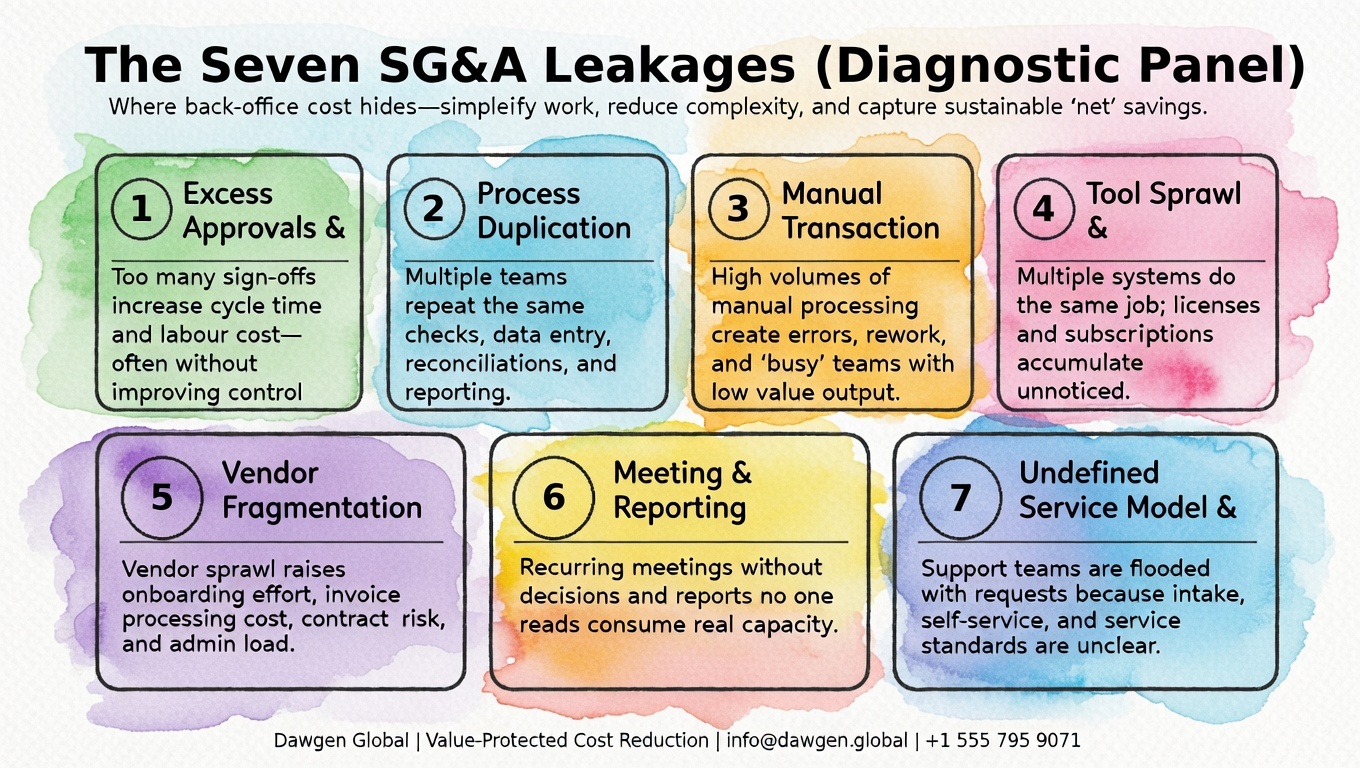
The Seven SG&A Leakages That Destroy Profitability
Leakage 1: Excess approvals and control layering
Too many approvals increase cycle time and labour cost, often without improving control quality.
Signal: approvals exist “because that’s how we’ve always done it.”
Leakage 2: Process duplication across functions
Multiple departments perform the same checks, reconciliations, and data entry.
Signal: finance, operations, and sales all maintain separate versions of the same data.
Leakage 3: Manual transaction overload (AP/AR, payroll, reporting)
High transaction volumes create processing cost and error risk.
Signal: the team is always “busy,” but value-added output is low.
Leakage 4: Tool sprawl and overlapping software subscriptions
Multiple systems do the same job; subscriptions accumulate.
Signal: teams use different tools for the same workflow.
Leakage 5: Vendor fragmentation (too many small suppliers)
Vendor sprawl increases:
-
sourcing effort
-
onboarding effort
-
invoice processing cost
-
contract risk
Signal: hundreds of vendors with minimal annual spend each.
Leakage 6: Poor meeting hygiene and reporting overload
Time spent in unproductive meetings and producing low-value reports is a real cost.
Signal: recurring meetings without decisions; reports no one reads.
Leakage 7: Undefined service model and uncontrolled demand
Support functions are flooded with requests because:
-
intake is unmanaged
-
self-service is absent
-
service standards are unclear
Signal: HR/IT/Finance are “firefighting” constantly.
Where SG&A Savings Usually Hide (High-Confidence Levers)
Finance and accounting
-
reduce close effort through standardisation and automation
-
simplify chart of accounts and reporting
-
reduce reconciliations through upstream controls
-
automate AP with vendor consolidation and e-invoicing
HR and workforce administration
-
streamline onboarding and employee lifecycle processes
-
reduce manual payroll exceptions
-
standardise policies and templates
-
introduce self-service for common requests
IT and technology
-
rationalise subscriptions and licenses
-
standardise endpoints and support model
-
consolidate platforms and reduce integration complexity
-
automate identity management and access provisioning
Legal/compliance and governance
-
standardise contracts and templates
-
reduce turnaround time through playbooks
-
implement contract lifecycle management discipline
-
improve risk controls with fewer manual checks
Facilities and office operations
-
space utilisation and footprint optimisation
-
vendor consolidation (security, cleaning, maintenance)
-
energy consumption optimisation
-
contract renegotiations
Quick Wins vs Structural Reshape in SG&A
Quick Wins (0–90 days)
-
cancel unused software subscriptions
-
reduce vendor sprawl (freeze new vendors; consolidate small suppliers)
-
simplify approvals for low-risk spend
-
remove redundant reports; reset meeting cadence
-
standardise templates and forms
-
introduce intake controls for IT/HR/Finance requests
Structural Reshape (3–18 months)
-
AP automation and spend-to-pay standardisation
-
shared services design (or partial shared services)
-
operating model redesign for HR/Finance/IT
-
policy simplification and decision-rights redesign
-
platform rationalisation (systems consolidation)
Sustained Advantage (18+ months)
-
continuous improvement cadence
-
service catalogues with SLAs
-
automation roadmap and digital workflow management
-
capability building (process owners, metrics, governance)
How V.A.L.U.E.™ Applies to SG&A Transformation
V — Validate the Profitability Challenge
-
quantify SG&A cost structure and hotspots
-
baseline transaction volumes, cycle times, error rates
-
identify “shadow work” and repeated rework
A — Analyse the Value Chain and Cost-to-Serve
-
map support function demand drivers (what creates the work?)
-
identify where SG&A issues create operational cost downstream
-
assess service model gaps and exception patterns
L — Locate Levers and Build Opportunity Portfolio
-
automation, simplification, consolidation, standardisation
-
quantify savings ranges (headcount avoidance, vendor savings, time savings)
U — Uplift & Prioritise
-
sequence quick wins first
-
prioritise high-volume processes and biggest leakages
-
build a roadmap with benefits, owners, and timing
E — Execute with Governance & Controls
-
establish workstreams (Finance, HR, IT, Facilities)
-
track savings and validate “net” capture
-
ensure controls are redesigned, not removed
™ — Transform for Sustainability
-
embed metrics and service catalogues
-
ensure process ownership and continuous improvement
-
hardwire automation and prevent complexity creep
Case Snapshot: Lower SG&A Cost, Faster Execution
A composite organisation reduced SG&A cost without mass layoffs by:
-
simplifying approvals and reducing duplicative reporting
-
consolidating vendors and standardising contracts
-
automating AP and IT access workflows
-
clarifying service models and introducing self-service for common requests
The result:
-
fewer errors and lower rework
-
faster cycle times
-
reduced vendor and software spend
-
sustainable savings validated by finance
SG&A Redesign Delivers Cost Advantage Without Weakening the Business
SG&A becomes expensive when complexity, manual work, and uncontrolled demand are allowed to grow. The goal is not to “cut overhead.” The goal is to design a lean performance engine that supports speed, control, and service—at a lower cost.
If you want value-protected cost reduction, SG&A redesign is one of the most controllable levers in your organisation.
Next Step!
Want to identify and capture SG&A savings without breaking service or controls?
Email [email protected] with the subject line “V.A.L.U.E. – SG&A Efficiency Scan” to request an initial discussion and our data intake checklist.
WhatsApp Global: +1 555 795 9071 | Contact form: https://www.dawgen.global/contact-us/
About Dawgen Global
“Embrace BIG FIRM capabilities without the big firm price at Dawgen Global, your committed partner in carving a pathway to continual progress in the vibrant Caribbean region. Our integrated, multidisciplinary approach is finely tuned to address the unique intricacies and lucrative prospects that the region has to offer. Offering a rich array of services, including audit, accounting, tax, IT, HR, risk management, and more, we facilitate smarter and more effective decisions that set the stage for unprecedented triumphs. Let’s collaborate and craft a future where every decision is a steppingstone to greater success. Reach out to explore a partnership that promises not just growth but a future beaming with opportunities and achievements.
 Email: [email protected]
  Visit: Dawgen Global Website

 WhatsApp Global Number : +1 555-795-9071
Caribbean Office: +1876-6655926 / 876-9293670/876-9265210  WhatsApp Global: +1 5557959071
USA Office: 855-354-2447
Join hands with Dawgen Global. Together, let’s venture into a future brimming with opportunities and achievements


