

Executive Summary
In many organisations, procurement is treated as a purchasing function—focused on negotiating lower prices, issuing purchase orders, and managing suppliers. That approach leaves significant value on the table. In today’s economic climate—marked by cost inflation, logistics volatility, FX pressures, and higher financing costs—procurement must evolve into a strategic sourcing engine.
The organisations that win are not simply those that negotiate harder; they are the ones that redesign demand, reduce specification complexity, consolidate spend, enforce compliance, and build supplier performance discipline. The result is sustainable cost advantage—without undermining quality, service, or risk controls.
This article explains:
-
Why “price-only procurement” often fails to deliver sustainable savings
-
The hidden cost drivers inside specifications, fragmentation, and uncontrolled buying
-
A practical sourcing maturity path for Caribbean and regional organisations
-
The “Five Procurement Leakages” that silently destroy profitability
-
How to apply the Dawgen V.A.L.U.E.-Chain Cost Advantage Framework™ to build a durable procurement savings pipeline
-
The governance and controls required to convert negotiated savings into validated “net” savings
If cost reduction is a competitiveness strategy, then procurement is one of the fastest and most controllable levers—when approached correctly.
Why “Price-Only Procurement” Fails
Negotiating price reductions is important—but it is rarely sufficient.
Here is why price-only efforts often underdeliver:
1) Savings don’t stick
You negotiate a better price, then:
-
users buy off-contract
-
suppliers change price due to “urgent” orders
-
delivery terms worsen
-
volume shifts to non-preferred suppliers
The negotiated saving evaporates.
2) The business is paying for complexity
Even with good prices, you may be overpaying because:
-
specifications are overly strict or inconsistent
-
you carry too many SKUs and variants
-
you order in small quantities too frequently
-
you run too many suppliers for the same category
Complexity adds cost through handling, inventory, quality variability, and administrative overhead.
3) Total cost isn’t being managed
Unit price is only one part of cost. The rest sits in:
-
freight and Incoterms decisions
-
duties and taxes
-
lead time and reliability
-
quality failures and returns
-
payment terms and working capital
-
internal processing and approval cost
A slightly higher unit price can be cheaper overall if it reduces waste, downtime, or expedited freight.
4) Procurement is reacting to urgency
When the “urgency tax” is present, procurement loses leverage:
-
urgent buys are done at premium prices
-
competition is bypassed
-
exceptions become normal
-
strategic sourcing is crowded out by firefighting
This is why procurement must be engineered—like an operating system—rather than treated as a transactional function.
The Procurement Opportunity in the Caribbean Context
For many Caribbean organisations, procurement is uniquely high-impact because of:
-
import dependence
-
FX exposure
-
freight costs and port variability
-
supplier concentration
-
scale constraints and fragmented demand
-
energy and utilities pricing pressures
-
higher funding costs (making working capital discipline valuable)
That context makes strategic sourcing especially powerful, because it targets not only price but terms, reliability, and cost-to-serve.
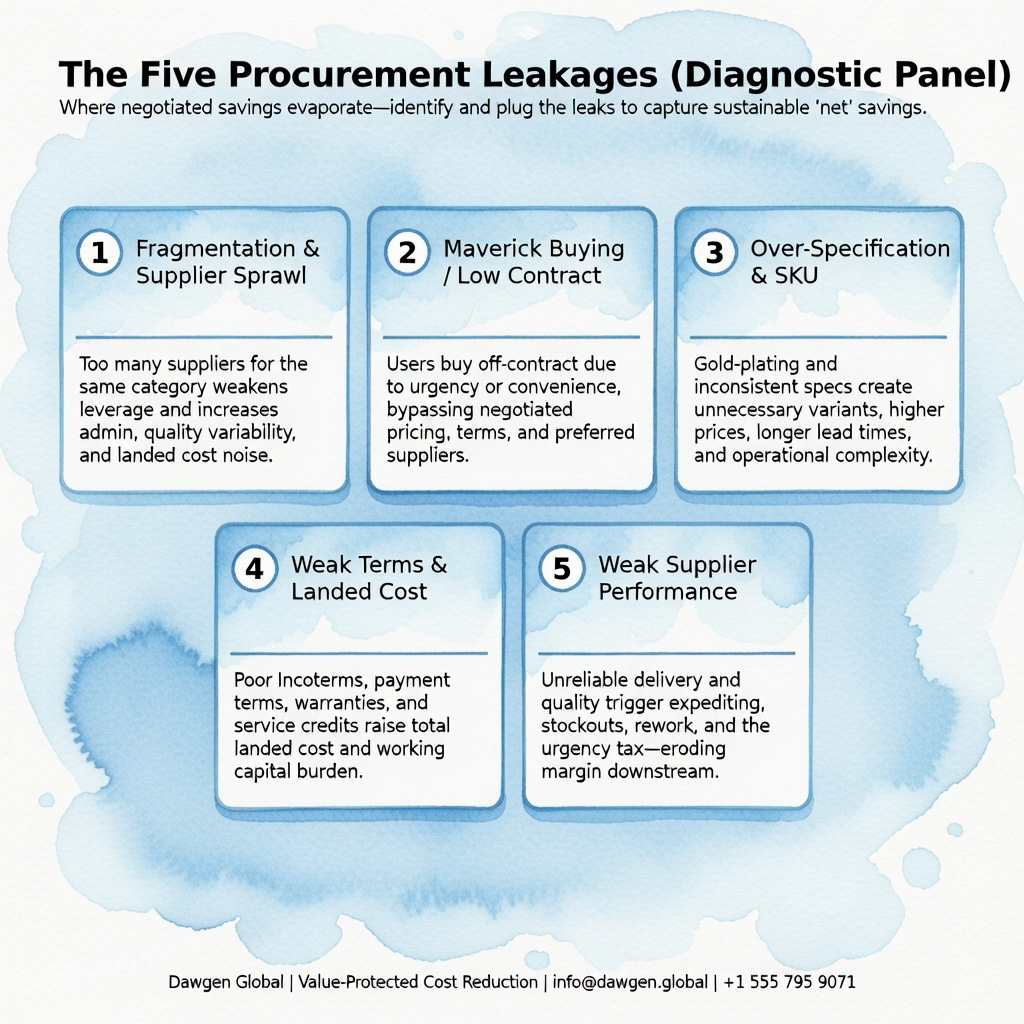
The Five Procurement Leakages That Destroy Profitability
These are common “silent leaks” we see across organisations:
Leakage 1: Fragmented spend and supplier sprawl
Multiple suppliers for the same category create:
-
weaker negotiating leverage
-
inconsistent terms
-
complexity in ordering and invoicing
-
higher admin and quality variability
Signal: lots of suppliers with small annual spend.
Leakage 2: Maverick buying and low contract compliance
Even when contracts exist, users buy outside them due to:
-
convenience
-
urgency
-
lack of controls
-
weak policy enforcement
Signal: negotiated contracts exist, but actual spend doesn’t follow them.
Leakage 3: Over-specification and “gold-plating”
Teams request specifications that exceed what is needed for customer value or regulatory compliance. This increases cost directly and can increase lead time.
Signal: multiple similar SKUs with minor spec differences; high rejection rates; supplier lead time problems.
Leakage 4: Poor terms and Incoterms choices
Supplier terms can be worth as much as price:
-
payment terms affect cash
-
Incoterms affect freight risk and cost
-
warranties affect lifecycle cost
-
rebates and service credits affect net price
Signal: favourable price but weak terms; frequent disputes or “surprise” landed cost variances.
Leakage 5: Supplier performance not measured or managed
Unreliable suppliers create cost across the chain:
-
stockouts and emergency buying
-
overtime and schedule disruption
-
quality failures and rework
-
customer dissatisfaction and returns
Signal: frequent expediting, inconsistent delivery performance, high defect rates.
What Strategic Sourcing Actually Means
Strategic sourcing is a disciplined approach that aligns procurement with business strategy and value chain outcomes. It includes:
1) Spend visibility and category strategy
-
understand where spend is concentrated
-
group spend into categories (not just suppliers)
-
develop category strategies (consolidate, standardise, substitute, partner)
2) Demand and specification management
-
standardise specifications where possible
-
reduce low-value variants
-
align specifications to customer value and risk requirements
-
rationalise the SKU portfolio
3) Competitive sourcing and negotiation discipline
-
run structured tenders or RFQs where appropriate
-
negotiate with fact-based cost drivers (not only price)
-
manage total landed cost
4) Contracting and compliance controls
-
ensure contracts are usable and easy to follow
-
build compliance mechanisms (PO controls, catalogs, approvals)
-
enforce purchasing policy and supplier lists
5) Supplier performance management
-
create scorecards (OTIF, quality, responsiveness, cost stability)
-
agree performance targets and improvement plans
-
reduce volatility and the urgency tax
Strategic sourcing is about building a machine that produces savings repeatedly—not a one-time negotiation event.
Quick Wins vs Structural Reshape in Procurement
Procurement is a strong lever for both quick wins and structural reshape.
Quick Wins (0–90 days)
-
enforce contract compliance (stop leakage immediately)
-
freeze supplier sprawl in key categories
-
renegotiate top supplier terms and payment conditions
-
tighten approval rules for non-preferred suppliers
-
target top 10 categories for rapid opportunity scan
-
reduce urgent buying through basic planning discipline
Structural Reshape (3–18 months)
-
category strategy redesign and consolidation
-
specification rationalisation and SKU simplification
-
supplier performance management and OTIF improvement
-
procurement operating model and policy redesign
-
procure-to-pay automation and controls
-
strategic partnerships for key imports and logistics
Sustained Advantage (18+ months)
-
continuous sourcing pipeline
-
periodic demand management reviews
-
embedded compliance and spend analytics
-
supplier collaboration for innovation and cost reduction
How V.A.L.U.E.™ Applies to Procurement Transformation
V — Validate the Profitability Challenge
-
quantify cost pools affected by procurement: price, landed cost, expediting, quality failures
-
identify the biggest spend categories and leakage patterns
-
set ambition: savings, cash impact, and service protection
A — Analyse the Value Chain and Cost-to-Serve
-
map procurement cost drivers across Source → Operate → Deliver
-
identify where supplier performance creates downstream cost-to-serve
-
assess contract compliance and urgency behaviour
L — Locate Levers and Build Opportunity Portfolio
-
levers by category: consolidate, standardise, substitute, renegotiate, re-term
-
quantify ranges for savings and cash impact
-
identify quick wins vs structural opportunities
U — Uplift & Prioritise
-
prioritise high-confidence categories first
-
build a sequencing roadmap
-
define governance and decision rights
E — Execute with Governance & Controls
-
establish workstreams by category
-
track negotiated vs realised savings
-
enforce contract compliance and prevent double counting
-
resolve issues quickly through cadence and escalation
™ — Transform for Sustainability
-
embed supplier scorecards
-
create ongoing sourcing pipeline
-
maintain specification discipline
-
prevent re-fragmentation and maverick buying
Case Snapshot: Procurement Savings That Actually Stuck
A composite regional organisation had negotiated price reductions annually—but savings did not stick due to off-contract buying and frequent urgent orders.
The organisation:
-
enforced preferred supplier lists
-
redesigned approvals for exceptions
-
consolidated spend in top categories
-
renegotiated payment terms and Incoterms
-
introduced supplier performance scorecards and OTIF targets
The result:
-
reduced unit costs and landed cost volatility
-
fewer emergency buys and expedited freight
-
improved supplier reliability and availability
-
savings that were validated and sustained
Procurement Is One of the Most Controllable Profit Levers—When Engineered Correctly
Cost advantage is not delivered by negotiation alone. It is delivered by a disciplined sourcing engine that:
-
reduces complexity
-
prevents leakage
-
improves supplier performance
-
manages total cost and risk
-
converts opportunities into validated “net” savings
In the current climate, procurement maturity is a differentiator—especially for import-dependent, logistics-sensitive markets.
Next Step!
Ready to build a procurement savings engine that delivers validated “net” savings—without compromising quality or service?
Email [email protected] with the subject line “V.A.L.U.E. – Procurement Opportunity Scan” to request an initial discussion and our data intake checklist.
WhatsApp Global: +1 555 795 9071 | Contact form: https://www.dawgen.global/contact-us/
About Dawgen Global
“Embrace BIG FIRM capabilities without the big firm price at Dawgen Global, your committed partner in carving a pathway to continual progress in the vibrant Caribbean region. Our integrated, multidisciplinary approach is finely tuned to address the unique intricacies and lucrative prospects that the region has to offer. Offering a rich array of services, including audit, accounting, tax, IT, HR, risk management, and more, we facilitate smarter and more effective decisions that set the stage for unprecedented triumphs. Let’s collaborate and craft a future where every decision is a steppingstone to greater success. Reach out to explore a partnership that promises not just growth but a future beaming with opportunities and achievements.
 Email: [email protected]
  Visit: Dawgen Global Website

 WhatsApp Global Number : +1 555-795-9071
Caribbean Office: +1876-6655926 / 876-9293670/876-9265210  WhatsApp Global: +1 5557959071
USA Office: 855-354-2447
Join hands with Dawgen Global. Together, let’s venture into a future brimming with opportunities and achievements


