
Why the Margin War Is Here to Stay—and How Leaders Build a Sustainable Cost Advantage
Executive Summary
Profitability across the Caribbean and global markets is being pressured by three simultaneous forces: rising operating costs, uneven revenue growth, and higher capital costs. While leaders can pursue multiple levers to protect margins—pricing, product mix, market expansion, innovation—cost remains the most directly controllable lever available to management in the short-to-medium term. Yet many cost programmes fail because they are treated as “budget cuts” rather than a strategic capability.
This article explains why the “margin war” is here to stay and why cost advantage is increasingly a strategic differentiator, not a back-office exercise. We outline how organisations can reduce cost without damaging customer experience or operational resilience by focusing on value-protected cost reduction—the central principle behind the Dawgen V.A.L.U.E.-Chain Cost Advantage Framework™.
You will learn:
-
Why costs are rising structurally—and why this is unlikely to reverse permanently
-
How higher interest rates make inefficiency more expensive and speed more valuable
-
Why “cutting spend” is not the same as reducing cost (and how savings evaporate)
-
The difference between quick wins and structural reshaping—both are needed
-
A practical 30–90 day starting playbook to begin capturing sustainable savings
If the winners of tomorrow are those who execute better and adapt faster, then cost advantage will be one of the most important capabilities leaders build today.
The Margin War: Why It’s Not a Temporary Problem
For many organisations, margin pressure used to arrive in cycles: inflation rises, demand softens, competition intensifies—then conditions stabilise. Today, margin pressure is increasingly persistent, driven by factors that behave more like structural shifts than short-lived fluctuations.
1) Costs are rising in more places at once
Organisations are seeing cost pressure across multiple layers of the value chain simultaneously:
-
Inputs: raw materials, components, packaging, imported supplies
-
Energy and utilities: electricity, fuel, refrigeration, backup generation
-
Labour: wage pressure, skills gaps, higher churn, productivity challenges
-
Logistics: shipping variability, port congestion, inland transport costs
-
Compliance and risk: cyber risk, regulatory requirements, data protection expectations
-
Technology: subscription-based systems, digital tools, and infrastructure costs
Even where inflation moderates, organisations rarely return to the previous cost baseline because new “standards” become embedded—supplier pricing, wage floors, service expectations, and compliance requirements tend to ratchet upward.
2) De-globalisation and supply chain reconfiguration can add cost
Global supply chains are not simply “normalising.” In many sectors, organisations are rethinking sourcing—shifting from single-country dependence to multi-sourcing, moving closer to home, or paying for resilience and shorter lead times.
These changes can be strategically necessary, but they often come with higher unit costs unless offset through:
-
better procurement discipline
-
specification optimisation
-
demand aggregation
-
stronger supplier performance management
-
smarter inventory policies
The implication is clear: resilience is valuable, but it must be engineered efficiently.
3) Customers are cost-conscious and less forgiving
Customers are increasingly seeking value—meaning they compare offerings across:
-
price
-
reliability
-
delivery speed
-
service
-
trust and brand
This is a critical point: cost programmes that weaken customer experience can destroy value. But organisations that reduce cost while preserving quality and reliability can reinvest to strengthen their offer—and gain share.
4) Capital costs penalise inefficiency
When the cost of capital rises, cash conversion becomes a strategic weapon. Inefficiency isn’t just “waste”—it becomes expensive.
Consider the hidden cost of:
-
excess inventory
-
slow receivables
-
poor planning that causes emergency purchases
-
rework and scrap
-
downtime and missed capacity
-
unprofitable customers that consume working capital and service time
Higher interest rates amplify these costs. That is why cost reduction and working capital improvement increasingly sit in the same strategic conversation.
Why Cost Is the Most Directly Controllable Profit Lever
Profitability is shaped by a mix of levers. But not all levers behave the same way.
Revenue growth is essential—but often harder to control
Revenue is influenced by market demand, customer behaviour, competitor actions, channel dynamics, and macroeconomic conditions. Even the best sales teams cannot always “sell through” uncertainty without changing price, offering incentives, or increasing service costs.
Pricing can be powerful—but limited by competition and customer sensitivity
Many organisations try to protect margin through price increases. That works until:
-
customers switch
-
volumes drop
-
competitors undercut
-
discounts creep back into the system
Price is a lever—yet it is constrained.
Cost is controllable—if you manage the drivers, not just the budget line
Cost reduction is often framed as “spend reduction.” But sustainable savings come from controlling the drivers that create cost:
-
complexity
-
inefficient processes
-
poor utilisation
-
leakage
-
weak governance
-
misaligned service levels
-
uncontrolled purchasing behaviour
-
outdated operating models
When leaders focus on drivers, cost becomes a strategic lever that can be pulled without weakening the organisation.
The Trap: Cutting Spend vs Reducing Cost
This distinction determines whether cost programmes create advantage or damage.
Cutting spend is often temporary
Spend can be cut by:
-
freezing hiring
-
pausing training
-
deferring maintenance
-
reducing service
-
delaying investments
These actions may reduce cost in the short term, but they often generate deferred costs later—downtime, quality issues, cyber risk exposure, customer dissatisfaction, and talent attrition.
Reducing cost requires changing the system
Cost is reduced sustainably when the operating system changes:
-
standardised purchasing channels with compliance controls
-
fewer low-value SKUs and product variations
-
better planning and inventory governance
-
redesigned logistics routes and service policies
-
streamlined processes and automation
-
revised organisation structure and decision rights
-
supplier performance management
Cost advantage is engineered, not wished into existence.
The Dawgen principle: Value-Protected Cost Reduction
At Dawgen Global, we treat cost reduction as a strategic capability anchored in one principle:
Savings must be value-protected.
If cost reduction undermines customer experience, resilience, or compliance, it is not advantage—it is fragility.
Value-protected cost reduction is about removing:
-
waste
-
duplication
-
leakage
-
unmanaged complexity
-
non-value-added activity
-
unpriced service
And it is about strengthening:
-
reliability
-
speed
-
controls
-
planning
-
accountability
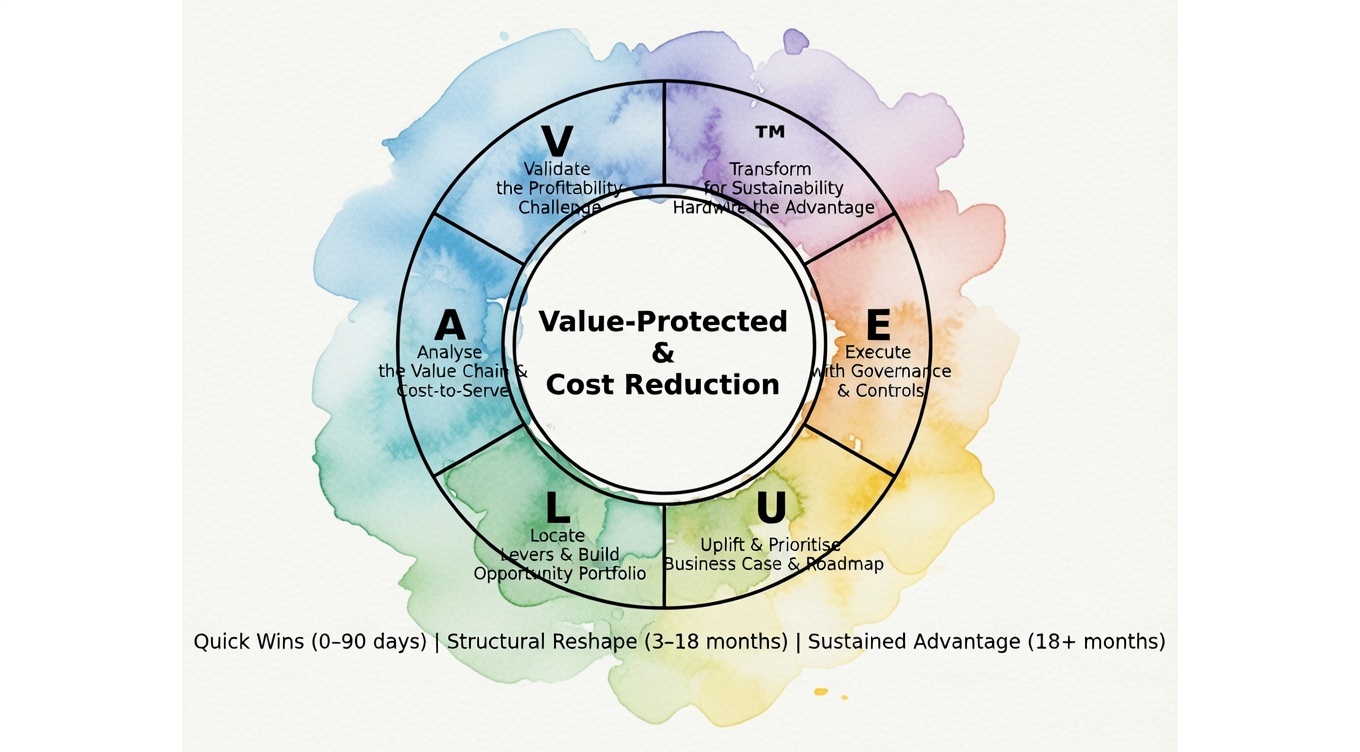
This is the foundation of the Dawgen V.A.L.U.E.-Chain Cost Advantage Framework™.
A Two-Speed Cost Programme: Quick Wins + Structural Reshape
One of the most common reasons cost programmes fail is that leaders treat all savings the same. In reality, savings fall into two categories:
1) Quick wins (0–90 days): cash and leakage
Quick wins are high-confidence actions that often deliver immediate value:
-
enforcing purchasing compliance and stopping maverick spend
-
renegotiating terms on priority suppliers and enforcing contract pricing
-
tightening overtime governance and rostering discipline
-
reducing rework and scrap through basic quality stabilisation
-
clearing slow-moving inventory and tightening replenishment rules
-
accelerating receivables and reducing credit leakage
-
improving demand planning discipline to reduce emergency freight and stockouts
Quick wins build momentum and fund confidence. But they are rarely enough.
2) Structural reshape (3–18 months): redesign the cost base
Structural savings come from redesign:
-
specification rationalisation and value engineering
-
procurement category strategy and supplier consolidation
-
operational redesign (layout, scheduling, maintenance model)
-
logistics and distribution network optimisation
-
operating model and SG&A redesign (spans, layers, shared services)
-
technology rationalisation and automation of controls
-
channel and service model redesign with commercial discipline
Structural reshape changes the cost system and creates durable advantage.
The Three Cost Leaks That Destroy Value Capture
Even well-designed programmes fail without governance. These are the most frequent “leaks”:
Leak #1: Savings evaporation
The organisation identifies savings, but they don’t show up in the P&L because:
-
spend shifts to different accounts
-
volumes change and obscure impact
-
business units re-spend “freed” budgets
-
supplier compliance collapses
-
service levels creep back up
Fix: Finance-validated savings tracking and controls.
Leak #2: Shadow spend (maverick purchasing)
Teams buy off-contract “because it’s urgent,” or because they prefer certain vendors. Over time, negotiated savings dissolve.
Fix: approved buying channels, purchase-to-pay controls, and accountability.
Leak #3: Complexity creep
Even if costs are reduced, complexity reappears:
-
too many SKUs
-
too many exceptions
-
too many suppliers
-
too many bespoke customer service arrangements
Fix: continuous discipline and periodic re-approval cycles.
A Practical 30–90 Day Starting Playbook (What Leaders Can Do Now)
If you want to begin immediately—without waiting for a full transformation programme—start here.
Step 1: Establish a “margin fact-base” (Week 1–2)
-
margin bridge (what changed and why)
-
cost baseline by value chain area
-
top 10 cost pools and the drivers behind them
-
quick leakage scan
Outcome: clarity and alignment.
Step 2: Create a focused opportunity heatmap (Week 2–4)
-
procurement: contract compliance, supplier terms, specification issues
-
operations: downtime, yield, rework, energy
-
logistics: routes, warehouse efficiency, inventory policy
-
commercial: returns, trade spend, service exceptions
-
SG&A: duplication, manual processes, tool sprawl
Outcome: a ranked list of opportunities with estimated ranges.
Step 3: Launch a two-speed programme (Week 4–12)
-
select 6–10 quick wins with clear owners
-
define 3–5 structural workstreams
-
set governance cadence (weekly reviews, biweekly steering)
Outcome: momentum plus a credible roadmap.
Step 4: Implement a Value Capture Office (VCO) discipline
Even a light PMO structure dramatically increases success rates by:
-
tracking initiatives
-
managing dependencies
-
ensuring finance validation
-
enforcing decisions
-
protecting value
Case Snapshot: How Cost Advantage Funds Growth
A mid-sized organisation facing margin compression launched a two-speed cost programme:
Quick wins (0–90 days)
-
1–3% savings from purchasing compliance and supplier term enforcement
-
cash release through inventory discipline and receivables focus
-
reduced urgent freight through planning improvements
Structural reshape (3–18 months)
-
3–6% savings via sourcing strategy + specification rationalisation
-
2–5% savings from operations productivity and downtime reduction
-
logistics redesign delivering cost reduction without lowering service levels
-
SG&A streamlining supported by automation
With improved margin resilience and better cash generation, leadership reinvested into customer service, product availability, and system upgrades—strengthening competitiveness rather than shrinking the business.
Tomorrow’s Winners Will Build Cost Advantage Today
The margin war is not simply a moment; it is the environment. In that environment:
-
price competition intensifies
-
customers demand value
-
capital costs punish inefficiency
-
volatility exposes weak operating systems
Cost advantage will separate winners from losers. But the winners will not be those who cut the deepest—they will be those who reduce cost intelligently, protect value, and build a repeatable capability across the end-to-end value chain.
That is what the Dawgen V.A.L.U.E.-Chain Cost Advantage Framework™ is designed to deliver.
Next Step!
Ready to uncover value-protected cost reduction across your value chain?
Email info@dawgen.global with the subject line “V.A.L.U.E. – Cost Opportunity Scan” to request an initial discussion and our data intake checklist.
WhatsApp Global: +1 555 795 9071 | Contact form: https://www.dawgen.global/contact-us/
About Dawgen Global
“Embrace BIG FIRM capabilities without the big firm price at Dawgen Global, your committed partner in carving a pathway to continual progress in the vibrant Caribbean region. Our integrated, multidisciplinary approach is finely tuned to address the unique intricacies and lucrative prospects that the region has to offer. Offering a rich array of services, including audit, accounting, tax, IT, HR, risk management, and more, we facilitate smarter and more effective decisions that set the stage for unprecedented triumphs. Let’s collaborate and craft a future where every decision is a steppingstone to greater success. Reach out to explore a partnership that promises not just growth but a future beaming with opportunities and achievements.
 Email: info@dawgen.global
  Visit: Dawgen Global Website

 WhatsApp Global Number : +1 555-795-9071
Caribbean Office: +1876-6655926 / 876-9293670/876-9265210  WhatsApp Global: +1 5557959071
USA Office: 855-354-2447
Join hands with Dawgen Global. Together, let’s venture into a future brimming with opportunities and achievements


