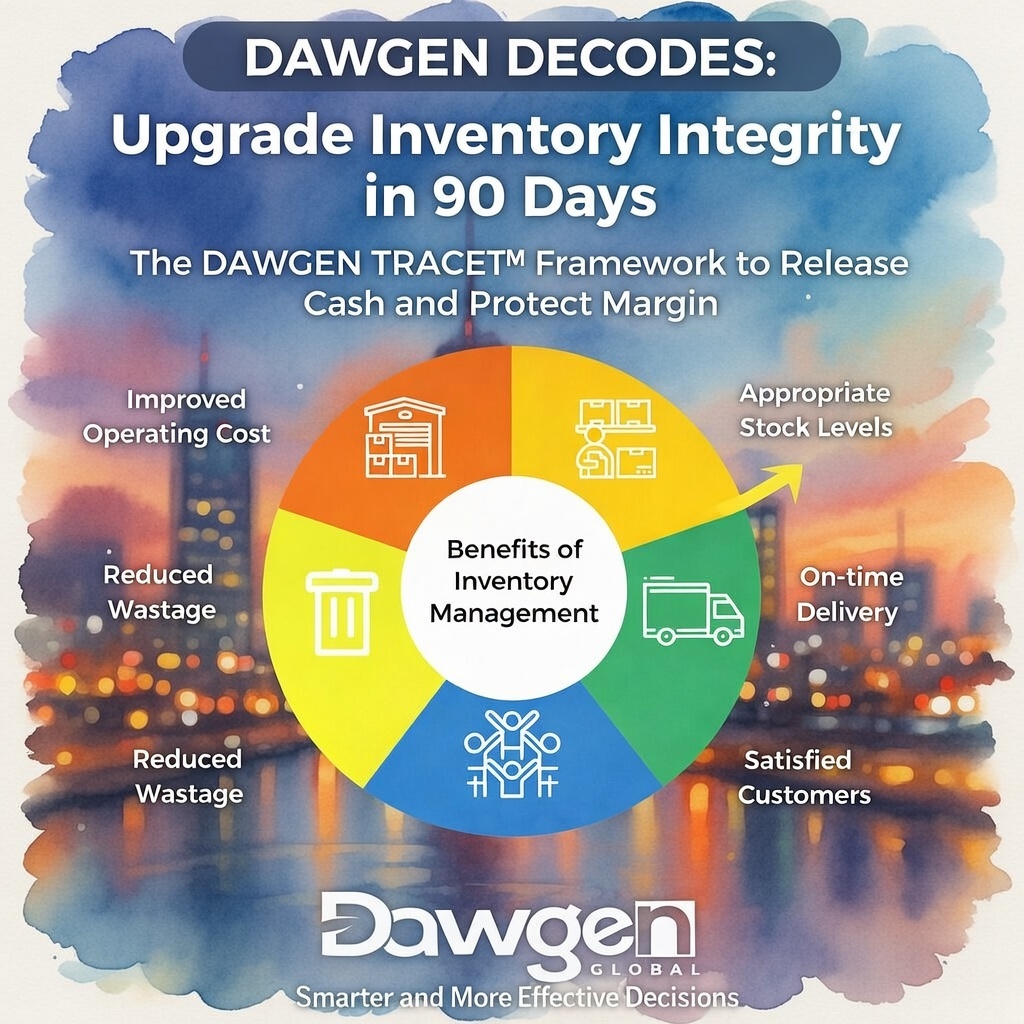
Dawgen Decodes: Inventory Integrity
Inventory is usually the biggest silent balance sheet risk in distribution and manufacturing—because small errors compound fast. A 2–5% stock accuracy gap can translate into lost sales, emergency purchasing, hidden shrinkage, overstated margins, and working-capital strain. This article introduces DAWGEN TRACE™, a practical framework to tighten inventory discipline end-to-end—from transaction design and controls, to root-cause analytics and cycle counting, to exception governance. We include a 90-day implementation plan, KPIs that boards and CFOs can actually monitor, and a composite case showing how a mid-sized distributor released cash and improved service levels without adding headcount.
Why inventory integrity is a growth strategy (not a back-office exercise)
In distribution and manufacturing, inventory is where strategy becomes operational reality:
-
Service levels depend on correct stock status and reliable replenishment signals.
-
Margins depend on accurate landed cost, pricing discipline, and prevention of “leakage” (waste, shrinkage, incorrect rebates, uncontrolled credits).
-
Cash flow depends on stock turns, aged inventory management, and the ability to avoid panic-buying.
-
Audit readiness depends on traceable evidence—who did what, when, why, and with what approval.
When inventory records are unreliable, leadership loses confidence in basic management reporting:
-
Sales questions the numbers.
-
Procurement overbuys “just in case.”
-
Operations expends energy on firefighting instead of improving throughput.
-
Finance spends month-end reconciling, explaining variances, and defending gross margin.
Inventory integrity is the bridge between growth ambition and operational control.
The hidden costs of poor inventory discipline
Most organisations recognise shrinkage and obsolescence. Fewer recognise the second-order effects that quietly destroy profitability:
1) Lost sales and reputational erosion
Phantom stock (system says “available,” shelf/bin says “not there”) creates stockouts, delayed orders, and damaged trust.
2) Gross margin distortion
If landed cost is inaccurate—or if rebates, freight, duty, and write-downs are treated inconsistently—then the gross margin line becomes a storytelling exercise, not a management tool.
3) Working capital lock-up
Inconsistent reorder logic, poor SKU governance, and weak slow-moving controls lead to growing days inventory outstanding (DIO). Cash remains trapped, even when the business is “profitable.”
4) Fraud and control exposure
Where stock adjustments are easy, approvals are informal, and roles are not segregated, inventory becomes an attractive target for manipulation.
5) Bad decisions at speed
When management dashboards are wrong, leadership makes faster decisions… in the wrong direction.
Introducing the DAWGEN TRACE™ Framework
DAWGEN TRACE™ is a disciplined approach that makes inventory auditable, measurable, and manageable. It is designed for distribution/retail and manufacturing, where SKU complexity, vendor dynamics, and operational pressure can overwhelm traditional controls.
TRACE™ =
T — Transaction design (clean movements, clean data)
R — Roles, rights, and approvals (segregation + accountability)
A — Accuracy engine (cycle counts + root-cause correction)
C — Cost & margin integrity (landed cost, rebates, write-downs)
E — Exceptions & evidence (dashboards, alerts, audit-ready proof)
Each element has practical actions, controls, and KPIs you can implement in 90 days.
T — Transaction design: Make the right thing the easy thing
Inventory fails most often at the transaction layer—receiving, picking, transfers, returns, and adjustments.
What “good” looks like
-
Every movement has a standard transaction type (no free-text workarounds).
-
Receiving follows three-way discipline (PO → GRN/receipt → invoice) where appropriate.
-
Transfers are paired (issue from location A + receipt into location B).
-
Returns have clear categories (saleable, damaged, expired, supplier-returnable, warranty).
-
Master data rules prevent SKU duplication, wrong UoMs, or uncontrolled substitutions.
TRACE™ controls to implement
-
Mandatory reason codes for adjustments, write-offs, and returns.
-
Barcode enforcement (where feasible) at receipt and pick.
-
Closed receiving: no receipt without PO (except defined exceptions with senior approval).
-
No negative stock policy (or controlled negative stock with daily exception review).
-
Quarantine locations for damaged/expired/returns pending inspection.
KPIs to monitor weekly
-
% receipts matched to PO
-
Adjustments value as % of inventory
-
Number of negative stock events
-
Returns by category and value
-
Transfer mismatches older than X days
R — Roles, rights, approvals: Segregation that works in real life
Segregation of duties (SoD) is often documented but not operationalised—especially in fast-moving warehouses or multi-branch distribution.
Risk hotspots
-
Same user can create vendor + create PO + receive + approve invoice.
-
Same user can create SKU + change cost + post adjustments.
-
Warehouse staff can post write-offs without independent review.
-
“Super users” accumulate excessive privileges over time.
TRACE™ role model (practical SoD)
Minimum segregation for most mid-sized organisations:
-
Procurement: create PO; cannot approve invoice or post inventory adjustments.
-
Receiving: post GRN; cannot create vendor/PO or change item costs.
-
Finance/AP: match and pay; cannot receive goods.
-
Inventory control: cycle counts, variance review; cannot approve own variances.
-
IT/System admin: maintain roles; cannot transact.
Approval design
-
Approval thresholds based on risk and value, not bureaucracy:
-
Inventory write-offs
-
Cost changes
-
High-value adjustments
-
New SKU creation
-
Supplier master changes
-
KPIs to monitor monthly
-
Count of users with elevated privileges
-
Number/value of write-offs by approver
-
Vendor master changes and “high-risk fields” changed (bank details, address, payment terms)
-
Overrides and manual postings
A — Accuracy engine: Stop counting for compliance—count to improve
Many organisations “count” inventory but don’t improve accuracy because they don’t fix root causes.
The TRACE™ accuracy engine
Step 1: Set a stock accuracy baseline
-
Select a representative set of SKUs (A, B, C classes).
-
Perform independent counts.
-
Quantify the accuracy gap: quantity variance, value variance, location variance.
Step 2: Move from annual counts to cycle counts
-
A items: weekly or biweekly
-
B items: monthly
-
C items: quarterly
(Adjust to your SKU volume and risk profile.)
Step 3: Root-cause every significant variance
Common root causes:
-
Receiving errors (wrong UoM, missed GRN lines)
-
Picking errors (substitutions not recorded)
-
Unrecorded transfers between bins/branches
-
Sales returns not processed accurately
-
Shrinkage/theft
-
BOM/production issues (manufacturing)
-
Master data issues (conversion factors, pack sizes)
Step 4: Fix the process, not just the number
A variance is not “resolved” until the root cause is eliminated or controlled.
KPIs to monitor
-
Stock accuracy % (by A/B/C)
-
Count compliance %
-
Variances by root cause category
-
Repeat variances (same SKU, same location)
-
Time to close variances
C — Cost & margin integrity: Defend the gross margin line
Inventory integrity includes how you value stock and how that valuation flows into gross margin, pricing, and profitability.
Common cost integrity failures
-
Freight/duty allocated inconsistently or not at all
-
Supplier rebates not accrued properly or tracked by SKU/category
-
Price protection and credit notes handled ad hoc
-
Obsolescence provisions not based on ageing and movement reality
-
Manufacturing variances buried in overhead or not analysed (yield, scrap, rework)
TRACE™ cost discipline
-
Standardise landed cost logic
-
Define what is included (freight, duty, insurance, handling, etc.)
-
Define allocation method (by weight, volume, value, units)
-
Lock methodology in policy and ERP configuration.
-
Rebate and vendor funding ledger
-
Track rebates by supplier, SKU group, period, and entitlement rule.
-
Reconcile rebate accruals to supplier statements.
-
Ageing governance
-
Define clear rules for slow-moving and obsolete stock.
-
Tie write-down decisions to sales history, shelf life, and demand forecasts.
-
Margin bridge reporting
Build a monthly bridge from prior margin to current margin:
-
Volume
-
Price
-
Mix
-
Cost changes
-
Shrinkage/write-offs
-
Rebates/credits
KPIs to monitor
-
Landed cost variance vs budget/expectation
-
Rebate capture rate (%)
-
Aged inventory as % of total
-
Write-downs vs policy
-
Gross margin bridge explained vs unexplained
E — Exceptions & evidence: Where proof lives and problems surface early
Inventory discipline collapses when exceptions are not visible or owned.
The TRACE™ exception board (weekly)
A simple dashboard with owners and deadlines:
-
Negative stock exceptions
-
Adjustment spikes by user/location
-
Aged transfer mismatches
-
High-value returns awaiting disposition
-
Slow-moving stock requiring action plans
-
Supplier short-ship trends
-
Production yield variances (manufacturing)
“Where evidence lives” (inventory edition)
If an issue arises—stock shrinkage, supplier dispute, or audit query—teams should know where proof lives:
Procurement/finance evidence
-
PO approvals, terms, and supplier master changes
-
GRN/receipt logs and match exceptions
-
Invoice approvals, credit notes, rebate agreements
-
Payment runs and bank authorisations
Warehouse/operations evidence
-
Receiving checklists, discrepancies, photos (where relevant)
-
Pick/pack logs, dispatch confirmations
-
Transfer issue/receipt pairs
-
Cycle count sheets, variance investigations, approvals
-
Write-off approvals and disposal evidence
IT/system evidence
-
Role/privilege logs
-
Transaction logs by user/time
-
Audit trail for cost changes and adjustments
-
Integration logs (POS/ERP/WMS interfaces)
When the evidence map is clear, response time drops dramatically and control confidence rises.
A composite case: How a distributor released cash and raised service levels
Business profile (composite case):
A multi-branch distributor with ~6,000 SKUs serving wholesale and retail channels. Growth was strong, but the business faced frequent stockouts, margin volatility, and rising working capital.
Symptoms
-
“Available” stock not found in locations
-
Emergency buying and expedited freight increasing
-
Monthly inventory adjustments rising
-
Slow-moving stock growing quietly
-
Rebate claims inconsistent across suppliers
What we did using TRACE™
-
Defined transaction rules and mandatory reason codes
-
Implemented A/B/C cycle counting and a variance root-cause process
-
Tightened roles and approvals; reduced super-user privileges
-
Standardised landed cost and introduced a vendor funding ledger
-
Created a weekly exception board owned by operations and finance
Outcomes within ~90 days
-
Stock accuracy improved materially for A-items
-
Stockouts reduced as phantom stock declined
-
Emergency purchases reduced
-
Better visibility into slow-moving stock and targeted sell-through actions
-
Improved confidence in gross margin reporting and SKU profitability insights
The key was not “counting more.” It was designing the system so errors could not hide and exceptions had clear owners.
A 90-day implementation plan (Distribution & Manufacturing)
Days 1–15: Diagnose and baseline
-
Confirm inventory process map (order-to-cash and procure-to-pay touchpoints)
-
Baseline stock accuracy (A/B/C sample)
-
Baseline adjustment profile (value, frequency, users, locations)
-
Baseline inventory ageing and slow-moving definition
-
Confirm current SoD and system roles
Deliverables
-
TRACE™ diagnostic summary
-
Inventory integrity baseline dashboard
-
Top 10 root causes hypothesis list
Days 16–45: Fix transaction design and controls
-
Implement reason codes and approval thresholds
-
Standardise receiving/transfer/returns workflows
-
Introduce cycle counting cadence
-
Lock down privileges and remove toxic combinations
-
Establish exception board and weekly governance
Deliverables
-
Updated SOPs + role matrix
-
Cycle count program + variance workflow
-
Exception dashboard with owners
Days 46–90: Cost integrity + performance embed
-
Standardise landed cost methodology
-
Implement rebate/funding tracking and reconciliation cadence
-
Launch margin bridge reporting
-
Expand cycle counts and root-cause closure discipline
-
Provide training and embed accountability routines
Deliverables
-
Landed cost and rebate policy pack
-
Monthly margin bridge template
-
KPI pack for management and board reporting
What boards and executives should ask (to test inventory integrity quickly)
-
What is our current stock accuracy (by A/B/C items)?
-
What are the top root causes of variances, and what has been fixed permanently?
-
Who can post adjustments and cost changes, and what is the approval logic?
-
What % of inventory is slow-moving/aged, and what is the action plan?
-
How do we ensure rebates and vendor credits are captured fully and on time?
-
Can we explain gross margin movements using a margin bridge?
-
If an incident occurs, do we know exactly where evidence lives?
If these answers are unclear, inventory is likely driving hidden risk and missed growth.
How Dawgen Global helps
Dawgen Global supports distribution and manufacturing clients with:
-
Inventory integrity diagnostics and rapid control uplift
-
Working capital optimisation linked to operational reality
-
Pricing, profitability, and margin analytics grounded in clean data
-
Risk assurance, internal audit readiness, and forensic-grade evidence discipline
-
Practical SOPs, governance dashboards, and leadership coaching to sustain change
Ready to upgrade inventory discipline in 90 days?
If you operate in distribution/retail or manufacturing and want to improve stock accuracy, protect margins, and release cash—Dawgen Global can help you implement DAWGEN TRACE™ with a pragmatic, executive-led approach.
Start the conversation: https://www.dawgen.global/contact-us/
📧 [email protected]
📞 Caribbean: 876-9293670 | 876-9293870
📞 WhatsApp Global: +1 555 795 9071
About Dawgen Global
“Embrace BIG FIRM capabilities without the big firm price at Dawgen Global, your committed partner in carving a pathway to continual progress in the vibrant Caribbean region. Our integrated, multidisciplinary approach is finely tuned to address the unique intricacies and lucrative prospects that the region has to offer. Offering a rich array of services, including audit, accounting, tax, IT, HR, risk management, and more, we facilitate smarter and more effective decisions that set the stage for unprecedented triumphs. Let’s collaborate and craft a future where every decision is a steppingstone to greater success. Reach out to explore a partnership that promises not just growth but a future beaming with opportunities and achievements.
 Email: [email protected]
  Visit: Dawgen Global Website

 WhatsApp Global Number : +1 555-795-9071
Caribbean Office: +1876-6655926 / 876-9293670/876-9265210  WhatsApp Global: +1 5557959071
USA Office: 855-354-2447
Join hands with Dawgen Global. Together, let’s venture into a future brimming with opportunities and achievements


