
Executive Summary
Tax is one of the biggest “silent drains” on business cashflow—especially for growth companies operating across the Caribbean and internationally. Many organisations treat tax as a once-a-year compliance exercise. That approach is risky and expensive. It leads to avoidable penalties, poor documentation, weak forecasting, missed incentives, inefficient group structures, transfer pricing exposure, and cash traps from late filings or incorrect remittances.
A modern tax strategy is not about aggressive schemes. It is about governance, forecasting, documentation, and smart structuring—so the business stays compliant while legally protecting cash, improving predictability, and supporting expansion. When tax is integrated into decisions (pricing, contracts, payroll, cross-border transactions, capex, dividends, and financing), companies gain stronger margins and reduced operational risk.
In this Dawgen Decodes article, Dawgen Global introduces a practical model for Tax Strategy for Growth using our DAWGEN EDGE™ Framework (Evaluate, Design, Govern, Enable, Execute & Evidence). You will learn what proactive tax management looks like, where businesses typically leak cash, and how to implement a disciplined tax operating system within 90 days.
1) Why Tax Strategy Matters More During Growth
Growth increases complexity:
-
more employees → more payroll compliance
-
more vendors and contracts → more withholding taxes and documentation
-
more cross-border activity → transfer pricing and permanent establishment risk
-
more financing → interest deductibility considerations
-
more technology and systems → VAT/GCT and invoicing controls
Many businesses fail not because they are unprofitable, but because they cannot manage the tax-cash cycle—remittances, instalments, filing deadlines, audit readiness, and documentation.
The tax-cash reality
Tax can create cash pressure even when profit is stable:
-
VAT/GCT paid on purchases before customer receipts
-
payroll taxes that must be remitted regardless of collections
-
withholding taxes held on behalf of the state
-
quarterly instalments misaligned with seasonality
-
penalties and interest due to administrative slippage
2) The Biggest Tax “Cash Leaks” We See in Practice
Across SMEs and mid-market groups, the most common tax drains are:
1) Weak tax forecasting
Companies know revenue forecasts, but not tax cash forecasts—so tax becomes a surprise.
2) Incorrect withholding tax treatment
Payments to contractors, professionals, non-residents, and certain services often trigger withholding taxes. Errors create assessments and penalties.
3) VAT/GCT control failures
Poor invoice discipline, incomplete documentation, and inconsistent coding lead to denied credits or inaccurate filings.
4) Payroll compliance slippage
Statutory deductions and payroll tax reporting are high-risk for penalties because they are frequent and time-sensitive.
5) Poor documentation and audit readiness
Tax authorities increasingly expect traceability, contracts, schedules, and reconciliations.
6) Inefficient business structure
The way you hold assets, book income, and allocate services across entities impacts tax costs and risk.
3) Tax Strategy vs Tax Compliance (They Are Not the Same)
Tax compliance:
-
file returns
-
remit on time
-
respond to audits
Necessary, but reactive.
Tax strategy:
-
integrate tax into decisions
-
forecast tax cashflows
-
design structures that support growth
-
manage risk and documentation
Proactive, efficient, and protective of cash.
A business that only “complies” is always catching up. A business with strategy stays ahead.
4) The DAWGEN EDGE™ Framework for Tax Strategy for Growth
E — Evaluate: Identify Exposure, Waste, and Opportunity
Dawgen Global begins with a practical tax diagnostic:
-
tax profile by entity and jurisdiction
-
compliance status (filings, remittances, arrears)
-
VAT/GCT control quality (invoice, coding, credits)
-
payroll compliance processes and reconciliations
-
withholding tax exposure mapping
-
cross-border transaction flows
-
incentive eligibility screening
-
audit readiness and documentation maturity
Deliverable: A Tax Health & Cash Leak Report—what’s at risk, what’s leaking, and what can be improved.
D — Design: Build the Tax Operating System
We design a tax operating model aligned to your business:
-
tax calendar across all jurisdictions/entities
-
roles and responsibilities (finance, HR, procurement, legal)
-
document requirements and retention rules
-
VAT/GCT process controls and reconciliations
-
withholding tax workflow embedded in AP approvals
-
quarterly tax forecasting process
-
tax clauses for contracts (gross-up, withholding, VAT/GCT treatment)
Deliverable: A tailored Tax Playbook (controls, templates, workflows).
G — Govern: Prevent Penalties and Reduce Audit Risk
Tax discipline requires governance:
-
approval gates for contracts and cross-border payments
-
evidence standards for VAT/GCT credits and zero-rated supplies
-
WHT decision matrix by vendor type and service category
-
monthly tax reconciliation checklist
-
audit response protocol and document packs
Deliverable: A Tax Governance Pack that keeps the business compliant and defensible.
E — Enable: Systems, Automation, and People
We enable speed and accuracy through:
-
cleaner chart of accounts tax mapping
-
VAT/GCT coding logic and exception flags
-
AP workflow tagging for withholding taxes
-
payroll system alignment with statutory reporting
-
dashboards and reminders for deadlines
-
training for finance and operational stakeholders
Deliverable: A system that reduces error and administrative stress.
E — Execute & Evidence: Prove Compliance and Cash Protection
Execution is tracked and evidenced through:
-
on-time filings and remittances
-
reduction in penalties and interest
-
improved VAT/GCT accuracy and credit recoverability
-
documented withholding tax compliance
-
audit-ready schedules and reconciliations
-
tax cashflow forecast accuracy
Deliverable: A Tax Evidence File—a ready-to-defend audit trail.
5) Practical Tax Strategies That Protect Cash (Without Taking Unnecessary Risk)
Strategy 1: Build a tax cashflow forecast (not just a P&L forecast)
A growth business should forecast:
-
VAT/GCT payments and expected credits/refunds
-
payroll remittances
-
quarterly instalments
-
withholding tax obligations
-
expected assessments and settlement plans (if any)
This creates predictability and prevents sudden cash shocks.
Strategy 2: Fix VAT/GCT at the source (invoice discipline)
Most VAT/GCT problems begin with:
-
late or incomplete invoices
-
wrong VAT/GCT codes
-
missing documentation
Fixing this upstream improves compliance and protects credits.
Strategy 3: Embed withholding tax checks into AP approvals
Withholding tax compliance should not be handled “after payment.”
It should be built into vendor onboarding and AP workflow:
-
what services trigger withholding?
-
resident vs non-resident rules
-
treaty considerations (where applicable)
-
documentation requirements (certificates, invoices, contracts)
Strategy 4: Align payroll controls with tax reality
Payroll compliance requires:
-
reconciliations between payroll system and remittances
-
clear ownership
-
deadline discipline
-
audit-ready documentation
Payroll is one of the most enforceable tax areas for authorities.
Strategy 5: Contract discipline (tax clauses)
Contracts should define:
-
who bears VAT/GCT
-
whether withholding tax applies
-
gross-up clauses if needed
-
responsibility for tax certificates and filings
This reduces disputes and protects cash.
Strategy 6: Structure for growth (without complexity for its own sake)
Group structure decisions can reduce tax risk and improve efficiency:
-
where income is earned
-
how services are charged between entities
-
asset holding structures
-
financing arrangements
This must be done carefully and legally, with documentation to support the commercial rationale.
6) A 90-Day Plan to Upgrade Tax Discipline
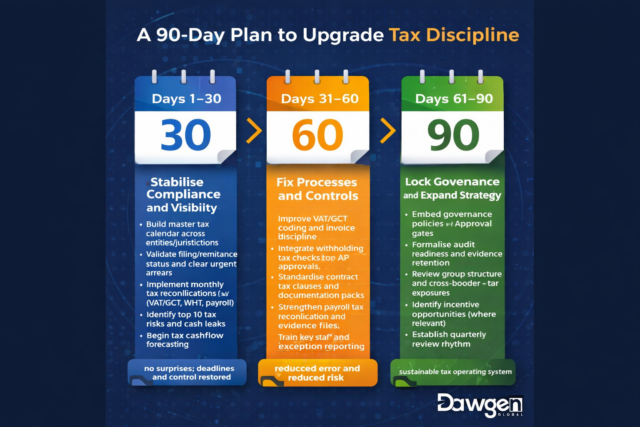
Days 1–30: Stabilise Compliance and Visibility
-
build a master tax calendar across entities/jurisdictions
-
validate filing/remittance status and clear urgent arrears
-
implement monthly tax reconciliations (VAT/GCT, WHT, payroll)
-
identify top 10 tax risks and cash leaks
-
begin tax cashflow forecasting
Outcome: no surprises; deadlines and control restored.
Days 31–60: Fix Processes and Controls
-
improve VAT/GCT coding and invoice discipline
-
integrate withholding tax checks into AP approvals
-
standardise contract tax clauses and documentation packs
-
strengthen payroll tax reconciliation and evidence files
-
train key staff and implement exception reporting
Outcome: reduced error and reduced risk.
Days 61–90: Lock Governance and Expand Strategy
-
embed governance policies and approval gates
-
formalise audit readiness and evidence retention
-
review group structure and cross-border exposures
-
identify incentive opportunities (where relevant)
-
establish quarterly review rhythm
Outcome: sustainable tax operating system.
7) The Tax Risk Areas That Boards Should Ask About
If your business is scaling, leadership should routinely ask:
-
Do we have a consolidated tax calendar for all jurisdictions?
-
Are VAT/GCT credits defensible and supported by documentation?
-
Are we correctly applying withholding tax across vendors and payments?
-
Are payroll remittances reconciled to payroll records monthly?
-
Are we exposed to transfer pricing or permanent establishment risks?
-
Do we have audit-ready schedules (reconciliations, contracts, computations)?
-
Do we forecast tax cashflows and instalments quarterly?
-
Are we missing incentives that apply to our sector or investment plans?
8) DAWGEN EDGE™ Tax Strategy Scorecard (Quick Diagnostic)
If you answer “YES” to three or more, you likely have avoidable tax risk or cash leakage:
-
Tax payments are often a surprise to leadership.
-
VAT/GCT returns rely on manual fixes at month-end.
-
Withholding tax is handled inconsistently across vendors.
-
Payroll remittances are not reconciled monthly to payroll registers.
-
Documentation is scattered; audit readiness is weak.
-
Cross-border transactions occur without a documented tax position.
-
Contracts do not consistently address VAT/GCT and withholding tax clauses.
-
Tax compliance depends on a single person rather than a system.
9) Why Dawgen Global
Dawgen Global is a multidisciplinary advisor—bringing tax, accounting, governance, legal awareness, and operational practicality together. We do not treat tax as a silo. We integrate tax discipline into how your business sells, contracts, hires, pays, and expands—so you stay compliant and protect cash with confidence.
Next Step: Get a Tax Health & Cash Leak Review (Confidential)
If you want to stay compliant while protecting cash and profit, Dawgen Global will deliver a confidential Tax Health & Cash Leak Review and a practical 90-day roadmap tailored to your business.
At Dawgen Global, we help you make Smarter and More Effective Decisions. Let’s have a conversation.
? Dive Deeper: https://dawgen.global/
? Connect with Us: [email protected]
Telephone Contact Centre:
? Caribbean: 876-9293670 | 876-9293870
? USA: 855-354-2447
WhatsApp Global: +1 555 795 9071
About Dawgen Global
“Embrace BIG FIRM capabilities without the big firm price at Dawgen Global, your committed partner in carving a pathway to continual progress in the vibrant Caribbean region. Our integrated, multidisciplinary approach is finely tuned to address the unique intricacies and lucrative prospects that the region has to offer. Offering a rich array of services, including audit, accounting, tax, IT, HR, risk management, and more, we facilitate smarter and more effective decisions that set the stage for unprecedented triumphs. Let’s collaborate and craft a future where every decision is a steppingstone to greater success. Reach out to explore a partnership that promises not just growth but a future beaming with opportunities and achievements.
 Email: [email protected]
  Visit: Dawgen Global Website

 WhatsApp Global Number : +1 555-795-9071
Caribbean Office: +1876-6655926 / 876-9293670/876-9265210  WhatsApp Global: +1 5557959071
USA Office: 855-354-2447
Join hands with Dawgen Global. Together, let’s venture into a future brimming with opportunities and achievements


