
OceanSwitch™ governance for running Red Ocean and Blue Ocean strategies at the same time—without metric contamination
Most leadership teams don’t choose Red or Blue—they inherit both
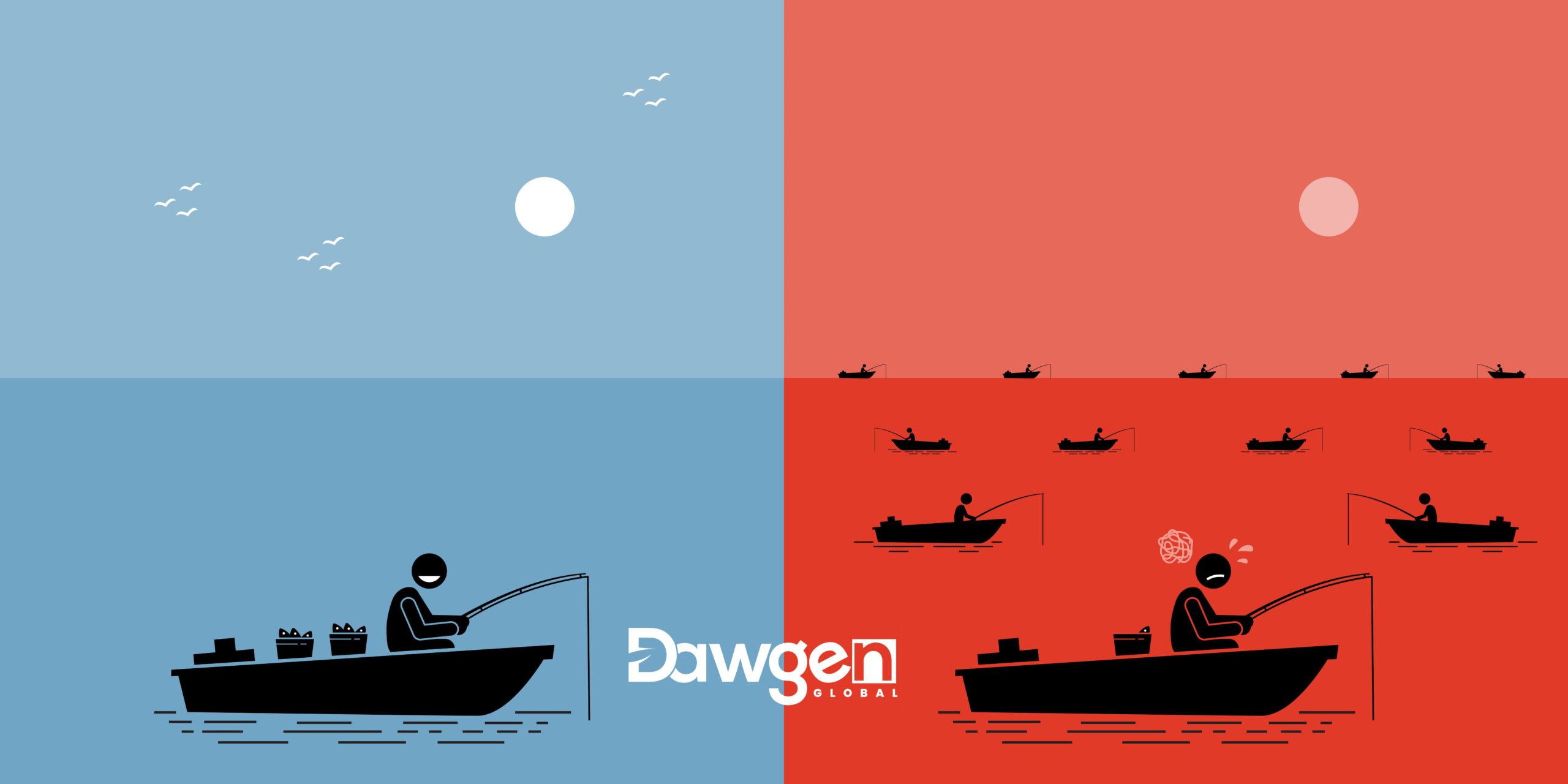
In theory, strategy discussions often ask leaders to choose: compete harder in the core or innovate into new market space. In practice, most organisations do not have that luxury. They operate in a Hybrid Reality—a portfolio of businesses, segments, or service lines where:
-
the core sits in a Red Ocean: competitive, price-sensitive, and margin-pressured, and
-
the future requires Blue Ocean moves: new demand, new value curves, and new business models.
The Hybrid Reality is not a temporary condition. It is the default operating environment for modern organisations—particularly in markets where customers are demanding more speed, transparency, digital enablement, and outcomes-based value, while competition remains intense and switching is easier.
The challenge is not understanding Red and Blue Ocean strategies. The challenge is running both simultaneously without:
-
starving innovation,
-
weakening the core,
-
confusing teams,
-
and measuring the wrong work with the wrong scorecard.
That is precisely what OceanSwitch™ is designed to solve. In prior articles, we introduced:
-
EDGECRAFT™: Dawgen Global’s Red Ocean playbook for margin, pricing, execution, and trust-led differentiation, and
-
HORIZONFORGE™: Dawgen Global’s Blue Ocean playbook for noncustomer demand, adoption design, ecosystem leverage, and scaling discipline.
This article focuses on the missing piece: Hybrid Governance—how to operate two strategic logics in one organisation without compromising either.
Why Hybrid strategies often fail: metric contamination and operating confusion
The single biggest reason Hybrid strategies fail is not a lack of ideas or effort. It is metric contamination.
What is metric contamination?
Metric contamination happens when:
-
Blue Ocean initiatives are forced to meet mature Red Ocean profitability targets too early, or
-
Red Ocean operations are excused from performance because “we’re innovating.”
Both failures feel rational in the moment. Both are destructive over time.
Blue Ocean initiatives need protected learning cycles and milestone-based funding. If leaders demand immediate margin perfection, experimentation stops, and the organisation retreats to incrementalism.
Red Ocean operations need discipline, standardisation, pricing control, and execution excellence. If leaders tolerate weak fundamentals because “the future is innovation,” the core engine declines—and the organisation loses the very cash and credibility needed to build the future.
OceanSwitch™ solves this by separating Red and Blue work using:
-
two scorecards,
-
two investment logics, and
-
two operating cadences—while keeping one unified narrative at the brand level.
The OceanSwitch™ Hybrid Governance Model
The governance model is built around four design principles:
-
Separate the engines (core vs new) without splitting the brand
-
Sequence the work (explore → design → scale) rather than “innovate everywhere”
-
Fund by proof points, not optimism
-
Measure what matters at each stage, not what is convenient
Let’s examine how this is implemented.
1) Portfolio mapping: label the work Red, Blue, or Hybrid—by segment, not by slogan
Hybrid governance begins with clarity. Most organisations already have multiple “oceans,” but they have not explicitly labelled them.
OceanSwitch™ recommends portfolio mapping at the level of:
-
service line, product line, or business unit, and then
-
segment, geography, or channel (where needed), because different segments can experience different oceans.
The practical output
Every material stream of work should be labelled:
-
RO (Red Ocean): competition-led optimisation
-
BO (Blue Ocean): market-creation and new demand
-
HY (Hybrid): an intentional split—defend + build in parallel
This labeling step alone improves decision quality because it forces leaders to stop debating everything as if it were one market.
2) Two engines, one leadership intent: “Defend and Extend” + “Discover and Scale”
Hybrid organisations operate two engines with different purposes.
Engine A: Defend and Extend (Red Ocean)
This engine is the core. Its mandate is:
-
protect margin and cash,
-
retain customers,
-
improve execution and reliability,
-
win share where profitable,
-
and reduce complexity.
This is where EDGECRAFT™ lives.
Engine B: Discover and Scale (Blue Ocean)
This engine builds the future. Its mandate is:
-
discover noncustomer demand,
-
design new value curves,
-
prove adoption,
-
and scale with repeatable delivery.
This is where HORIZONFORGE™ lives.
The leadership intent
The Hybrid Reality is successful when leaders can hold a single intent:
“Strengthen today’s engine to fund tomorrow’s growth, while building tomorrow’s growth to reduce dependence on today’s rivalry.”
That is the strategic balance OceanSwitch™ operationalises.
3) Two scorecards: performance optimisation vs learning-to-scale
This is the most important structural change in Hybrid governance: separate scorecards.
A. The Red Ocean Scorecard (EDGECRAFT™ KPIs)
These are mature performance metrics, typically tracked monthly:
-
Margin quality: contribution margin, gross margin, realisation rate
-
Pricing discipline: discount rate, pricing leakage, write-offs, scope creep
-
Client health: retention, churn, renewal rates, share of wallet
-
Execution speed: quote-to-cash cycle time, onboarding time, delivery lead time
-
Delivery efficiency: cost-to-serve by segment, rework rate, utilisation/throughput
-
Cash discipline: DSO, billing timeliness, working capital conversion
-
Quality and trust: error rates, compliance adherence, auditability, client satisfaction
These KPIs reinforce operational excellence and economic strength.
B. The Blue Ocean Scorecard (HORIZONFORGE™ KPIs)
These are stage-appropriate metrics, tracked more frequently during exploration and design:
-
Problem validation: evidence of unmet need, willingness to trial, urgency signals
-
Adoption and activation: onboarding completion, early usage, time-to-first-value
-
Pilot conversion: pilot-to-paid conversion rate, decision cycle time
-
Cohort signals: retention by cohort, repeat usage, referral interest
-
Unit economics trajectory: early CAC signals, gross margin trend as delivery standardises
-
Partner leverage: partner-sourced pipeline, partner-enabled fulfilment capacity
-
Iteration speed: time between experiments, learning cycle throughput
These metrics ensure the Blue Ocean engine is not prematurely judged by mature profitability, but is still held to disciplined progress.
4) Two investment logics: ROI funding vs milestone funding
A Hybrid organisation should not fund everything the same way.
Red Ocean funding: ROI-based optimisation
For the core, investment should be justified by:
-
margin improvement,
-
cost-to-serve reduction,
-
retention uplift,
-
conversion improvement,
-
cash acceleration.
This is conventional but vital—because the Red Ocean engine must be cash-generative.
Blue Ocean funding: milestone-based learning
Blue Ocean initiatives should be funded in tranches tied to proof points. Example milestone gates:
-
Demand proof: validated problem and target noncustomer segment
-
Adoption proof: repeated pilots with consistent activation
-
Conversion proof: pilot-to-paid conversion achieved at acceptable cycle time
-
Repeatability proof: success across multiple customers and contexts
-
Scale proof: standard playbooks, QA, and unit economics trending correctly
This model protects the organisation from two extremes:
-
over-investing too early in unproven concepts, and
-
under-investing in initiatives that need time to mature.
5) Two operating cadences: monthly performance vs rapid learning
Cadence is governance in practice.
Red Ocean cadence: monthly performance management
-
performance reviews by service line and segment
-
pricing and pipeline discipline
-
delivery capacity planning
-
margin leakage remediation
-
client health and renewals
Blue Ocean cadence: bi-weekly (or weekly) learning reviews
-
experiment backlog review
-
pilot pipeline and conversion review
-
adoption friction diagnostics
-
product/service iteration decisions
-
partner enablement progress
The Blue Ocean cadence is faster because learning is the output. Without speed, the organisation “innovates” slowly and loses momentum.
6) How to structure teams without creating internal rivalry
Hybrid strategies can create internal tension when:
-
the innovation team is viewed as privileged, or
-
the core team is viewed as “legacy.”
OceanSwitch™ recommends a structure with clear accountabilities:
Clear ownership
-
Core Owner (Red Engine Lead): accountable for margin, retention, and execution outcomes
-
Venture Owner (Blue Engine Lead): accountable for proof points, adoption, and scalability
-
Portfolio Sponsor (Executive): resolves resource conflicts and enforces governance rules
Shared services with guardrails
Some capabilities can be shared (brand, finance, compliance, IT), but delivery and metrics should not be blended. The principle is:
Shared support, separate scorecards.
7) The “translation layer”: keeping one brand while running two strategies
Even when operations differ, the market should experience one coherent identity.
Hybrid leaders create a translation layer that keeps the brand consistent:
-
one “why” (purpose),
-
one strategic narrative,
-
and a clear segmentation of offers (core vs new).
This is where the OceanSwitch™ story is powerful:
-
EDGECRAFT™ strengthens performance and trust in the core, and
-
HORIZONFORGE™ builds new demand and future relevance.
Both can sit under a single brand promise: smarter, more effective decisions—delivered with discipline and innovation.
What Hybrid success looks like: clarity, speed, and economic strength
When Hybrid governance is implemented well, three outcomes emerge:
1) The core becomes more profitable and less chaotic
Standardisation increases, pricing discipline improves, and teams spend less time firefighting.
2) Innovation becomes less risky and more credible
Blue Ocean initiatives progress through clear gates, with measurable learning and adoption signals, rather than vague enthusiasm.
3) Leadership decisions become faster
When the organisation has explicit scorecards and investment logic, leaders stop re-litigating every decision. The governance model makes the trade-offs clear.
The Hybrid Reality is not a problem—it is the advantage
Many organisations treat the Hybrid Reality as a tension to manage. OceanSwitch™ reframes it as an advantage to design.
If the core is disciplined and cash-generative, the organisation can invest in the future without destabilising itself. If Blue Ocean initiatives are governed with milestone-based discipline, the organisation can build future growth pathways without gambling.
That is the real opportunity:
-
Defend today with EDGECRAFT™.
-
Build tomorrow with HORIZONFORGE™.
-
Run both with OceanSwitch™ Hybrid Governance.
In the next article in this series, we will provide a practical implementation guide: Ocean Mapping in 30 Days—a step-by-step process leaders can use to label their portfolio, choose postures, and deploy the right playbooks with the right scorecards.
About Dawgen Global
“Embrace BIG FIRM capabilities without the big firm price at Dawgen Global, your committed partner in carving a pathway to continual progress in the vibrant Caribbean region. Our integrated, multidisciplinary approach is finely tuned to address the unique intricacies and lucrative prospects that the region has to offer. Offering a rich array of services, including audit, accounting, tax, IT, HR, risk management, and more, we facilitate smarter and more effective decisions that set the stage for unprecedented triumphs. Let’s collaborate and craft a future where every decision is a steppingstone to greater success. Reach out to explore a partnership that promises not just growth but a future beaming with opportunities and achievements.
 Email: [email protected]
  Visit: Dawgen Global Website

 WhatsApp Global Number : +1 555-795-9071
Caribbean Office: +1876-6655926 / 876-9293670/876-9265210  WhatsApp Global: +1 5557959071
USA Office: 855-354-2447
Join hands with Dawgen Global. Together, let’s venture into a future brimming with opportunities and achievements


