

How Dawgen Global’s tri‑lens diligence converts uncertainty into decision‑ready insight—and protects value before you sign.
Due diligence should do more than compile documents. It must answer, with evidence, the only question that matters: What must be true for this deal to create value—and how confident are we that it is true? Dawgen Global’s DILIGENCE3D™ provides a disciplined way to get there.
Built inside the ACQUIRE360™ framework, DILIGENCE3D™ combines three primary lenses—Market, Financial, and Customer—and extends to Legal/Tax/People/Technology/ESG modules where they are material to value or to license‑to‑operate. The result is a risk‑ranked, value‑focused assessment that feeds valuation (ValueQuad™), terms (SPA/APA), and integration (the 100‑Day Value Map™).
This article details how to plan, execute, and synthesize DILIGENCE3D™ so boards and investment committees can move fast and keep control—especially in founder‑led SMEs, carve‑outs/spin‑offs, and cross‑border transactions across the Caribbean and the wider Americas.
Why Diligence Fails (and How to Avoid It)
Common diligence failures are predictable:
- Box‑ticking without thesis alignment → Produces data but not decisions.
- Late discovery of material issues → Creates price chips, re‑trades, or walk‑aways after expensive cycles.
- Over‑reliance on management forecasts → Underplays cyclicality, customer risk, or execution constraints.
- Blind spots in non‑financial risk → Tax, cyber, regulatory, or culture derail value after signing.
DILIGENCE3D™ counters these with four operating principles:
- Thesis‑linked scope: The investment thesis defines the questions; the checklist follows.
- Materiality‑based effort: Concentrate work where value and risk actually live.
- Triangulation: Validate claims from independent angles (data, third parties, market signals).
- Synthesis: Convert findings into guardrails for price, terms, and Day‑1 plans—not just long reports.
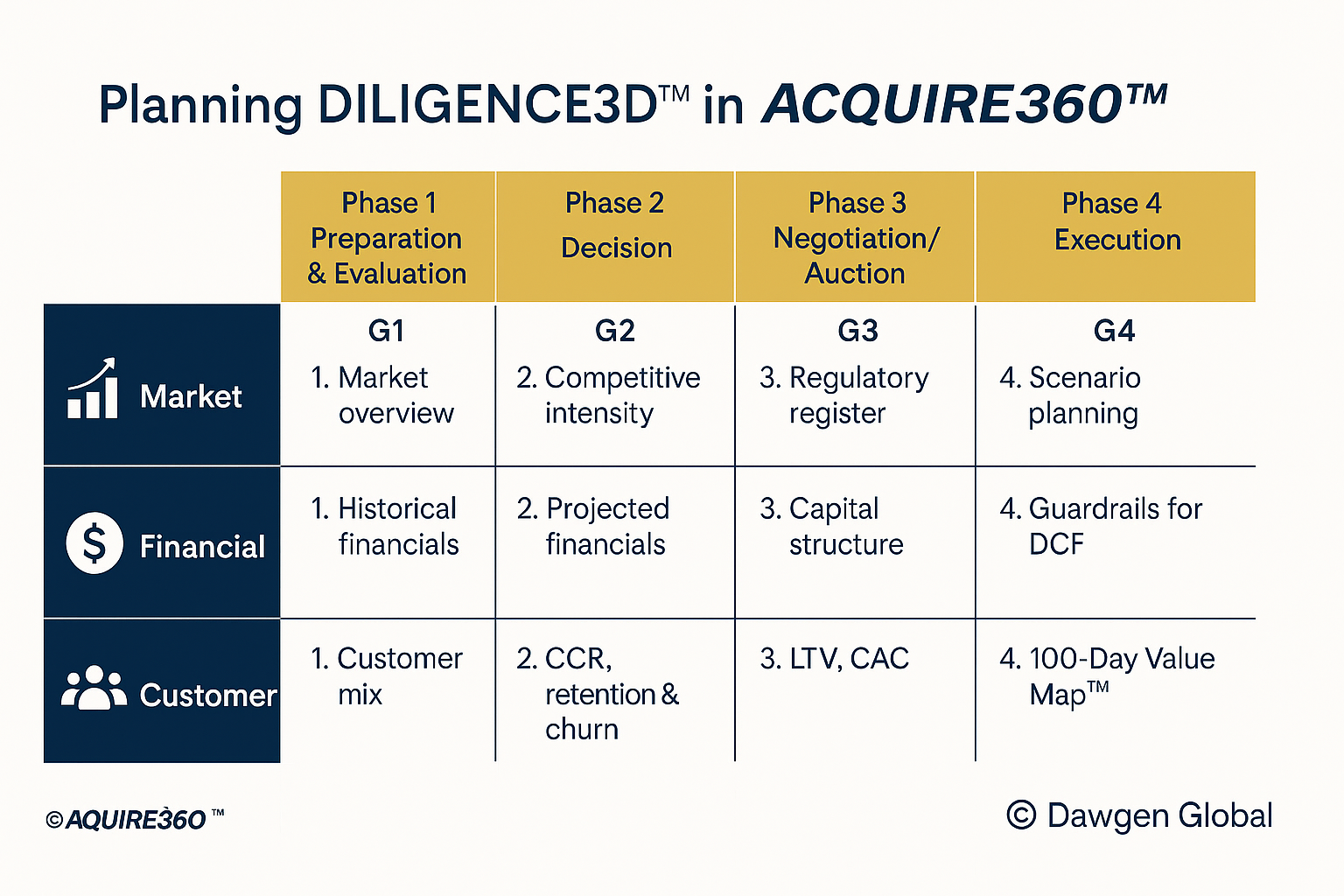
Planning DILIGENCE3D™ in ACQUIRE360™
Diligence is not a phase; it’s a spine that passes through all four ACQUIRE360™ stages:
- Phase 1 — Preparation & Evaluation: Draft the thesis and a Diligence Plan v1; run early proxies (“QoE‑Lite”, market triangulation, customer cohorts) to kill/confirm.
- Phase 2 — Decision: Approve the diligence budget and scope; lock Valuation Guardrails informed by early insight.
- Phase 3 — Negotiation/Auction: Execute deep dives; structure terms (locked‑box vs completion accounts, earn‑outs, W&I insurance) with findings in mind.
- Phase 4 — Execution: Clear conditions precedent; translate results into the 100‑Day Value Map™ and KPI cadence.
Governance: Weekly Diligence SteerCo, issue tracker with RAG statuses, and clear owners for every workstream. Findings are summarized in a Deal Factsheet updated continuously and rolled into the Board/IC pack at each gate (G1→G4).
Lens 1 — Market: Earning the Right to Grow
Market diligence tests whether the target operates in an environment where your value creation plan can succeed. Key questions:
1.1 Market Size, Structure, and Dynamics
- TAM/SAM/SOM: Independent triangulation using multiple sources; reconcile bottom‑up (accounts and pricing) with top‑down (industry stats).
- Growth Drivers: Regulatory change, technology diffusion, consumer shifts, input cost trends, substitution.
- Industry Structure: Five‑Forces‑Plus—add ecosystem and platform effects, regulatory moat, and data advantage.
- Price/Margin Dynamics: Historical pricing power, discounts, and pass‑through ability; evidence of price wars or collusion risks.
1.2 Competitive Positioning
- Share & Rank: Estimate using triangulation (customer interviews, channel checks, public data).
- Differentiation & Moat: Switching costs, network effects, contracts/tenor, IP, brand equity.
- Cost Position: Unit economics benchmarked to peers; supply chain resilience and concentration.
1.3 Regulatory & Country Risk (Caribbean Nuance)
- Licensing: Sector‑specific requirements (financial services, healthcare, energy, telecom).
- Competition: Filing thresholds and review timelines by jurisdiction.
- FX & Capital Controls: Convertibility, repatriation, and hedging cost; feed into ValueQuad™.
- Tax Treaties & Withholding: Structuring implications; Separation/TSA if carve‑out crosses borders.
1.4 Outputs
- Market Map and Defensibility Score.
- Regulatory Risk Register with likelihood/severity and mitigation.
- Margin Pressure Heatmap (input price exposure, wage trends, competitive discounting).
Lens 2 — Financial: Quality of Earnings and Cash
Financial diligence validates the economic engine—past, present, and forecast. Its purpose is to protect valuation and inform terms.
2.1 Quality of Earnings (QoE)
- Revenue Recognition: Policies vs practice; cut‑off tests; impact of multi‑element arrangements; ASC/IFRS compliance.
- Normalization: Non‑recurring items, related‑party transactions, owner compensation, and pro‑forma adjustments for carve‑outs.
- Margin Integrity: Gross margin by product/segment; mix and price/volume variance analysis.
- Working Capital: Seasonal patterns, DSO/DPO/DIO, factoring or reverse factoring, and sustainability of terms.
2.2 Cash Conversion & Capex
- Cash Conversion Cycle: Bridge from EBITDA to FCF; leakage analysis (taxes, interest, maintenance capex).
- Capex & Intangibles: Maintenance vs growth split; capitalization policies; tech debt.
- Debt & Off‑Balance Sheet: Leases, guarantees, contingent liabilities, litigation provisions.
2.3 Forecast Assessment
- Plan‑to‑Actuals: Historic forecast accuracy, pipeline coverage, conversion rates, and win/loss.
- Sensitivity Trees: Volume, price, churn, FX, interest rate; identify break‑evens and covenant headroom.
- WACC & Terminal: Feed to ValueQuad™ (DCF); reconcile with comps.
2.4 Outputs
- QoE Pack with adjustments and normalized EBITDA/FCF.
- Cash Conversion Bridge and Covenant Headroom analysis.
- Scenario Book (Base/Upside/Downside) with key levers and monitoring KPIs.
Lens 3 — Customer: The Revenue Spine
Revenue durability is rarely a spreadsheet cell; it lives in customer behavior. Customer diligence examines resilience and growth potential.
3.1 Segmentation & Cohorts
- Segmentation: By size, industry, channel, or use case.
- Cohorts: Retention curves, expansion/contraction, and cohort revenue mix over time.
- Unit Economics: LTV/CAC by segment; payback and contribution margins.
3.2 Concentration & Contract Quality
- CCR (Customer Concentration Ratio): % of revenue from top‑x accounts; identify cliff risks by contract expiry/tenor and terms (termination, price escalators, step‑downs).
- Pricing Mechanics: Indexation, volume tiers, discount leakage, and rebate structures.
3.3 Experience & Health
- NPS/CSAT: Score trends and verbatims; service‑level SLAs and penalties.
- Churn Diagnostics: Involuntary vs voluntary churn; channel conflict; product gaps.
- Pipeline Quality: Coverage ratios, stage‑to‑win %, and aging.
3.4 Outputs
- Customer Ladder (top accounts with risk/opportunity flags).
- Retention & Expansion Charts by cohort.
- Commercial Diligence Summary with immediate Day‑1 actions.
Extended Modules—When and How to Turn Them On
Turn on extended diligence when risk materiality is high or when value creation relies on these domains.
Legal & Compliance
- Corporate structure, title to key assets, litigation, sanctions, data privacy.
- SPA/APA Implications: Reps, warranties, caps/baskets, indemnities; W&I insurance feasibility.
Tax & Structuring
- Historical tax compliance and exposures; VAT/GCT recovery; transfer pricing; treaty benefits; WHT on cross‑border flows.
- Acquisition structure modeling (asset vs share; step‑ups; substance requirements).
People & Leadership
- Key talent dependency; retention risk; succession; union agreements; compensation alignment with value creation.
- Cultural fit (CCI) and change capacity.
Technology & Cyber
- Core systems architecture; scalability; vendor lock‑in; API maturity; cloud posture.
- Cyber controls (identity, patching, backups, DR); breach history; cyber insurance.
Operations & Supply Chain
- Footprint; throughput; OEE; logistics cost; single‑source risk; resilience planning.
ESG & Climate
- Emissions profile; regulatory exposure; environmental liabilities; community relations; governance quality.
Output: Modular Risk Cards with severity/likelihood, evidence, and recommended price/term/integration responses.
Turning Findings into Price, Terms, and Day‑1 Action
Diligence is useful only if it changes the model and shapes the contract.
6.1 Price & Valuation (ValueQuad™)
- Update Public/M&A comps and DCF with normalized figures and risk‑adjusted forecasts.
- Reconcile valuation range with a Fairness Narrative (what you know now vs before diligence).
6.2 Terms & Protections
- Price Mechanism: Locked‑box vs completion accounts based on working‑capital volatility and leakages.
- Earn‑outs: Tie to measurable drivers where diligence revealed plan risk (e.g., net new ARR, CCR reduction).
- W&I Insurance: Use to bridge rep gaps while maintaining seller proceeds.
- Covenants/MAC: Reflect known risks (cyber remediation plan, regulatory approvals).
6.3 Integration & 100‑Day Value Map™
- Leadership & Culture: CCI‑informed appointments; decision rights; incentive realignment.
- Customer Actions: Early renewals; price harmonization; SLA upgrades; churn‑at‑risk playbooks.
- Systems & Data: Minimum viable data flows; access and identity; TSA scope (if carve‑out).
Operating Model: Cadence, Tools, and Documentation
- Cadence: Weekly Diligence SteerCo; daily stand‑ups in peak weeks.
- Tracker: Central issue log (RAG), owner, evidence, decision impact (Price/Terms/Integration).
- Artifacts: Request List, Data Room Index, Q&A log, Risk Cards, QoE Pack, Customer Ladder, Market Map, Scenario Book.
- Audit Trail: Decisions and rationales captured for lenders/regulators and future internal learnings.
KPIs for DILIGENCE3D™
- % of thesis‑critical questions resolved pre‑G3 (target >85%).
- QoE Adjustments as % of EBITDA (variance vs IOI model).
- CCR after top‑3 renewals (post‑signing track).
- Regulatory approval timeline variance (planned vs actual).
- Cyber remediation backlog cleared by Day‑30 (%).
- Synergy confidence index at G3 (evidence‑weighted).
Pitfalls and How We Engineer Around Them
- Management “data theater.” Solution: Third‑party triangulation and raw system pulls where possible; sample audits.
- Late discovery of customer cliffs. Solution: Cohort analysis + contract ladder + targeted customer calls under NDA.
- Underestimating working capital needs. Solution: Seasonal curves and stress tests; link to completion accounts or WC true‑up.
- Ignoring culture. Solution: CCI pre‑signing; Day‑1 leadership and comms baked into 100‑Day Value Map™.
- Country risk creeping into price post‑signing. Solution: FX/interest hedging plan and covenant design at G3; approval sequencing mapped to regulatory calendars.
Special Situations
Founder‑Led SMEs
- Right‑size the request list; conduct QoE‑Lite first; use vendor notes/earn‑outs to bridge information gaps; plan key‑person transition with retention and mentoring overlays.
Carve‑Outs
- Build a Separation Workstream from Day‑1 of diligence; quantify stranded costs; price and govern the TSA; define Day‑1 systems minimums.
Sponsor‑Backed Assets
- Expect process rigor and tight timetables; be bid‑ready; use auction ladders; emphasize certainty of funds and W&I insurance to stay competitive without overpaying.
Cross‑Border Deals in the Caribbean
- Integrate Country Risk Compass inputs (FX convertibility, exchange control approvals, tax treaty utilization, local content rules) into ValueQuad™ and term sheet design.
Case Study (Fictionalized): Seeing Around Corners
Context: A regional energy services company sought to acquire a Trinidad‑based maintenance contractor to expand into LNG facilities.
Market Lens: DILIGENCE3D™ mapped regulatory approvals and contractor license requirements across three jurisdictions. Vendor concentration at critical OEMs suggested a potential choke point.
Financial Lens: QoE normalized EBITDA down 9% after removing one‑off hurricane‑related work and capitalizing maintenance appropriately. Working capital analysis revealed seasonal cash needs not visible in monthly averages; covenant design was adjusted.
Customer Lens: Cohort analysis showed excellent retention in LNG but weak expansion in downstream petrochemicals. CCR flagged a top‑2 customer risk; term sheet included a customer novation condition precedent and a 12‑month earn‑out tied to winning two planned maintenance contracts.
Outcomes: ValueQuad™ range narrowed; price mechanism set to completion accounts with a locked WC target; W&I insurance used to bridge rep gaps on historical environmental liabilities; Day‑1 plan prioritized OEM relationship MOUs and a safety certification upgrade.
Lesson: Tri‑lens diligence revealed issues early enough to design price, terms, and Day‑1 actions—protecting value without losing speed.
Checklists & Work Aids
Thesis‑Linked Diligence Scoper
- Investment thesis and sources of value
- Must‑be‑true conditions and how to test them
- Materiality thresholds by workstream
- Evidence sources and triangulation plan
Market Request List (Excerpt)
- Market size/growth sources; price indices; competitor set; share estimates and methodology; regulatory calendar; supply chain concentration metrics.
Financial Request List (Excerpt)
- Trial balances, revenue by product/segment, contract register, AR/AP aging, inventory turns, capex by category, debt schedule, tax filings, leases, contingencies.
Customer Request List (Excerpt)
- Top‑50 customers with revenue by year and product; contracts with terms/renewal dates; churn reasons; pipeline report and conversion metrics; NPS/CSAT studies.
Synthesis Template
- Key findings (by lens)
- Implications for ValueQuad™
- Implications for terms (SPA/APA)
- Implications for 100‑Day Value Map™
How Dawgen Global Works with You
We lead diligence from thesis to synthesis—not just the data room. A typical engagement includes:
- Kick‑off & Thesis Alignment (Week 0): Confirm what must be true; finalize the Diligence Plan.
- Early Proxies (Weeks 1–2): QoE‑Lite, cohort retention, market triangulation to validate or kill the case.
- Deep Dives & Site Work (Weeks 2–6): Full request list, management sessions, third‑party calls, and legal/tax/tech tracks as required.
- Synthesis & Pricing (Weeks 5–7): Update ValueQuad™, structure the term sheet, outline Day‑1 plan.
- Pre‑Close Readiness (Weeks 7–10): Conditions precedent, regulatory sequencing, Day‑1/Day‑30/Day‑100 milestones.
You gain decisions, not just documents: Go/No‑Go clarity, price range justification, terms that protect value, and an integration plan that starts capturing it from Day‑1.
Next Step!
Planning an acquisition, carve‑out, or cross‑border consolidation? Put DILIGENCE3D™ to work so your next deal is evidence‑led from thesis to Day‑100.
Email: [email protected]
WhatsApp (Global): +1 555 795 9071
At Dawgen Global, we help you make Smarter and More Effective Decisions. Let’s align your thesis, test what must be true, and convert diligence into price, terms, and Day‑1 action.
© Dawgen Global. ACQUIRE360™, DILIGENCE3D™, ValueQuad™, 100‑Day Value Map™, Country Risk Compass, Culture Compatibility Index (CCI), Customer Concentration Ratio (CCR) are service marks of Dawgen Global.
About Dawgen Global
“Embrace BIG FIRM capabilities without the big firm price at Dawgen Global, your committed partner in carving a pathway to continual progress in the vibrant Caribbean region. Our integrated, multidisciplinary approach is finely tuned to address the unique intricacies and lucrative prospects that the region has to offer. Offering a rich array of services, including audit, accounting, tax, IT, HR, risk management, and more, we facilitate smarter and more effective decisions that set the stage for unprecedented triumphs. Let’s collaborate and craft a future where every decision is a steppingstone to greater success. Reach out to explore a partnership that promises not just growth but a future beaming with opportunities and achievements.
✉️ Email: [email protected] ? Visit: Dawgen Global Website
? ? WhatsApp Global Number : +1 555-795-9071
? Caribbean Office: +1876-6655926 / 876-9293670/876-9265210 ? WhatsApp Global: +1 5557959071
? USA Office: 855-354-2447
Join hands with Dawgen Global. Together, let’s venture into a future brimming with opportunities and achievements


