
Most Caribbean businesses don’t decide to upgrade their finance function — they wait until something breaks. Here are the seven signals that tell you the setup that got you here won’t get you where you’re going.
Every growing company outgrows its finance setup eventually. The bookkeeper-and-spreadsheet model that served you at JMD 20 million in revenue starts to strain at JMD 100 million, and quietly fails somewhere on the way to JMD 500 million. The difficulty is that the failure is rarely loud. There is no alarm. Instead, the numbers arrive a little later each month, the cash surprises grow a little more frequent, and the founder spends a few more late nights doing work that should have become someone else’s job two years ago.
The cost of waiting too long is real — missed tax deadlines, financing applications declined for want of clean statements, decisions made on numbers that were already three weeks stale. The good news is that outgrowing your finance setup follows a recognisable pattern. Once you know the signs, you can act before the strain becomes a crisis.
Below are the seven we see most often across the region. If two or three sound familiar, your setup is already behind your business. If you can tick four or more, you have probably been operating without a real finance function for longer than you think.
| In short — You have outgrown your finance setup when your numbers are consistently late, your cash position is a guess, the function depends on a single person, your spreadsheets are generating errors, you can’t answer the strategic questions investors and lenders ask, compliance has become a recurring fire drill, or you — the owner — are still personally running the books. Any one is a warning. Several together mean it is time to move to a managed finance function. |
The seven signs
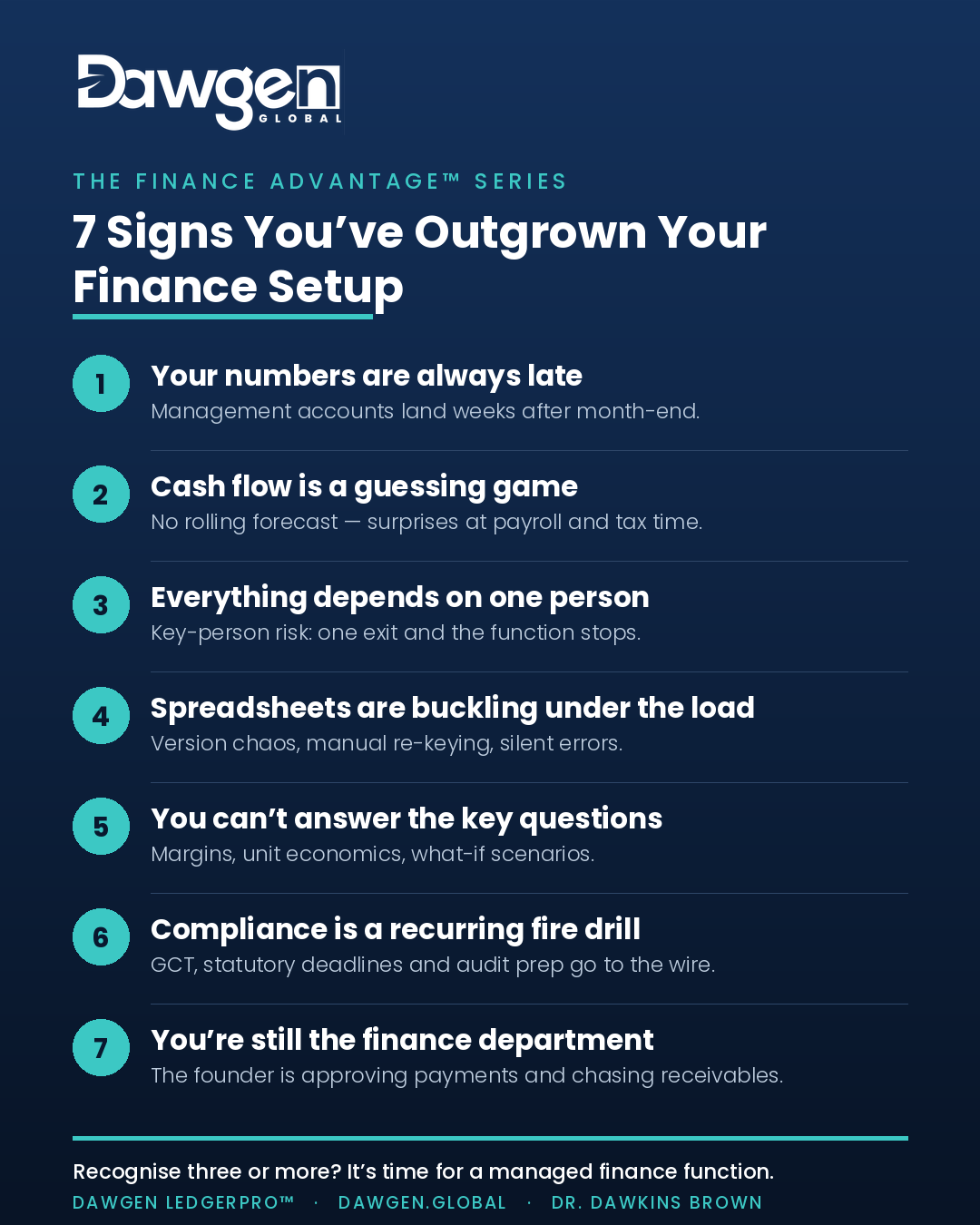
- Your numbers are always late
A healthy business closes its books within five to ten working days of month-end. If your management accounts routinely arrive three, four, or six weeks late — or only when the auditor asks for them — you are steering by the rear-view mirror. Late numbers are not just an inconvenience; they change the quality of every decision you make. By the time you learn that margins slipped in March, it is May, and you have already repriced, restocked, and rehired on the assumption that nothing had changed.
- Your cash position is a guess
Profit is an opinion; cash is a fact. Businesses that have outgrown their setup can usually tell you what is in the bank today, but not what will be in the bank in six weeks. There is no rolling forecast, no view of receivables quietly ageing past 90 days, no early warning before a payroll or a GCT payment lands at an awkward moment. Growing companies fail far more often from running out of cash than from running out of profit — and the warning signs were always sitting in the numbers nobody was watching.
- Everything depends on one person
This is the quiet risk founders underrate the most. If a single bookkeeper or accountant holds the passwords, knows the chart of accounts, remembers which supplier gets paid when, and is the only person who understands your reconciliations, then your entire finance function is one resignation, one illness, or one bad week away from stopping. Key-person risk in finance is not a personnel problem; it is a continuity problem. A real finance function is a system, not a person.
- Your spreadsheets are breaking under the weight
Spreadsheets are wonderful — until they aren’t. The signs of a setup that has outgrown them are familiar: several “final” versions, formulas nobody dares touch, manual re-keying between systems, consolidations that swallow a whole day, and errors that surface only when a number refuses to tie. When the tool that runs your finances can be silently broken by a dragged cell or a deleted row, you have outgrown it. Modern cloud accounting and reporting platforms exist precisely because spreadsheets stop scaling past a certain point.
- You can’t answer the questions that matter
What is your gross margin by product line? Which customers are actually profitable once you account for the cost to serve them? What happens to cash if sales drop 15% next quarter? If your finance setup can produce a profit-and-loss statement but cannot answer questions like these, it is recording history rather than informing strategy. The moment you seek financing, take on investors, or plan a serious expansion, these are the questions you will be asked — and “I’ll have to check” is an expensive answer.
- Compliance has become a recurring fire drill
Every filing deadline should be a non-event. If GCT returns, statutory payments, and audit preparation instead trigger a last-minute scramble — late nights pulling documents together, penalties for missed dates, an auditor waiting on schedules that should have existed all along — your setup is reactive rather than in control. Compliance handled well is invisible. Compliance handled by a stretched setup is a tax on your time and, often, a literal tax in penalties and interest.
- You are still the finance department
This is the most expensive sign of all, because the currency is the founder’s attention. If you are personally approving every payment, chasing receivables, running payroll, or rebuilding the cash forecast in a spreadsheet at 11 p.m., your business is paying its most valuable person to do work that a managed finance function would do better and for less. Every hour you spend inside the books is an hour you are not spending on customers, strategy, and growth — the things only you can do.
What outgrowing your setup actually costs
The costs of a finance function that has fallen behind your business are easy to underestimate, because most of them stay invisible until they aren’t:
- Decisions made on stale or wrong numbers, compounding quietly over quarters.
- Financing declined or delayed because statements weren’t clean enough to satisfy a lender or investor.
- Penalties and interest from missed compliance deadlines.
- The opportunity cost of leadership time spent on bookkeeping.
- The single largest risk: not seeing a cash crunch until it is already happening.
A useful benchmark: well-run companies spend roughly 1–2% of revenue on their finance function. If you are spending far less than that, you are almost certainly under-resourced — and paying for it in the hidden costs above rather than in a line item you can see.
What a managed finance function changes
The alternative to a stretched in-house setup is not necessarily a bigger in-house team. A fully loaded in-house finance hire costs roughly US$55,000–$70,000 a year once you add salary, statutory contributions, software, training, and management — for a single point of capability and a single point of failure.
A managed finance function — Dawgen LedgerPro™ — delivers the whole capability for a fraction of that: typically US$650–$1,800 per month for a growing business, depending on transaction volume and scope. Instead of one person you get a team and a system: clean books closed on a fixed schedule, a rolling cash-flow view, modern cloud reporting, compliance handled before deadlines rather than after them, and a single point of accountability that does not resign. Where the business needs strategic finance leadership without a full-time hire, a Virtual or Fractional CFO layer (typically US$3,000–$12,000 per month) adds forecasting, scenario planning, and board-ready reporting on top.
If your books are behind, the move usually begins with a cleanup — generally around US$150–$175 per back-month to bring historical records current — after which the function runs forward on a predictable monthly basis.
So which model do you need?
A rough guide:
- Entry record-keeping (US$300–$600/mo): very small or early-stage businesses that mainly need accurate books and timely filings.
- Managed finance function — Dawgen LedgerPro™ (US$650–$1,800/mo): growing companies that need a complete, reliable finance operation — close, reporting, payables, receivables, compliance support — without building a team.
- Virtual / Fractional CFO (US$3,000–$12,000/mo): businesses that also need strategic financial leadership: forecasting, fundraising support, margin and pricing analysis, board reporting.
Most companies that recognise three or more of the seven signs are ready for the managed model — and many add the CFO layer within a year as the strategic questions grow.
Frequently asked questions
How many of the seven signs mean it’s time to act?
One is a warning; three or more means your finance setup is already behind your business. The signs compound — late numbers make cash harder to forecast, which makes compliance more reactive, which consumes more founder time — so the longer you wait, the more entangled they become.
Can’t I just hire a more experienced accountant?
Sometimes — but a single senior hire still leaves you with key-person risk, a single point of capability, and a fully loaded cost of US$55,000–$70,000 a year. A managed finance function gives you a team, a system, and continuity for a fraction of that, and it scales with you rather than capping out at one person’s bandwidth.
My books are months behind. Is it too late?
No. Catching up historical records — a “cleanup” — is routine, typically around US$150–$175 per back-month, and is the normal first step before moving to a clean, forward-looking monthly process.
Will outsourcing finance mean losing control of my numbers?
A well-designed managed finance function does the opposite. You keep approval authority and full visibility; what you hand over is the work, not the control. Most owners end up with more insight into their numbers than they had before, not less.
| See what your numbers should look like.
If two or three of these signs sound familiar, your finance setup is already behind your business — and the cost of waiting compounds every month. Dawgen LedgerPro™ gives growing Caribbean companies a complete, managed finance function: clean books on a fixed schedule, a clear cash-flow view, and compliance handled before the deadline, not after it. dawgen.global · [email protected] · 876-929-3670 / 876-665-5926 · US 855-354-2447 |
About Dawgen Global
Dawgen Global is an independent, integrated multidisciplinary professional services firm headquartered at 47 Trinidad Terrace, New Kingston, Jamaica, serving more than 15 territories across the Caribbean. Founded and led by Dr. Dawkins Brown, Executive Chairman, the firm is independent and not affiliated with any international network. It delivers a full suite of professional services under one roof: audit and assurance; tax advisory; IT and digital transformation; risk management; cybersecurity; actuarial and insurance regulatory advisory; HR advisory; mergers and acquisitions; corporate recovery; business advisory and strategy; accounting BPO and virtual CFO services; and legal process outsourcing.
The proposition is simple: big-firm capability without the big-firm price. Dawgen Global’s integrated approach is built for the specific complexities and opportunities of the Caribbean market, helping organizations make sharper, better-informed decisions that drive measurable progress.
To explore a partnership, reach out:
- Website: dawgen.global
- Email: [email protected]
- WhatsApp (Global): +1 555-795-9071
- Caribbean offices: +1 876-665-5926 | +1 876-929-3670 | +1 876-926-5210


