How Caribbean Leaders Scale AI Safely—Without Slowing Innovation
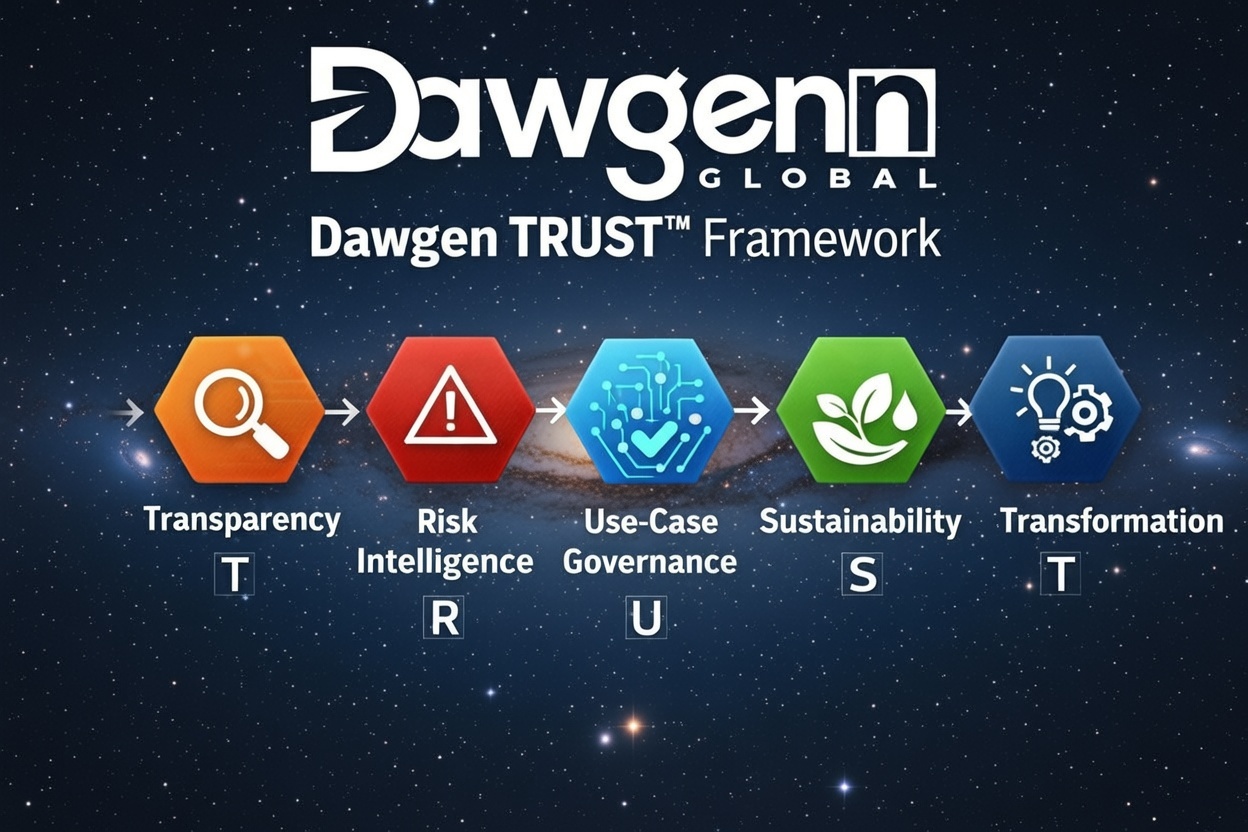
Dawgen TRUST™
Executive Summary
Many organisations think their AI risk is a technology problem. In reality, the biggest AI failures happen because of governance failures: unclear ownership, undefined decision rights, unapproved model changes, vendor updates with no oversight, and “shadow AI” spreading across teams.
That’s why the “U” in the Dawgen TRUST™ Framework is Use-Case Governance—the discipline of ensuring every AI use case has:
-
a clear purpose aligned to strategy,
-
the right owners and decision rights,
-
defined boundaries and “red lines,”
-
proportional controls based on impact,
-
change governance across model updates and vendor releases,
-
and audit-ready evidence for stakeholders.
Use-Case Governance is how Caribbean organisations move from scattered AI experiments to trusted, scalable adoption—especially when AI affects customers, credit, claims, compliance, HR, procurement, or public-facing decisions.
This article provides a practical blueprint to implement Use-Case Governance within 30–90 days, using a tiered approach (Tier 1/2/3), operating routines, templates, and a governance model that is strong enough for regulators and boards—yet light enough for SMEs and mid-market organisations.
1) Why AI Governance Must Start with Use Cases (Not Tools)
Most AI programs start with tool selection:
-
“Let’s buy a chatbot.”
-
“Let’s install a copilot.”
-
“Let’s automate underwriting.”
-
“Let’s use AI to detect fraud.”
But governance must start earlier:
1.1 The use case defines the risk
The same AI tool can be low risk in one use case (internal summarisation) and high risk in another (benefit eligibility, credit decisions, compliance monitoring).
1.2 The use case defines the controls
High-impact use cases require:
-
human oversight,
-
recourse and explainability,
-
strict change management,
-
monitoring and assurance.
Low-risk use cases require:
-
safe-use rules,
-
access controls,
-
privacy boundaries.
1.3 The use case defines accountability
You can’t govern AI if you can’t answer:
-
Who owns the outcome?
-
Who owns the data?
-
Who approves changes?
-
Who is accountable when something goes wrong?
Use-Case Governance answers these questions upfront.
2) The Caribbean Reality: AI Adoption Is Already Happening
Even if your organisation “has no AI strategy,” AI is already present through:
-
embedded AI features in ERP, CRM, and accounting platforms
-
vendor tools used for AML, fraud, claims, credit, HR screening
-
customer service chat and ticketing platforms
-
staff using public AI tools to draft emails, proposals, and analyses
-
consultants and vendors using AI on your data without clear boundaries
The biggest risk is not “AI later.”
It’s AI now—without governance.
3) The Most Common AI Governance Failures (And Their Root Causes)
Failure 1: No single owner
AI is “owned by IT,” but IT doesn’t own business outcomes.
Or it’s “owned by business,” but business doesn’t own security, privacy, or model integrity.
Root cause: governance is unclear.
Failure 2: AI decisions become “automatic” by drift
A model starts as decision support. Over time, teams rely on it like a decision maker.
Root cause: no tiering and no human-in-the-loop rules.
Failure 3: Vendor updates change outcomes unexpectedly
A vendor pushes a model update that changes scoring or recommendations.
Root cause: no change governance and no update “watch window.”
Failure 4: Shadow AI spreads
Staff use AI tools with sensitive data because they’re faster.
Root cause: no safe-use policy and no approved alternatives.
Failure 5: No audit trail
When a regulator, auditor, or board asks, “How was this outcome produced?” nobody can reconstruct it.
Root cause: no evidence pack and no traceability discipline.
Use-Case Governance prevents all five.
4) Dawgen’s Use-Case Tiering Model (The Practical Core)
To keep governance proportional, Dawgen Global recommends a 3-tier model:
Tier 1 — High Impact AI (Citizen/Customer/Regulatory Impact)
AI that can affect:
-
customer eligibility, pricing, credit, claims
-
compliance monitoring or enforcement triggers
-
employee hiring, termination, performance assessments
-
public sector benefits, licensing, approvals
-
material financial reporting estimates or disclosures (including ESG)
Tier 1 requirements:
✅ formal approval and use-case register
✅ clear decision rights + owner accountability
✅ human oversight for adverse outcomes
✅ explainability and recourse design
✅ strict change management and update approvals
✅ monitoring + drift detection
✅ audit-ready evidence pack
Tier 2 — Operational Impact AI (Productivity at Scale)
AI used for:
-
internal risk triage
-
case prioritisation
-
anomaly detection dashboards
-
forecasting and planning
-
document extraction and classification
Tier 2 requirements:
✅ documented scope and boundaries
✅ control checks and quality validation
✅ change governance (lighter than Tier 1)
✅ monitoring with threshold alerts
✅ evidence pack (lean version)
Tier 3 — Low Risk AI (General Productivity)
AI used for:
-
drafting emails, summaries, internal knowledge search
-
meeting minutes, templates, brainstorming
-
non-sensitive content creation
Tier 3 requirements:
✅ safe-use policy
✅ data handling rules (no sensitive inputs)
✅ approved tools list
✅ access controls and training
Tiering is how you scale adoption while keeping trust.
5) The Use-Case Register: Your Single Source of Truth
An AI use-case register is a living inventory of:
-
every AI system, feature, vendor tool, and internal model
-
its tier rating and purpose
-
its owners and decision rights
-
the data used
-
key risks and controls
-
monitoring metrics
-
change history and approvals
What should be included (minimum):
-
Use-case name and business purpose
-
Owner (business accountable) + co-owner (IT/security)
-
Tier rating (1/2/3)
-
Data sources and data classification (sensitive/non-sensitive)
-
Decision type (advisory vs automated vs hybrid)
-
Human oversight rules
-
Change governance rules
-
Monitoring metrics and thresholds
-
Evidence pack location and reviewer cadence
If you can’t list your AI use cases, you can’t govern them.
6) Decision Rights: Who Can Approve What?
Use-Case Governance requires decision rights—simple, explicit, and enforced.
Dawgen’s recommended decision-rights split:
-
Business Owner: accountable for outcomes, value delivery, and process integrity
-
Data Owner: accountable for data quality, access, retention, and privacy alignment
-
Technology Owner: accountable for reliability, security, and operational controls
-
Risk/Compliance Owner: accountable for policy, regulatory alignment, and assurance readiness
-
Executive Sponsor (Tier 1): accountable for approving high-impact deployment and risk tradeoffs
What must be approved (Tier 1):
-
initial deployment
-
material data changes
-
model update or vendor release
-
thresholds that trigger automated actions
-
expansions to new populations, geographies, or products
-
changes to recourse mechanisms
AI should not change materially without an owner approving the change.
7) Change Governance: The Most Underestimated Control
Most AI incidents happen after deployment—not before.
Why?
Because AI changes:
-
models drift
-
data patterns shift
-
vendors update features
-
prompts and policies get modified
-
staff workarounds appear
The “watch window” approach (highly practical)
For Tier 1 use cases, require:
-
mandatory change notice (internal or vendor)
-
defined “watch window” after updates (e.g., 14–30 days)
-
enhanced monitoring during the window
-
documented evaluation after the window
-
escalation if thresholds are breached
This single practice prevents many surprises.
8) Monitoring: What to Track So You See Problems Early
Monitoring must match the use case.
Tier 1 monitoring examples:
-
outcomes distribution shifts (approvals/denials)
-
complaint volume and escalation rates
-
override rates by staff
-
drift indicators (accuracy vs baseline)
-
segment fairness checks (where legally appropriate)
-
vendor uptime and incident logs
-
unusual spikes in automated actions
Tier 2 monitoring examples:
-
extraction accuracy on samples
-
false positive rates on anomaly detection
-
processing time improvements
-
queue backlog metrics
-
exception rates by department
Monitoring should be tied to actions. If there is no action, it isn’t monitoring—it’s reporting.
9) Audit-Ready Evidence Packs (The Governance Proof)
A Tier 1 evidence pack should include:
-
use-case definition and tier rating
-
accountability and decision rights matrix
-
data flow and privacy summary
-
risk scenarios and controls
-
testing and validation results
-
monitoring metrics and thresholds
-
change logs and approvals
-
incidents and remediation history
-
recourse and communication procedures
-
vendor assurance documentation (where relevant)
This is what protects leadership when scrutiny appears.
10) A 30–60–90 Day Implementation Roadmap
Days 1–30: Establish control without slowing adoption
-
create a use-case register template
-
identify all AI systems and vendor AI tools already in use
-
tier each use case (1/2/3)
-
assign owners and decision rights
-
publish a basic safe-use policy for Tier 3
Days 31–60: Operationalise Tier 1 governance
-
implement approvals and change governance
-
define monitoring metrics and thresholds
-
build evidence pack templates
-
embed “watch windows” for updates
-
train teams on oversight and escalation rules
Days 61–90: Mature assurance and scale responsibly
-
run one Tier 1 assurance review
-
test an incident playbook
-
refine the register and governance cadence
-
expand into additional use cases with confidence
This approach is built for Caribbean realities: speed, limited resources, high accountability.
Moving Forward: The Dawgen Global Advantage
Dawgen Global helps Caribbean organisations scale AI safely through Use-Case Governance that is:
-
globally informed and regionally practical,
-
audit-ready and stakeholder-defensible,
-
lightweight enough to move quickly,
-
rigorous enough for Tier 1 risk exposure.
Through our borderless, high-quality delivery methodology, we support:
-
AI use-case registers and tiering
-
governance design and decision rights
-
change governance and vendor update controls
-
monitoring dashboards and thresholds
-
evidence packs for audit/assurance readiness
-
training and operating routines that stick
Next Step: Request a Proposal
If your organisation is deploying AI (or vendor AI tools) and you want to scale safely without slowing innovation, Dawgen Global can help you implement Use-Case Governance using the Dawgen TRUST™ Framework.
📩 Request a proposal: [email protected]
💬 WhatsApp Global: 15557959071
🔗 https://www.dawgen.global/contact-us/
Share:
-
your current AI tools and vendors,
-
which decisions AI influences today,
-
your highest-impact customer or compliance workflows,
-
and whether you anticipate audits, regulator attention, or stakeholder assurance.
We’ll respond with a tailored scope for AI Governance, Tiering, Monitoring, Vendor Controls, and Audit-Ready Evidence Packs.
About Dawgen Global
Dawgen Global is one of the top accounting and advisory firms in Jamaica and the Caribbean, offering multidisciplinary services in audit, tax, advisory, risk assurance, cybersecurity, and digital transformation. Our AI assurance and governance services help clients deploy AI safely and effectively—building trust, resilience, and competitive advantage in a rapidly changing environment.
“Embrace BIG FIRM capabilities without the big firm price at Dawgen Global, your committed partner in carving a pathway to continual progress in the vibrant Caribbean region. Our integrated, multidisciplinary approach is finely tuned to address the unique intricacies and lucrative prospects that the region has to offer. Offering a rich array of services, including audit, accounting, tax, IT, HR, risk management, and more, we facilitate smarter and more effective decisions that set the stage for unprecedented triumphs. Let’s collaborate and craft a future where every decision is a steppingstone to greater success. Reach out to explore a partnership that promises not just growth but a future beaming with opportunities and achievements.
 Email: [email protected]
  Visit: Dawgen Global Website

 WhatsApp Global Number : +1 555-795-9071
Caribbean Office: +1876-6655926 / 876-9293670/876-9265210  WhatsApp Global: +1 5557959071
USA Office: 855-354-2447
Join hands with Dawgen Global. Together, let’s venture into a future brimming with opportunities and achievements


