From first contact with the FSC to a licence in hand, the application runs through predictable stages. Here is each step, how long it takes, and where applications stall.
In short: the VASP licensing journey is not a single submission but a sequence — pre-application engagement, a formal application, a completeness review (proposed at around 10 business days), a substantive assessment (indicatively 60 to 90 business days), an information-request phase, and finally a decision and issuance. Knowing the stages in advance turns a daunting process into a manageable project. Most delay is self-inflicted: incomplete applications rejected at the first gate, and weak documentation that triggers round after round of questions. This walkthrough sets out each stage, realistic timings, and how to keep the clock running in your favour.
Think of it as a project, not a form
The most useful reframe is to stop thinking of licensing as filling in a form and start treating it as a managed project with real dependencies. The substance footprint takes months to build; fit-and-proper packs must be assembled for every controller and officer; the business plan and financial model take time to write well. These are not tasks you complete inside the application window — they are the work you do before you file.
The reason this matters is timing. The FSC’s clock only starts when a complete application is submitted, and it only keeps running when your responses are prompt and complete. Readiness before filing, therefore, is the single biggest determinant of how long the whole process takes.
Treating it as a project also unlocks parallelism. Many of the dependencies can be built at the same time rather than one after another — the substance footprint, the fit-and-proper packs, the business plan and the policy suite can all progress concurrently if the work is coordinated. A firm that runs these as a single, sequenced programme, rather than discovering each requirement in turn, reaches a filing-ready position far sooner. That coordination — knowing what must be done, in what order, and what can overlap — is often where an experienced adviser earns their place.
Stage 1 — Pre-application engagement
Before committing to a formal filing, early and informal engagement with the FSC is invaluable. It lets an applicant confirm which licence class fits, understand the regulator’s expectations, and surface gaps while they are still cheap to fix. Come to that engagement prepared — with a clear description of the activities, the class you believe applies, and an honest read of your readiness. Good pre-engagement de-risks everything that follows and often shortens the formal process considerably.
Stage 2 — Submission
The formal application is a bundle, not a document. It brings together the completed forms, the business plan and financial model, fit-and-proper packs for every assessed person, evidence of capital and its source of funds, the substance footprint, and the core policies — AML/CFT, business conduct and custody. Everything should be cross-referenced so the FSC can move from a claim in the narrative to the evidence behind it without hunting. A complete, well-organised bundle is the single biggest lever an applicant has over the timeline.
Stage 3 — Completeness review (~10 business days)
The FSC’s first step is not to judge the merits but to check that the application is complete — that every required element is present. The proposals contemplate this review taking around 10 business days. Applications that are missing pieces are returned at this gate, and this is precisely where many applicants lose weeks: a single absent document can send a bundle back to the end of the queue. The remedy is unglamorous but decisive — a rigorous internal completeness check against the requirements before anything is filed.
| The completeness gate is the cheapest place to fail — and the easiest to pass
Nothing about the completeness review tests the quality of your business; it only tests whether the paperwork is all there. Failing here wastes weeks for an entirely avoidable reason. Build a checklist from the requirements, tick off every item against the actual bundle, and have someone other than the author verify it before submission. |
Stage 4 — Substantive assessment (~60–90 business days)
Once an application is accepted as complete, the FSC assesses its substance: the viability of the model, the risk-and-control framework, client-asset safety, the fit-and-proper standing of owners and officers, the substance footprint, and capital adequacy. The proposals indicate a window of roughly 60 to 90 business days for this stage — but that clock is elastic. In practice it effectively pauses whenever the regulator is waiting for the applicant to respond to a question, so the real duration depends heavily on how the applicant handles what comes next.
Stage 5 — Information requests
Almost every application generates questions. The FSC will ask for clarification, further evidence, or remediation of a weakness, and how an applicant handles these requests is what determines the true timeline. The best practice is straightforward: designate a single point of coordination so nothing falls between people; turn responses around quickly; answer completely rather than partially, because a half-answer simply invites a follow-up; and disclose proactively rather than waiting to be asked. Every incomplete response is another round, and every round is more weeks.
Stage 6 — Decision and issuance
At the end of the assessment the FSC grants the licence — potentially with conditions — asks for further changes, or refuses. On approval, the licence issues and, importantly, the obligations begin: ongoing supervision, periodic reporting, and being held to the business plan the applicant submitted. It is worth remembering that approval is the start of the supervisory relationship, not the end of the work. A firm that wrote its plan honestly is now simply running the business it described.
A conditional grant is common and should not be read as a setback. The FSC may attach conditions — a cap on certain activities until a control is embedded, a reporting undertaking, or a requirement to close a specific gap within a set period — as a proportionate way to license a sound business while managing a residual concern. The practical response is to treat each condition as a live obligation with an owner and a deadline, because failing to satisfy a licence condition is itself a supervisory issue.
An indicative end-to-end timeline
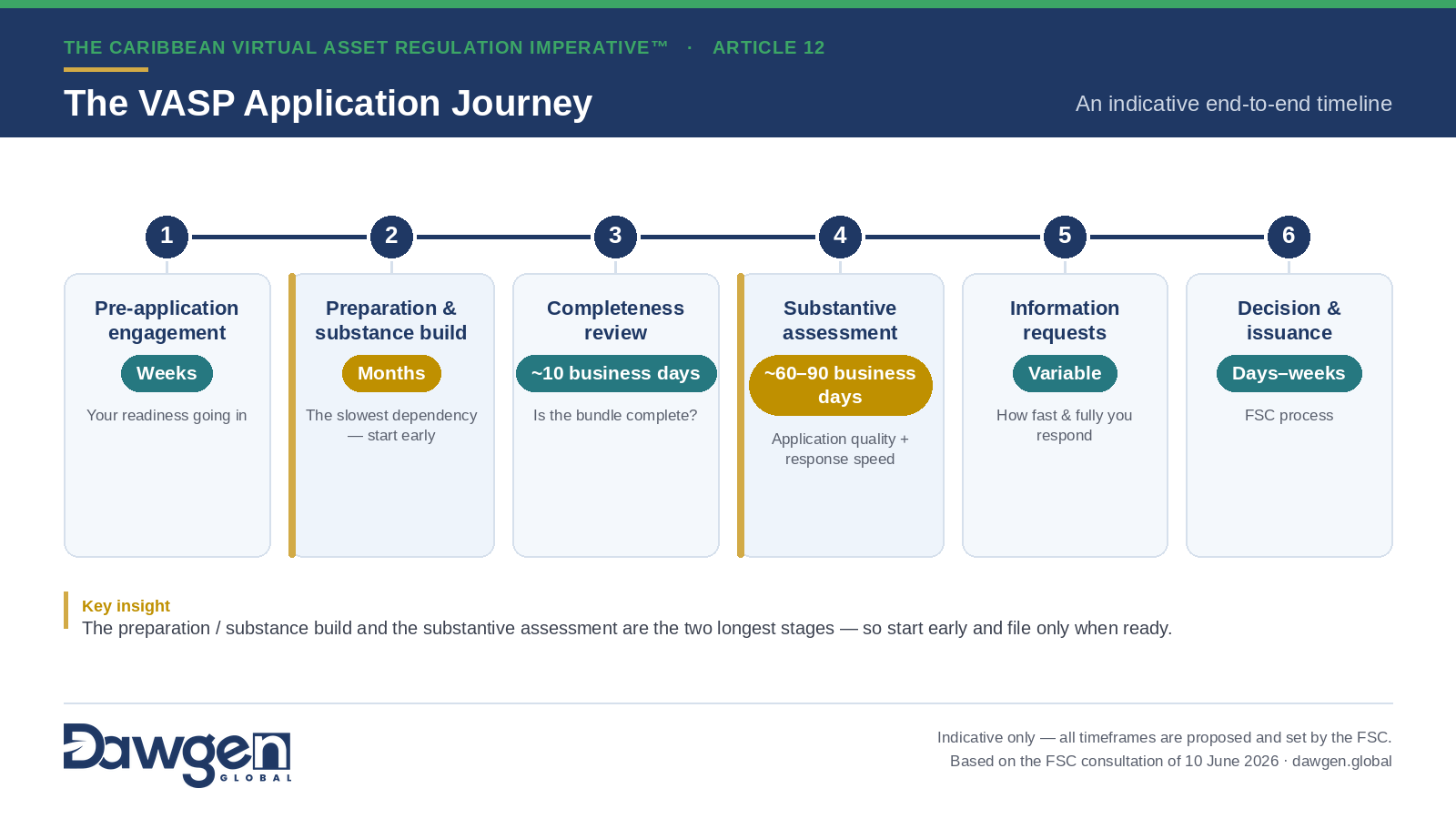
Putting the stages together gives a realistic picture. The figures below are indicative and reflect the proposals; the FSC sets the actual timeframes, and readiness drives everything.
| Stage | Indicative duration | What determines it |
| Pre-application engagement | Weeks (variable) | Your readiness going in |
| Preparation & substance build | Months | The slowest dependency — start early |
| Completeness review | ~10 business days | Whether the bundle is complete |
| Substantive assessment | ~60–90 business days | Application quality + response speed |
| Information requests | Variable (pauses momentum) | How fast and fully you respond |
| Decision & issuance | Days to weeks | FSC process |
The honest takeaway is that, once you are genuinely ready to file, the regulatory process realistically runs to several months end to end — and considerably longer if you file before you are ready. The single largest variable is not the FSC; it is the applicant’s own preparation and responsiveness.
How to keep the clock in your favour
The levers that shorten the timeline are almost entirely within the applicant’s control:
- Prepare fully before filing — the clock rewards readiness, not haste.
- Run an internal completeness check, verified by someone other than the author.
- Assign a single coordinator to own the FSC relationship and all responses.
- Answer information requests fast and in full — never partially.
- Start the substance build early; it is the slowest dependency of all.
- Be candid throughout — concealment is discovered and adds rounds.
The pattern behind all of these is the same: front-load the work, and the clock runs short. Leave the work until the application is in, and it runs long.
Frequently asked questions
How long does a VASP licence take end-to-end?
Realistically several months once you are ready to file. The substantive assessment is proposed at roughly 60 to 90 business days, but total time depends heavily on your readiness before filing and how quickly and completely you respond to information requests. Figures are indicative and set by the FSC.
What happens if my application is incomplete?
It is returned at the completeness review — proposed at around 10 business days — and effectively rejoins the queue. This is one of the most common and avoidable causes of delay; a rigorous pre-filing completeness check prevents it.
Does the assessment clock keep running while the FSC waits for me?
Effectively no. Information requests pause the momentum of the assessment, so the real duration is shaped by how fast and fully you respond. Prompt, complete answers keep the process moving; slow or partial ones extend it.
Should I engage the FSC before applying?
Yes. Pre-application engagement helps confirm the right licence class, clarifies the regulator’s expectations, and surfaces gaps while they are still inexpensive to fix. It typically de-risks and shortens the formal process.
What most extends the timeline?
Two things: an incomplete or weak application that stumbles at the gates, and slow or partial responses to information requests. Both are within your control, which is why preparation and responsiveness matter more than anything the regulator does.
| How Dawgen Global can help
Dawgen Global project-manages VASP licence applications end to end — assessing readiness, sequencing the build, assembling and quality-checking the application bundle, and acting as the single point of coordination for the FSC’s information requests. We are not a licence applicant and do not operate any virtual asset business — our role is advisory and assurance. We run the pre-filing completeness check, manage the assessment relationship to keep the clock moving, and prepare fast, complete responses to every FSC query. Separately, and subject to independence, we provide assurance engagements — including proof of reserves — for licensed VASPs. To steer your application from first contact to licence in hand, contact us at [email protected] or visit dawgen.global. |
This article is part of The Caribbean Virtual Asset Regulation Imperative™ series by Dawgen Global, powered by DAGAF™ — the Dawgen Digital Asset Governance & Assurance Framework. It is general information based on the FSC’s consultation documents of 10 June 2026; all timeframes are indicative and proposed, and remain subject to change following consultation. It is not legal, regulatory or investment advice. Confirm details against the FSC’s published papers.
About Dawgen Global
Dawgen Global is an independent, integrated multidisciplinary professional services firm headquartered at 47 Trinidad Terrace, New Kingston, Jamaica, serving more than 15 territories across the Caribbean. Founded and led by Dr. Dawkins Brown, Executive Chairman, the firm is independent and not affiliated with any international network. It delivers a full suite of professional services under one roof: audit and assurance; tax advisory; IT and digital transformation; risk management; cybersecurity; actuarial and insurance regulatory advisory; HR advisory; mergers and acquisitions; corporate recovery; business advisory and strategy; accounting BPO and virtual CFO services; and legal process outsourcing.
The proposition is simple: big-firm capability without the big-firm price. Dawgen Global’s integrated approach is built for the specific complexities and opportunities of the Caribbean market, helping organizations make sharper, better-informed decisions that drive measurable progress.
To explore a partnership, reach out:
- Website: dawgen.global
- Email: [email protected]
- WhatsApp (Global): +1 555-795-9071
- Caribbean offices: +1 876-665-5926 | +1 876-929-3670 | +1 876-926-5210


