
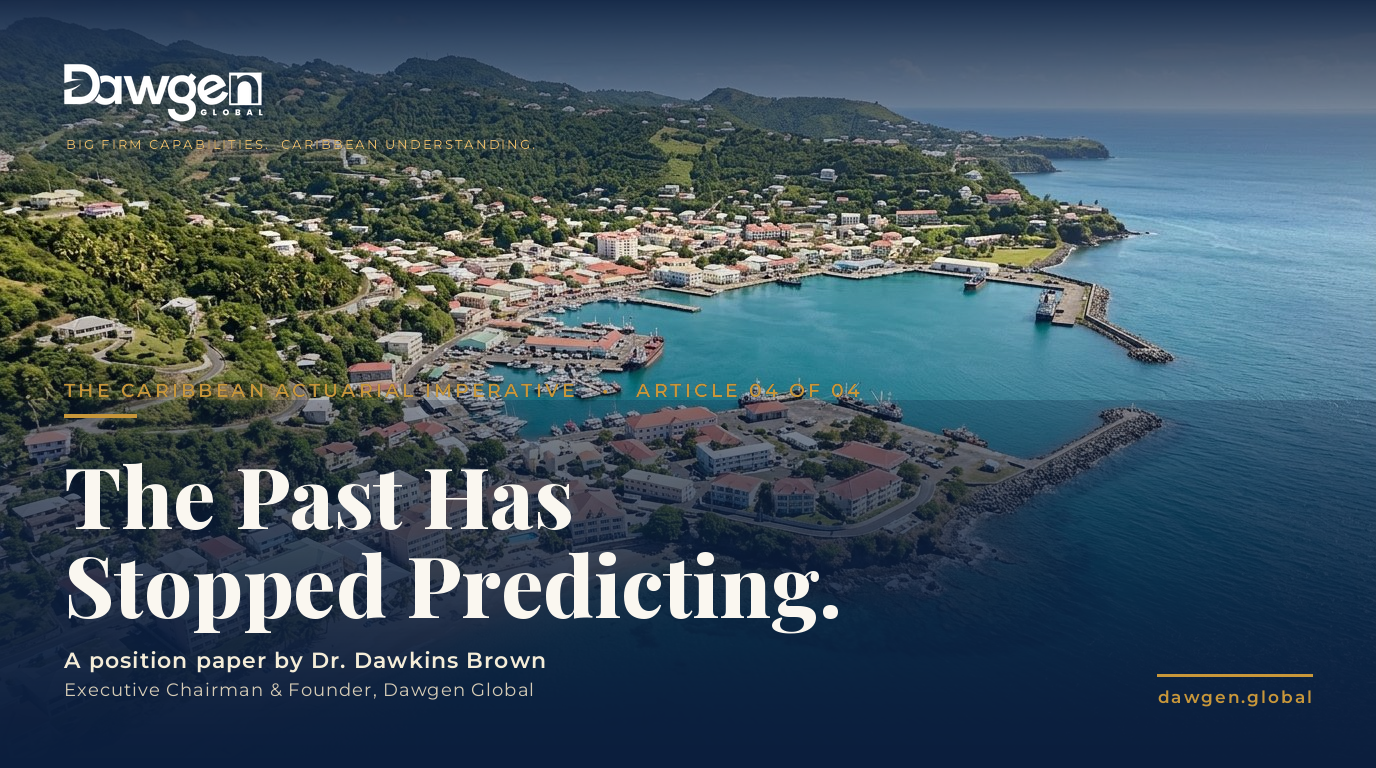
Actuarial science rests on the premise that the past is a guide to the future. Climate is the exposure for which that premise no longer holds — and a region built on coastlines is being asked, by ratings agencies, correspondent banks, and supervisors, to measure a risk for which its own history has stopped being evidence.
SERIES CONCLUSION
This is the fourth and final paper in The Caribbean Actuarial Imperative, an editorial series from Dawgen Global — an independent, integrated, multidisciplinary professional services firm spanning eleven service disciplines across more than fifteen Caribbean territories. The first paper introduced the Long‑Horizon Test for the decisions whose consequences outrun the quarterly window. The second examined pension valuation, the third the reserving of long‑tail liabilities. Each took up an obligation already sitting on the balance sheet, waiting to be measured well. This paper turns to the exposure that is only now arriving on the balance sheet — and that breaks the assumption on which the first three papers, and actuarial science itself, quietly rest.
It is written for the boards, chief executives, chief financial officers, treasurers, and risk and audit committees of Caribbean institutions — and particularly for those who have assumed that climate is an environmental matter, a corporate‑responsibility matter, or a matter for the insurers, rather than a quantification problem already on their own books. It is the forward frontier of Caribbean actuarial work, and the area in which institutional capability will most clearly separate the region’s leaders over the next five years.
Every actuarial method in the first three papers assumed that the future would resemble the past closely enough for history to be evidence. Climate is the first major exposure of the modern balance sheet for which that assumption is no longer safe — and a region of coastlines is being asked to measure it anyway.
1. The risk with no usable history
The disciplines of the first three papers — valuing a pension, reserving for claims, provisioning for losses — share a hidden foundation. Each infers the future from the past: from mortality experience, from claims‑development patterns, from historical loss ratios. The actuary’s art is to do that inference rigorously and to be explicit about its limits. But the inference only works if the process generating the future is stable enough that yesterday’s data describes tomorrow’s risk.
Climate is the exposure for which that stability has broken. The frequency and severity of the hazards that matter most to the Caribbean — hurricanes, storm surge, flooding, drought, coastal erosion — are no longer drawn from the same distribution that generated the historical record. A hundred years of storm data understates a risk that is still changing. The actuarial problem is therefore not the familiar one of estimating a stable distribution from a sample; it is the harder one of quantifying an exposure whose own history has ceased to be a reliable witness. This does not make actuarial method useless. It makes it indispensable in a new mode — forward‑looking, scenario‑based, and explicit about a degree of uncertainty the older methods rarely had to confront.
2. Why this is an actuarial problem, not an environmental one
The most consequential misconception in the Caribbean boardroom is that climate risk is a matter of sustainability reporting, corporate responsibility, or environmental compliance — a reputational and disclosure question to be handled by a committee and a policy statement. That framing is not wrong so much as dangerously incomplete. It addresses how an institution describes its climate posture. It does not address what climate exposure is doing to the numbers on the institution’s balance sheet.
Climate risk is, at its core, the same kind of problem the first three papers described: a set of uncertain future financial consequences arising from decisions and assets already on the books, payable over a long horizon, material to the institution’s financial position, and difficult to recover from if mis‑measured. That is the precise profile the Long‑Horizon Test was built to identify. A hotel group’s beachfront real estate, a bank’s mortgage book concentrated in a flood‑exposed parish, an insurer’s catastrophe accumulation, a manufacturer’s single coastal facility — each is a quantifiable financial exposure to a physical hazard, and each is an actuarial question wearing an environmental label.
3. The two exposures: physical and transition
Climate presents a Caribbean institution with two distinct financial exposures, and conflating them is a common analytical error. Both are quantifiable; they are quantified differently.
Physical risk is the exposure to the hazard itself — the damage a storm does to an asset, the business interruption a flood causes, the insurance loss a hurricane drives, the impairment a coastal property suffers as the sea advances. For a region of small island states, physical risk is the dominant exposure, and it is the one for which historical data is least reliable and forward scenarios most necessary.
Transition risk is the exposure to the world’s response to climate — the cost of changing regulation, shifting energy prices, evolving market preferences, and the repricing of carbon‑intensive assets. For the Caribbean, transition risk arrives less through domestic policy than through external channels: the correspondent bank that reprices its relationship, the ratings agency that adjusts its methodology, the tourism source‑market that changes its travel behaviour, the development financier that attaches new conditions. An institution can be a small emitter and still carry large transition exposure, because the exposure is to other parties’ transitions, not only its own.
4. Who is now asking — and why the question is no longer optional
For most of the period in which climate risk has been discussed, a Caribbean institution could treat its quantification as discretionary — worthwhile, perhaps, but not required. That period is closing, and it is closing not because of domestic regulation but because of the institutions on which Caribbean finance depends.
- Correspondent banks, on which Caribbean institutions rely for access to the global financial system, increasingly assess the climate exposure of their counterparties as part of the de‑risking calculus that has already withdrawn correspondent relationships from parts of the region. An institution that cannot describe its climate exposure in quantified terms is harder to bank.
- Ratings agencies have incorporated climate exposure into their methodologies for sovereigns, financial institutions, and insurers. For a Caribbean issuer, the difference between a quantified, well‑governed climate position and an unexamined one increasingly shows up in the rating, and therefore in the cost of capital.
- Supervisors and regulators across the region, and the international standards they progressively adopt, are moving climate‑related financial disclosure and stress testing from aspiration toward expectation — following the same trajectory the second and third papers described for valuation and reserving discipline.
- Development financiers, reinsurers, and institutional investors increasingly require a quantified climate position as a condition of participation, attaching the requirement to the capital itself.
The common thread is that the demand for quantification is arriving through the institution’s most important external relationships — its bankers, its raters, its supervisors, its funders. The question is no longer whether to measure climate exposure, but whether the institution measures it before these parties require the institution to, or after.
5. The Dawgen Global Climate Exposure Questions
The seven questions below are the framework Dawgen Global uses to move a Caribbean board from a qualitative awareness of climate to a quantified, governable position. They are the climate counterpart to the Long‑Horizon Test, the Valuation Governance Questions, and the Reserve Integrity Questions of the earlier papers — and they require no climate‑science expertise to ask, only the refusal to treat a material financial exposure as someone else’s subject.
- Which of our assets, exposures, and revenue streams are concentrated in physical locations or sectors most exposed to climate hazard — and have we mapped that concentration, or only assumed it is diversified?
- What is the estimated financial consequence to us of a severe but plausible physical event — a major hurricane, a significant flood — across damage, interruption, and impairment, not insured loss alone?
- Where are we exposed to other parties’ transitions — our correspondent banks, our ratings, our source markets, our funders — rather than only to our own emissions?
- Have we quantified these exposures under forward scenarios, or are we relying on historical loss experience that the hazard has already outgrown?
- Which single climate exposure, if it materialised, would damage us most — and do we have a plan, a reserve, or a transfer for it, or only a hope that it will not?
- Can we describe our climate exposure in quantified terms to a correspondent bank, a ratings agency, or a supervisor today — and if not, what would we need to be able to do so?
- Are we measuring this ahead of the parties who will require it of us, or will we be measuring it under their deadline and on their terms?
A board that can answer these seven has converted climate from a reputational posture into a governed financial exposure — which is the only form in which it can actually be managed.
6. Where Caribbean institutions are most exposed, and least measured
The gap between exposure and measurement is wider for climate than for any obligation in the earlier papers, because the exposure is large, concentrated, and almost entirely un‑quantified outside the largest insurers. In our advisory experience across the region, the exposures most often carried without measurement cluster in a few places.
- Coastal and tourism real estate, where the value of the asset and the revenue it generates are both exposed to physical hazard, and where the impairment risk is rarely modelled until a financier or a valuer forces it.
- Lending books concentrated by geography, where a bank or credit union’s mortgage and commercial exposure is correlated to a single set of parishes or coastlines in a way that diversification analysis built on borrower type entirely misses.
- Insurance and reinsurance accumulation, where catastrophe exposure is the core actuarial question and where reinsurance availability and pricing — themselves shifting with global climate experience — determine the viability of the underlying business.
- Single‑site operational dependence, where a manufacturer, processor, or utility depends on one coastal or flood‑exposed facility whose loss would be existential, and whose risk has never been quantified as a financial exposure to the enterprise.
- Sovereign and quasi‑sovereign exposure, where the institution’s own fortunes are tied to a government whose fiscal capacity is itself climate‑exposed — a second‑order exposure that is real, material, and almost never measured at the institutional level.
7. What climate‑grade actuarial advisory looks like
The actuarial work that produces durable value in climate quantification carries the character the series has identified throughout, adapted to an exposure without a stable history.
- It is forward‑looking and scenario‑based by necessity, building the quantification on plausible future scenarios rather than on historical loss experience the hazard has outgrown — and it is explicit about the uncertainty that approach carries, rather than disguising it as precision.
- It separates physical from transition exposure and quantifies each in its own terms, rather than collapsing them into a single undifferentiated ‘climate risk’ line.
- It produces a quantified position an institution can actually present — to a correspondent bank, a ratings agency, a supervisor, or a funder — rather than a narrative disclosure that describes intent without measuring exposure.
- It is integrated with the institution’s capital, reserving, valuation, audit, and regulatory work, because climate exposure touches all of them — the reserving discipline of the third paper, the capital adequacy of the first, and the disclosure the regulators of the second are beginning to require.
- It is delivered by professionals who can carry the technical rigour of scenario quantification into language a non‑specialist board can act on — the same rare quality the first paper named as the most valuable an actuary can have, and the one this frontier most demands.
8. What the series has argued
These four papers have made a single argument in four settings. Caribbean institutions routinely authorise, hold, and report obligations whose financial consequences extend far beyond the quarterly horizon, and they do so, far more often than they should, without the structured handling of uncertainty that actuarial discipline provides. The Long‑Horizon Test identified those obligations. Pension valuation showed that the governing number is an argument to be examined, not a fact to be ratified. Reserving showed that a provision is a prediction the auditor must rely upon, and is therefore the institution’s to govern first. Climate showed that the newest and largest of these exposures has arrived precisely as the historical methods reach their limit — and must be quantified anyway.
The through‑line is that actuarial discipline is not, for the Caribbean board, a specialist function to be delegated and forgotten. It is a way of governing uncertainty over long horizons — and the institutions that treat it as such, ahead of the regulator, the auditor, the ratings agency, and the correspondent bank that will eventually require it, are the ones that will carry their long‑horizon obligations with confidence rather than discover them under pressure. That is the imperative the series set out to name. The institutions that act on it will not wait to be required to.
9. How Dawgen Global delivers actuarial advisory
Dawgen Global is an independent, integrated, multidisciplinary professional services firm. Its actuarial work is delivered through the firm’s Actuarial Services Division, which operates within the broader Risk Advisory practice and is led by senior licensed professionals with internationally recognised credentials. The Division’s work covers pension valuation and scheme governance, reserving methodology and long‑tail liability estimation, capital adequacy and stress testing, climate risk quantification, and the application of actuarial methods to non‑insurance domains. It operates alongside the firm’s ten other service disciplines — Audit & Assurance, Tax Advisory, IT & Digital Transformation, Risk Management, Cybersecurity, HR Advisory, M&A Advisory, Corporate Recovery, Business Advisory & Strategy, Accounting BPO and Virtual CFO services, and Legal Process Outsourcing.
The integration is, for climate, decisive. A quantified climate exposure must be reconciled with the institution’s capital, its reserving, its audited financial statements, its regulatory disclosure, and the position it presents to its bankers and funders — every one of which is a discipline the firm already holds under one roof. An independent, integrated, multidisciplinary firm is the natural home for that combination. The structural separation between the independent advisor and the technology partner that the firm argues for across its work applies to climate modelling as well: the scenario‑modelling software and data infrastructure are selected with each client, downstream of the strategic and methodological judgements this paper, and this series, have been about.
ABOUT THE ACTUARIAL SERVICES DIVISION
The Dawgen Global Actuarial Services Division operates within the firm’s Risk Advisory practice and is led by senior licensed professionals with internationally recognised actuarial credentials. The Division’s work covers pension valuation and scheme governance, reserving methodology and long‑tail liability estimation, capital adequacy and stress testing, climate risk quantification, and the application of actuarial methods to non‑insurance domains including credit unions and co‑operative societies, self‑funded employer benefit schemes,
Dawgen Global is an independent, integrated, multidisciplinary professional services firm headquartered at Dawgen Towers, 47-49 Trinidad Terrace, Kingston 5, Jamaica, operating across more than fifteen Caribbean territories. The firm spans eleven service disciplines and works with a curated network of global technology partners and vendors to design, develop, and implement effective client solutions. Dawgen Global is independent and integrated — not affiliated with, a member of, or backed by any external network.
dawgen.global • [email protected] • Dawgen Towers, 47-49 Trinidad Terrace, Kingston 5, Jamaica
This thought leadership paper is published for general information only and does not constitute legal, tax, audit, actuarial, regulatory, or investment advice. The Climate Exposure Questions described above are illustrative of Dawgen Global’s advisory methodology and should be adapted to the specific circumstances, regulatory environment, and risk profile of each institution. Independent professional advice should be obtained before acting on any matter discussed in this paper. © 2026 Dawgen Global. All rights reserved.
About Dawgen Global
“Embrace BIG FIRM capabilities without the big firm price at Dawgen Global, your committed partner in carving a pathway to continual progress in the vibrant Caribbean region. Our integrated, multidisciplinary approach is finely tuned to address the unique intricacies and lucrative prospects that the region has to offer. Offering a rich array of services, including audit, accounting, tax, IT, HR, risk management, and more, we facilitate smarter and more effective decisions that set the stage for unprecedented triumphs. Let’s collaborate and craft a future where every decision is a steppingstone to greater success. Reach out to explore a partnership that promises not just growth but a future beaming with opportunities and achievements.
 Email: [email protected]
  Visit: Dawgen Global Website

 WhatsApp Global Number : +1 555-795-9071
Caribbean Office: +1876-6655926 / 876-9293670/876-9265210  WhatsApp Global: +1 5557959071
USA Office: 855-354-2447
Join hands with Dawgen Global. Together, let’s venture into a future brimming with opportunities and achievements


