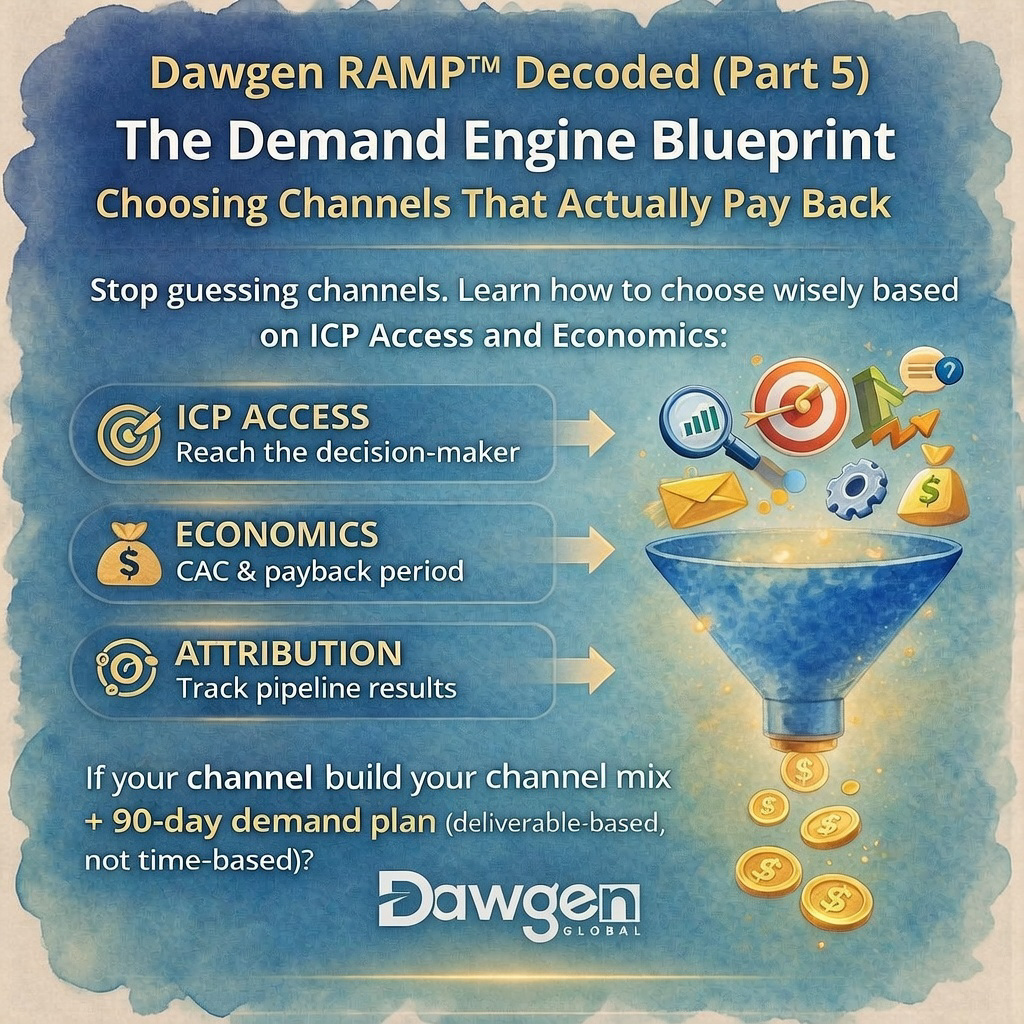
Dawgen RAMP™ Decoded: From Marketing to Money
Framework: RAMP™ = Relevance → Attraction → Monetization → Propulsion
Where we are: Parts 1–4 built the Relevance foundation—ICP clarity, positioning, and proof-led messaging. Now we move into Attraction: how to generate demand predictably.
Most businesses don’t have a “channel problem.”
They have a channel economics problem.
They pick channels because:
-
competitors are using them,
-
a platform is trending,
-
a consultant “recommended” it,
-
or it feels intuitive.
Then they wonder why spend increases, results are inconsistent, and pipeline is unpredictable.
Dawgen’s position is simple:
Your channel strategy should be an investment decision, not a marketing preference.
This article gives you the blueprint to choose channels that pay back—based on your ICP, your sales motion, and unit economics.
The Biggest Misconception in Marketing: “More Channels = More Growth”
It sounds logical: if one channel helps, multiple channels should help more.
In reality, multiple channels without clarity creates:
-
fragmented messaging,
-
inconsistent measurement,
-
shallow execution,
-
and wasted budget.
A strong demand engine usually starts with 2–3 primary channels that:
-
can reliably reach the decision-maker,
-
match how your ICP buys, and
-
produce measurable pipeline within acceptable economics.
Only after those channels are stable do you expand.
The Dawgen Demand Engine Definition
A demand engine is not “posting content” or “running ads.”
A demand engine is a system that:
-
creates attention (reach),
-
converts attention into intent (leads),
-
qualifies intent into opportunity (pipeline),
-
and feeds the sales process (revenue).
If your channel does not connect to pipeline and revenue, it is not a demand engine. It is a visibility activity.
Visibility is fine—but only if it supports demand.
The Dawgen Channel Selection Principle: Access + Economics + Fit
To choose channels properly, Dawgen evaluates every channel using three lenses:
1) Access: Can this channel reliably reach the ICP decision-maker?
2) Economics: Will it pay back within acceptable CAC and payback period?
3) Fit: Does it match the sales motion, offer type, and buying behavior?
If any lens fails, the channel becomes expensive.
Step 1: Start With the ICP Access Map (Not a Channel List)
Before you pick a channel, you must answer:
Where does your Spearhead ICP actually pay attention?
Build a simple access map:
ICP Access Map
-
Search behavior: what do they Google when the problem is urgent?
-
Communities: what groups, associations, and networks do they trust?
-
Platforms: LinkedIn, YouTube, Instagram, TikTok—where do they engage professionally?
-
Events: what conferences, webinars, and industry events matter?
-
Influencers: who shapes their buying opinions?
-
Referrals: what trusted sources introduce solutions?
-
Partners: what vendors or advisors already serve them?
This map tells you where marketing can have leverage.
If your ICP is a B2B decision-maker, for example, it’s usually easier to win through:
-
LinkedIn + direct outreach,
-
partnerships,
-
targeted events,
-
and search (SEO) around buying intent.
If your ICP is consumer-driven, you may need:
-
short-form content,
-
paid social,
-
influencer collaboration,
-
and strong landing-page conversion.
The point is: your ICP determines channel priority.
Step 2: Understand the 4 Channel Families (and what they’re best for)
Dawgen groups channels into four families:
A) Owned Channels
Examples: website, blog, email list, YouTube channel, WhatsApp broadcast list, webinars you host.
Best for: compounding growth over time; credibility and conversion.
B) Paid Channels
Examples: Google Ads, LinkedIn Ads, Meta Ads, sponsorships, paid newsletters.
Best for: speed and controlled reach (if your message and offer are sharp).
C) Partner Channels
Examples: alliances, resellers, co-marketing, referral networks.
Best for: trust transfer and lower CAC (often the most underused channel).
D) Outbound Channels
Examples: cold email, LinkedIn outreach, targeted calling, account-based outreach.
Best for: B2B pipeline acceleration when the ICP is known and messaging is proof-led.
A mature demand engine typically blends 2–3 of these families.
Step 3: Choose Channels Using the Dawgen PAYBACK Test
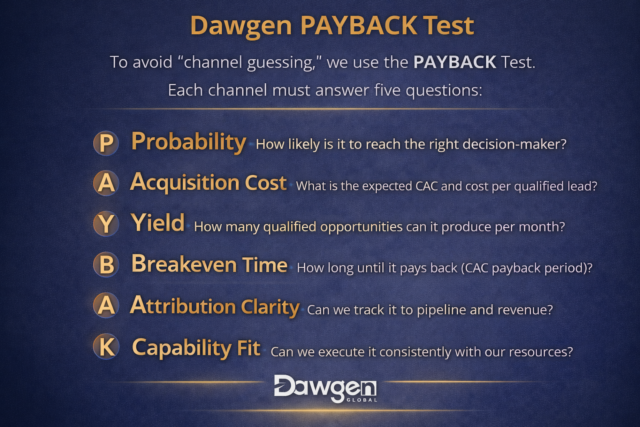
To avoid “channel guessing,” we use the PAYBACK Test. Each channel must answer five questions:
P — Probability: How likely is it to reach the right decision-maker?
A — Acquisition Cost: What is the expected CAC and cost per qualified lead?
Y — Yield: How many qualified opportunities can it produce per month?
B — Breakeven Time: How long until it pays back (CAC payback period)?
A — Attribution Clarity: Can we track it to pipeline and revenue?
C — Capability Fit: Can we execute it consistently with our resources?
K — Kill Criteria: What metrics trigger stopping or adjusting?
If you cannot answer these questions, you do not have a strategy—you have a hope.
Step 4: Match Channel to Sales Motion (The Hidden Driver)
Many channel failures occur because the channel doesn’t match the sales motion.
Sales motions (simplified)
-
High-trust, high-ticket, longer cycle (professional services, B2B consulting)
-
Mid-ticket, consultative (packages, managed services)
-
Low-ticket, high volume (consumer products, e-commerce)
Here’s the Dawgen alignment:
If you sell high-trust, high-ticket
Best channel bets:
-
thought leadership (owned),
-
partnerships (trust transfer),
-
outbound (targeted),
-
selective paid (retargeting, search intent).
You do not want to rely mainly on broad awareness ads. You want credibility + precision.
If you sell mid-ticket consultative
Best channel bets:
-
lead magnet + email nurture (owned),
-
paid + landing pages (paid),
-
webinars/workshops (owned),
-
outbound follow-up (outbound).
If you sell low-ticket high volume
Best channel bets:
-
paid social + creative testing,
-
influencer collaborations,
-
SEO product-intent keywords,
-
conversion optimization.
This is why “what worked for another business” often fails for you. Their sales motion is different.
Step 5: Use Channel Stacking (How Real Engines Are Built)
Most businesses treat channels as separate “activities.”
Dawgen builds channel stacks—channels that reinforce each other.
Here are three proven stacks:
Stack 1: Authority Stack (High-trust B2B)
-
Thought leadership article (owned)
-
LinkedIn distribution + executive posts (owned)
-
Partner co-hosted webinar (partner)
-
Retargeting ads to proof assets (paid)
-
Outbound follow-up to attendees (outbound)
This stack creates trust and accelerates conversion.
Stack 2: Intent Stack (Buyer-ready demand)
-
SEO for high-intent search terms (owned)
-
Google search ads for the same terms (paid)
-
Landing page + proof-led messaging (owned)
-
Email nurture + case studies (owned)
-
Sales call / consult CTA (monetization bridge)
This stack wins when the buyer is already problem-aware.
Stack 3: Pipeline Stack (Fast B2B build)
-
Spearhead ICP list (data)
-
Proof-led outbound sequences (outbound)
-
LinkedIn credibility posts (owned)
-
Case study asset + offer system (owned)
-
Meeting → proposal → close playbook (monetization)
This stack is the fastest way to build pipeline when you know who you’re targeting.
Step 6: Define Your Channel KPI Tree (Lead → Close → Cash)
A channel should not be judged by “likes” or “impressions.”
It should be judged by its contribution to the commercial system.
Dawgen KPI Tree (simplified)
-
Reach (views, impressions)
-
Engagement (clicks, time on page)
-
Leads (form fills, inquiries, WhatsApp messages)
-
Qualified leads (fit + intent)
-
Opportunities (sales meetings, proposals)
-
Wins (closed deals)
-
Revenue (cash collected)
-
CAC + Payback (profitability)
When you install this, channel debates end. Numbers decide.
Step 7: Set Kill Criteria (So You Stop Wasting Money)
Most firms waste money because they do not define in advance what failure looks like.
Dawgen sets kill criteria by channel:
-
If cost per qualified lead exceeds X for Y weeks → adjust or pause
-
If conversion rate is below threshold → fix offer or landing page
-
If outbound reply rate is weak → adjust ICP list and messaging
-
If webinar attendance is low → improve partner leverage and topic relevance
Kill criteria protects budget and forces optimization.
The Dawgen Recommendation: Your First Demand Engine Should Be “Narrow and Deep”
For most service businesses and complex B2B environments, the smartest demand engine start is:
-
Owned thought leadership (credibility)
-
Outbound (precision pipeline)
-
Partner channel (trust transfer)
-
Light paid retargeting (conversion lift)
Not because paid ads don’t work—but because paid ads amplify what is already true.
If your relevance and proof aren’t strong yet, paid spend accelerates waste.
What Comes Next in Part 6
Part 6 will show you how to turn thought leadership into pipeline systematically:
Content That Creates Customers: The 90-Day Attraction Calendar
Not “posting for visibility”—but content as a revenue asset.
Next Step: Get the RAMP™ Demand Launch Kit
If your pipeline is inconsistent, the answer is not “try more channels.”
The answer is to install a demand engine built on:
-
ICP access,
-
channel economics,
-
and a system that links to pipeline.
Dawgen’s RAMP™ Demand Launch Kit is a deliverable-based engagement that gives you:
-
a channel strategy based on the PAYBACK test,
-
a channel stack designed for your sales motion,
-
proof-led landing page and CTA structure,
-
and a 90-day demand plan linked to Lead → Close → Cash metrics.
To get started, email [email protected] or message Global WhatsApp: +1 555 795 9071 and ask for the RAMP™ Demand Launch Kit.
About Dawgen Global
“Embrace BIG FIRM capabilities without the big firm price at Dawgen Global, your committed partner in carving a pathway to continual progress in the vibrant Caribbean region. Our integrated, multidisciplinary approach is finely tuned to address the unique intricacies and lucrative prospects that the region has to offer. Offering a rich array of services, including audit, accounting, tax, IT, HR, risk management, and more, we facilitate smarter and more effective decisions that set the stage for unprecedented triumphs. Let’s collaborate and craft a future where every decision is a steppingstone to greater success. Reach out to explore a partnership that promises not just growth but a future beaming with opportunities and achievements.
 Email: [email protected]
  Visit: Dawgen Global Website

 WhatsApp Global Number : +1 555-795-9071
Caribbean Office: +1876-6655926 / 876-9293670/876-9265210  WhatsApp Global: +1 5557959071
USA Office: 855-354-2447
Join hands with Dawgen Global. Together, let’s venture into a future brimming with opportunities and achievements


