
A Dawgen Global thought‑leadership series for founders and CEOs in the Caribbean and other emerging markets
Growth breaks in predictable places. As small businesses become medium and then large, what once worked begins to fail: the founder can no longer do it all; direction turns into bottlenecks; delegation dissolves into drift; coordination hardens into bureaucracy; and maturity risks complacency. The Dawgen 5‑S Growth Framework™ offers a practical roadmap for leaders to anticipate—and master—these turning points.
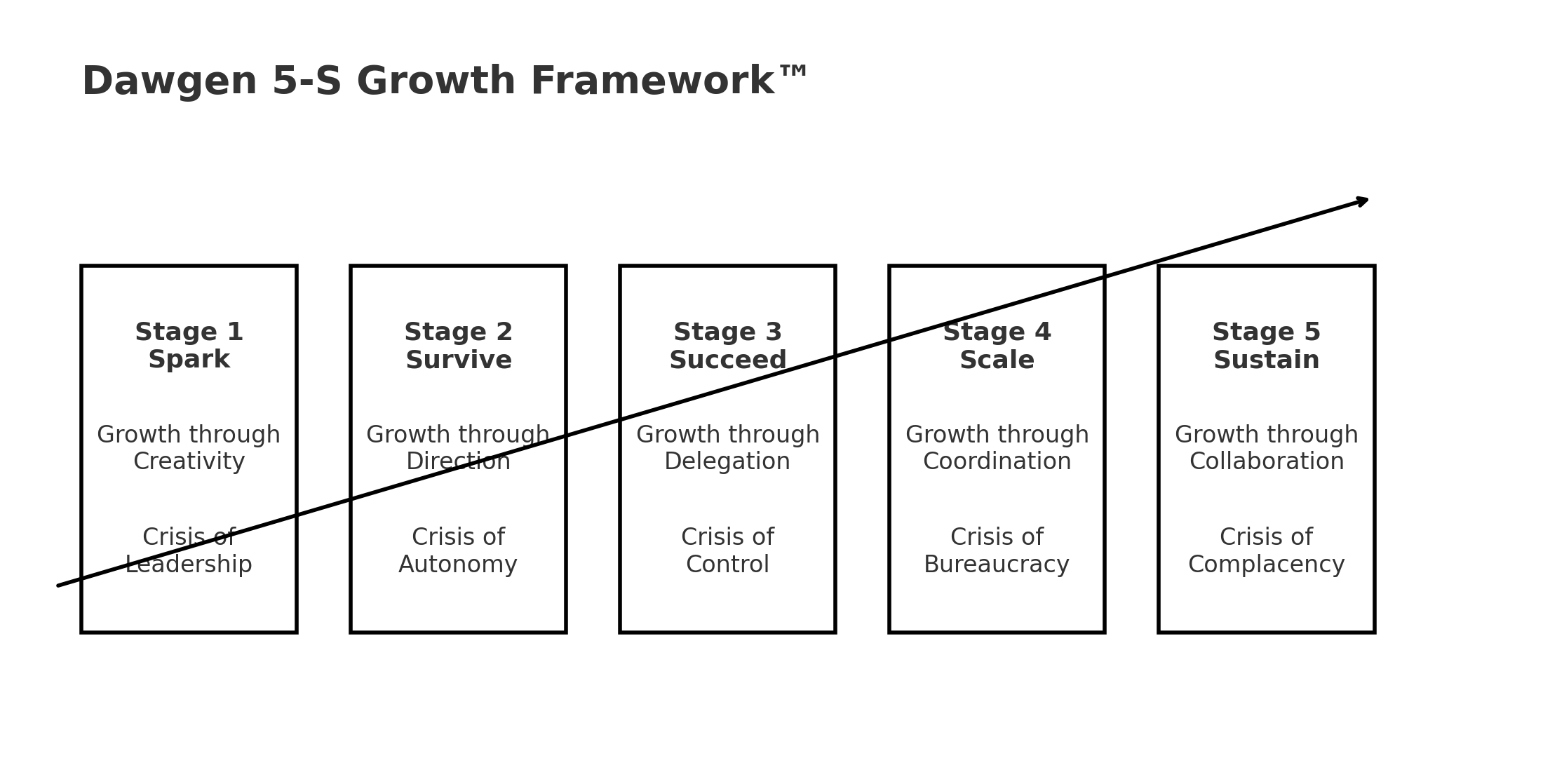
The framework maps five stages of organizational evolution, each with a dominant growth lever and a signature crisis:
- S1: Spark — Grow by creativity; crisis of leadership.
- S2: Survive — Grow by direction; crisis of autonomy.
- S3: Succeed — Grow by delegation; crisis of control.
- S4: Scale — Grow by coordination; crisis of bureaucracy.
- S5: Sustain — Grow by collaboration; multi‑crisis vigilance.
Across the series, we translate this model into operating practices tailored for SMEs in the Caribbean and other emerging markets—where realities like FX volatility, logistics constraints, family ownership, and regulatory complexity demand grounded solutions. This opening article introduces the model, explains the shifting leadership jobs‑to‑be‑done, and equips you with scorecards, checklists, and a 90‑day action plan to locate your current stage and move forward with confidence.
Why Growth Stalls (and What to Do About It)
Most growth challenges aren’t mysterious—they’re structural and repeatable. Three patterns appear again and again:
- Capability Mismatch: The organization’s capabilities (people, processes, systems) lag behind the demands of scale. The founder’s heroics overstay their welcome; ad‑hoc practices don’t survive complexity.
- Decision Debt: Early decisions made for speed become hidden liabilities: unclear decision rights, undefined accountabilities, and undocumented processes load the system with friction.
- Resource Myopia: Working capital tightens just as you need to invest in professionalization. Without stage‑fit finance and controls, growth amplifies risk rather than value.
The remedy is not “more of the same,” but stage‑fit design—right‑sized structures and disciplines that evolve with the company.
The Dawgen 5‑S Growth Framework™ at a Glance
Each S‑stage is defined by three elements: dominant growth lever, signature crisis, and capabilities to build next. Use this as a quick diagnostic and design guide.
S1: Spark — From Chaos to Cadence
- Growth lever: Creativity, founder energy, rapid learning cycles, and customer intimacy.
- Signature crisis: Leadership. The founder struggles to supply the leadership bandwidth and clarity the growing entity needs.
- Build next: Minimal leadership system (weekly rhythm), cash discipline, early product/market signals, first critical hires or fractional specialists.
S2: Survive — Direction Without Drag
- Growth lever: Clear direction and disciplined execution against a focused plan.
- Signature crisis: Autonomy. As complexity increases, decision bottlenecks stall the business; teams lack room to act.
- Build next: Roles and decision rights, stage‑fit KPIs, pricing and unit economics, collections and cash conversion, basic policies that enable (not hinder) speed.
S3: Succeed — Delegation That Sticks
- Growth lever: Delegation, professional managers, and distributed accountability.
- Signature crisis: Control. Empowered teams drift from strategy; data and governance are inconsistent.
- Build next: Lightweight governance (OKRs linked to strategy), P&L accountability, internal controls, FP&A cadence, leadership development for new managers.
S4: Scale — Coordination at Speed
- Growth lever: Cross‑functional coordination and portfolio/PMO discipline.
- Signature crisis: Bureaucracy. Layers and policies throttle responsiveness; customer experience suffers.
- Build next: Operating model choices (BU vs. functional vs. matrix), program/portfolio management, service standards, automation in the middle/back office, risk & compliance by design.
S5: Sustain — Collaborate to Compound
- Growth lever: Collaboration across ecosystems—partners, platforms, alliances; disciplined capital allocation.
- Signature crisis: Complacency and complexity risk. Without renewal, value erodes; complexity reduces clarity.
- Build next: Innovation and renewal loops, partnership playbooks, M&A integration discipline, succession and talent marketplaces, ESG and reputation risk management.
Jobs‑to‑Be‑Done of Leadership Across the 5‑S
Leaders must change how they create value as the company crosses the S‑stages:
- S1 → S2: Move from doing to directing. Establish a clear strategy‑on‑a‑page; create a weekly operating rhythm; safeguard runway.
- S2 → S3: Move from directing to delegating. Clarify decision rights; define scorecards; develop first‑line managers; standardize core processes.
- S3 → S4: Move from delegating to designing systems. Choose an operating model; build a PMO‑lite; scale shared services; codify risk & controls.
- S4 → S5: Move from designing systems to designing ecosystems. Build partnerships, govern portfolios, and reallocate capital to the next S‑curve.
A leader who does not evolve becomes the bottleneck their company cannot bypass.
Stage‑Fit Finance, Risk & Control
Financial architecture must level up with each stage:
- S1: Cash is king. Track burn and runway; implement simple pricing tests; invoice fast, collect faster. Keep a lean chart of accounts.
- S2: Unit economics become non‑negotiable. Introduce rolling 13‑week cash forecasting; tighten working capital (receivables aging, inventory turns, payables terms); standardize approvals.
- S3: FP&A cadence. Monthly management accounts on time; variance analysis; scenario planning; stage‑fit internal controls and audit readiness.
- S4: Portfolio finance. Multi‑BU reporting; cost‑to‑serve analytics; capital approval governance; compliance and risk frameworks embedded in operations.
- S5: Capital allocation & resilience. Return‑on‑capital discipline; M&A and alliance governance; ESG metrics; stress‑testing and contingency planning.
The objective is consistent: fund growth without losing control.
People & Culture That Don’t Break
Growing organizations fail most often at the people layer. The remedy is sequencing, not perfection.
- S1: Hire for range and learning speed. Use fractional specialists to fill gaps. Founder sets values through behavior.
- S2: Formalize roles, expectations, and a basic performance rhythm. Start a manager bootcamp for emerging leaders.
- S3: Professionalize—clear job architectures and pay bands; career pathways; OKR‑linked performance; internal mobility; succession plans for critical roles.
- S4: Scale culture through systems—onboarding at volume, leadership pipeline, recognition mechanisms, and governance that promotes speed with safety.
- S5: Evolve from culture fit to culture add. Build talent marketplaces; succession and board renewal; sustained learning and external networks.
Go‑to‑Market Evolution: From Product‑Market Fit to Portfolio‑Market Fit
Commercial engines change materially across stages:
- S1: Learn the customer’s pain; test value propositions; pilot channels; work directly with early adopters.
- S2: Focus your ICPs; tighten pricing; codify the sales process; build a basic pipeline discipline and customer success motions.
- S3: Segment accounts; specialize roles (new business vs. account management); introduce RevOps; define SLAs between marketing, sales, and delivery.
- S4: Orchestrate portfolios and cross‑sells; enter new geographies or verticals; automate marketing and CX; measure lifetime value and cost‑to‑serve by segment.
- S5: Build ecosystems—alliances, platforms, and partnerships; pursue adjacencies via JV/M&A; reshape GTM around collaborative value creation.
Operating Rhythm: The Cadence That Compounds
A predictable rhythm powers execution:
- Weekly: Leadership huddle (S1–S2), then executive ops meeting (S3–S5). Short dashboards; decisions, not updates; clear owners and deadlines.
- Monthly: Financial close and management reporting; KPI review; risk scan; people moves; portfolio checkpoint (from S4 onwards).
- Quarterly: Strategy refresh/OKR set; resource reallocation; capability reviews; customer and partner listening.
- Annually: Budget and capital plan; audit and compliance assurance; succession and board evaluation; scenario planning and war‑games.
Make the calendar the single source of truth for governance.
Metrics That Matter (By Stage)
S1: Spark
- Runway (months), monthly net burn, new qualified learnings, early customer NPS, founder time‑on‑strategy (%), first‑pass yield in delivery.
S2: Survive
- Gross margin, cash conversion cycle, DSO/DPO, pipeline coverage (x of target), win rates, on‑time delivery, first response time, role clarity index.
S3: Succeed
- EBITDA margin, budget variance, OKR attainment %, manager effectiveness score, internal control exceptions, customer retention and expansion rates.
S4: Scale
- Portfolio ROI, cost‑to‑serve by segment, SLA adherence, cross‑functional cycle times, employee engagement, compliance adherence index.
S5: Sustain
- ROIC, innovation throughput (ideas→pilots→scale), partnership value contribution, ESG score, succession coverage (critical roles), complexity index.
The Five Crises—How to Diagnose and Respond
Crisis 1: Leadership (S1 → S2)
Symptoms: Founder is the funnel; decisions stall; priorities change weekly; burnout looms.
Countermoves: Strategy‑on‑a‑page; weekly operating rhythm; 90‑day priorities; hire or fractionalize missing spikes; create a cash and KPI cockpit.
Crisis 2: Autonomy (S2 → S3)
Symptoms: Teams wait for approval; leaders chase every decision; growth slows despite demand.
Countermoves: Decision‑rights map (e.g., RAPID/RACI), clear role charters, thresholds for approvals, manager bootcamp, KPI transparency.
Crisis 3: Control (S3 → S4)
Symptoms: Inconsistent data; initiatives multiply; P&L surprises; strategy drift.
Countermoves: Lightweight governance (OKRs → portfolio), management reporting discipline, internal controls, FP&A cadence, operating model choices.
Crisis 4: Bureaucracy (S4 → S5)
Symptoms: Slow responses; customer pain from process; meetings multiply; innovation stalls.
Countermoves: PMO‑lite with WIP limits; service charters and SLAs; automation in the middle/back office; kill‑switches for low‑value policies.
Crisis 5: Complacency/Complexity (S5 → Renewal)
Symptoms: Flat growth despite resources; risk incidents rise; talent stagnates; partners disengage.
Countermoves: Renewal loops (venture board, stage‑gate), capital allocation discipline, external partnerships and acquisitions, succession and culture refresh.
Readiness Scorecard (Advance Criteria)
Use this checklist to judge if you’re ready to progress:
- From S1 to S2: Clear ICP and value proposition; 90‑day plan with 3–5 priorities; 6+ months runway; first two critical roles filled; weekly rhythm adopted.
- From S2 to S3: Documented core processes; decision‑rights map working; role clarity >80%; positive unit economics; 13‑week cash forecast on track.
- From S3 to S4: Monthly close <10 working days; reliable dashboards; OKRs tied to strategy; first‑line managers performing; internal controls tested; operating model selected.
- From S4 to S5: Portfolio governance in place; customer SLAs met >90%; cost‑to‑serve understood; PMO delivering throughput; regulatory compliance stable.
- S5 Renewal: ROIC discipline; innovation funnel healthy; succession coverage for critical roles; partnership ecosystem producing measurable value.
Case Vignettes (Anonymized, Caribbean Context)
- Agri‑Processing (S1→S2): A founder with a breakout pepper sauce line faced stockouts and cash strain. By installing a weekly rhythm, negotiating supplier terms, and focusing on two high‑margin SKUs, the business moved to disciplined growth with positive cash conversion in 90 days.
- Hospitality (S2→S3): A boutique hotel expanded to two locations; approvals jammed. A decision‑rights redesign empowered onsite managers with thresholds, improving guest response times by 40% and pushing RevPAR up despite FX swings.
- Professional Services (S3→S4): A regional firm with rising revenue suffered margin shocks. A PMO‑lite and cost‑to‑serve analytics aligned pricing, reduced write‑offs, and harmonized delivery, restoring EBITDA while improving client NPS.
- Distribution (S4→S5): As a multi‑island distributor matured, processes slowed GTM. Introducing service charters, automating order‑to‑cash, and pruning low‑value policies lifted on‑time delivery and freed capacity for partnerships.
- Fintech (S5 Renewal): A mature platform plateaued. A venture board and portfolio stage‑gates rebalanced investments, spun down stale products, and funded a new partner‑led offering that reignited growth.
Tools & Templates Included in This Series
- Strategy‑on‑a‑Page (SoaP)
- Decision‑Rights Map (RACI/RAPID hybrids)
- 13‑Week Cash Flow & Working Capital Tracker
- OKR Library by Stage
- Manager Bootcamp Syllabus
- PMO‑Lite Portfolio Kanban
- Risk & Control Baseline for SMEs
- Stage‑Fit KPI Dashboards
- Renewal Loop & Capital Allocation Playbook
These assets will be made available with each deep‑dive article so leaders can implement immediately.
Your 90‑Day Action Plan (Start Here)
Days 1–15: Locate and Stabilize
- Run the Dawgen 5‑S Diagnostic (quick survey + interview).
- Draft your Strategy‑on‑a‑Page and 90‑day priorities (max five).
- Install a weekly leadership huddle with a simple dashboard (cash, sales, delivery, people).
- Identify the top three decision bottlenecks; define temporary thresholds and owners.
Days 16–45: Build the Spine
- Implement the 13‑week cash and collections cadence; revisit pricing.
- Document 3–5 core workflows (order‑to‑cash, procure‑to‑pay, recruit‑to‑onboard, incident‑to‑resolution, month‑end close).
- Launch a manager bootcamp for first‑line leaders; clarify role charters.
- Set 1–2 control points per core process (approval limits, segregation of duties, reconciliations).
Days 46–90: Align and Accelerate
- Translate strategy to OKRs; publish team scorecards.
- Choose an operating model direction (if S3+): BU vs. functional vs. matrix.
- Stand up a PMO‑lite board with WIP limits; kill or pause low‑value initiatives.
- Run a partner scan (if S4+); identify 2–3 collaboration bets and define stage‑gates.
By day 90, you should have clarity on your stage, a cadence that compounds, and the governance to fund growth without losing control.
Frequently Asked Questions
Q1. Can a company be in more than one stage at the same time?
Yes. Functions and business units may be at different maturity levels. The 5‑S offers a dominant stage view for the enterprise, plus local stage assessments for units.
Q2. How do family‑owned businesses use this model?
Clarify governance (board and management roles), succession pathways, and decision rights to reduce the autonomy and control crises. The cadence and capital allocation disciplines are especially critical.
Q3. What about regulated sectors?
Embed risk and compliance by design rather than adding layers later. Use PMO‑lite and service charters to keep speed while meeting obligations.
Q4. Is this only for high‑growth companies?
No. Even steady‑growth firms benefit from stage‑fit design. The crises show up with any complexity increase—from new products to new locations.
Q5. How does this relate to valuations and investor readiness?
Progressing through S‑stages reliably increases organizational quality—reducing key‑person risk, improving predictability, and strengthening controls, all of which support better valuations and financing terms.
How to Use This Series (and What’s Next)
This opener sets the architecture. The subsequent deep‑dives show exactly how to implement each stage:
- S1: Spark — From Chaos to Cadence
- S2: Survive — Direction without Drag
- S3: Succeed — Delegation that Sticks
- S4: Scale — Coordination at Speed
- S5: Sustain — Collaborate to Compound
- Crossing the Chasms — The Inflection Playbook
- Money that Scales — Finance & Control across the 5‑S
- Teams that Grow Up — People & Culture across the 5‑S
- From PMF to Portfolio‑Market Fit — GTM Evolution
- Scaling in the Caribbean — Case Anthology
Each article includes tools, diagnostics, and templates so you can apply the concepts the same day.
Final Word: Growth with Control
Speed without control is risk; control without speed is stagnation. The Dawgen 5‑S Growth Framework™ helps leaders achieve both, by installing the right disciplines at the right time. In emerging markets—where uncertainty is a constant—stage‑fit design is the difference between fragility and resilience.
Call to Action — Let’s Scale, Smart and Fast
Get your Dawgen 5‑S Growth Diagnostic and 90‑Day Action Plan. We’ll assess your current S‑stage, map the crises ahead, and co‑design a practical plan you can execute immediately.
- 📧 Email: [email protected]
- 💬 WhatsApp: +1 555 795 9071
Dawgen Global — We help you make smarter, more effective decisions.
© Dawgen Global Group. Dawgen 5‑S Growth Framework™ is a trademark of Dawgen Global Group.
About Dawgen Global
“Embrace BIG FIRM capabilities without the big firm price at Dawgen Global, your committed partner in carving a pathway to continual progress in the vibrant Caribbean region. Our integrated, multidisciplinary approach is finely tuned to address the unique intricacies and lucrative prospects that the region has to offer. Offering a rich array of services, including audit, accounting, tax, IT, HR, risk management, and more, we facilitate smarter and more effective decisions that set the stage for unprecedented triumphs. Let’s collaborate and craft a future where every decision is a steppingstone to greater success. Reach out to explore a partnership that promises not just growth but a future beaming with opportunities and achievements.
✉️ Email: [email protected] 🌐 Visit: Dawgen Global Website
📞 📱 WhatsApp Global Number : +1 555-795-9071
📞 Caribbean Office: +1876-6655926 / 876-9293670/876-9265210 📲 WhatsApp Global: +1 5557959071
📞 USA Office: 855-354-2447
Join hands with Dawgen Global. Together, let’s venture into a future brimming with opportunities and achievements


