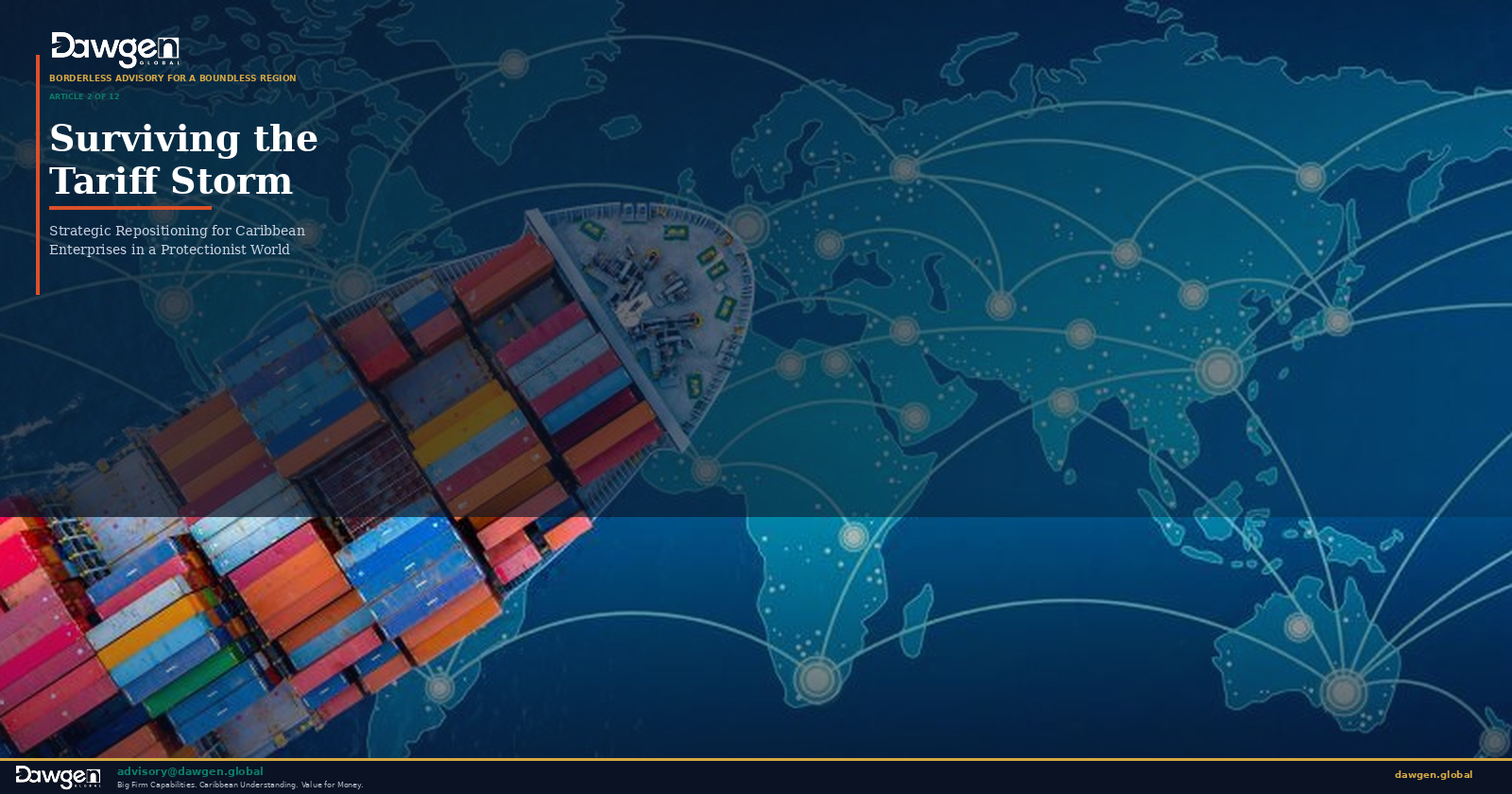
The Day the Rules Changed
On April 2, 2025, the rules of Caribbean trade changed overnight. President Trump’s “Liberation Day” executive order imposed a blanket 10 per cent reciprocal tariff on goods imports from virtually every country in the world, including every CARICOM member state. For Guyana, the rate was set at 38 per cent. For Trinidad and Tobago, 15 per cent. For the rest of the Caribbean, 10 per cent – applied to goods that had, in many cases, entered the United States duty-free for decades under the Caribbean Basin Initiative.
The economic logic was brutal in its simplicity. Caribbean manufacturers that had built their export strategies around preferential US market access woke up to discover that their competitive advantage had been erased by presidential decree. Importers of American goods across the region faced immediate cost increases that rippled through supply chains, inventory pricing, and consumer budgets. Tourism-dependent economies confronted the secondary effect: American households paying an estimated additional US$1,000 to US$1,300 per year in tariff-driven price increases would have less disposable income for Caribbean holidays.
Then, in a development that underscored just how volatile this landscape has become, the US Supreme Court ruled in early 2026 that the use of the International Emergency Economic Powers Act to impose tariffs was unconstitutional – a landmark decision that invalidated the legal basis for the IEEPA tariffs but left intact the Section 232 and Section 301 tariffs that preceded them. The Caribbean found itself in legal limbo: some tariff barriers removed, others remaining, and no certainty about what would replace them.
The lesson for every Caribbean enterprise is not that the tariffs came or went. It is that they can come again, in any form, at any time, targeting any sector, from any trading partner. The era of stable, predictable trade preferences is over. The question is whether your organisation is built to survive – and thrive – in the world that has replaced it.
The Anatomy of Caribbean Trade Exposure
To understand why the tariff storm is so dangerous for Caribbean enterprises, you must first understand the structural vulnerabilities that make the region uniquely exposed to trade-policy disruption.
Vulnerability 1: Extreme Trade Concentration
The United States is CARICOM’s largest trading partner, absorbing approximately 40 per cent of the region’s total goods exports. For individual countries, the concentration is even more extreme. Trinidad and Tobago’s petroleum and LNG exports are overwhelmingly US-directed. Jamaica’s bauxite and alumina shipments depend heavily on American demand. Guyana’s rapidly growing oil-export economy is deeply intertwined with US energy markets. When a single trading partner can impose unilateral tariffs that affect nearly half of your export revenue, you are not participating in a trade relationship. You are operating within a dependency.
Vulnerability 2: Import Dependency for Essentials
The Caribbean imports approximately US$6 billion in food products annually. A significant portion of those imports originates from the United States – everything from wheat flour and rice to poultry and dairy products. When US tariffs trigger retaliatory measures or when supply-chain disruptions increase the cost of American goods, Caribbean consumers and businesses absorb the impact through higher prices on products that have no readily available domestic substitutes. The same dependency extends to manufactured inputs, machinery, pharmaceuticals, and technology products that Caribbean enterprises require to operate.
Vulnerability 3: Narrow Export Bases
Most Caribbean economies depend on a remarkably narrow range of export products. Tourism dominates the service-export economies of Barbados, The Bahamas, Jamaica, and the Eastern Caribbean. Petroleum and petrochemicals drive Trinidad and Tobago’s export revenue. Minerals and commodities underpin Guyana, Jamaica, and Suriname. When tariffs target these specific sectors – or when broader economic disruption in source markets reduces demand for Caribbean tourism – there is no diversified export portfolio to cushion the blow.
Vulnerability 4: Limited Negotiating Leverage
CARICOM collectively represents a trade volume that barely registers on the radar of the world’s major economies. As Ambassador Wayne McCook, CARICOM’s Assistant Secretary-General for the Single Market and Trade, has candidly observed, the region must negotiate collectively because no individual island nation possesses the leverage to secure favourable terms on its own. Yet even collective negotiation faces constraints: the Caribbean Basin Initiative remains in place but its tariff benefits were suspended. CARICOM’s engagement with the US Trade Representative continues, but the framework for the future trade relationship remains undefined.
The Five-Front Strategic Response: A Framework for Caribbean Enterprise Resilience
Surviving the tariff storm requires more than monitoring trade-policy headlines. It requires a fundamental strategic repositioning that reduces exposure, diversifies dependencies, builds resilience, and identifies opportunity within disruption. Dawgen Global’s advisory practice has developed a five-front framework that Caribbean enterprises can deploy immediately.
Front 1: Supply Chain Diversification and Resilience Mapping
The first imperative is to understand, with granular precision, exactly where your organisation’s supply chain is exposed to trade-policy disruption – and then systematically diversify those exposure points.
This begins with a Supply Chain Vulnerability Audit: a structured assessment that maps every critical input, identifies the country of origin for each, calculates the tariff exposure under current and plausible future scenarios, and evaluates the availability of alternative suppliers. The audit should encompass not just direct inputs but also second-tier and third-tier suppliers whose own disruptions can cascade through your operations.
For Caribbean enterprises, the practical priorities include identifying regional alternatives to US-sourced inputs, particularly in food, packaging, and industrial materials. CARICOM’s revised Common External Tariff regime, effective from January 2026, and its updated Rules of Origin framework are designed precisely to facilitate this intra-regional sourcing. Enterprises that have not examined the commercial viability of sourcing from within CARICOM are leaving resilience on the table.
Beyond the region, ECLAC’s recommendation to diversify trade relationships towards China, the European Union, India, ASEAN, the Gulf States, and the African Continental Free Trade Area is equally applicable at the enterprise level. The Afreximbank’s US$3 billion credit facility for CARICOM countries and the forthcoming CARICOM Payment and Settlement System are creating the financial infrastructure to make Africa-Caribbean trade commercially practical for the first time.
Front 2: Export Market Diversification
If supply-chain diversification reduces your vulnerability to input disruption, export-market diversification reduces your vulnerability to demand disruption. An enterprise that sells 80 per cent of its output to the United States is one executive order away from crisis. An enterprise that distributes its exports across the US, the EU, Canada, the UK, and emerging markets in Latin America and Africa has structural resilience.
The practical challenge for Caribbean enterprises is that export diversification requires market intelligence, regulatory knowledge, logistics infrastructure, and commercial relationships that take time to build. This is precisely where advisory support adds value: identifying which markets offer the strongest demand for your specific products, understanding the regulatory requirements for market entry, evaluating the logistics economics of serving those markets from a Caribbean base, and building the commercial relationships that convert market access into actual sales.
CARICOM’s existing trade agreements with the European Union (the CARIFORUM-EU Economic Partnership Agreement), the United Kingdom, Canada, Colombia, Costa Rica, and Cuba represent market-access opportunities that most Caribbean enterprises have never seriously explored. The region’s services exports – particularly in technology, creative industries, financial services, and professional services – represent diversification pathways that are not subject to the same tariff vulnerabilities as goods exports.
Front 3: Cost Structure Optimisation
In a protectionist world, cost competitiveness becomes more important, not less. When tariffs add 10 to 38 per cent to the landed cost of your products in the US market, every dollar of unnecessary cost in your operations magnifies the competitive disadvantage.
Caribbean enterprises should undertake a rigorous Cost Competitiveness Review that examines every element of their cost structure: input costs, labour productivity, energy costs, logistics and freight, regulatory compliance costs, and overhead allocation. The objective is not indiscriminate cost-cutting but strategic cost optimisation – identifying where costs can be reduced without degrading quality or capability, and where investments in productivity (through technology, automation, or process improvement) can deliver cost reductions that more than offset the tariff burden.
Dawgen Global’s WC-PULSE Framework™, introduced in our earlier thought-leadership series, is directly applicable here. Working-capital optimisation releases trapped capital that can be redeployed into productivity investments. The framework’s Caribbean-specific calibration – including its currency-volatility overlay, government-receivables adjustment, and hurricane-season buffer – ensures that the optimisation is grounded in regional realities rather than generic global assumptions.
Front 4: Regulatory Intelligence and Trade-Policy Monitoring
The Supreme Court’s 2026 ruling on IEEPA tariffs demonstrates that trade policy is now a domain of continuous legal and political uncertainty. Caribbean enterprises cannot afford to treat trade-policy monitoring as a quarterly exercise conducted by reviewing newspaper headlines. They need systematic, real-time intelligence on the policy developments that affect their specific sectors, markets, and supply chains.
This means understanding not just what tariffs currently apply, but what tariffs are being proposed, challenged, negotiated, or litigated. It means tracking CARICOM’s negotiations with the US Trade Representative, the EU’s review of the CARIFORUM agreement, the evolution of the African Continental Free Trade Area, and the bilateral discussions between individual Caribbean countries and their trading partners. It means monitoring the regulatory changes in target export markets that could create new barriers or new opportunities.
For most Caribbean enterprises, building this intelligence capability in-house is neither practical nor cost-effective. This is advisory work by definition – and it is advisory work that requires both global trade-policy expertise and deep Caribbean context. A firm that understands WTO dispute mechanics but not CARICOM’s CET revision, or that tracks US tariff policy but not the CARIFORUM-EU EPA review, will deliver incomplete intelligence that leads to incomplete strategy.
Front 5: Strategic Scenario Planning and Organisational Agility
The final front is perhaps the most important: building the organisational capability to respond rapidly to trade-policy changes that cannot be predicted. This is the discipline of scenario planning – developing detailed response plans for a range of plausible trade-policy futures, stress-testing your organisation’s financial resilience under each scenario, and building the decision-making processes that allow you to execute the appropriate response within days, not months.
The scenarios that every Caribbean enterprise should be planning for include: a return of broad-based US tariffs under new legal authority; sector-specific tariffs targeting Caribbean export products; retaliatory tariffs from third countries that disrupt Caribbean supply chains; the expiration or non-renewal of preferential trade arrangements; currency-driven competitiveness shifts caused by trade-policy disruption; and a sustained reduction in US tourism demand driven by domestic economic pressure.
For each scenario, the enterprise needs a pre-built response: which markets to prioritise, which suppliers to activate, which cost levers to pull, which products to reposition, and which investments to accelerate or defer. The organisations that will navigate the tariff storm most successfully are not those that predict the future correctly but those that have prepared for multiple futures simultaneously.
Caribbean Tariff Exposure at a Glance
| Country | Tariff Rate | Primary Exposure | Key Risk | Strategic Priority |
| Guyana | 38% (reduced) | Oil, agriculture | Highest tariff in CARICOM | Accelerate non-US market development for oil derivatives |
| Trinidad & Tobago | 15% | LNG, petrochemicals | Energy-sector concentration | Diversify downstream products, explore EU/Asian markets |
| Jamaica | 10% | Bauxite, alumina, rum | Tourism demand reduction | Services export growth, intra-CARICOM sourcing |
| Barbados | 10% | Rum, tourism services | US tourist spending decline | UK/EU market expansion, financial services diversification |
| OECS States | 10% | Agriculture, tourism | Scale constraints limit alternatives | Collective CARICOM negotiation, niche export development |
| Bahamas | 10% | Tourism, financial services | Near-total US tourism dependency | Source-market diversification, digital services |
The Opportunity Within the Storm
Trade disruption does not only destroy value. It also creates it – for enterprises that are positioned to move when others are paralysed by uncertainty.
The CARICOM region is already responding at the institutional level. The revised Common External Tariff and Rules of Origin framework is designed to stimulate intra-regional trade. The CARICOM Payment and Settlement System, being developed in partnership with Afreximbank, will enable efficient cross-border payments in regional currencies. The draft Regional Industrial Policy is laying foundations for increased productivity and deeper linkages between Caribbean producers. Bilateral negotiations with the UK, EU, Brazil, India, and the African Union are opening new market-access corridors.
At the enterprise level, the opportunities are equally tangible. Manufacturers that invest now in alternative sourcing and export-market development will be better positioned than competitors who wait for the trade landscape to stabilise – because it will not stabilise. Services exporters – in technology, creative industries, financial services, and professional services – can exploit the fact that services trade is largely immune to tariff disruption. Enterprises that build scenario-planning capability will make faster, better decisions when the next policy shock arrives.
The tariff storm is not a temporary disruption to be endured. It is a permanent shift in the operating environment that demands permanent changes in how Caribbean enterprises think about markets, supply chains, cost structures, and strategic agility. The organisations that make those changes now will define the next era of Caribbean competitiveness.
IS YOUR ORGANISATION BUILT FOR THE NEW TRADE REALITY?
Dawgen Global’s Trade Strategy and Supply Chain Advisory practice helps Caribbean enterprises navigate the tariff storm through structured vulnerability assessments, supply-chain diversification planning, export-market analysis, cost-competitiveness reviews, and scenario-planning frameworks – all delivered digitally, at Caribbean-calibrated pricing, with the deep regional context that generic global advisory cannot provide.
Start the conversation:
Dawgen Global | Borderless Advisory for a Boundless Region
“Embrace BIG FIRM capabilities without the big firm price.”
Borderless Advisory for a Boundless Region – The Series
Article 2: “Surviving the Tariff Storm” (You are here)
Article 3: “The Digital CFO: How Caribbean Finance Leaders Are Replacing Spreadsheets with Strategic Intelligence”
Article 4: “Cybersecurity Is a Boardroom Issue: Building Cyber Resilience in the Caribbean’s Most Targeted Region”
Article 5: “ESG Without the Greenwash: A Practical Framework for Caribbean Sustainability Reporting”
Article 6: “The Talent Equation: Solving the Caribbean’s Skills Crisis Through Strategic Human Capital Management”
Article 7: “From Compliance Burden to Competitive Edge: Navigating Caribbean Regulatory Modernisation”
Article 8: “AI for the Caribbean Enterprise: A Practical Adoption Roadmap Beyond the Hype”
Article 9: “Climate-Proofing Your Balance Sheet: Financial Resilience in the Age of Category 5 Storms”
Article 10: “Mergers, Acquisitions, and Strategic Alliances: Building Scale in Small-Market Economies”
Article 11: “The Audit of the Future: How Technology Is Transforming Assurance in the Caribbean”
Article 12: “Vision 2030: A Strategic Blueprint for Caribbean Enterprise Competitiveness”
About Dawgen Global
“Embrace BIG FIRM capabilities without the big firm price at Dawgen Global, your committed partner in carving a pathway to continual progress in the vibrant Caribbean region. Our integrated, multidisciplinary approach is finely tuned to address the unique intricacies and lucrative prospects that the region has to offer. Offering a rich array of services, including audit, accounting, tax, IT, HR, risk management, and more, we facilitate smarter and more effective decisions that set the stage for unprecedented triumphs. Let’s collaborate and craft a future where every decision is a steppingstone to greater success. Reach out to explore a partnership that promises not just growth but a future beaming with opportunities and achievements.
 Email: [email protected]
  Visit: Dawgen Global Website

 WhatsApp Global Number : +1 555-795-9071
Caribbean Office: +1876-6655926 / 876-9293670/876-9265210  WhatsApp Global: +1 5557959071
USA Office: 855-354-2447
Join hands with Dawgen Global. Together, let’s venture into a future brimming with opportunities and achievements


