Executive Summary
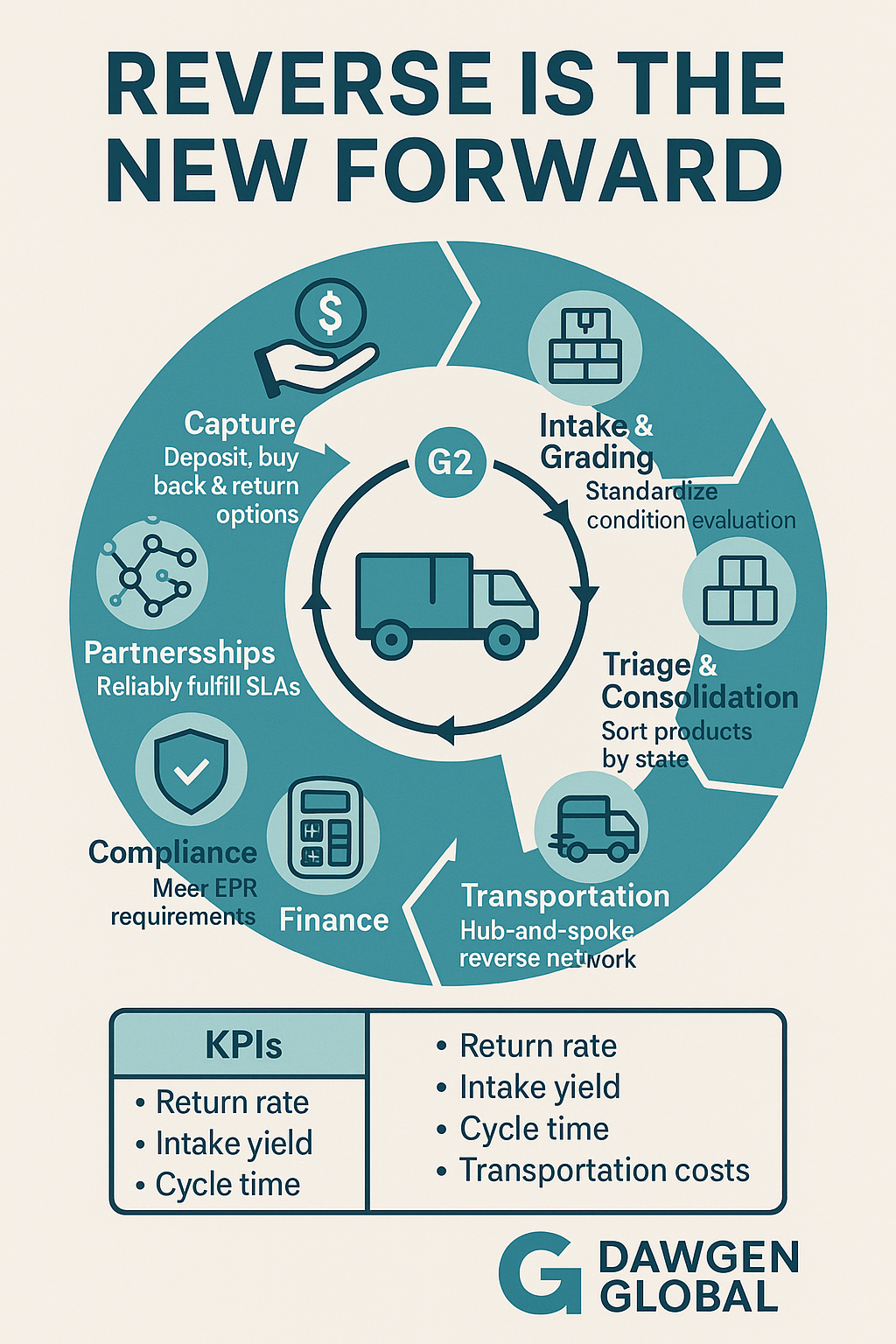
Circular economy strategies succeed or fail on the strength of their logistics. If customers can’t return products easily, if intake damages items, or if networks can’t handle variable volumes, then refurbishment, remanufacture, and high‑value recycling will never achieve reliable unit economics. Reverse logistics is not an afterthought to forward supply chains; it is an operating system for value recovery. This article presents Dawgen Global’s operating approach to designing and running reverse logistics as a competitive advantage—spanning capture, intake, triage, consolidation, transport, compliance, data, and partner orchestration. We also detail metrics, risks, and a 100‑day rollout plan to move from pilot to dependable performance.
Thesis: Make returns frictionless, make intake predictable, and make flows visible—then circular unit economics follow.
Why Reverse Logistics Is Different (and Harder)
- Uncertain supply. Return volumes and conditions fluctuate with seasonality, promotions, and failure modes.
- Heterogeneous condition. Items arrive across A/B/C grades and scrap; packaging varies; accessories may be missing.
- Distributed origins. Returns come from households, field service, stores, business customers, and third‑party sites.
- Time sensitivity. Every day in transit increases depreciation and inventory aged risk; parts harvesting windows close quickly.
- Regulatory overlay. Right‑to‑repair, e‑waste, WEEE, batteries, biohazards, and cross‑border rules complicate handling.
These challenges require a purpose‑built network and processes, not a bolted‑on returns desk.
The Dawgen Reverse Logistics Framework
We organize reverse logistics into eight building blocks. Each block includes objectives, design choices, artifacts, KPIs, and guardrails.
1) Capture & Customer Experience (Make Returns Frictionless)
Objective: Maximize return participation at lowest friction and cost.
Design Choices
- Channel options: mail‑back with pre‑paid labels; pick‑up; retail drop‑off; lockers; field‑service collection.
- Incentives: deposits, instant credits, loyalty rewards, or buy‑back prices; dynamic incentives by product and region.
- Guided returns: digital wizards, QR codes, and in‑box guides to choose options and declare condition; photo capture for pre‑grading.
- Packaging kits: reusable totes, right‑sized cartons, and damage‑resistant fixtures; return packing instructions printed inside.
Artifacts: CX scripts, return portal, packaging bill of materials, and incentive tables.
KPIs: return capture rate; average time‑to‑return; packaging compliance; incentive redemption rate; cost per captured unit.
Guardrails: cap incentives to unit economics; fraud controls via serial verification and geo‑fencing.
2) Intake & Grading (Protect Value at First Touch)
Objective: Standardize intake to avoid damage, accelerate triage, and separate hazardous items.
Design Choices
- Intake cells: visual SOPs; EHS controls; barcode/QR/RFID scan at arrival; photo booth for condition logging.
- Grading standards: A/B/C/scrap with objective checks; accessories checklist; cosmetic thresholds; function smoke tests.
- Hazard handling: battery isolation; spill kits; quarantine zones; auto‑discharge jigs.
- Dock‑to‑stock timing: targets for receipt → grade → put‑away into triage bins.
Artifacts: SOPs; grading decision trees; tool and jig lists; EHS checklist.
KPIs: intake cycle time; grading FPY; transit damage rate; quarantine rate; EHS incidents.
Guardrails: mandatory evidence capture; line‑stop authority; no re‑boxing without photos and grade tag.
3) Triage & Consolidation (Sort for the Highest Value Path)
Objective: Route each unit to its best value path quickly: refurbish, remanufacture, parts harvest, resale as is, or recycle.
Design Choices
- Triage decision engine: rules based on SKU, grade, accessories, age, warranty, geography, and current price bands.
- Micro‑triage cells: small cells near return origins to pre‑sort and harvest high‑value parts.
- Consolidation hubs: regional nodes for volume processing with modular refurb cells.
- Kitting & spares: harvest parts kits for field service and refurbishment lines.
Artifacts: routing rules; kitting lists; hub layout; work instructions.
KPIs: sorting accuracy; time‑to‑triage; parts harvest yield; mis‑route rate; refurb queue time.
Guardrails: periodic rules calibration; dual review for scrap decisions; quarantines for uncertain grades.
4) Transportation & Network Topology (Move Returns Reliably)
Objective: Build a network that balances cost, speed, carbon, and reliability.
Design Choices
- Hub‑and‑spoke with regional intake nodes and central refurb/reman hubs.
- Lane design for pickup/drop‑off, store returns, and B2B collections; consolidation thresholds for milk runs.
- Carbon‑aware routing and mode choices; reuse of forward routes.
- Reusable packaging flows with reverse tote pooling.
Artifacts: network map; lane playbooks; carrier SLAs; pool management.
KPIs: on‑time pickup/delivery; cost per returned unit‑km; damage in transit; carbon per unit‑km; lane fill rate.
Guardrails: dual‑sourced critical lanes; surge playbooks; weather and port disruption contingency.
5) Compliance & Risk (Operate Safely and Legally)
Objective: Ensure every movement meets EPR, waste, safety, and customs rules.
Design Choices
- Documentation pack: chain of custody, material passports, hazardous declarations, and permits.
- Country matrix: rules for batteries, e‑waste, medical, packaging; return‑to‑manufacturer allowances.
- Security & IP: data wipe procedures; tamper‑evident seals; theft prevention for high‑value returns.
Artifacts: compliance calendar; audit templates; customs cheat sheet.
KPIs: audit pass rate; incident rate; time‑to‑clear customs; data‑wipe success.
Guardrails: stop‑ship triggers; external assurance for claims; insurance coverage checks.
6) Data & Traceability (Know What’s Where, When, and Why)
Objective: Maintain visibility from capture to disposition.
Design Choices
- Material passports tied to serials/modules; QR/RFID scans at each touch.
- Event streams from capture → intake → grade → route → refurb/reman/harvest/recycle → resale.
- Dashboards for operational teams and executives; andon alerts for SLA breaches.
- Partner APIs and validation rules at source to reduce errors and latency.
Artifacts: data dictionary; API contracts; dashboard templates; reconciliation scripts.
KPIs: scan compliance; data completeness/accuracy; time‑to‑trace; partner latency.
Guardrails: least‑privilege access; immutable logs; third‑party verification for impact claims.
7) Partnerships & Commercials (Build a Winning Ecosystem)
Objective: Align incentives across repairers, carriers, recyclers, marketplaces, and retailers.
Design Choices
- SLAs & gain‑share linked to yield, turnaround, damage, and sell‑through.
- By‑product markets for scrap and components with quality bands and take‑or‑pay terms.
- Channel policy for refurbished sales; guardrails against gray‑market leakage.
Artifacts: MOU/SLAs; pricing annexes; partner scorecards.
KPIs: partner on‑time; yield vs. SLA; sell‑through; claims rate; net recovery per unit.
Guardrails: periodic audits; termination clauses; approved secondary market list.
8) Finance & Planning (Make the Numbers Work)
Objective: Plan capacity and capital with returns volatility in mind.
Design Choices
- Volume forecasting using warranties, sales cohorts, seasonality, and promotions.
- Stage‑gated capex for hubs and cells; lease early, buy at utilization thresholds.
- Working capital design for deposits/credits; inventory financing for refurbished stock.
Artifacts: forecast model; capex policy; CCC playbook.
KPIs: forecast accuracy; capex intensity; CCC; inventory age; write‑down rate.
Guardrails: P10/P50/P90 scenarios; buffer stocks for high‑value parts; credit risk controls.
The Reverse Logistics KPI Tree
Outcome KPIs
- Net recovery value per unit; contribution margin
- Virgin‑material displacement per unit
- NPS/CSAT for the return experience
Process KPIs
- Capture rate; average time‑to‑return
- Intake cycle time; grading FPY
- Transit damage rate; on‑time pickup/delivery
- Parts harvest yield; routing accuracy
Leading Indicators
- Incentive redemption; return portal completion rates
- Scan compliance; data latency
- Partner SLA early warnings
Case Vignette: Turning Returns into Reliability
A regional appliances brand struggled with low capture and high transit damage. Dawgen redesigned the reverse network:
- Introduced deposit‑back incentives and locker drop‑off; capture rose from 31% to 57% in 12 weeks.
- Deployed reusable totes and foam fixtures; transit damage fell 46%.
- Stood up micro‑triage at two stores; parts harvest yield increased 22%.
- Implemented QR‑based passports and event streams; time‑to‑trace dropped from days to <15 minutes.
Unit economics crossed the hurdle, enabling G2 scale and entry to ScaleGrid™ build‑out.
Common Pitfalls & How to Avoid Them
- One‑size‑fits‑all returns.
Fix: offer multiple return channels and price incentives by segment/SKU. - Late grading.
Fix: add micro‑triage at origin; photo capture and quick tests at intake. - Inconsistent packaging.
Fix: provide kits; train stores; include return guides in boxes; reusable totes. - Data gaps at partners.
Fix: API contracts; scan requirements; validation at source; reconcile daily. - Cannibalization fears.
Fix: separate refurbished channels; pricing floors; quota credits for attach/retention. - Compliance drift.
Fix: site checklists; quarterly audits; mandatory chain‑of‑custody evidence.
100‑Day Rollout Plan
Days 1–20: Design & Mobilize
- Map current return flows; identify leakage and damage points.
- Choose channels and incentives; draft SOPs for intake and grading.
- Select hubs and micro‑triage sites; align carrier SLAs.
Days 21–50: Pilot & Instrument
- Launch 2–3 return channels; deploy packaging kits and QR passports.
- Run micro‑triage; collect yield and damage data; tune routing rules.
- Stand up dashboards and andon alerts.
Days 51–80: Optimize & Expand
- Adjust incentives; refine lanes; roll out to more stores/geographies.
- Negotiate by‑product outlets; finalize partner SLAs and gain‑share.
- Lock network blueprint for ScaleGrid™.
Days 81–100: Decide & Fund
- Present economics, reliability, and NPS; enter Gate G2 for scale.
- Approve stage‑gated capex and working capital plans.
FAQs for Executives
Q1: What’s the best first channel?
Start where friction is lowest for your customers—often retail drop‑off or scheduled pick‑up for bulky items; test two channels in parallel.
Q2: How do we control costs with incentives?
Tie incentives to verified serial scans; cap by unit economics; use dynamic pricing to balance capture and margin.
Q3: Can we reuse forward carriers?
Yes—but define reverse SLAs separately and add damage‑prevention standards and proof‑of‑custody.
Q4: What data do we need on Day 1?
Serial IDs, grade, routing decision, timestamps, and chain‑of‑custody. Add deeper material passport fields as you scale.
Conclusion: Make Reverse the New Forward
Reverse logistics is where circular value becomes real. When returns are easy, intake is disciplined, flows are visible, and partners are aligned, every loop—repair, reuse, refurbishment, remanufacture, recycling—gains speed and yield. With Dawgen Global’s framework, reverse becomes a profit engine that stabilizes margins, reduces risk, and strengthens brand trust.
Build a Reverse Network That Wins
Ready to turn returns into reliable economics? Let’s design and launch your reverse logistics network.
Request a proposal today:
Email: [email protected]
WhatsApp: +1 555 795 9071
Dawgen Global | LoopWorks™ — Smarter and More Effective Decisions, by design.
About Dawgen Global
“Embrace BIG FIRM capabilities without the big firm price at Dawgen Global, your committed partner in carving a pathway to continual progress in the vibrant Caribbean region. Our integrated, multidisciplinary approach is finely tuned to address the unique intricacies and lucrative prospects that the region has to offer. Offering a rich array of services, including audit, accounting, tax, IT, HR, risk management, and more, we facilitate smarter and more effective decisions that set the stage for unprecedented triumphs. Let’s collaborate and craft a future where every decision is a steppingstone to greater success. Reach out to explore a partnership that promises not just growth but a future beaming with opportunities and achievements.
✉️ Email: [email protected] 🌐 Visit: Dawgen Global Website
📞 📱 WhatsApp Global Number : +1 555-795-9071
📞 Caribbean Office: +1876-6655926 / 876-9293670/876-9265210 📲 WhatsApp Global: +1 5557959071
📞 USA Office: 855-354-2447
Join hands with Dawgen Global. Together, let’s venture into a future brimming with opportunities and achievements


