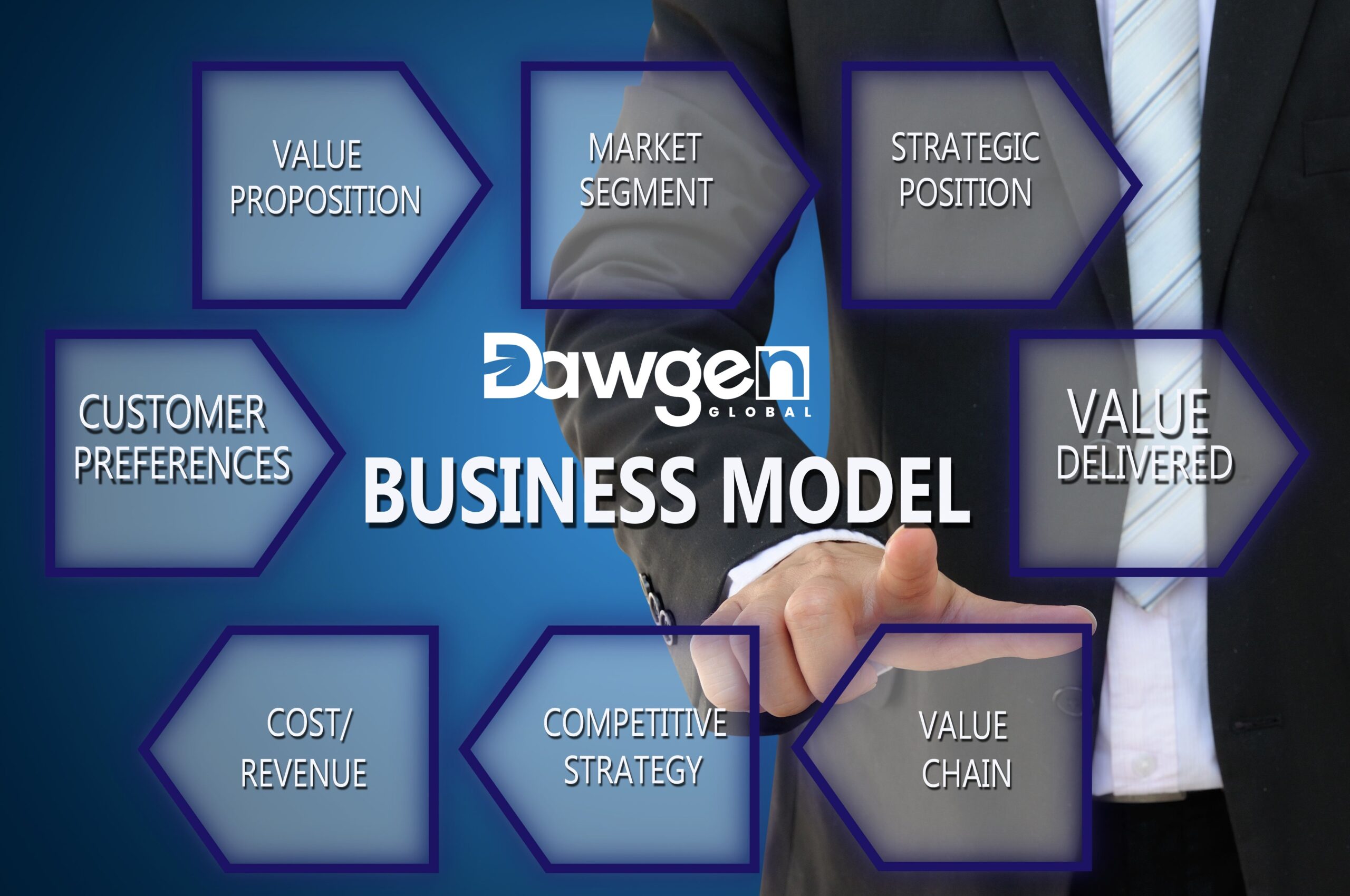
Business model innovation is no longer a discretionary exercise. In fast-moving markets, it is a requirement for relevance, resilience, and growth. Yet, while many organizations now speak confidently about “new models”—subscriptions, platforms, ecosystems, usage-based pricing, open innovation—the practical challenge remains unchanged:
How do we select the right business model pattern without exposing the enterprise to avoidable risk?
The problem is not a shortage of ideas. It is the tendency to make high-impact business model choices with insufficient discipline—driven by competitor imitation, consultant hype, or internal enthusiasm. Too often, organizations select a pattern because it sounds modern rather than because it fits:
-
their customers’ buying logic,
-
their operational and technological capability,
-
their financial and cash flow constraints, and
-
their governance and risk posture.
This is precisely why the Pattern Fit Evaluation exists within the Dawgen Enterprise Value Design Framework (DEVD). It is the formal mechanism that converts business model patterns from “interesting possibilities” into governable strategic options—and prevents the organization from scaling a model that is structurally misaligned.
In this article, we define the Pattern Fit Evaluation, explain why it matters, provide a board-ready method for applying it, and show how it enables innovation with discipline rather than exposure.
1) Why Pattern Selection Is a Board-Level Decision
Business model patterns are not small tactical choices. They determine the structure of value creation and value capture. Selecting the wrong pattern can produce consequences that are difficult to reverse:
-
Revenue volatility that destabilizes planning and liquidity.
-
Margin leakage due to mispriced cost-to-serve.
-
Capability gaps that delay execution and inflate overhead.
-
Partner dependencies that create reputational or operational exposure.
-
Governance failures when controls are not designed into the model.
Put simply: a business model pattern is a capital allocation decision, a risk decision, and a strategic positioning decision—all at once.
This is why boards and executive committees must insist on a structured selection method. Pattern Fit Evaluation provides that method.
2) What Is Pattern Fit Evaluation?
Pattern Fit Evaluation is DEVD’s structured process for assessing which business model patterns—or combination of patterns—best align with:
-
The organization’s enterprise value thesis,
-
The realities of customer behavior and willingness to pay,
-
The feasibility of operational delivery at scale, and
-
The integrity of the economics and risk controls.
It does not ask, “Is this pattern interesting?”
It asks, “Is this pattern fit-for-purpose in our context, and can we evidence viability before scaling?”
The output is a Pattern Fit Scorecard: a disciplined, comparative view of candidate patterns with explicit assumptions, risks, and requirements.
3) Why Organizations Choose the Wrong Patterns
Before outlining the method, it is important to address why pattern selection so often fails.
A) “Copy-the-leader” thinking
Organizations imitate the model of a global leader without recognizing that the leader’s success depends on conditions they may not share: scale, brand power, platform economics, low marginal cost distribution, or deep data capability.
B) Confusing product innovation with model innovation
Adding a digital feature or launching a new product does not automatically justify shifting to a new revenue model. A subscription model, for example, requires ongoing value delivery and retention dynamics that many organizations are not designed to manage.
C) Underestimating operating model implications
Patterns are not pricing options—they are operating systems. A Long Tail model requires discovery and catalogue management capability. An Orchestrator model requires trust and dispute resolution mechanisms. Pay-Per-Use requires metering and billing integrity.
D) Ignoring the risk profile
Some patterns introduce significant governance exposure: revenue volatility, cyber risk, partner concentration, data risk, or reputational risk from ecosystem failures.
E) Scaling before evidence
Many organizations move too quickly from concept to full rollout without validating assumptions about adoption, retention, pricing tolerance, and cost-to-serve.
Pattern Fit Evaluation is designed to prevent these failure modes.
4) The DEVD Pattern Fit Scorecard: A Board-Ready Selection Tool
At Dawgen Global, we recommend evaluating patterns through a structured scorecard using six domains. This method allows management teams to compare patterns on a consistent basis and gives boards visibility into the real trade-offs.
Domain 1: Strategic Alignment (Enterprise Value Thesis)
Key question: Does this pattern directly support our enterprise value objective?
Examples of value objectives:
-
Stabilize cash flow through recurring revenue.
-
Defend margins under competitive price pressure.
-
Expand into underserved niches without inflating overhead.
-
Increase utilization of existing assets and capabilities.
-
Build ecosystem control and defensibility.
Board attention: Patterns must be chosen because they deliver on a value thesis—not because they are fashionable.
Domain 2: Customer Fit (Demand and Willingness to Pay)
Key question: Does this pattern match how customers buy, use, and perceive value?
This includes:
-
Who is the payer versus beneficiary?
-
What triggers adoption?
-
How price-sensitive is the segment?
-
What is the customer tolerance for pricing complexity?
-
What are retention and switching dynamics?
Board attention: Many pattern failures occur because the customer does not behave as assumed.
Domain 3: Capability Fit (Delivery Feasibility at Scale)
Key question: Can we operate this pattern reliably, at scale, with our current or realistically buildable capabilities?
This covers:
-
Technology and data maturity.
-
Process scalability and standardization.
-
Talent and leadership capability.
-
Partner readiness and governance mechanisms.
Board attention: A pattern can be strategically attractive and customer-aligned, yet operationally unrealistic.
Domain 4: Economics Fit (Unit Economics and Cash Conversion)
Key question: Does the pattern produce robust economics under realistic stress conditions?
This requires:
-
Unit economics modeling (contribution margins by segment/channel).
-
Sensitivity analysis (churn, utilization, discounting, partner fees).
-
Revenue timing and cash conversion assessment.
-
Cost-to-serve behavior under complexity.
Board attention: Strong revenue growth can coexist with poor profitability and cash strain. Economics must be engineered, not assumed.
Domain 5: Risk and Control Fit (Governance Readiness)
Key question: Can this pattern be governed—controls, compliance, assurance, and cyber—without slowing execution to a halt?
Key risk categories:
-
Cybersecurity and data privacy.
-
Third-party and partner risk.
-
Financial reporting integrity and auditability.
-
Regulatory exposure and compliance obligations.
-
Reputational risk due to customer experience or ecosystem failures.
Board attention: Patterns that increase dependency or volatility require stronger controls and more mature governance.
Domain 6: Complexity and Time-to-Impact (Practicality)
Key question: How complex is the transition, and how quickly can value be realized?
This includes:
-
Change management and organizational readiness.
-
Implementation sequencing.
-
Pilot feasibility.
-
Investment intensity and payback profile.
Board attention: Patterns that are “right” in theory can fail in practice if the transition pathway is unrealistic.
5) Red-Flag Criteria: When Boards Should Pause Pattern Adoption
A strong Pattern Fit Evaluation always includes explicit “red flags”—conditions that trigger a pause or require mitigation before proceeding.
Typical red flags include:
-
The pattern depends on scale economics the organization cannot realistically achieve.
-
The model introduces revenue volatility that the balance sheet cannot absorb.
-
The organization lacks data integrity for pricing, metering, or segmentation decisions.
-
Partner reliance is high, but partner governance is weak or undeveloped.
-
Cost-to-serve is poorly understood, and pricing cannot be anchored to economics.
-
The model cannot be made auditable or compliant at scale.
Red flags do not automatically eliminate a pattern. They simply force disciplined mitigation and evidence plans.
6) Pattern Fit in Action: How the Same Pattern Looks Different by Context
Pattern Fit Evaluation is essential because the same pattern can be high-fit in one context and low-fit in another.
Example 1: Pay-Per-Use
High fit when:
-
Usage is measurable and can be metered reliably.
-
Customers resist fixed commitments and prefer variable spend.
-
The provider has strong data systems and billing integrity.
-
Revenue volatility can be managed through tiering or minimum commitments.
Low fit when:
-
Usage cannot be measured with confidence.
-
Billing disputes are likely or customer trust is low.
-
The provider’s cost base is largely fixed, creating margin risk under low utilization.
Example 2: Orchestrator
High fit when:
-
The organization can build trust and verification mechanisms.
-
Network effects are realistically achievable.
-
The organization can govern partner quality and customer experience.
-
Monetization is defensible (take rate, subscription, value-added services).
Low fit when:
-
Market liquidity is unlikely (thin supply/demand).
-
The organization cannot enforce standards across the ecosystem.
-
It becomes a low-margin intermediary with high reputational exposure.
Example 3: No Frills
High fit when:
-
Customers genuinely value “good enough” and price dominates.
-
Operations can be redesigned for structural cost advantage.
-
The brand can sustain a simplified proposition without confusion.
Low fit when:
-
The organization attempts “discounting” without operational redesign.
-
Customer expectations remain premium, creating dissatisfaction and churn.
This is the essence of Pattern Fit Evaluation: patterns are not universally good or bad—they are context-dependent.
7) Selecting One Pattern vs. A Pattern Portfolio
Many organizations discover an important truth during Pattern Fit Evaluation:
They do not need one pattern. They need a governed portfolio of patterns.
For example:
-
A core model may be No Frills for price-sensitive segments, while premium segments use Mass Customization.
-
The organization may adopt Make More of It to fund investment in an Orchestrator platform.
-
A Long Tail strategy may pair naturally with an Open Business Model to broaden supply and offerings.
DEVD does not assume a single-pattern future. Instead, it evaluates how patterns interact and ensures governance mechanisms are designed to prevent complexity from eroding margins.
8) The Link to EVLA: Pattern Fit Depends on Assumptions
Pattern Fit Evaluation is not performed in isolation. It depends directly on the Enterprise Value Logic Assessment (EVLA).
EVLA identifies what must be true. Pattern Fit Evaluation asks which patterns are most realistic given:
-
the assumptions,
-
the risk hotspots,
-
and the capabilities.
This prevents the common error of choosing a pattern first and then trying to justify it afterward.
9) The Practical Output: What Management and Boards Receive
A complete Pattern Fit Evaluation produces deliverables that boards can review and challenge.
Core outputs
-
Pattern Fit Scorecard (comparative scoring and rationale)
-
Assumptions Impact Map (which assumptions each pattern intensifies)
-
Economics Sensitivity Summary (stress-test highlights)
-
Risk and Controls Requirements (what must be built)
-
Pilot Recommendation (what to test first, where, and how)
-
Scale-Readiness Gate Criteria (evidence thresholds)
This makes the pattern decision transparent, auditable, and governable.
10) Conclusion: Innovation Must Be Fit—Not Just Fast
In business model innovation, the greatest risk is not choosing an imperfect pattern. It is choosing a pattern that does not fit—and scaling it before evidence confirms viability.
The Pattern Fit Evaluation within the Dawgen Enterprise Value Design Framework (DEVD) enables organizations to innovate responsibly. It ensures that pattern selection is anchored in:
-
strategic intent,
-
customer truth,
-
operational feasibility,
-
economic integrity, and
-
governance readiness.
In doing so, it protects enterprise value while enabling reinvention.
Next Step!
If your organization is considering subscriptions, usage-based pricing, platform strategies, open models, or any material business model change, a disciplined Pattern Fit Evaluation can reduce risk and accelerate confident decision-making.
To explore how Dawgen Global can apply the Pattern Fit Evaluation—as part of the Dawgen Enterprise Value Design Framework (DEVD)—to your organization, email us at [email protected].
About Dawgen Global
“Embrace BIG FIRM capabilities without the big firm price at Dawgen Global, your committed partner in carving a pathway to continual progress in the vibrant Caribbean region. Our integrated, multidisciplinary approach is finely tuned to address the unique intricacies and lucrative prospects that the region has to offer. Offering a rich array of services, including audit, accounting, tax, IT, HR, risk management, and more, we facilitate smarter and more effective decisions that set the stage for unprecedented triumphs. Let’s collaborate and craft a future where every decision is a steppingstone to greater success. Reach out to explore a partnership that promises not just growth but a future beaming with opportunities and achievements.
 Email: [email protected]
  Visit: Dawgen Global Website

 WhatsApp Global Number : +1 555-795-9071
Caribbean Office: +1876-6655926 / 876-9293670/876-9265210  WhatsApp Global: +1 5557959071
USA Office: 855-354-2447
Join hands with Dawgen Global. Together, let’s venture into a future brimming with opportunities and achievements


