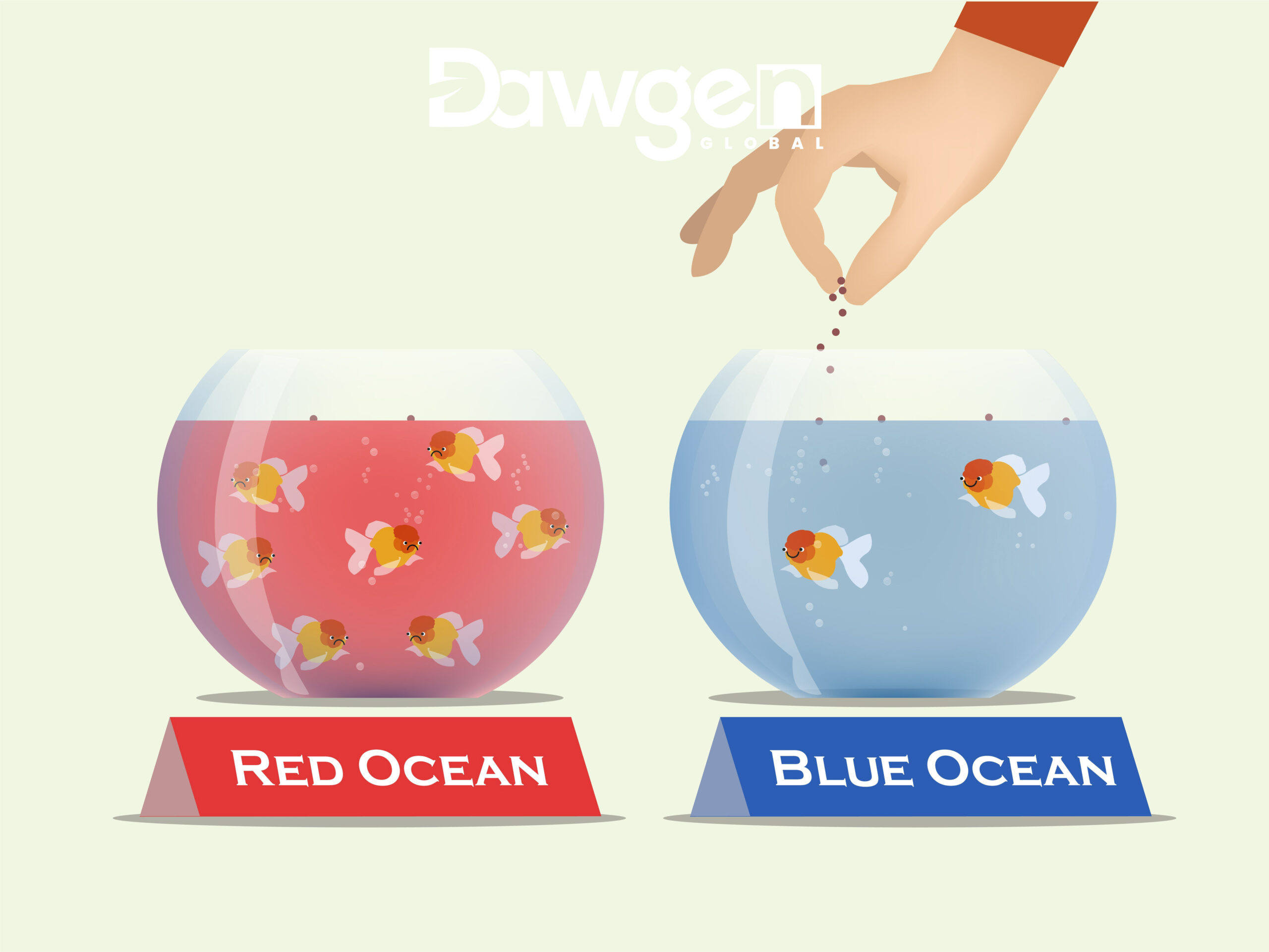
Dawgen Global’s dual-ocean framework for competing effectively in Red Oceans and creating new demand in Blue Oceans
Introduction: why “one strategy” no longer works
Most leadership teams recognise the language of Red Oceans and Blue Oceans. What is far less common is the organisational discipline to operate both logics at the same time—deliberately, repeatably, and with the right governance. That gap is costly.
When an organisation applies a Red Ocean mindset to a Blue Ocean opportunity, it typically over-emphasises near-term margin, demands certainty too early, and under-invests in discovery. The result is predictable: promising ideas are killed before they mature.
When an organisation applies a Blue Ocean mindset to a Red Ocean reality, it often pursues novelty while the core business leaks margin, discounts too freely, and loses share through inconsistent execution. The result is also predictable: the firm “innovates” while its fundamentals weaken.
Dawgen Global developed OceanSwitch™ to solve this practical problem. OceanSwitch™ is not a motivational concept. It is a strategic operating framework: a clear way to diagnose where you are playing, select the right posture, deploy the right playbook, and govern performance with metrics that reinforce the strategy rather than sabotage it.
This first article introduces the OceanSwitch™ framework and explains how leaders can use it to drive clarity, prioritisation, and performance—whether they operate in professional services, financial services, consumer markets, or diversified groups where different business lines face different competitive conditions.
The core principle: strategy must match the ocean you are in
Strategy is often presented as a single unified plan. In practice, organisations run portfolios—even if they sell one brand. You might have:
-
one segment that is commoditised and price-pressured,
-
another segment that pays for reliability and trust,
-
and a third where customers are not even sure what “good” looks like yet.
These are different oceans. They require different strategies.
Red Ocean reality
A Red Ocean is a market where:
-
competitors are clearly defined and compare well on familiar dimensions,
-
customers can easily price-shop or feature-compare,
-
rivalry compresses margins,
-
growth is frequently share-driven rather than category-expanding.
In this context, winning is a function of economics, differentiation discipline, execution quality, and distribution strength.
Blue Ocean reality
A Blue Ocean is a market space where:
-
customer needs are not well served by the existing category,
-
demand can be created rather than fought over,
-
the basis of competition can be changed by redefining value,
-
rivalry is reduced because the offering does not map neatly onto incumbents.
In this context, winning is a function of insight, adoption design, business model innovation, and scaling capability.
The first leadership task, therefore, is not “be innovative” or “be efficient.” It is: be correct about context—and then operate accordingly.
Introducing OceanSwitch™: Dawgen Global’s dual-ocean framework
OceanSwitch™ is built around a simple sequence:
-
Diagnose the ocean you are in (by business line, segment, geography, channel, or customer type)
-
Choose the correct strategic posture (defend/attack/consolidate vs explore/design/scale)
-
Deploy the correct playbook (EDGECRAFT™ for Red Oceans, HORIZONFORGE™ for Blue Oceans)
-
Govern with the right scorecards, investment rules, and cadences
This sequence does two important things:
-
It converts a strategy conversation from “opinions” to structured choices.
-
It prevents the most common failure mode: using the wrong metrics for the wrong work.
Step 1 — Diagnose: which ocean are we in?
Misdiagnosis is the hidden cause of strategic underperformance. Leaders often label a market “Red” simply because margins are low, when the real problem is poor pricing discipline or undifferentiated delivery. Conversely, leaders label a market “Blue” simply because it involves technology or a new service line, when customers are already comparing providers on the same familiar dimensions.
OceanSwitch™ uses five signals to diagnose the ocean.
The five Ocean Signals
1) Market structure
-
Red signal: many similar providers with comparable offers
-
Blue signal: undefined space; few direct analogues; value not standardised
2) Customer buying basis
-
Red signal: decisions are made on price, turnaround time, and familiar features
-
Blue signal: customers struggle to articulate needs; they “patch together” substitutes
3) Growth pattern
-
Red signal: category growth is modest; share capture is the main path to growth
-
Blue signal: latent demand exists; growth can come from new buyers and new use cases
4) Differentiation durability
-
Red signal: differentiation is quickly copied; features converge
-
Blue signal: value curve is distinct; the offering changes what matters
5) Profit pattern
-
Red signal: margin pressure from rivalry; discounting is common
-
Blue signal: ability to command premium economics once adoption barriers are overcome
The Ocean Label: Red, Blue, or Hybrid
OceanSwitch™ does not force a binary choice. In many organisations, the honest answer is Hybrid:
-
the core is a Red Ocean engine that must be defended and optimised,
-
while targeted bets explore Blue Ocean opportunities for future growth.
Hybrid is not indecision. Done well, Hybrid is a sophisticated portfolio strategy.
Step 2 — Choose the right strategic posture
Once the ocean is labelled, leadership selects a posture. This matters because posture defines priorities, trade-offs, and the meaning of “progress.”
Red Ocean postures
Defend: protect margin and retention, reduce vulnerability, improve efficiency
Attack: take share through sharper positioning, superior execution, and channel strength
Consolidate: prune low-return work, simplify offerings, refocus on profit pools
Blue Ocean postures
Explore: discover noncustomers and validate unmet needs
Design: define the new value curve and business model; prove adoption
Scale: standardise delivery, expand distribution, and industrialise economics
A common organisational error is trying to “scale” before “explore” is complete. OceanSwitch™ prevents this by tying postures to specific proof points.
Step 3 — Deploy the playbooks: EDGECRAFT™ and HORIZONFORGE™
OceanSwitch™ is actionable because it is paired with two branded playbooks.
EDGECRAFT™: winning in Red Oceans
EDGECRAFT™ is Dawgen Global’s Red Ocean playbook—designed for crowded markets where advantage comes from measurable edge rather than novelty.
At its core, EDGECRAFT™ answers four questions:
-
Where is our profit actually made (and lost)?
-
What will we be famous for in this market?
-
Which customers are we choosing not to compete for?
-
How do we execute faster and more reliably than rivals?
EDGECRAFT™ focuses on disciplined differentiation, economics, pricing control, channel strength, and trust-building—because in Red Oceans, these are the levers that endure.
HORIZONFORGE™: creating Blue Oceans
HORIZONFORGE™ is Dawgen Global’s Blue Ocean playbook—designed to create new demand and reduce direct rivalry by redefining value.
At its core, HORIZONFORGE™ answers four different questions:
-
Who are the noncustomers—and why do they opt out?
-
What factors should be eliminated, reduced, raised, or created to reset value?
-
What business model makes adoption easy and scaling credible?
-
How do we build a category narrative that attracts demand and partners?
HORIZONFORGE™ is as much about adoption and scalability as it is about creativity. Many Blue Ocean initiatives fail not because the idea is weak, but because switching costs and perceived risk were not engineered out of the customer journey.
Step 4 — Govern: two scorecards, two investment logics, two cadences
If OceanSwitch™ has a “secret,” it is governance. Strategy does not fail in boardrooms; it fails in operating rhythms. Most organisations use one performance system for everything, then wonder why initiatives stall.
OceanSwitch™ separates Red and Blue work by design.
Two scorecards
Red Ocean Scorecard (performance optimisation):
-
margin (gross and contribution)
-
retention and churn
-
market share or share proxies
-
cost-to-serve by segment
-
pricing leakage and discount rate
-
cycle time (quote-to-cash, delivery lead time)
-
cash conversion / working capital efficiency
-
quality metrics and rework
Blue Ocean Scorecard (learning-to-scale):
-
validated problem-solution fit signals
-
adoption rate and activation
-
conversion from pilot to paid
-
cohort retention and usage
-
unit economics trajectory (as it matures)
-
partner leverage (distribution without linear headcount)
-
time-to-iterate (speed of learning cycle)
Blue Ocean work is not immune to financial discipline. It is simply governed through the correct sequence: prove demand, prove adoption, prove unit economics, then scale.
Two investment logics
Red Ocean investment: fund ROI-positive improvements, operational excellence, pricing discipline, and retention engines.
Blue Ocean investment: fund milestone-based learning—release funding in tranches when proof points are met.
Two cadences
Red Ocean cadence: monthly performance cadence focused on execution and economics.
Blue Ocean cadence: shorter iteration cadence (often bi-weekly) focused on testing assumptions and reducing adoption friction.
This is how organisations prevent metric contamination:
-
Blue initiatives are not strangled by short-term margin demands,
-
Red operations are not excused from performance because “we are innovating.”
The Hybrid portfolio: defending the core while building the future
Many organisations in the Caribbean region operate in markets where:
-
price sensitivity is real,
-
competitive offerings are similar,
-
and trust, quality, and responsiveness are decisive factors.
At the same time, many of those same organisations are being pushed by customers toward new needs:
-
digitalisation and automation,
-
faster decision cycles,
-
compliance complexity,
-
cybersecurity and privacy risks,
-
talent constraints and outsourcing models.
This is a classic Hybrid environment. OceanSwitch™ enables leaders to:
-
keep the Red Ocean engine healthy, profitable, and disciplined,
-
while making targeted Blue Ocean bets with governance that increases the odds of success.
Importantly, Hybrid is not a vague commitment to “do both.” It is a commitment to separate the operating systems while aligning them to a single strategic narrative.
Common failure modes OceanSwitch™ is designed to prevent
To appreciate the value of a dual-ocean framework, it helps to name the patterns that repeatedly undermine strategy:
1) Treating innovation as a marketing campaign
Organisations announce innovation, but do not change the adoption path, business model, or delivery system. Customers remain unconvinced, and uptake is weak.
OceanSwitch™ addresses this with HORIZONFORGE™—especially NoncustomerMining™ and FrictionlessAdoption™ disciplines.
2) Competing everywhere, winning nowhere
In Red Oceans, many firms remain broad and undisciplined: they accept low-margin work, discount to win volume, and exhaust delivery teams. Over time, differentiation disappears.
OceanSwitch™ addresses this with EDGECRAFT™—especially PrecisionSegmentation™ and PricingCommand™ disciplines.
3) Measuring the wrong thing at the wrong time
Blue Ocean initiatives are judged as if they are mature businesses. Red Ocean businesses are evaluated with vague innovation rhetoric.
OceanSwitch™ addresses this through the two-scorecard governance model.
4) Scaling before proof
Leaders fall in love with an idea and attempt scale without proving adoption. The result is heavy spend, low traction, and internal cynicism.
OceanSwitch™ enforces posture sequencing: Explore → Design → Scale.
A practical way to use OceanSwitch™ in your next strategy cycle
OceanSwitch™ is intended to be operational—not theoretical. A straightforward deployment approach looks like this:
Phase 1: Portfolio ocean mapping (2–4 weeks)
-
map business lines/segments and apply the five Ocean Signals
-
label each as Red, Blue, or Hybrid
-
select strategic posture for each
Phase 2: Playbook activation (4–8 weeks)
-
deploy EDGECRAFT™ moves for Red Ocean areas (pricing, cost-to-serve, differentiation wedge, channel motions)
-
deploy HORIZONFORGE™ moves for Blue Ocean opportunities (noncustomer discovery, value curve reset, pilot design)
Phase 3: Governance hardwiring (ongoing)
-
implement two scorecards
-
set milestone-based funding for Blue initiatives
-
run Red and Blue cadences in parallel with clear ownership
The output is not a “strategy document.” The output is a strategic operating system—one that improves decision quality and reduces wasted effort.
Strategy is context, and context is portfolio
OceanSwitch™ is built on a simple leadership truth: most organisations do not have one market. They have many. Even if they sell one brand, they serve multiple segments, needs, geographies, and channels—each with its own competitive realities.
Red Oceans demand EDGECRAFT™: disciplined economics, durable differentiation, pricing control, execution speed, and trust.
Blue Oceans demand HORIZONFORGE™: insight into noncustomers, value curve reset, frictionless adoption, and scalable business models.
When leaders can switch deliberately between these logics—without blending them into confusion—the organisation gains three advantages:
-
sharper prioritisation,
-
stronger performance in the core, and
-
a credible pathway to future growth.
In the next article in this series, we will go deeper into EDGECRAFT™: the seven Red Ocean moves Dawgen Global uses to help organisations protect margin, strengthen differentiation, and win share—without relying on discounting or unsustainable complexity.
About Dawgen Global
“Embrace BIG FIRM capabilities without the big firm price at Dawgen Global, your committed partner in carving a pathway to continual progress in the vibrant Caribbean region. Our integrated, multidisciplinary approach is finely tuned to address the unique intricacies and lucrative prospects that the region has to offer. Offering a rich array of services, including audit, accounting, tax, IT, HR, risk management, and more, we facilitate smarter and more effective decisions that set the stage for unprecedented triumphs. Let’s collaborate and craft a future where every decision is a steppingstone to greater success. Reach out to explore a partnership that promises not just growth but a future beaming with opportunities and achievements.
 Email: [email protected]
  Visit: Dawgen Global Website

 WhatsApp Global Number : +1 555-795-9071
Caribbean Office: +1876-6655926 / 876-9293670/876-9265210  WhatsApp Global: +1 5557959071
USA Office: 855-354-2447
Join hands with Dawgen Global. Together, let’s venture into a future brimming with opportunities and achievements


