Executive Summary
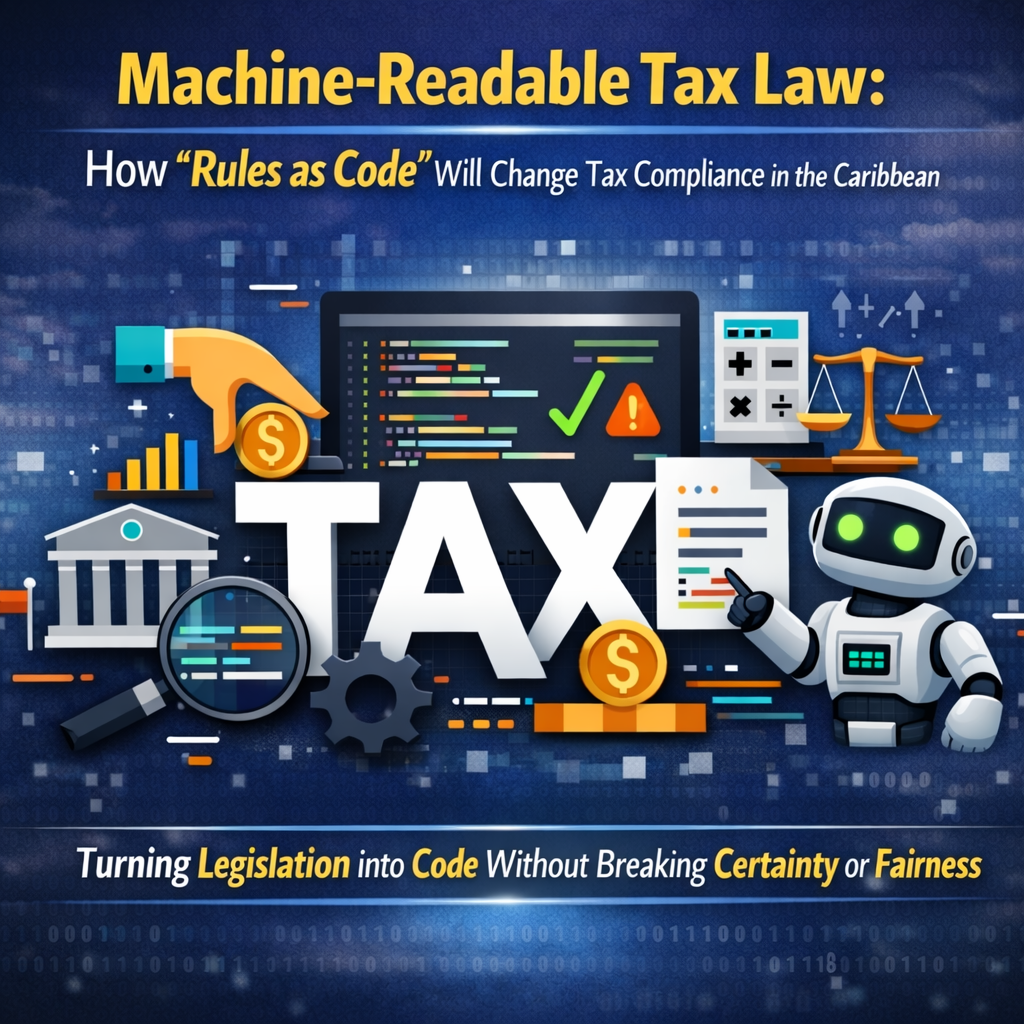
Tax systems are being pushed—by digitisation, APIs, and real-time reporting—toward a new operating model: compliance embedded in software. But there is a fundamental constraint: software cannot reliably apply tax rules unless those rules are expressed in a way that is consistent, testable, and unambiguous. This is the promise—and the controversy—of machine-readable tax law: translating parts of tax legislation, guidance, and administrative rules into structured logic that can be executed by systems.
Done well, machine-readable rules reduce errors, speed up compliance, improve taxpayer experience, and enable smarter enforcement. Done badly, they can undermine legal certainty, create “black box” administration, and shift decision-making away from the law into opaque system design. For Caribbean countries—where capacity constraints and legacy systems are real—this is not a future debate. It is arriving via e-services, VAT validation, e-invoicing, payroll integrations, and prefilled returns.
This article explains what machine-readable tax law is (and isn’t), how leading jurisdictions implement “rules as code,” the governance safeguards required to protect due process, and a practical pathway for Caribbean tax administrations and businesses to prepare.
1) What “machine-readable tax law” actually means
Machine-readable tax law refers to representing tax rules in structured formats that computers can interpret and apply consistently. It spans a spectrum:
A) Machine-readable guidance (lowest risk)
-
structured guidance documents
-
decision trees and eligibility checkers
-
tax calculators aligned to published rules
-
standardized definitions and taxonomies
B) Machine-executable rules (rules as code)
-
formal logic that can be executed by systems
-
validations and pre-checks (e.g., VAT return validations)
-
real-time checks in portals or APIs
-
automated determinations for clearly defined scenarios
C) Fully automated outcomes (highest governance requirements)
-
automated assessments
-
automated penalties or notices
-
automated refund eligibility screening
-
system-generated audit triggers
Critical distinction: machine-readable ≠ “the computer replaces the law.”
The law remains the authority. Rules-as-code is an implementation layer that must be transparent, traceable, and contestable.
2) Why tax needs machine-readable rules now
Tax is becoming system-driven. Consider what is already happening globally and increasingly in the Caribbean:
-
compliance is moving into payroll and accounting systems
-
data-driven audits rely on structured validation and matching
-
administrations are prefilling returns based on third-party data
-
APIs and integrations require standardized inputs and outputs
-
real-time reporting (or near real-time) requires deterministic validations
All of these require something traditional legislation is not designed for: computable clarity.
The pain today (for taxpayers and authorities)
-
ambiguous definitions interpreted differently across auditors and taxpayers
-
inconsistent application of exemptions, rates, and timing rules
-
high error rates caused by tax coding issues in ERP/accounting systems
-
refund delays due to manual verification processes
-
disputes driven by inconsistent administrative interpretation
Machine-readable rules are a way of reducing friction—if governance is sound.
3) What global implementation looks like: typical use cases
Most jurisdictions start in areas where rules are relatively standardized and benefits are immediate.
3.1 VAT validations and return controls
Examples of machine-readable VAT logic:
-
arithmetic and consistency checks
-
VAT registration validation for counterparties
-
duplicate invoice checks (where invoice reporting exists)
-
threshold tests for filing frequency and eligibility
-
risk-based flags for unusual input-output relationships
3.2 Payroll rules (PAYE and statutory deductions)
Payroll is naturally structured:
-
thresholds and tax bands
-
allowances and deductions (where rule-based)
-
employer/employee contribution rules
-
filing and payment deadlines
-
late payment interest calculations
3.3 Withholding taxes and reporting regimes
WHT often depends on:
-
payment type classification
-
residency status (subject to verification)
-
treaty rate eligibility (requires careful safeguards)
3.4 Incentives and exemptions eligibility
Eligibility checkers—when properly designed—can reduce:
-
misapplication of incentives
-
inconsistent interpretation
-
administrative delays in approvals
3.5 Taxpayer lifecycle automation
-
registration checks
-
deregistration triggers
-
compliance status certificates
-
reminders and nudges
Key pattern: start with decision support and validations, then expand cautiously.
4) The big risk: turning “law” into “system policy”
The main governance risk is simple:
If systems encode rules incorrectly—or encode policy choices not clearly supported by law—tax administration becomes a technology decision rather than a legal one.
This creates three dangerous outcomes:
4.1 Loss of legal certainty
Taxpayers rely on published law and guidance. If the system behaves differently than the law, compliance becomes unpredictable.
4.2 Black-box administration
If taxpayers cannot see the logic behind determinations, they cannot:
-
correct errors
-
comply properly
-
challenge decisions fairly
4.3 “Automation bias” inside the authority
Staff may treat system outcomes as correct, even when facts or legal interpretation require human judgment.
Therefore: machine-readable rules must be designed with transparency, traceability, and contestability as core principles.
5) The governance safeguards that make rules-as-code legitimate
A credible machine-readable program needs a governance stack that mirrors legal process.
5.1 Rule provenance: link every rule to legal authority
Every executable rule must be traceable to:
-
a statutory provision
-
a regulation
-
a published ruling/guidance
-
an administrative practice that is clearly documented
If no authority exists, it’s not a rule—it’s a policy choice that must be formalised first.
5.2 Version control and effective dates
Tax rules change. Systems must manage:
-
rule versions by effective date
-
transitional provisions
-
grandfathering
-
auditability of historical outcomes (“what rule was applied at the time?”)
5.3 Testing and scenario-based validation
Before any rule goes live:
-
test suites should cover standard and edge cases
-
industry and practitioner scenarios should be used
-
changes should include regression testing to avoid breaking prior logic
5.4 Human override and escalation
Not all tax issues can be automated. Systems must support:
-
exception handling
-
human review for discretionary or judgment-based cases
-
audit trails for overrides (who, why, and legal basis)
5.5 Explainability to taxpayers
Taxpayers must be able to see:
-
why a return was rejected
-
why an amount was calculated
-
what data triggered an issue
-
how to correct it
-
how to dispute it
5.6 Due process and appeal rights
Automation must not weaken rights. If the system issues decisions:
-
mechanisms for review must exist
-
timelines and evidence standards must be clear
-
taxpayers must have access to the decision rationale and input data
6) What should be automated—and what should not
A practical way to manage risk is to classify rules by suitability.
Suitable for automation (high confidence)
-
arithmetic and consistency checks
-
statutory deadlines and interest computations
-
threshold tests (registration thresholds, filing obligations)
-
standard tax rate application to clearly defined classifications (when classification is robust)
-
structured payroll computations
Needs caution (requires safeguards)
-
VAT input claim eligibility in complex exemption environments
-
residency determinations
-
transfer pricing and anti-avoidance determinations
-
“substance” tests
-
treaty entitlement and beneficial ownership tests
-
incentive eligibility with qualitative conditions
Not appropriate for full automation
-
discretionary relief
-
investigations requiring fact-finding
-
cases where law requires judgment or balancing tests
Caribbean implication: start with high-confidence areas (VAT validations, payroll calculations, deadlines), and keep judgment-heavy domains as decision-support, not decision-making.
7) Caribbean realities: why machine-readable rules matter even more
Caribbean administrations face real constraints:
-
limited specialist capacity
-
high dependency on manual processes
-
uneven taxpayer digitisation
-
informal economy pressures
-
legacy systems
Machine-readable rules can help, but only if adopted pragmatically:
7.1 Reduce inconsistent interpretation
Consistency is particularly valuable in smaller markets where:
-
a few large cases can distort enforcement focus
-
administrative inconsistency can undermine investor confidence
7.2 Improve VAT integrity and refund credibility
VAT disputes and refund delays create cash-flow strain. Structured rules and validations can:
-
improve quality at filing
-
reduce manual back-and-forth
-
speed legitimate refunds
-
isolate fraud risk more precisely
7.3 Support SME compliance
Many SMEs struggle with complex requirements. Embedded, rule-driven guidance can:
-
reduce errors
-
improve confidence in tax coding
-
lower cost-to-comply
8) A practical Caribbean implementation pathway
Here is a staged approach that manages governance risk while delivering real value.
Phase 1: Standardise definitions and data taxonomies (0–6 months)
-
publish standard VAT code libraries and classification guidance
-
standardise taxpayer identifiers and business classifications
-
define schemas for payroll and VAT reporting fields
-
align definitions across agencies where possible
Phase 2: Build “explainable validations” (6–18 months)
-
implement portal/API validations with clear error messages
-
build calculators and eligibility checkers for common scenarios
-
publish validation rules transparently (as guidance)
Phase 3: Introduce rules-as-code for high-certainty computations (18–36 months)
-
payroll withholding calculations (where law is deterministic)
-
interest and penalties computations (with visibility)
-
VAT arithmetic and matching logic
-
structured pre-checks for registrations and deregistrations
Phase 4: Expand to assisted compliance and prefilling components (36+ months)
-
prefilling where third-party data is strong
-
risk-based nudges and discrepancy notifications
-
ecosystem integration for accounting/payroll software
Golden rule: every expansion must increase transparency and fairness, not just automation.
9) What businesses should do now: treat “rules-as-code” as a compliance change
Even before government introduces formal rules-as-code, businesses are already affected because:
-
portals reject returns that fail validations
-
audits increasingly rely on data checks
-
software vendors embed tax logic that can create errors if not governed
Business readiness checklist
-
Document tax logic in your systems
-
VAT codes, exemption handling, reverse charge logic
-
payroll tax tables and benefit taxability logic
-
Create change controls for tax configuration
-
who can edit tax codes and rates
-
approval workflows
-
audit logs
-
Build reconciliations that align to “machine logic”
-
VAT return ↔ sales ledger ↔ GL
-
payroll submissions ↔ payroll register ↔ statutory payments
-
Invest in evidence packs
When systems enforce rules, disputes become evidence-based. Have:
-
data lineage documentation
-
system exports and audit trails
-
clear narratives for adjustments
10) Composite case study (anonymised): “Multi-Entity Services Group”
Situation: A regional services group operated multiple VAT registrations. VAT coding differed across entities, and payroll allowance taxability was inconsistent across departments.
Issue: Portal validations flagged mismatches; audits focused on classification and inconsistent treatment rather than material evasion.
Solution:
-
standardised VAT codes and tax logic across systems
-
introduced a tax configuration governance policy
-
created monthly reconciliation packs and exception reports
Outcome: fewer validation failures, faster filing cycles, improved audit defensibility.
Lesson: As tax becomes machine-validated, internal system discipline becomes the first line of tax risk management.
11) How Dawgen Global helps: bridging law, operations, and systems
Dawgen Global’s Tax team supports clients and stakeholders in navigating the shift toward machine-readable compliance through:
-
tax policy interpretation mapped to practical business workflows
-
VAT and payroll compliance diagnostics and remediation
-
tax configuration governance (ERP/payroll) and control frameworks
-
reconciliation design and audit defence packs
-
readiness assessments for validations, prefilling, and integration
-
advisory support to public-sector stakeholders on transparent and lawful rules-as-code governance
Next Step!
If your organisation wants to reduce VAT and payroll errors, strengthen audit defensibility, and prepare for the shift toward machine-validated and software-embedded tax compliance, Dawgen Global can help.
📩 Email: [email protected]
💬 WhatsApp Global: +1 555 795 9071
🔗 Request support: https://www.dawgen.global/contact-us/
About Dawgen Global
“Embrace BIG FIRM capabilities without the big firm price at Dawgen Global, your committed partner in carving a pathway to continual progress in the vibrant Caribbean region. Our integrated, multidisciplinary approach is finely tuned to address the unique intricacies and lucrative prospects that the region has to offer. Offering a rich array of services, including audit, accounting, tax, IT, HR, risk management, and more, we facilitate smarter and more effective decisions that set the stage for unprecedented triumphs. Let’s collaborate and craft a future where every decision is a steppingstone to greater success. Reach out to explore a partnership that promises not just growth but a future beaming with opportunities and achievements.
 Email: [email protected]
  Visit: Dawgen Global Website

 WhatsApp Global Number : +1 555-795-9071
Caribbean Office: +1876-6655926 / 876-9293670/876-9265210  WhatsApp Global: +1 5557959071
USA Office: 855-354-2447
Join hands with Dawgen Global. Together, let’s venture into a future brimming with opportunities and achievements


