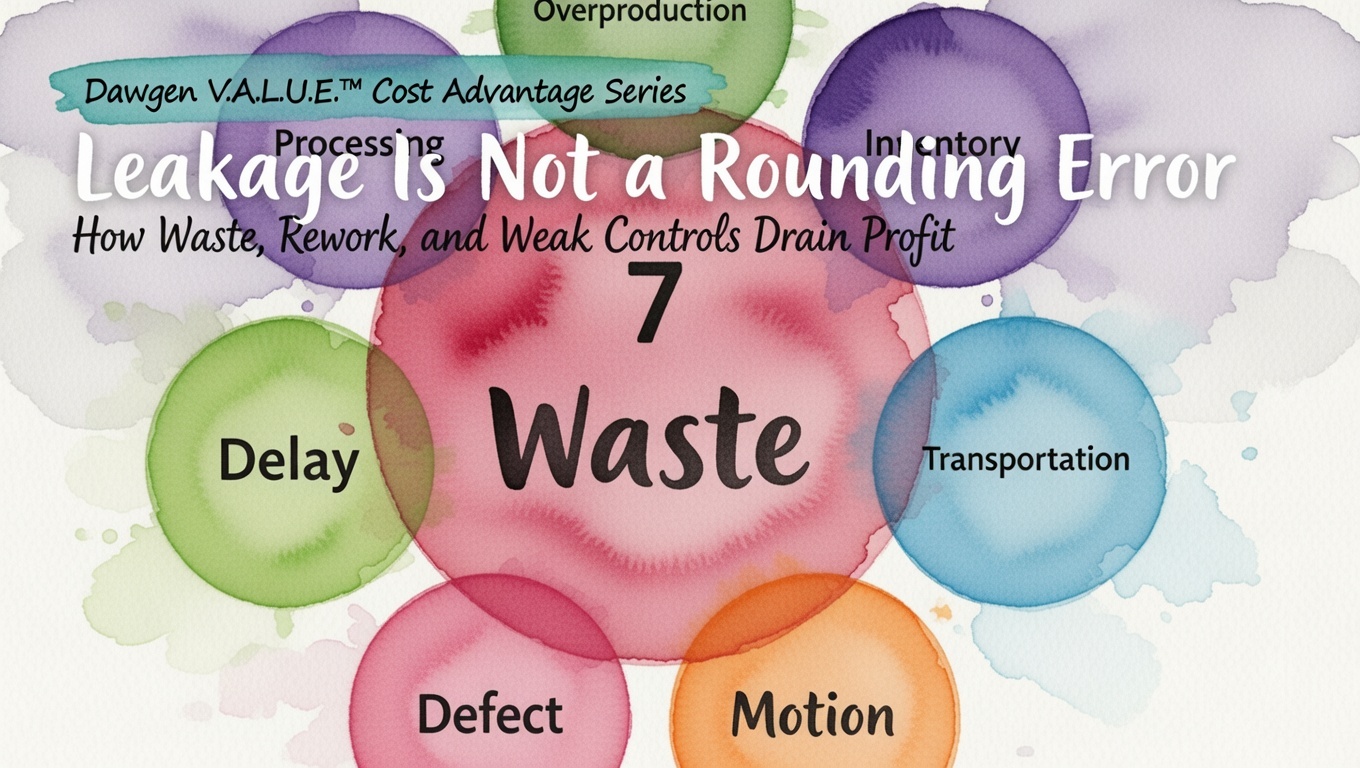
Executive Summary
Most organisations think profitability is lost in big-ticket decisions—pricing, headcount, or major contracts. In reality, margins often die quietly through leakage: small, repeated losses caused by waste, rework, errors, weak controls, and ungoverned exceptions. Leakage compounds. It creates hidden “cost gravity” that drags down profit even when revenue is stable.
In the Caribbean, leakage risk is rising because of tighter labour markets, higher input costs, complex supply chains, FX constraints, and increasing compliance demands. These pressures make it easier for exceptions to become normal, for “temporary workarounds” to become permanent, and for operational discipline to erode.
This article explains:
-
what leakage is (and why it is rarely visible in the P&L)
-
the five most common leakage patterns that destroy profitability
-
why many cost programmes fail by chasing savings while ignoring leakage
-
how to identify leakage using practical diagnostics and “hotspot” dashboards
-
sector lenses across distribution, manufacturing, banking, insurance, hospitality, construction, and public sector
-
how Dawgen’s V.A.L.U.E.-Chain Cost Advantage Framework™ turns leakage control into sustainable savings
If your organisation is under margin pressure, stopping leakage is one of the fastest, safest ways to improve profit without breaking service levels or growth.
1) What “Leakage” Really Means
Leakage is unnecessary cost or lost value that occurs because processes, controls, and behaviours allow it. It is not “the cost of doing business.” It is the cost of doing business poorly—repeatedly.
Leakage is different from “cost”
Normal costs are intentional:
-
payroll for required roles
-
logistics cost aligned to service strategy
-
utilities at the level required for output
-
procurement spend aligned to demand
Leakage is unintentional:
-
paying twice (duplicate invoices, rework, returns, claims)
-
paying for errors (expedites, overtime, penalties)
-
paying for weak discipline (maverick buying, uncontrolled discounts)
-
paying for weak performance (downtime, poor yields, inefficiency)
Why leakage is hard to see
Leakage hides because:
-
it is distributed across departments (no single owner)
-
it appears as small “non-material” amounts—until aggregated
-
it’s coded into normal accounts (repairs, supplies, misc., overtime, write-offs)
-
it’s treated as unavoidable noise rather than controllable failure modes
A simple way to frame it:
Savings are what you plan to reduce. Leakage is what you fail to prevent.
In strong organisations, savings initiatives and leakage control work together.
2) The Leakage Equation: Why Small Losses Become Big Losses
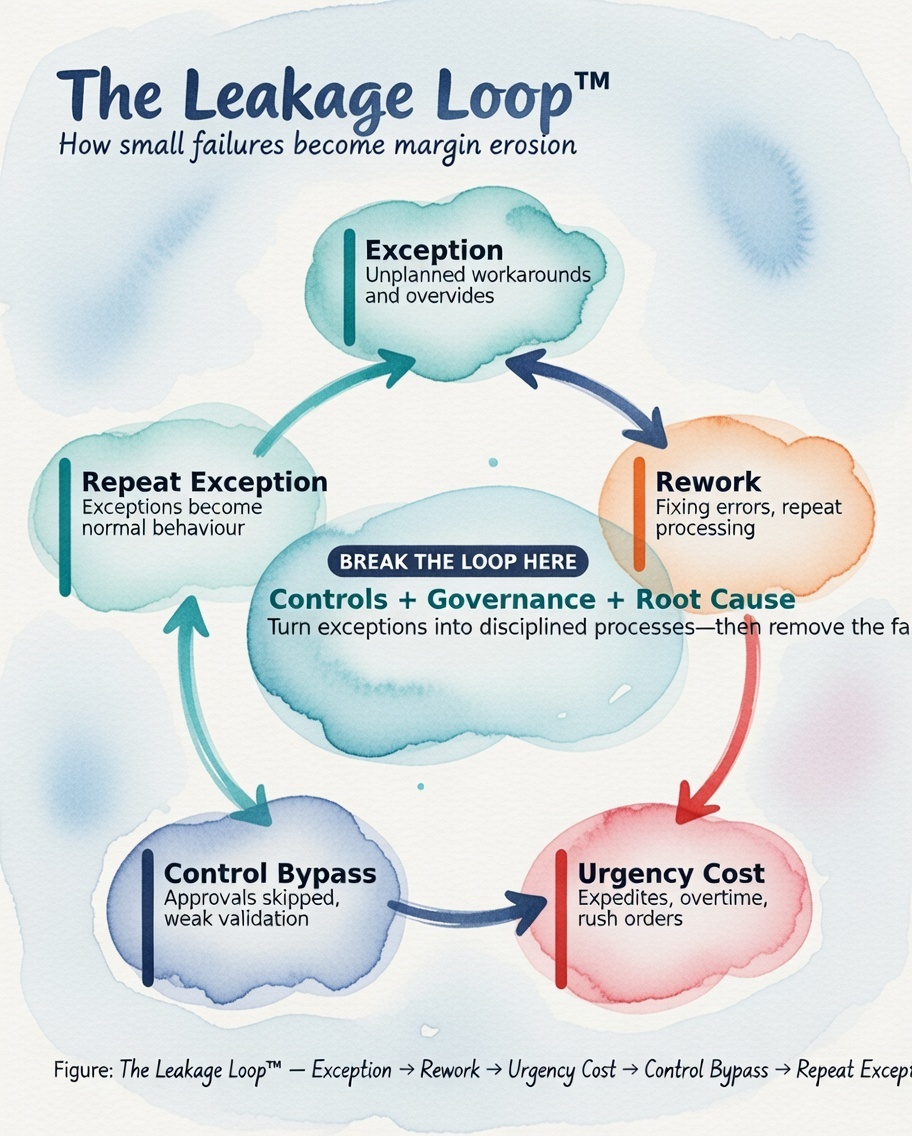
Leakage usually starts as exceptions:
-
“Just this once, we’ll rush ship.”
-
“We’ll accept that invoice; the paperwork is late.”
-
“Give the discount—we can fix it later.”
-
“We’ll skip the cycle count this month.”
-
“We’ll approve the variation; the client needs it.”
Exceptions create habits. Habits become operating norms.
The compounding effect
Leakage compounds through three multipliers:
-
Frequency (how often it happens)
-
Propagation (how many downstream processes it affects)
-
Recovery cost (how expensive it is to fix)
Example: a picking error in a distribution warehouse is not one cost. It can become:
-
re-delivery cost
-
returns processing cost
-
credit note administration cost
-
customer service time
-
damage/write-off
-
loss of trust and future orders
Leakage is rarely one event. It is a chain reaction.
3) Five Leakage Patterns That Destroy Profitability
Across industries, leakage tends to cluster into a few recurring patterns.
Leakage Pattern 1: Waste and Scrap (Physical or Time-Based)
Waste includes:
-
damaged inventory
-
spoilage
-
excess packaging and handling
-
idle labour and idle equipment
-
unnecessary movement and double handling
-
overproduction or building ahead of demand
Time waste is often the largest: waiting, rework loops, handoffs, approvals.
Leakage Pattern 2: Rework and Quality Failure
Rework is one of the most expensive leakage forms because you pay twice:
-
second labour cost
-
additional materials
-
delays and penalties
-
reputation damage
Rework shows up as:
-
repeat inspections
-
job re-dos
-
claims and disputes
-
corrections and journal adjustments
-
customer returns and complaints
Leakage Pattern 3: Exception Costs and “Urgency Tax”
The urgency tax is the premium paid for poor planning:
-
emergency freight
-
expedited procurement
-
last-minute overtime
-
premium contractor labour
-
rush fees and penalties
Urgency costs feel “necessary” in the moment, but they are usually avoidable with better discipline.
Leakage Pattern 4: Contract, Pricing, and Policy Leakage
Commercial leakage includes:
-
uncontrolled discounts and rebates
-
waived fees and penalties
-
weak enforcement of payment terms
-
unapproved credit notes
-
scope creep and variation orders without governance
-
failure to collect and enforce claims
This is common where frontline teams try to “save the relationship” with concessions—without visibility of profit impact.
Leakage Pattern 5: Control Failure (Process and Governance)
Control leakage includes:
-
duplicate payments
-
invoice errors not detected
-
maverick buying and non-compliant spend
-
weak segregation of duties
-
missing approvals
-
weak master data governance
-
weak asset and inventory controls
Control leakage is dangerous because it can become fraud risk if left unchecked.
4) Why Traditional Cost Programmes Miss Leakage
Many cost reduction programmes focus on:
-
renegotiating supplier rates
-
reducing headcount
-
cutting budgets
-
consolidating facilities
These can work—but they often fail to deliver the expected profit because leakage continues.
The common trap: “Savings achieved, profit not improved”
This happens when:
-
savings are offset by increased exceptions (expedites, overtime, claims)
-
controls are weak, so spend rebounds
-
behaviours do not change
-
KPIs are not aligned to savings
-
finance validation is missing (double-counting or “gross” savings reported instead of net)
Leakage control is what converts cost initiatives into real, bankable savings.
5) The Leakage Diagnostic: How to Find the Money
Leakage control starts with diagnosis. The key is to look for signals, not perfect data.
A) The “Leakage Hotspot” Dashboard
Build a quick dashboard using 12–18 months of data:
Operational Signals
-
overtime hours and overtime cost
-
rework incidents and repeat jobs
-
return rates and credit notes
-
scrap/waste/write-offs
-
downtime hours and breakdown frequency
-
expedite shipments and rush orders
Commercial Signals
-
discount rate by customer/segment
-
volume vs margin inconsistencies
-
claim disputes and uncollected amounts
-
aged receivables and concessions
Control Signals
-
invoice adjustments and disputes
-
purchase order non-compliance
-
exceptions and approval overrides
-
inventory variance and shrinkage
-
asset loss and maintenance anomalies
You’re not searching for perfection. You’re searching for patterns.
B) Process Walks and “Exception Mapping”
Spend 2–3 days mapping exceptions:
-
where workarounds occur
-
where approvals are bypassed
-
where data is re-keyed
-
where handoffs create delays
-
where controls are “paper only”
This is where organisations discover that “the process on paper” is not how work actually happens.
7) Sector Lens: How Leakage Shows Up Across Industries
To ensure full coverage, here are practical leakage examples and control levers by sector.
Sector Lens 1: Distribution (FMCG, Importers, Wholesale)
Leakage patterns
-
picking errors → returns → re-delivery cost
-
uncontrolled credit notes and rebates
-
over-servicing low-margin accounts (high delivery frequency, small orders)
-
inventory shrinkage and expiry
-
maverick buying and emergency replenishment (“urgency tax”)
High-impact levers
-
tighten returns authorisation + root-cause (packaging, QC, training)
-
enforce delivery calendars and MOQs by segment
-
inventory cycle counting discipline and variance ownership
-
link commercial concessions to margin and approvals
-
daily exception dashboard for expediting and credits
Composite case snapshot (anonymised)
A multi-branch distributor reduced returns by tightening pick accuracy and enforcing returns rules. The hidden win: fewer re-deliveries and lower overtime in the warehouse—net profit improved beyond the “visible” savings.
Sector Lens 2: Manufacturing
Leakage patterns
-
yield loss, scrap, and rework loops
-
downtime and maintenance backlog
-
excess energy consumption from inefficient runs
-
quality escapes leading to customer claims
-
poor production planning triggering overtime and rush inputs
High-impact levers
-
“first-pass yield” measurement and root-cause teams
-
maintenance discipline (planned vs unplanned ratio)
-
standard work and line balancing
-
energy dashboards tied to output (kWh per unit)
-
tighten planning cadence to reduce rushes
Composite case snapshot
A manufacturer cut scrap through tighter process controls and maintenance discipline, reducing rework and stabilising throughput. They improved profit without cutting headcount—because they stopped paying twice for the same output.
Sector Lens 3: Banking
Leakage patterns
-
process inefficiency in onboarding and servicing
-
repeated KYC remediation and compliance rework
-
manual reconciliations and correction cycles
-
vendor and tech spend fragmentation (“shadow spend”)
-
policy exceptions in credit approvals leading to losses
High-impact levers
-
reduce rework by fixing data quality and upstream controls
-
standardise workflows and reduce exception approval layers
-
consolidate vendors and enforce contract performance
-
automate reconciliation controls where ROI is clear
-
track rework cost as a measurable operating leakage
Composite case snapshot
A bank reduced repeat KYC remediation by tightening data capture and implementing exception governance. Productivity improved and complaints reduced—savings sustained because the failure mode was fixed.
Sector Lens 4: Insurance
Leakage patterns
-
claims cycle time delays → higher loss adjustment expense
-
rework due to missing documentation
-
repair network inefficiency and vendor disputes
-
fraud and leakage risk in weak controls
-
duplication across systems and manual checks
High-impact levers
-
claims triage rules and documentation discipline
-
vendor SLAs and performance dashboards
-
fraud controls and exception triggers
-
reduce rework through standard templates and digital capture
-
finance validation of “net” savings (avoid double counting)
Composite case snapshot
An insurer improved claims processing by reducing documentation rework and tightening vendor governance. The result was lower leakage, faster settlement, and a measurable reduction in overhead tied to claims handling.
Sector Lens 5: Hospitality (Hotels, Food Service)
Leakage patterns
-
food waste and spoilage
-
labour scheduling inefficiency (overstaffing at low occupancy)
-
emergency purchases and last-minute vendor deliveries
-
weak storeroom controls and shrinkage
-
energy leakage (AC, boilers, laundry, kitchens)
High-impact levers
-
waste tracking by outlet and menu engineering
-
labour productivity KPIs (hours per occupied room, covers per labour hour)
-
supplier delivery schedules + vendor consolidation
-
storeroom controls and inventory accuracy
-
energy KPIs per room night
Composite case snapshot
A hotel group reduced waste and emergency buying by improving inventory planning and vendor scheduling. They protected guest experience while reducing both direct cost and the hidden urgency tax.
Sector Lens 6: Construction
Leakage patterns
-
rework from design changes and poor scope control
-
variation orders without governance
-
idle labour and equipment due to late materials
-
site wastage and theft
-
claims and disputes that go uncollected
High-impact levers
-
change control governance and variation approval discipline
-
weekly work planning linked to site logistics
-
materials staging and delivery scheduling
-
tighter subcontractor performance management
-
track rework hours and cost as a core KPI
Composite case snapshot
A contractor reduced rework and idle time by enforcing change control and improving site logistics planning. The “savings” showed up as fewer rush orders and better productivity—not just lower visible costs.
Sector Lens 7: Public Sector
Leakage patterns
-
fragmented procurement and inconsistent compliance
-
weak contract management and supplier performance
-
asset leakage and low utilisation
-
slow approvals creating urgency spending
-
process duplication across agencies
High-impact levers
-
centralise spend visibility and enforce compliance
-
contract performance SLAs and governance cadence
-
fleet and asset utilisation dashboards
-
reduce approval layers and digitise controls
-
a Value Capture Office (VCO) approach for execution discipline
Composite case snapshot
A public entity reduced leakage by tightening contract management and improving asset utilisation. The biggest win came from reducing the “workaround economy” created by slow approvals.
8) Applying Dawgen’s V.A.L.U.E.™ Framework to Leakage Control
Leakage control is not a one-off audit. It is a structured transformation that protects value while restoring discipline.
V — Validate the Profitability Challenge
-
quantify leakage signals (returns, overtime, rework, scrap, credits, expedites)
-
link leakage to margin erosion and cash pressure
-
define ambition: “stop the bleed” targets by cost pool
A — Analyse the Value Chain and Cost-to-Serve
-
map where leakage occurs across the value chain
-
identify which customers/products/channels trigger exceptions
-
isolate root causes (people/process/technology/policy)
L — Locate Levers and Build the Opportunity Portfolio
-
quick wins: rule enforcement, approval discipline, exception controls
-
structural fixes: process redesign, standard work, supplier performance management
-
controls: segregation, automation, audit trails, data governance
U — Uplift & Prioritise (Business Case + Roadmap)
-
prioritise by size + speed + risk + ease
-
separate “gross savings” from “net validated savings”
-
build a roadmap: 0–90 days, 3–18 months, 18+ months
E — Execute with Governance and Controls
-
run workstreams (operations, procurement, commercial, finance validation)
-
cadence: weekly reviews, biweekly steering, monthly reporting
-
track initiatives, resolve blockers, validate savings
™ — Transform for Sustainability
-
hardwire controls and behaviours
-
update policies that drive exceptions
-
embed dashboards and ownership
-
train managers to manage leakage, not just budgets
9) Quick Wins vs Structural Fixes
Leakage reduction should move at two speeds.
Quick Wins (0–90 days)
-
enforce approvals and stop uncontrolled exceptions
-
tighten returns and credit rules
-
implement cycle counts in high-variance categories
-
stop duplicate payments through basic control checks
-
implement “urgency” approval rules for expediting and overtime
-
publish leakage dashboards weekly
Structural Reshape (3–18 months)
-
redesign processes to remove rework loops
-
standardise work and training
-
improve supplier performance management
-
improve planning and forecasting cadence
-
strengthen system controls and data governance
Sustained Advantage (18+ months)
-
embed leakage ownership into performance scorecards
-
automate monitoring and exception flags
-
establish continuous improvement cadence
-
sustain through VCO governance
Stopping Leakage Is Profit’s Fastest “No-Regret” Move
Leakage is not a rounding error. It is the silent killer of profit, cash, and operational stability. The organisations that win will be those that restore discipline, reduce rework, eliminate urgency spending, and hardwire controls—without weakening service or growth.
Next Step!
Ready to identify and stop your biggest leakage points—fast?
Email [email protected] with the subject line “V.A.L.U.E. – Leakage Diagnostic” to request a first discussion and our leakage hotspot checklist.
WhatsApp Global: +1 555 795 9071 | Contact form: https://www.dawgen.global/contact-us/
About Dawgen Global
“Embrace BIG FIRM capabilities without the big firm price at Dawgen Global, your committed partner in carving a pathway to continual progress in the vibrant Caribbean region. Our integrated, multidisciplinary approach is finely tuned to address the unique intricacies and lucrative prospects that the region has to offer. Offering a rich array of services, including audit, accounting, tax, IT, HR, risk management, and more, we facilitate smarter and more effective decisions that set the stage for unprecedented triumphs. Let’s collaborate and craft a future where every decision is a steppingstone to greater success. Reach out to explore a partnership that promises not just growth but a future beaming with opportunities and achievements.
 Email: [email protected]
  Visit: Dawgen Global Website

 WhatsApp Global Number : +1 555-795-9071
Caribbean Office: +1876-6655926 / 876-9293670/876-9265210  WhatsApp Global: +1 5557959071
USA Office: 855-354-2447
Join hands with Dawgen Global. Together, let’s venture into a future brimming with opportunities and achievements


