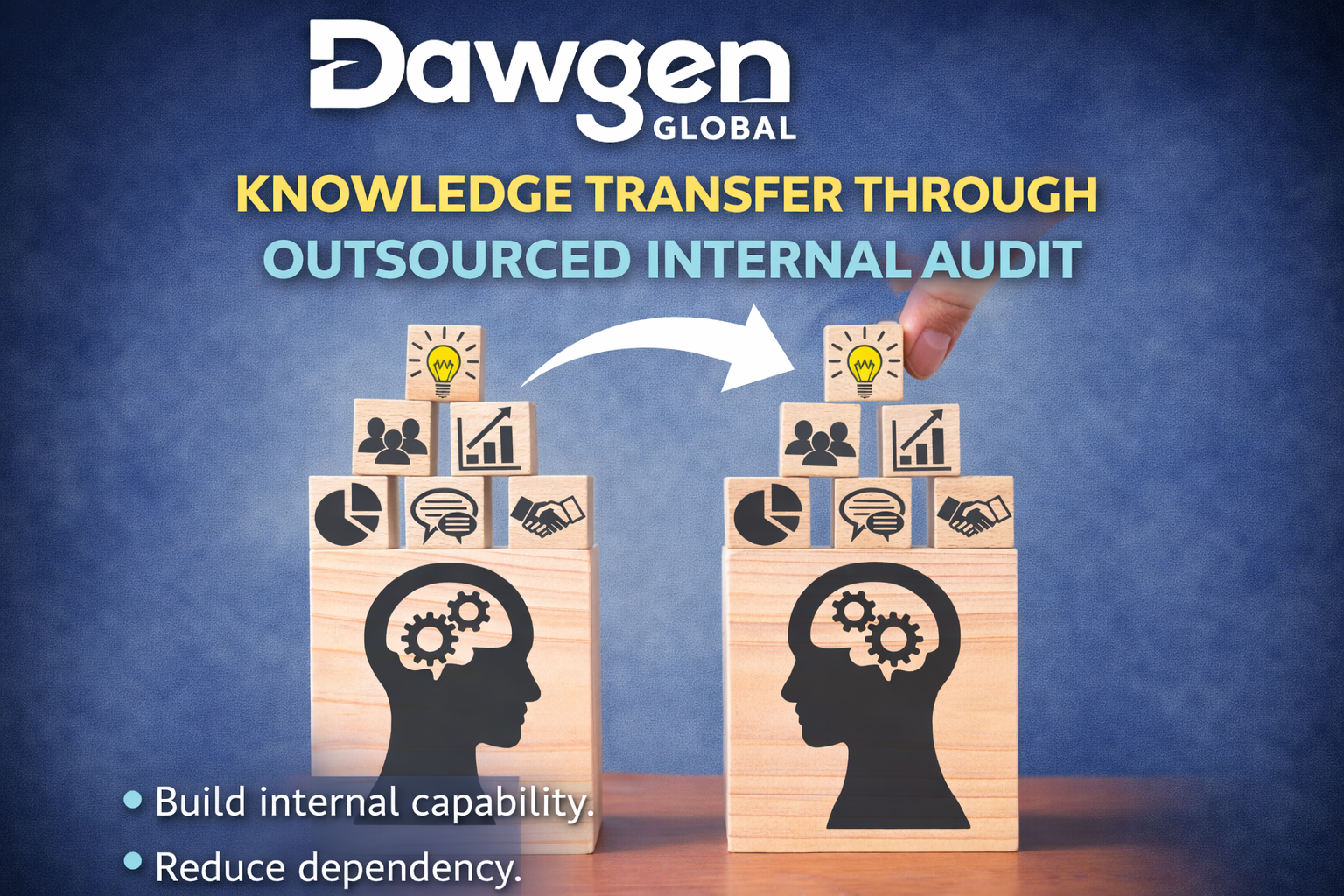
Beyond Assurance — The Capability Dividend
When Caribbean boards and audit committees evaluate the case for outsourcing or co-sourcing the internal audit function, the conversation typically centres on two primary considerations: the quality of the independent assurance the provider will deliver, and the cost of the arrangement relative to maintaining an in-house team. These are legitimate and important considerations. But they consistently overlook what may be the most strategically significant benefit that a well-structured outsourced internal audit engagement can generate: the systematic transfer of professional knowledge, methodology, and audit capability into the client organisation.
Knowledge transfer — the deliberate, structured process through which the expertise, methodology, and professional judgement of the external provider is progressively embedded within the client’s own people, processes, and institutional memory — transforms outsourced internal audit from a recurring service purchase into a capability investment. The organisation that approaches outsourcing with a knowledge transfer agenda does not merely receive audit reports at the end of each engagement. It receives, over time, the building blocks of a world-class internal audit capability that it owns outright and that continues to generate governance value long after any individual engagement has concluded.
This article — the eighth in Dawgen Global’s The Internal Audit Imperative series — examines knowledge transfer in the outsourced and co-sourced internal audit context with the depth and specificity that this strategically important topic deserves. We explore what knowledge transfer means in practice, the distinction between explicit and tacit knowledge and why it matters for transfer design, the eight principal channels through which knowledge flows from provider to client, the four-stage capability maturity progression that a structured transfer programme can deliver, the governance conditions that enable effective transfer, and the Caribbean-specific dynamics that make knowledge transfer both more urgently needed and more practically achievable than executives often assume.
| KEY INSIGHT
An outsourced internal audit provider that delivers assurance without transferring knowledge is providing a service. A provider that delivers assurance while systematically building the client’s own capability is providing a strategic investment — one whose returns compound over the life of the relationship and extend long beyond it. |
Explicit and Tacit Knowledge: Understanding What Must Be Transferred
Before examining the mechanisms of knowledge transfer, it is essential to understand the nature of what is being transferred. Professional auditors possess two fundamentally different types of knowledge, and they require different transfer mechanisms.
Explicit Knowledge: The Transferable Artefacts
Explicit knowledge is knowledge that can be articulated, documented, and shared in written or structured form. In the internal audit context, explicit knowledge includes the methodology frameworks that guide how audits are planned and executed, the risk assessment templates that structure the identification and prioritisation of audit universe components, the working paper standards that define the documentation required to support audit conclusions, the finding classification criteria that determine how issues are rated by significance, the IIA Standards and their application to specific audit scenarios, and the regulatory frameworks relevant to the client’s industry.
Explicit knowledge is the most straightforward to transfer — it can be embedded in documented deliverables, training materials, and methodology libraries that the client retains as enduring assets. A provider that delivers audit engagements without sharing the underlying methodology documentation — treating its frameworks as proprietary tools to be withheld rather than client assets to be developed — is not engaged in knowledge transfer. It is engaged in knowledge retention for competitive advantage at the client’s expense.
Tacit Knowledge: The Harder-to-Transfer Craft
Tacit knowledge is knowledge that resides in the professional’s judgement, experience, and instinctive understanding — the ability to recognise a control weakness from a pattern of circumstantial evidence, to calibrate the significance of a finding in the context of the organisation’s specific risk environment, to navigate a challenging interview with a defensive control owner, or to craft an audit finding that is simultaneously accurate, fair, and actionable. This knowledge cannot be fully documented or transmitted through training materials alone. It is acquired primarily through experience — by doing audit work, making professional judgements, receiving expert feedback, and reflecting on the outcomes.
Tacit knowledge transfer requires structured experiential learning: in-house auditors must work alongside experienced provider professionals, observe how expert judgement is applied in real audit situations, participate in decisions that would otherwise be made exclusively by the provider, and receive specific, timely feedback on their own developing judgements. The design of the knowledge transfer programme must therefore prioritise not just the sharing of artefacts but the creation of structured opportunities for experiential learning that gradually build the tacit knowledge of the client’s own people.
| KEY INSIGHT
The documentation a provider leaves behind when an engagement concludes transfers explicit knowledge. The experience in-house auditors gain by working alongside the provider during the engagement transfers tacit knowledge. Both are essential — but only the second builds the professional judgement that is the hallmark of a genuinely capable internal audit function. |
Eight Knowledge Transfer Channels: A Practical Framework
Effective knowledge transfer in the outsourced internal audit context requires the deliberate deployment of multiple complementary channels — each targeting different types of knowledge and different dimensions of audit capability. The table below presents eight principal transfer channels, describing how each works, the type of knowledge it transfers, and its effectiveness as a transfer mechanism.
| Transfer Channel | How It Works | Knowledge Type | Transfer Effectiveness |
| Methodology Documentation | Provider shares documented audit methodology — risk assessment templates, engagement planning tools, working paper frameworks, finding classification criteria, and report templates — with in-house team for continued use | Explicit | High — methodology is immediately transferable and reusable without provider presence |
| Joint Fieldwork Execution | In-house auditors work alongside provider professionals during fieldwork, observing and participating in risk identification, control testing, evidence evaluation, and finding development | Tacit | High — experiential learning is the most effective mechanism for internalising audit craft |
| Supervised Report Writing | In-house auditors draft audit reports under provider supervision; provider provides structured feedback on clarity, risk calibration, root cause analysis, and recommendation quality | Tacit | High — report quality is a critical and often underdeveloped skill in developing IA teams |
| Formal Training Sessions | Provider conducts structured training sessions on specific audit disciplines: risk-based planning, data analytics, IT audit methodology, fraud awareness, IIA Standards compliance | Explicit | Medium — training provides conceptual foundation but must be reinforced through applied practice |
| Audit Committee Presentation Shadowing | In-house team members attend and observe provider’s audit committee presentations, developing governance communication skills and board-level audit literacy | Tacit | Medium — develops confidence and communication capability over multiple cycles |
| Structured Debriefs | Provider conducts post-engagement debriefs with in-house team — reviewing what was audited, how, what was found, and what alternative approaches might have been applied | Tacit and Explicit | Medium to High — reflection-based learning reinforces experiential insights |
| Professional Certification Support | Provider supports in-house staff in pursuing CIA, CISA, CFE, or CPA certification — through study materials, mock examinations, and structured study leave arrangements | Explicit | Medium — certification provides credential validation and structures professional knowledge development |
| Knowledge Repository Development | Provider supports client in building a structured audit knowledge repository — documenting the audit universe, control environment baseline, prior findings, and risk profile updates | Explicit | High — creates institutional memory that persists beyond the engagement and supports continuity |
The most effective knowledge transfer programmes deploy all eight channels in a coordinated and sequenced manner — beginning with the foundational explicit channels (methodology documentation and formal training) that establish the conceptual framework, and progressively deepening into the experiential tacit channels (joint fieldwork, supervised report writing, and audit committee presentation shadowing) that build the professional judgement that distinguishes a capable auditor from a technically informed one.
Barriers to Effective Knowledge Transfer — and How to Overcome Them
Knowledge transfer between an external provider and a client organisation does not happen automatically, even in the most well-intentioned outsourcing arrangements. Several barriers consistently impede transfer effectiveness in Caribbean engagements, and each must be proactively addressed.
Provider Incentive Misalignment
The most fundamental barrier to knowledge transfer in outsourced arrangements is a misalignment of provider incentives. An external provider whose commercial model depends on the client’s continued dependency has a structural disincentive to transfer knowledge effectively — because effective knowledge transfer, by definition, reduces the client’s need for the provider over time. This misalignment is not necessarily a product of bad faith: it is a predictable consequence of engagement models that reward ongoing service delivery rather than capability development.
The solution is to design knowledge transfer obligations explicitly into the engagement contract — specifying the transfer channels to be deployed, the deliverables to be produced, and the capability milestones to be achieved at defined intervals. A provider that resists contractual knowledge transfer obligations should be viewed with significant caution: the resistance reveals an engagement model built on client dependency rather than genuine partnership.
Absorptive Capacity Constraints
Knowledge transfer is a two-sided process — the provider must transmit, but the client must absorb. In-house audit staff who are under-qualified, overstretched, or unfamiliar with the conceptual foundations of professional internal audit practice cannot absorb advanced methodology at the pace the provider delivers. This absorptive capacity constraint is common in Caribbean organisations where the internal audit function is being built from a low base.
Addressing absorptive capacity requires a sequenced approach: begin with foundational knowledge transfer — basic audit process, risk assessment concepts, working paper standards — before advancing to more sophisticated methodology. It also requires an investment in the educational and professional development of in-house staff that parallels the outsourcing engagement, ensuring that their individual capability grows in step with the knowledge the provider is making available.
Cultural Barriers to Learning
In some Caribbean organisational contexts, the cultural dynamics of the provider-client relationship can inhibit knowledge transfer. If in-house staff perceive the external provider as a superior authority whose methods are to be observed but not questioned, they will not engage with the provider’s work in the exploratory, questioning manner that generates the deepest tacit learning. Equally, if providers adopt an expert posture that discourages questions and positions in-house staff as passive recipients rather than developing professionals, the transfer relationship is unbalanced in a way that limits its effectiveness.
Effective knowledge transfer requires a deliberate partnership culture — one in which the provider is positioned not as an authority dispensing expertise but as a mentor facilitating learning, and in which in-house staff are encouraged to ask questions, challenge approaches, propose alternatives, and develop their own audit judgements rather than simply implementing the provider’s directions.
Staff Turnover and Knowledge Attrition
In the Caribbean context, where professional mobility is high and qualified audit staff are in significant demand across sectors, the risk of losing transferred knowledge through staff turnover is acute. An in-house auditor who has participated in two years of joint engagements with a high-quality provider and developed genuine audit capability is an attractive proposition for other employers — and when they leave, they take their tacit knowledge with them.
Mitigating this risk requires both retention strategies — competitive compensation, professional development investment, career pathway clarity — and knowledge management practices that convert as much tacit knowledge as possible into documented explicit knowledge. A well-maintained audit knowledge repository, comprehensive working paper documentation, and a structured onboarding programme for new team members can significantly reduce the knowledge attrition that staff turnover would otherwise cause.
The Four-Stage Capability Maturity Progression
A well-designed knowledge transfer programme does not merely share knowledge — it builds capability progressively, in a structured sequence that moves the client organisation from dependence on the external provider toward increasing self-sufficiency, while maintaining the specialist external expertise and structural independence that sound governance permanently requires. The table below presents the four-stage maturity progression that a structured knowledge transfer programme can deliver over a five-year horizon.
| Maturity Stage | Knowledge Transfer Activities | Capability Milestone |
| Stage 1: Foundational (Years 1–2) | Provider leads all engagements; in-house staff observe and assist; methodology documentation transferred; basic training delivered | In-house team understands audit process and can execute supervised fieldwork; methodology library established |
| Stage 2: Developing (Years 2–3) | Provider leads complex and specialist engagements; in-house team leads standard engagements under provider supervision; supervised report writing; KPI reporting established | In-house team can independently execute standard audit engagements; CAE or senior auditor role developing; QAIP framework in place |
| Stage 3: Competent (Years 3–5) | Provider covers specialist areas (IT audit, forensics, regulatory) and quality assurance function; in-house team leads majority of engagements; joint audit committee presentations | In-house function operates independently for generalist audit universe; external provider supplement for specialist risk areas; first EQA completed |
| Stage 4: Advanced (Years 5+) | Provider provides specialist supplementation and periodic quality assurance review; in-house team fully self-sufficient for standard and complex engagements | Mature, IIA-conformant in-house function; regular EQA cycle maintained; provider engaged for specialist skills and independence assurance on sensitive engagements |
The four-stage progression illustrates a crucial point: knowledge transfer in the context of outsourced internal audit is not a short-term project with a defined endpoint. It is a multi-year capability development journey that requires sustained commitment from both the provider and the client organisation — and sustained investment in the governance infrastructure, professional development, and quality management that the journey demands.
Caribbean organisations that approach outsourced internal audit with a five-year capability development horizon — rather than a year-by-year service renewal mindset — will derive dramatically greater value from their provider relationships and will emerge from the engagement with an internal audit function that is genuinely world-class by regional standards.
| KEY INSIGHT
The difference between a five-year outsourcing engagement that leaves the client more dependent on the provider than when it started, and one that leaves the client with a mature, capable internal audit function, is not the quality of the provider’s audit work. It is whether knowledge transfer was deliberately designed into the engagement from the outset. |
The Governance Conditions for Effective Knowledge Transfer
Knowledge transfer does not happen by accident — and it cannot happen without the right governance conditions. Four conditions are essential.
Contractual Knowledge Transfer Obligations
As noted above, knowledge transfer must be embedded in the engagement contract as an explicit deliverable — not left to the goodwill of the provider. The contract should specify the transfer channels to be deployed, the documentation deliverables to be produced, the training sessions to be conducted, the certification support to be provided, and the capability milestones to be achieved. It should also include an annual knowledge transfer report — presented to the audit committee alongside the quality assurance report — that documents what has been transferred, how in-house capability has developed, and what the transfer priorities are for the forthcoming year.
Audit Committee Oversight of Transfer Progress
The audit committee should include knowledge transfer progress as a standing agenda item in its annual review of the outsourced or co-sourced IA arrangement. This oversight function sends a clear signal to both the provider and in-house management that capability development is a governance priority — not merely an aspiration. It also provides the audit committee with the information it needs to assess whether the outsourcing arrangement is generating the full strategic value it is capable of delivering.
Management Investment in In-House Staff Development
Knowledge transfer requires time — time for in-house staff to participate in joint engagements, attend training sessions, review methodology documentation, and pursue professional certifications. This time must be actively protected by management: shielded from competing operational demands, supported with appropriate study leave and training budgets, and recognised in performance evaluations as a valued investment rather than a distraction from productive work.
A Named Knowledge Transfer Coordinator
Every effective knowledge transfer programme benefits from a named internal coordinator — typically the in-house CAE, Head of Internal Audit, or a senior in-house auditor — who is responsible for tracking transfer activities, maintaining the knowledge repository, coordinating training schedules, and reporting progress to the audit committee. Without a designated owner, knowledge transfer tends to be crowded out by the operational demands of delivering the audit programme — present in principle but absent in practice.
| DAWGEN GLOBAL: KNOWLEDGE TRANSFER AS A CORE ENGAGEMENT COMMITMENT
At Dawgen Global, knowledge transfer is not an optional add-on to our outsourced and co-sourced Internal Audit engagements — it is a core commitment that we design into every client relationship from the outset. Our engagements include: documented methodology transfer (risk assessment frameworks, working paper templates, report standards); structured joint fieldwork with in-house staff; formal training sessions on audit disciplines relevant to the client’s risk universe; supervised report writing with detailed feedback; certification support for in-house auditors pursuing CIA, CISA, or CFE credentials; and an annual knowledge transfer report presented to the audit committee. We measure our success not just by the quality of the assurance we deliver today, but by the capability we have built in our clients’ organisations for tomorrow. Contact us at [email protected] to discuss how a knowledge transfer-focused outsourced IA engagement with Dawgen Global can build lasting governance capability in your organisation. |
The Caribbean Imperative: Why Knowledge Transfer Matters Most Here
The strategic importance of knowledge transfer in outsourced internal audit is universal — but it is particularly acute in the Caribbean context, for reasons that are structural, demographic, and developmental.
The Caribbean professional talent market for qualified internal auditors is thin by global standards. The pool of professionals holding CIA, CISA, or CFE credentials, with experience in risk-based audit methodology and exposure to multi-disciplinary audit engagements, is limited relative to the governance needs of the region’s private sector, financial institutions, and public bodies. This scarcity means that Caribbean organisations cannot simply recruit their way to internal audit excellence — they must develop it, systematically and deliberately, through exactly the kind of structured knowledge transfer that a well-designed outsourcing relationship with a capable provider can deliver.
The Caribbean’s regional integration agenda — the deepening of CARICOM economic relationships, the growth of cross-border conglomerates, and the increasing engagement of Caribbean enterprises with international capital markets — is simultaneously raising the governance expectations that Caribbean organisations must meet and creating the economic incentives for investing in the governance infrastructure to meet them. Building world-class internal audit capability is not merely a compliance investment in this context. It is a strategic enabler of the regional integration and international engagement that Caribbean enterprises are pursuing.
Finally, the Caribbean has a rich tradition of professional excellence — lawyers, accountants, engineers, and physicians who are recognised internationally for the quality of their training and practice. The same tradition of professional excellence is achievable in internal audit, and the structured knowledge transfer that a high-quality outsourcing relationship provides is one of the most effective mechanisms for accelerating the journey. The investment required is real — but so are the returns, both for the individual organisations that make it and for the broader governance ecosystem of the Caribbean region.
Conclusion: The Engagement That Keeps Giving
An outsourced internal audit engagement that is designed with knowledge transfer at its heart is not merely a recurring service relationship — it is a compounding capability investment. Each joint engagement deepens the in-house team’s audit craft. Each methodology document adds to the organisation’s knowledge repository. Each formal training session expands the conceptual foundation of in-house staff. Each certification achieved validates and credentials the capability that the engagement has built. And each annual knowledge transfer report gives the audit committee the evidence it needs to assess whether its investment in the outsourcing relationship is generating the governance returns it was designed to produce.
For Caribbean organisations seeking not just to purchase independent assurance but to build the governance infrastructure that their evolving risk environments and governance expectations demand, knowledge transfer is not a secondary consideration in the outsourcing decision. It is a primary one — and the quality of a provider’s knowledge transfer commitment is one of the most important criteria by which the selection decision should be made.
In Article 9 — Technology-Enabled Internal Audit: Data Analytics, Continuous Monitoring, and the AI Frontier — we examine how the integration of advanced technology into the internal audit process is transforming what is possible: expanding audit coverage, accelerating risk detection, and enabling the continuous assurance model that represents the future of internal audit excellence.
| BUILD WORLD-CLASS INTERNAL AUDIT CAPABILITY IN YOUR ORGANISATION
Dawgen Global’s outsourced and co-sourced Internal Audit engagements are designed to deliver independent assurance and lasting capability. Through structured knowledge transfer, methodology sharing, joint working, and mentorship, we build the internal audit literacy and technical competency that your organisation needs — long after every engagement concludes. Request a Proposal Today: Tel: 876-929-3670 | 876-665-5926 | |
About Dawgen Global
“Embrace BIG FIRM capabilities without the big firm price at Dawgen Global, your committed partner in carving a pathway to continual progress in the vibrant Caribbean region. Our integrated, multidisciplinary approach is finely tuned to address the unique intricacies and lucrative prospects that the region has to offer. Offering a rich array of services, including audit, accounting, tax, IT, HR, risk management, and more, we facilitate smarter and more effective decisions that set the stage for unprecedented triumphs. Let’s collaborate and craft a future where every decision is a steppingstone to greater success. Reach out to explore a partnership that promises not just growth but a future beaming with opportunities and achievements.
 Email: [email protected]
  Visit: Dawgen Global Website

 WhatsApp Global Number : +1 555-795-9071
Caribbean Office: +1876-6655926 / 876-9293670/876-9265210  WhatsApp Global: +1 5557959071
USA Office: 855-354-2447
Join hands with Dawgen Global. Together, let’s venture into a future brimming with opportunities and achievements


