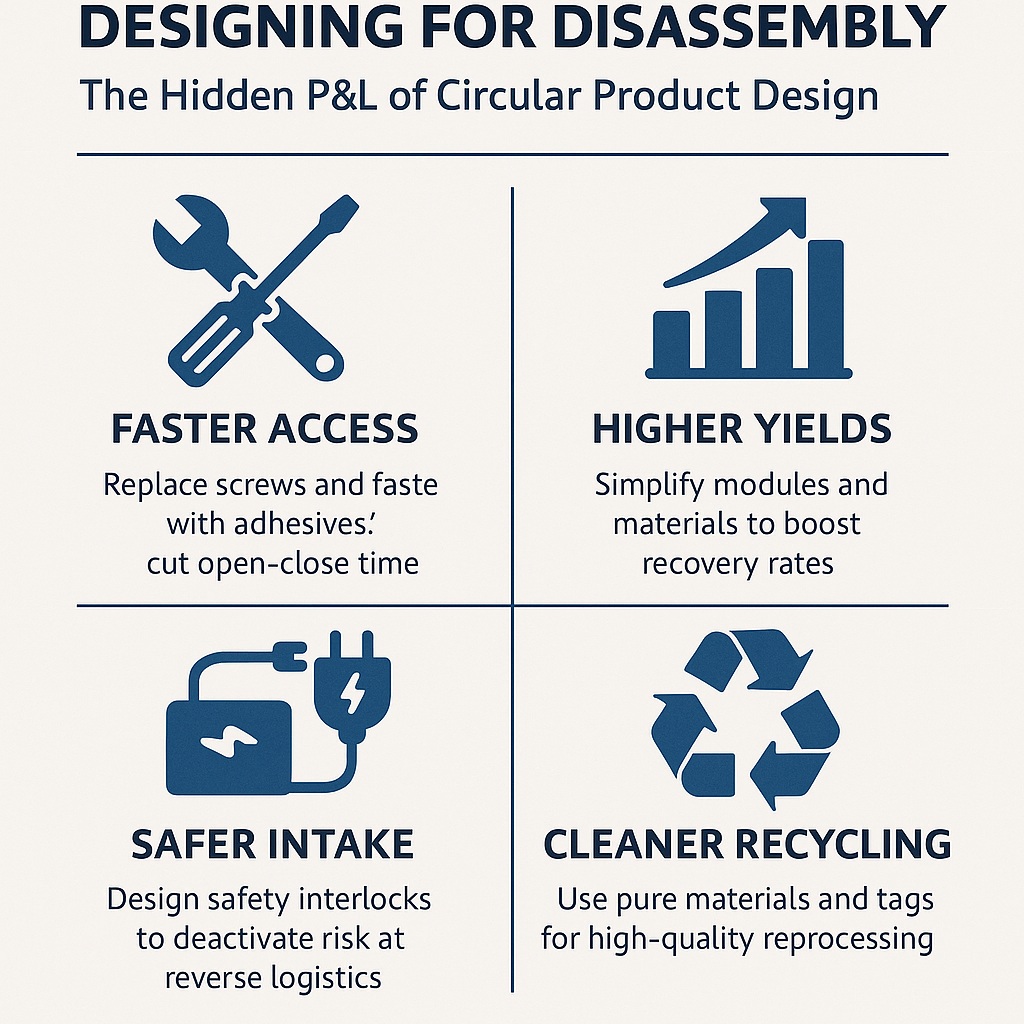
Executive Summary
Most circular economy programs live or die in the design studio. If products cannot be opened, graded, repaired, upgraded, or harvested quickly and safely, the economics of refurbishment, remanufacture, and high‑yield recycling will never scale. Designing for Disassembly (DfD) is the missing profit‑and‑loss (P&L) lever: it converts engineering choices—fasteners, adhesives, modules, materials—into measurable gains in yield, cycle time, warranty cost, working capital, and customer lifetime value (LTV). This article unpacks the business case, the engineering patterns that matter, a practical metrics stack, and a 90‑day roadmap to embed DfD across product lines—so LoopSight™, BetForge™, and ScaleGrid™ can deliver enterprise performance.
Thesis: Every extra minute in disassembly, every ounce of contamination, and every non‑recoverable subassembly shows up on the P&L. DfD moves those losses into bankable value.
Why DfD Is a Financial Strategy (Not Just Good Intentions)
1) Yield & Margin. Faster access to field‑failure components raises refurbishment first‑pass yields (FPY) and cuts rework. Higher salvage rates increase parts availability and reduce BOM costs for remanufacture.
2) Cycle Time & Working Capital. Shorter disassembly and triage times translate to lower WIP, faster resale/turn, and improved Cash Conversion Cycle (CCC).
3) Warranty & Quality. Modular, replaceable subassemblies reduce failure tails and simplify warranty operations—shrinking reserves and claims handling costs.
4) Compliance & Risk. Clear separation of hazardous materials and standardized labeling lower regulatory risk and disposal fees while enabling higher‑value recycling streams.
5) Customer Experience & LTV. Repairability and upgradeability increase retention, support Product‑as‑a‑Service (PaaS), and grow certified pre‑owned channels without cannibalizing new sales when paired with right pricing floors.
The DfD Playbook: Engineering Patterns that Pay
1) Fasteners over Adhesives (Wherever Feasible)
- Why it pays: Reduces heat/chemical steps; prevents cosmetic damage; enables repeatable torque/quality control.
- Patterns: torque‑controlled screws; captive fasteners; quick‑release clips with life‑cycle validation.
- Metrics: seconds to access target module; strip rate; re‑seal integrity post‑repair.
2) Access Hierarchies & Service Loops
- Why it pays: High‑failure or wear components should be reachable in ≤ target seconds without disturbing unrelated systems.
- Patterns: service doors; pull‑out trays; top‑down vs. bottom‑up access; external test ports.
- Metrics: number of operations to access each FRU (field‑replaceable unit); tool changes; damage risk index.
3) Modularity & Standard Interfaces
- Why it pays: Enables upgrades, harvesting, and remanufacture with predictable takt time.
- Patterns: uniform connector families; blind‑mate connectors; keyed plugs; mechanical datum surfaces; standardized gasket sizes.
- Metrics: cross‑SKU part commonality (%); module swap time; calibration time after swap.
4) Material Choices & Purity Bands
- Why it pays: Cleaner recycling streams command higher value; fewer mixed materials improve yield.
- Patterns: mono‑material housings; limited polymer families; marked resin IDs; coatings that don’t contaminate; removable labels.
- Metrics: purity of recycled output; contamination incidents; de‑inking or de‑coating time.
5) Non‑Destructive Open/Close Cycles
- Why it pays: Supports multiple service events across the asset life; reduces scrap.
- Patterns: gasketed seals; resealable adhesives; snap‑fits rated for N cycles; screw‑boss reinforcement.
- Metrics: successful re‑seal rate; leak/ingress failure rate post‑service.
6) Identification & Traceability by Design
- Why it pays: Speeds intake grading and triage; reduces data entry errors; enables warranty verification.
- Patterns: QR/RFID/NFC tags bound at module level; etched part IDs; color coding for hazard classes; embedded material passports.
- Metrics: seconds to positive ID; scan/read failure rate; traceability coverage (% of BOM).
7) Safety & EHS Simplification
- Why it pays: Cuts PPE/time requirements and litigation risk; avoids damage to adjacent modules.
- Patterns: physical barriers; automatic discharge points; tool‑less safety interlocks; clear hazardous fastener icons.
- Metrics: incident rate; EHS audit findings; time lost due to lockout/tagout.
8) Packaging & Transport for Returns
- Why it pays: Reduces transit damage and false scrap; ensures grade A/B recovery rates.
- Patterns: reusable totes; crush‑zones; fixtures that hold geometry; return instructions printed inside packaging.
- Metrics: transit damage rate; return compliance rate; average return condition grade.
The DfD Metrics Stack: From Design Review to P&L
Design‑Stage KPIs
- FRU access time per component (sec)
- Number of operations & tool changes to access FRUs
- % mono‑material housings or limited polymer families
- Module interchangeability/commonality (%) across SKUs
- Traceability coverage (% of BOM with passport tags)
Operational KPIs
- Intake grading cycle time (sec)
- Refurb FPY (%) and rework rate (%)
- Average refurbishment labor minutes per unit
- Parts harvest yield (%) and salvage value per core
- Purity bands achieved in recycling streams (%)
Financial/Outcome KPIs
- Unit margin uplift vs. baseline (%)
- Payback period for DfD redesign (months)
- Warranty reserve as % of sales (Δ vs. baseline)
- CCC improvement (days)
- Virgin material intensity (kg per revenue)
Tip: Embed DfD KPIs into the Design for X (DfX) checklist and require sign‑off from Operations, Service, and Reverse Logistics before engineering releases.
Governance: The DfD Gate in Dawgen LoopWorks™
- Gate D (Design Release): No release unless target FRU access times, traceability coverage, and purity constraints are met or an exception is explicitly approved by the Value Council.
- LoopSight™ feed: Design choices update Opportunity Cards (e.g., new expected yields, access times).
- BetForge™ integration: DfD assumptions flow into unit‑level economics and pilot playbooks (tools, jigs, SOPs).
- ScaleGrid™ embed: SOPs codify torques, sequencing, and inspection points aligned to the DfD intent; dashboards monitor drift.
Case Vignettes (Illustrative)
1) Appliances: Pump Module Access
A washing machine redesign moved a high‑failure pump to a front‑access tray with captive screws and quick‑disconnect hoses. Access time fell from 11 minutes to 3 minutes, refurb FPY rose by 10 pp, and warranty reserves dropped 18%. The redesign paid back in 8 months.
2) Networking Equipment: Router Bay Modularity
A telecom vendor standardized connectors and instituted keyed, blind‑mate modules. Parts harvesting time decreased by 42%, and certified pre‑owned margins rose by 9 pp as upgrade kits reused core housings.
3) Consumer Electronics: Battery Isolation & Reuse
A handheld device added a mechanical battery isolation switch and pull tabs, replacing solvent release. Intake safety incidents fell to zero; grade A/B recovery improved by 15 pp; high‑purity aluminum housings achieved premium recycling value.
DfD Patterns Library: Quick Reference
- Fasteners & Access: captive screws; snap‑fits rated for N cycles; service doors; pull‑tabs; test ports.
- Modules & Interfaces: FRUs; blind‑mate connectors; alignment datums; standard gasket kits.
- Materials & Labels: mono‑materials; resin IDs; low‑tox coatings; peelable labels; non‑contaminating inks.
- Traceability: QR/RFID/NFC at module level; etched IDs; digital passports in PLM/ERP.
- Safety: auto‑discharge; interlocks; hazard color codes; safe torque values.
- Packaging for Returns: reusable totes; geometry fixtures; printed return guides; shock indicators.
Embedding DfD in the Product Creation Process
- Charter the DfD Targets. During concept, set measurable goals (e.g., “battery access ≤ 120s; traceability ≥ 95% of BOM; polymer families ≤ 3”).
- Co‑Design with Downstream Functions. Workshop with Service, Reverse Logistics, and Recyclers to validate targets and tooling needs.
- Prototype with Disassembly in Mind. Run timed tear‑downs; measure access, damage, and contamination; iterate with fixture/jig design.
- Digital Twin & Work Instructions. Capture the intended sequence and torque specs; generate visual SOPs for ScaleGrid™.
- Pilot with Real Returns. In BetForge™, use authentic used units, not only lab‑clean samples; measure FPY, cycle time, and yield under realistic dirt and wear.
- Close the Loop into Design. Feed pilot metrics back into design changes before G2 scale decisions.
Risk & Guardrails
- Risk: Cosmetic Damage During Access
Guardrail: protective covers; torque control; non‑marring tools; sacrificial wear strips. - Risk: Connector/Seal Wear Across Cycles
Guardrail: life‑cycle testing; replaceable gasket kits; rated snap‑fits; inspection criteria. - Risk: Mixed‑Material Contamination
Guardrail: mono‑material housings; quick‑separate hardware; color‑coded fasteners; peelable labels. - Risk: Tooling Creep
Guardrail: standard tool set; poka‑yoke jigs; design review for any new tool; cost cap per station. - Risk: Safety Incidents on Intake
Guardrail: discharge points; interlocks; hazard labeling; SOP training and certification ladder.
The DfD Economics Model (Illustrative)
Inputs: disassembly time per FRU, fastener count, scrap/rework rate, salvage price per harvested part, component replacement rates, warranty tail probabilities, and transit damage rates.
Outputs:
- Incremental margin uplift per refurbished unit
- Payback period for redesign
- Salvage value per core
- Impact on CCC (days)
- Reduction in warranty reserve (%)
Sensitivity: return capture rate, grade distribution, resale price elasticity, logistics cost per unit, and labor rates.
90‑Day Roadmap to Institutionalize DfD
Weeks 1–3: Baseline & Target Setting
- Tear‑down current product lines; time the top 10 FRUs; calculate scrap and cosmetic damage.
- Set measurable targets and add to DfX checklist; align on exception process.
Weeks 4–6: Co‑Design & Prototype
- Run cross‑functional design sprints; prototype access changes (doors, fasteners); simulate service loops and intake SOPs.
- Define traceability schema and tag locations; build the material passport data dictionary.
Weeks 7–9: Pilot & Instrument
- Test on real returns; capture FPY, cycle times, and safety incidents; tune fixtures and scripts.
- Update unit economics; prepare BetForge™ business case adjustments.
Weeks 10–13: Gate D & Rollout
- Present results to the Value Council; approve design release with DfD targets baked in.
- Train manufacturing and service teams; publish SOPs and andon triggers in ScaleGrid™.
FAQs for Executives
Q1: Will DfD increase BOM cost?
Sometimes marginally. But lifecycle economics—higher yield, lower warranty, faster turns—typically dominate BOM deltas. Use payback analysis at unit level to avoid false negatives.
Q2: Can we retrofit DfD to existing products?
Yes. Start with high‑failure modules and easy wins (fasteners, access doors, connectors, labeling). Save deep structural changes for next‑gen models.
Q3: How does DfD interact with IP and tamper concerns?
Use sealed modules where needed, but design serviceable layers with proprietary tools or authentication. Focus on safety and quality while enabling authorized repair ecosystems.
Q4: What if channel partners resist repairability?
Pair DfD with refurbished channel policies, pricing floors, and attach/retention incentives so new sales are protected while circular revenue grows.
Conclusion: Design Is the First Factory
Circular operations are only as good as the products they touch. Designing for Disassembly is how leaders make circularity dependable and profitable—unlocking higher yields, faster cycle times, safer workflows, cleaner material streams, and better customer outcomes. When DfD is embedded into the LoopWorks™ system—scouted in LoopSight™, funded in BetForge™, and standardized in ScaleGrid™—circularity stops being a project and becomes a P&L advantage.
Put DfD to Work
Ready to turn design decisions into measurable circular value? Let’s architect your DfD roadmap and integrate it with LoopWorks™.
Request a proposal today:
Email: [email protected]
WhatsApp: +1 555 795 9071
Dawgen Global | LoopWorks™ — Smarter and More Effective Decisions, by design.
About Dawgen Global
“Embrace BIG FIRM capabilities without the big firm price at Dawgen Global, your committed partner in carving a pathway to continual progress in the vibrant Caribbean region. Our integrated, multidisciplinary approach is finely tuned to address the unique intricacies and lucrative prospects that the region has to offer. Offering a rich array of services, including audit, accounting, tax, IT, HR, risk management, and more, we facilitate smarter and more effective decisions that set the stage for unprecedented triumphs. Let’s collaborate and craft a future where every decision is a steppingstone to greater success. Reach out to explore a partnership that promises not just growth but a future beaming with opportunities and achievements.
✉️ Email: [email protected] 🌐 Visit: Dawgen Global Website
📞 📱 WhatsApp Global Number : +1 555-795-9071
📞 Caribbean Office: +1876-6655926 / 876-9293670/876-9265210 📲 WhatsApp Global: +1 5557959071
📞 USA Office: 855-354-2447
Join hands with Dawgen Global. Together, let’s venture into a future brimming with opportunities and achievements


