
Executive Summary
Many businesses grow revenue but still struggle to grow profit. The most common reason is not “high costs” alone—it is weak pricing discipline, unclear profitability by product/customer, and an unmanaged product mix. Companies often price based on competitors, tradition, or intuition, while hidden leakage (discounts, returns, delivery costs, FX, wastage, overtime, and slow-paying customers) quietly destroys margin.
Sustainable earnings require a structured profitability system: clear contribution margins, consistent pricing rules, visibility into customer profitability, and product mix governance. This is not about “raising prices blindly.” It is about understanding where the business makes money, where it loses money, and what levers create profitable growth.
In this Dawgen Decodes article, Dawgen Global lays out a practical toolkit—anchored in our DAWGEN EDGE™ Framework (Evaluate, Design, Govern, Enable, Execute & Evidence)—to help Caribbean and global businesses improve pricing decisions, protect margins, and build a product/customer portfolio that generates predictable profit.
1) The Profitability Problem Most Businesses Don’t See
In many companies, “profitability” is assessed at the company-wide level. The P&L shows a single gross margin % and net profit figure. But the reality is:
-
Some products are highly profitable.
-
Some customers are profitable.
-
Some channels are profitable.
-
Some combinations destroy profit—yet look “busy” and grow revenue.
This creates a dangerous illusion: revenue growth becomes a substitute for profitability discipline.
Typical symptoms
-
Margins decline while sales increase.
-
Discounts become routine and unmanaged.
-
“Best customers” are the slowest payers.
-
Returns, wastage, and logistics costs rise unnoticed.
-
Inventory grows, but cash tightens.
-
Management cannot confidently answer: “Where exactly do we make money?”
2) The CFO’s Core Question: “What are we selling, to whom, and at what real margin?”
Profitability is not only about pricing. It is about the full economic reality of serving customers:
Real margin = Price – direct costs – service costs – leakage – risk cost
Where “service costs” and “leakage” often include:
-
freight/delivery and handling
-
overtime and production inefficiency
-
spoilage and wastage
-
returns and credits
-
FX losses
-
sales commissions
-
payment terms (cash tied up in receivables)
-
bad debt risk
-
warranty/service obligations
If you only evaluate margin based on “invoice less cost of goods,” you are likely overstating profitability for the very products/customers that are harming you.
3) Profitability Metrics That Actually Matter
To improve earnings, leaders must move beyond a single gross margin.
1) Gross margin (GM)
Useful, but incomplete.
2) Contribution margin (CM)
CM = Revenue – variable costs (COGS + variable selling/servicing costs)
This is the most powerful metric for product and customer decisions.
3) Customer profitability
Not all revenue is equal. A customer who pays late, disputes invoices, demands special delivery, and negotiates heavy discounts may be unprofitable even with high volume.
4) Product mix contribution
The business should track which products/services drive profit—not just sales.
5) Cash-adjusted profitability
Profit that ties up cash for 90 days is not the same as profit collected in 7 days.
4) The DAWGEN EDGE™ Framework for Pricing & Profitability Discipline
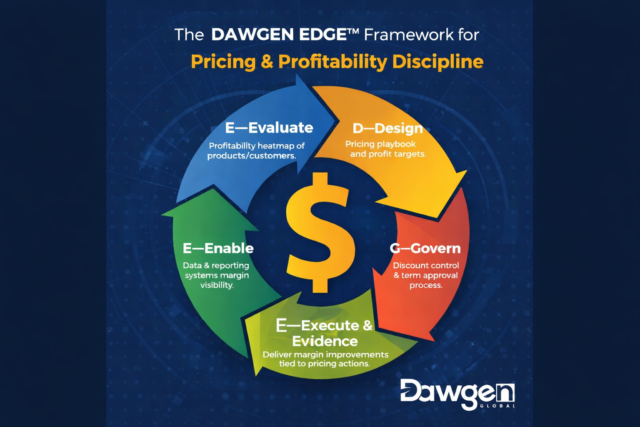
E — Evaluate: Find the Profit Leaks
Dawgen Global starts by diagnosing:
-
current pricing structure and discount practices
-
product-level profitability (gross and contribution)
-
customer profitability (including servicing cost)
-
channel profitability (wholesale/retail/e-commerce/export)
-
leakage sources: returns, wastage, freight, FX, overtime
-
working capital impact by customer segment (DSO patterns)
-
cost allocation validity (are costs assigned logically?)
Deliverable: A Profitability Heatmap that ranks products/customers into:
-
Grow (high profit, scalable)
-
Fix (profit potential, but leakage exists)
-
Reprice (margin too low for value delivered)
-
Exit (consistently destroys profit)
D — Design: Build a Pricing Architecture
We design pricing rules that reflect value, cost, and risk:
-
price bands and minimum margin rules
-
discount authority levels (who can discount, by how much)
-
pricing by channel and customer segment
-
FX and inflation adjustment rules
-
bundling strategies that protect margin
-
“good/better/best” packaging (value ladders)
Deliverable: A Pricing Playbook with clear guardrails.
G — Govern: Control Discounts, Terms, and Exceptions
Pricing discipline is governance discipline:
-
discount approval thresholds
-
exception reporting (who discounted below minimum margin)
-
contract/quote controls
-
customer terms governance (credit limits, deposits, stop-ship policy)
-
monthly review of loss-making accounts/products
Deliverable: A Pricing & Profit Governance Pack.
E — Enable: Data, Systems, and Reporting
Profitability improvement requires usable data:
-
clean product and customer master data
-
tracking discounts separately from “sales”
-
systems to capture delivery, returns, and service costs
-
reporting dashboards that show margin by product/customer/channel
Deliverable: A reporting system that produces monthly profitability insight.
™ — Execute & Evidence: Deliver Measurable Margin Improvement
Execution is tracked through:
-
margin uplift vs baseline
-
reduction in discount leakage
-
improvement in customer DSO mix
-
reduced returns/wastage
-
profitability shifts in product mix
Deliverable: A performance log linking pricing actions to earnings outcomes.
5) The Practical Toolkit: 7 Levers That Improve Profit Fast
Lever 1: Stop unmanaged discounting
Discounting should be a strategy, not a habit.
Practical actions:
-
separate “list price” from “net price”
-
require reason codes for discounts
-
set discount approval limits
-
report “discount leakage” monthly
Lever 2: Introduce minimum margin thresholds
Establish minimum acceptable gross and contribution margin by product/category.
-
Below threshold → automatic review
-
Exceptions require approval and documented rationale
Lever 3: Fix product mix
If low-margin products dominate volume, the business becomes busy but weak.
Practical actions:
-
promote high-margin products
-
repackage offers to improve contribution
-
reduce shelf space / focus for margin destroyers
-
discontinue persistent “loss leaders” unless strategic and controlled
Lever 4: Price for risk (terms and collections)
Customers who pay slowly consume your cash and increase risk. Terms should reflect that reality.
Practical actions:
-
pricing tiers linked to payment terms
-
deposits for high-risk accounts
-
incentives for early payment (selective)
-
penalties or stop-ship for delinquency
Lever 5: Fix hidden costs and leakage
Margin is often lost outside the pricing decision:
-
returns and credits
-
delivery inefficiencies
-
overtime and productivity loss
-
wastage/spoilage
-
FX exposure
You can improve profit without raising price by reducing leakage.
Lever 6: Rebuild cost-to-serve visibility
Some customers require more service, more deliveries, more customization.
Practical actions:
-
segment customers by cost-to-serve
-
introduce service fees where justified
-
adjust minimum order quantities
-
standardize delivery schedules
Lever 7: Improve pricing communication and value framing
Price increases fail when value is not communicated.
Practical actions:
-
tie price to service levels, reliability, quality, warranties, speed
-
explain inflation/FX drivers where relevant
-
offer options (good/better/best) instead of a single price
6) A 30/60/90-Day Plan to Improve Profitability and Mix
Days 1–30: Diagnose and Create Guardrails
-
build profitability heatmap (products/customers)
-
identify top 10 margin leak drivers
-
implement discount tracking and approval limits
-
set minimum margin thresholds
-
flag top loss-making customers/products for action
Outcome: visibility and immediate control.
Days 31–60: Reprice, Fix Terms, Reduce Leakage
-
reprice low-margin categories and high-risk customers
-
renegotiate supplier inputs where possible
-
implement stop-ship/credit control discipline
-
reduce returns and disputes (root cause fixes)
-
adjust product mix promotions and sales focus
Outcome: margin uplift begins.
Days 61–90: Embed Discipline and Scale Winners
-
formalize pricing playbook and governance
-
implement ongoing profitability reporting cadence
-
restructure product portfolio (exit chronic loss-makers)
-
integrate pricing strategy into budgeting and forecasting
Outcome: sustainable earnings system.
7) Common Mistakes (and How to Avoid Them)
Mistake 1: Raising prices without data
Fix: segment pricing, protect key accounts, apply minimum margin rules.
Mistake 2: Treating all customers equally
Fix: profitability + cost-to-serve + risk-based segmentation.
Mistake 3: Ignoring product mix
Fix: incentivize sales on contribution, not just revenue.
Mistake 4: Using gross margin alone
Fix: contribution margin and cash-adjusted profitability.
Mistake 5: Weak governance over discounting
Fix: approval thresholds + exception reporting + accountability.
8) DAWGEN EDGE™ Pricing & Profitability Scorecard (Quick Diagnostic)
If you answer “YES” to three or more, you likely have margin leakage and product mix risk:
-
Discounts are common, but not tracked as a KPI.
-
You cannot show profitability by product and customer monthly.
-
Sales incentives focus on revenue, not contribution margin.
-
Returns, credits, or wastage are rising without clear root cause action.
-
“Best customers” are slow payers or frequent disputers.
-
Minimum margin thresholds are not enforced.
-
You suspect some products lose money, but you keep selling them.
-
Pricing changes happen ad hoc, not through a playbook.
9) Why Dawgen Global
Dawgen Global brings a multidisciplinary perspective to profitability improvement—combining finance analytics, operational process, risk governance, tax implications, and technology enablement. Pricing is not just a commercial decision; it impacts cash, compliance, reporting, and enterprise risk. We help you build a repeatable profitability system, not a one-time price increase.
Next Step: Get Your Profitability Heatmap (Confidential)
If you want to protect margins and grow profit—not just revenue—Dawgen Global will provide a confidential Profitability Heatmap and a practical action roadmap to improve pricing discipline, customer profitability, and product mix.
At Dawgen Global, we help you make Smarter and More Effective Decisions. Let’s have a conversation.
🔗 Dive Deeper: https://dawgen.global/
📧 Connect with Us: [email protected]
Telephone Contact Centre:
📞 Caribbean: 876-9293670 | 876-9293870
📞 USA: 855-354-2447
WhatsApp Global: +1 555 795 9071
About Dawgen Global
“Embrace BIG FIRM capabilities without the big firm price at Dawgen Global, your committed partner in carving a pathway to continual progress in the vibrant Caribbean region. Our integrated, multidisciplinary approach is finely tuned to address the unique intricacies and lucrative prospects that the region has to offer. Offering a rich array of services, including audit, accounting, tax, IT, HR, risk management, and more, we facilitate smarter and more effective decisions that set the stage for unprecedented triumphs. Let’s collaborate and craft a future where every decision is a steppingstone to greater success. Reach out to explore a partnership that promises not just growth but a future beaming with opportunities and achievements.
 Email: [email protected]
  Visit: Dawgen Global Website

 WhatsApp Global Number : +1 555-795-9071
Caribbean Office: +1876-6655926 / 876-9293670/876-9265210  WhatsApp Global: +1 5557959071
USA Office: 855-354-2447
Join hands with Dawgen Global. Together, let’s venture into a future brimming with opportunities and achievements


