How to grow share and improve profitability through offer design, packaging, and smarter customer selection (EDGECRAFT™)
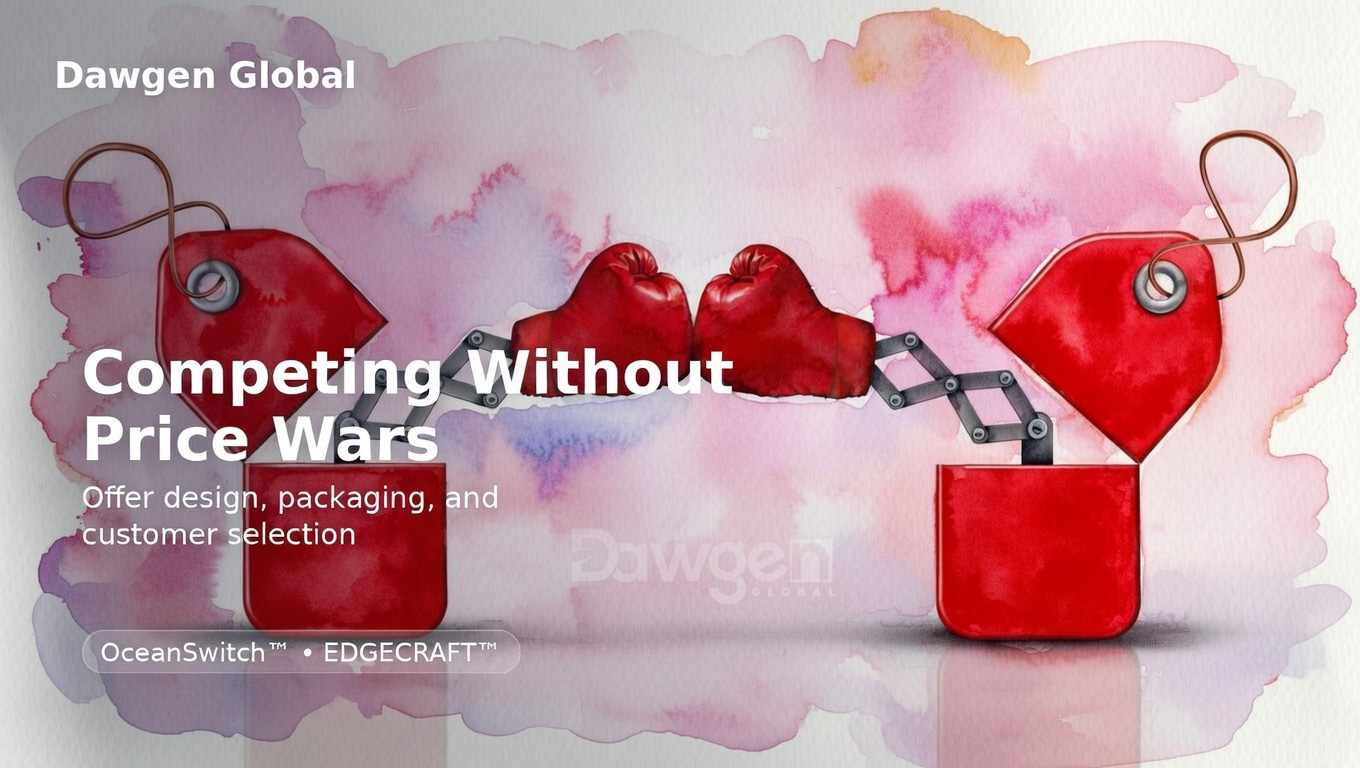
Price wars are rarely a strategy. They are usually a symptom: the market sees your offer as comparable, so buyers default to price as the decision tool. The EDGECRAFT™ approach escapes price wars by redesigning what the market compares—shifting from “services and tasks” to outcome offers, using tiered packaging to enable trade-down instead of discounting, pricing complexity through transparent add-ons, and strengthening customer selection and terms so low-quality revenue doesn’t dictate your economics.
What you will gain from this article
-
A practical model to reduce price pressure without losing competitiveness
-
A packaging playbook (Standard / Enhanced / Premium) that protects margin
-
A method to turn “extras” into priced add-ons (instead of margin leaks)
-
A simple risk test to spot when you’re being pulled into price wars
-
A 30-day sprint to implement the changes quickly and consistently
1) Why price wars happen in Red Oceans
In a crowded market, price wars show up when buyers believe:
-
the offers are similar,
-
the outputs are comparable, and
-
switching feels low risk.
When a buyer thinks “I can get the same thing anywhere,” the negotiation inevitably becomes “who will do it for less?”
EDGECRAFT™ principle:
Don’t “defend” your price. Change what is being compared.
2) The EDGECRAFT™ Price-War Escape Model
To compete without price wars, EDGECRAFT™ uses three levers that work together:
-
Offer Architecture — make the offer less comparable
-
Packaging & Anchors — guide choice and protect margin
-
Customer Selection & Terms — prevent low-quality revenue from driving the business
If you fix only one lever (e.g., packaging) but ignore customer selection or terms, price pressure returns through another door.
3) Offer Architecture: move from “services” to “outcome offers”
In Red Oceans, many firms sell inputs:
-
hours,
-
tasks,
-
generic deliverables.
Inputs invite one thing: price comparison.
Outcome offers sell the result, not just the work:
-
risk reduced,
-
speed improved,
-
errors avoided,
-
decision confidence increased,
-
compliance achieved.
Practical shift: define the “job to be done”
Ask what the client is really hiring you for:
-
“Help us reduce margin leakage.”
-
“Help us close month-end faster.”
-
“Help us avoid a regulatory failure.”
-
“Help us make an investment decision with confidence.”
Then design your offer around that job, using language the buyer recognises.
Bullet-point outcome framing (copy/paste ready for proposals)
-
Outcome: what changes for the client
-
Decision gates: what must be approved and when
-
Evidence: what proof/verification is included
-
Governance: what cadence and oversight reduces risk
This reduces commoditisation because it shifts the buyer’s attention from “tasks” to “certainty.”
4) Packaging: use tiers so price becomes a choice, not a fight
A single quote creates a single battlefield: price.
Tiering creates options and trade-offs.
Standard / Enhanced / Premium structure
Tier 1: Standard (core outcome)
-
clear scope, defined turnaround
-
limited customisation
-
designed for predictability
Tier 2: Enhanced (decision acceleration)
-
faster turnaround, added diagnostics
-
more stakeholder touchpoints
-
stronger executive summary outputs
Tier 3: Premium (risk and governance)
-
highest assurance, proactive oversight
-
board-ready documentation
-
priority access / escalation pathways
EDGECRAFT™ rule: never discount—trade down
If a buyer wants a lower price:
-
you do not discount the same tier,
-
you trade down to a lower tier with less scope, slower turnaround, or less governance.
This protects margin and keeps fairness across clients.
Bullet-point “trade-down” language
-
“We can reduce the fee by moving from Enhanced to Standard, which changes the turnaround and reduces stakeholder sessions.”
-
“Alternatively, we can keep Enhanced and adjust scope by removing X and Y.”
5) Anchors: frame value around outcomes, not unit price
Procurement pressure intensifies when buyers anchor on:
-
hourly rate,
-
unit pricing,
-
lowest bid comparisons.
EDGECRAFT™ reframes with outcome anchors:
-
cost of delay,
-
cost of rework,
-
cost of failure,
-
cost of uncertainty.
ValueProof™ framing question
“What does it cost the client if this is late, wrong, disputed, or non-compliant?”
This is not sales theatre. It is commercial clarity.
Bullet-point value anchors
-
time saved and leadership attention preserved
-
risk reduced and avoided downside
-
improved predictability and fewer disputes
-
faster decisions and execution speed
6) Add-ons: charge for complexity instead of absorbing it
Price wars often happen because firms give away “extras” to win or keep clients.
Convert extras into transparent add-ons:
-
accelerated turnaround (“rush premium”)
-
additional entities/locations
-
extra stakeholder workshops
-
additional revision cycles
-
extra reporting packs / board packs
-
implementation support
Why add-ons work
-
buyers see it as fair: they pay for what they request
-
teams stop “over-servicing” quietly
-
profitability becomes engineered, not hoped for
Bullet-point add-on menu structure
-
add-on name + what it adds
-
trigger condition (“applies when…”)
-
fixed fee or rate
-
acceptance/approval mechanism
7) Customer selection: not all revenue is good revenue
Some customers are not price-sensitive—they are value-blind:
-
always choose the cheapest,
-
change scope constantly,
-
delay approvals,
-
dispute invoices,
-
pay late.
They create high cost-to-serve and pull you into discounting habits.
EDGECRAFT™ selection rule
Prefer customers who value:
-
risk reduction,
-
speed,
-
governance,
-
reliability,
-
auditability,
-
decision confidence.
And manage value-blind customers with:
-
tighter scope,
-
stronger milestone billing,
-
explicit change control,
-
clearer revision limits,
-
greater prepayment.
Bullet-point qualification signals
-
“What is the decision risk if this goes wrong?”
-
“Who signs off and by when?”
-
“What is your approval cycle?”
-
“Is this a lowest-price purchase or a risk-managed purchase?”
8) Terms and milestones: win profitability through contract design
In Red Oceans, terms are not admin—they are strategy. They stop price wars from returning after signature.
EDGECRAFT™ term controls
-
milestone billing tied to acceptance windows
-
change control and variation pricing
-
revision limits (included vs charged)
-
approval timelines and delay consequences
-
rush premiums for speed
These controls reduce disputes and prevent post-sale discounting.
9) The 15-minute Price War Risk Test
Answer quickly:
-
Can a buyer compare your offer to a competitor in one sentence?
-
Are you selling tasks (inputs) rather than outcomes?
-
Do you have tiers that allow trade-down instead of discounting?
-
Do you price complexity through add-ons?
-
Do you qualify out low-quality buyers—or chase everything?
-
Do your terms protect delivery economics and cash?
If most answers are “no,” price wars are not a threat—they’re your default future.
10) A practical 30-day Price-War Escape Sprint
Week 1: Redesign the offer
-
define the job-to-be-done
-
rewrite the offer around outcomes and decision gates
Week 2: Build the packages
-
Standard / Enhanced / Premium
-
define trade-down rules and what changes by tier
Week 3: Create add-ons
-
list common “extras”
-
price and document triggers
Week 4: Align selection and terms
-
implement qualification filters
-
tighten SOW language and milestones
-
train teams to use trade language (not discount language)
Price wars become optional when the offer is engineered
If your offer is highly comparable, price wars are inevitable.
If your offer is an outcome system—with tiers, add-ons, selection discipline, and strong terms—price wars become optional.
In the next article, we’ll build the operating layer that sustains this advantage: Execution Cadence and Operating Rhythm—how to run a disciplined commercial system that keeps pricing, scope, delivery, and cash aligned month after month.
About Dawgen Global
“Embrace BIG FIRM capabilities without the big firm price at Dawgen Global, your committed partner in carving a pathway to continual progress in the vibrant Caribbean region. Our integrated, multidisciplinary approach is finely tuned to address the unique intricacies and lucrative prospects that the region has to offer. Offering a rich array of services, including audit, accounting, tax, IT, HR, risk management, and more, we facilitate smarter and more effective decisions that set the stage for unprecedented triumphs. Let’s collaborate and craft a future where every decision is a steppingstone to greater success. Reach out to explore a partnership that promises not just growth but a future beaming with opportunities and achievements.
 Email: [email protected]
  Visit: Dawgen Global Website

 WhatsApp Global Number : +1 555-795-9071
Caribbean Office: +1876-6655926 / 876-9293670/876-9265210  WhatsApp Global: +1 5557959071
USA Office: 855-354-2447
Join hands with Dawgen Global. Together, let’s venture into a future brimming with opportunities and achievements


