

Every day, Caribbean households and businesses pay overseas companies for streaming, software subscriptions, cloud storage, online advertising, apps and digital content. Until now, most of those purchases have carried no local consumption tax, while a local business selling a similar service has had to charge GCT or VAT. Two of the region’s largest economies are now closing that gap.
Jamaica and Trinidad and Tobago have each announced that consumption tax will apply to digital services supplied from abroad. This article explains what has been announced, how such rules usually work, who will be affected, and what businesses on both sides of the transaction should do now.
What has been announced
Jamaica. In the 2026/27 budget presented on 12 February 2026, the Minister of Finance announced that General Consumption Tax (GCT) will apply to digital services and intangibles supplied by providers outside Jamaica and consumed in Jamaica. The Government’s stated aim is that digital services consumed in Jamaica should bear GCT in the same way as equivalent services supplied locally. The measure is expected to begin in the last quarter of the 2026/27 fiscal year and to be fully operational in 2027, subject to enabling legislation. It is estimated to raise about J$300 million in 2026/27 and J$4.2 billion in 2027/28. Details of registration thresholds, collection methods and any simplified regime for non-resident suppliers had not been published when this article was written.
Trinidad and Tobago. In the 2027 budget presented on 12 October 2026, the Minister of Finance proposed that VAT at the standard rate apply to digital services provided by non-residents. The detailed rules will be set out in the Finance Bill and supporting guidance.
Side by side
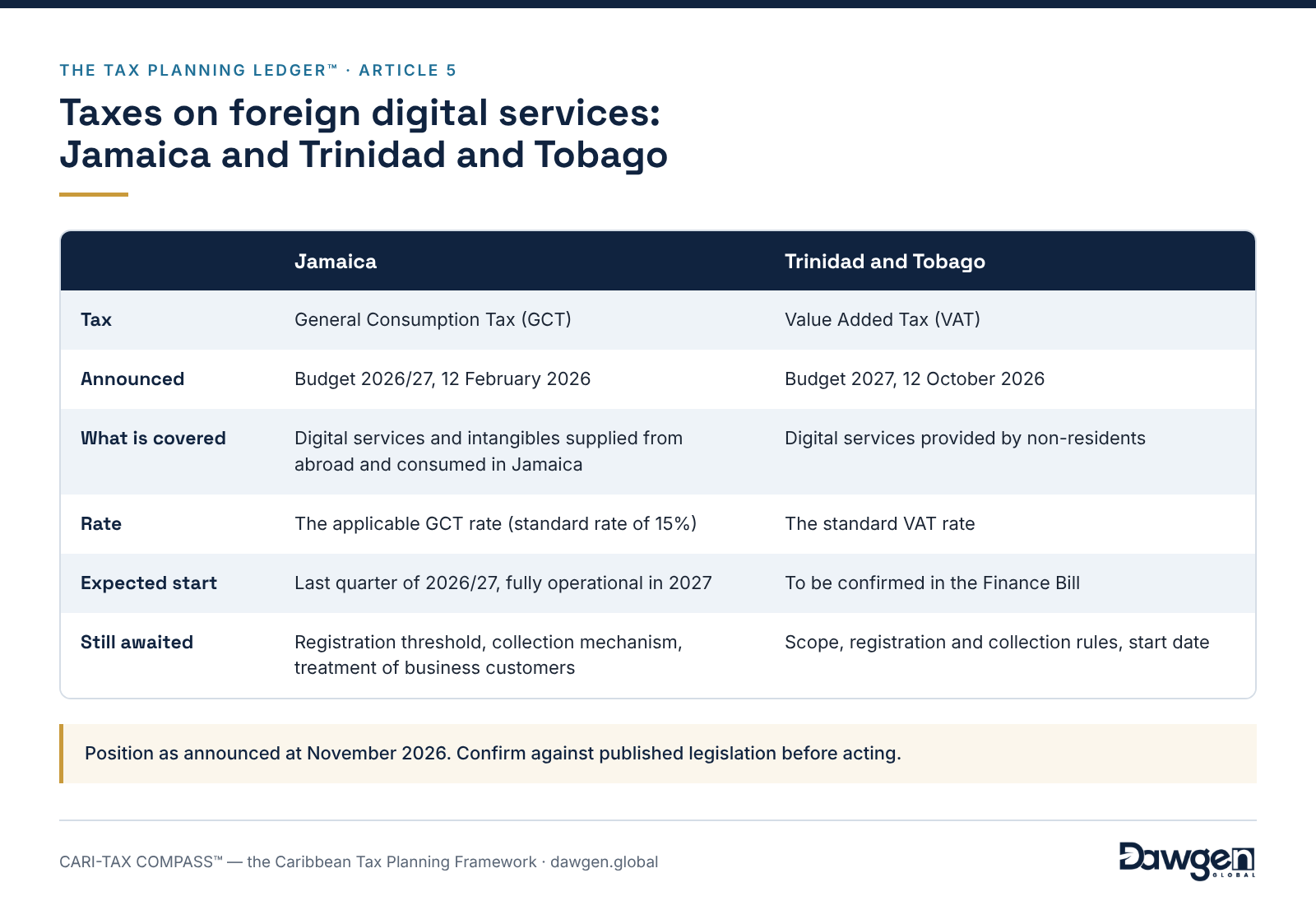
| Jamaica | Trinidad and Tobago | |
| Tax | General Consumption Tax (GCT) | Value Added Tax (VAT) |
| Announced | Budget 2026/27, 12 February 2026 | Budget 2027, 12 October 2026 |
| What is covered | Digital services and intangibles supplied from abroad and consumed in Jamaica | Digital services provided by non-residents |
| Rate | The applicable GCT rate (standard rate of 15%) | The standard VAT rate |
| Expected start | Last quarter of 2026/27, fully operational in 2027 | To be confirmed in the Finance Bill |
| Key details still awaited | Registration threshold, collection mechanism, treatment of business customers | Scope definition, registration and collection rules, start date |
 Dawgen Global illustration
How these rules usually work
Final details will come from each country’s legislation, but rules of this kind around the world, many based on OECD guidance on the destination principle, tend to share common features. Businesses can prepare for them now:
- Registration of non-resident suppliers. Foreign providers selling to local consumers are usually required to register, often through a simplified online process, once their local sales pass a threshold.
- Business and consumer sales treated differently. Sales to registered local businesses are often handled by the customer accounting for the tax itself, while sales to consumers are taxed by the supplier.
- Evidence of the customer’s location. Suppliers typically rely on billing address, payment card country, IP address or mobile network to decide whether a customer is local.
- Platforms and marketplaces. Where apps or services are sold through a platform, the platform may be treated as the supplier and made responsible for the tax.
- Regular returns and payment, often quarterly, sometimes in local currency.
Who will be affected
Overseas digital suppliers. Streaming services, software and SaaS providers, cloud and hosting companies, online advertising platforms, app stores, e-learning providers and online marketplaces will need to assess whether they must register, how to identify Jamaican and Trinidadian customers, how to show the tax on receipts and how to file and pay.
Local businesses that buy digital services. Retailers, manufacturers, banks, hotels and professional firms that subscribe to foreign software and platforms may see higher prices, new tax lines on invoices and new questions about whether they can recover the tax as input credit. Finance teams will need to update supplier records, contracts and accounting codes.
Caribbean digital businesses. Local providers have long argued that they compete at a disadvantage against untaxed foreign services. The new rules level that field at home. At the same time, Caribbean firms that sell digital services to customers in other territories should expect similar rules to apply to them abroad.
Consumers. Subscription prices are likely to rise by the amount of the tax unless suppliers absorb it.
The practical issues to resolve
- Is what you buy or sell a “digital service”? Definitions will matter: a fully automated download is clearly digital; a service delivered online by a person may or may not be.
- Who is your customer? Distinguishing registered businesses from consumers needs reliable data, such as tax registration numbers.
- Where is your customer? Location evidence must be captured at the point of sale and kept as records.
- Are your prices tax-inclusive or tax-exclusive? Contracts and price lists may need to change.
- Can your systems cope? Billing, invoicing and accounting systems must be able to apply the right tax, show it correctly and report it.
- Can you recover the tax? Local registered businesses should check how input tax recovery will work for these purchases.
What to do now
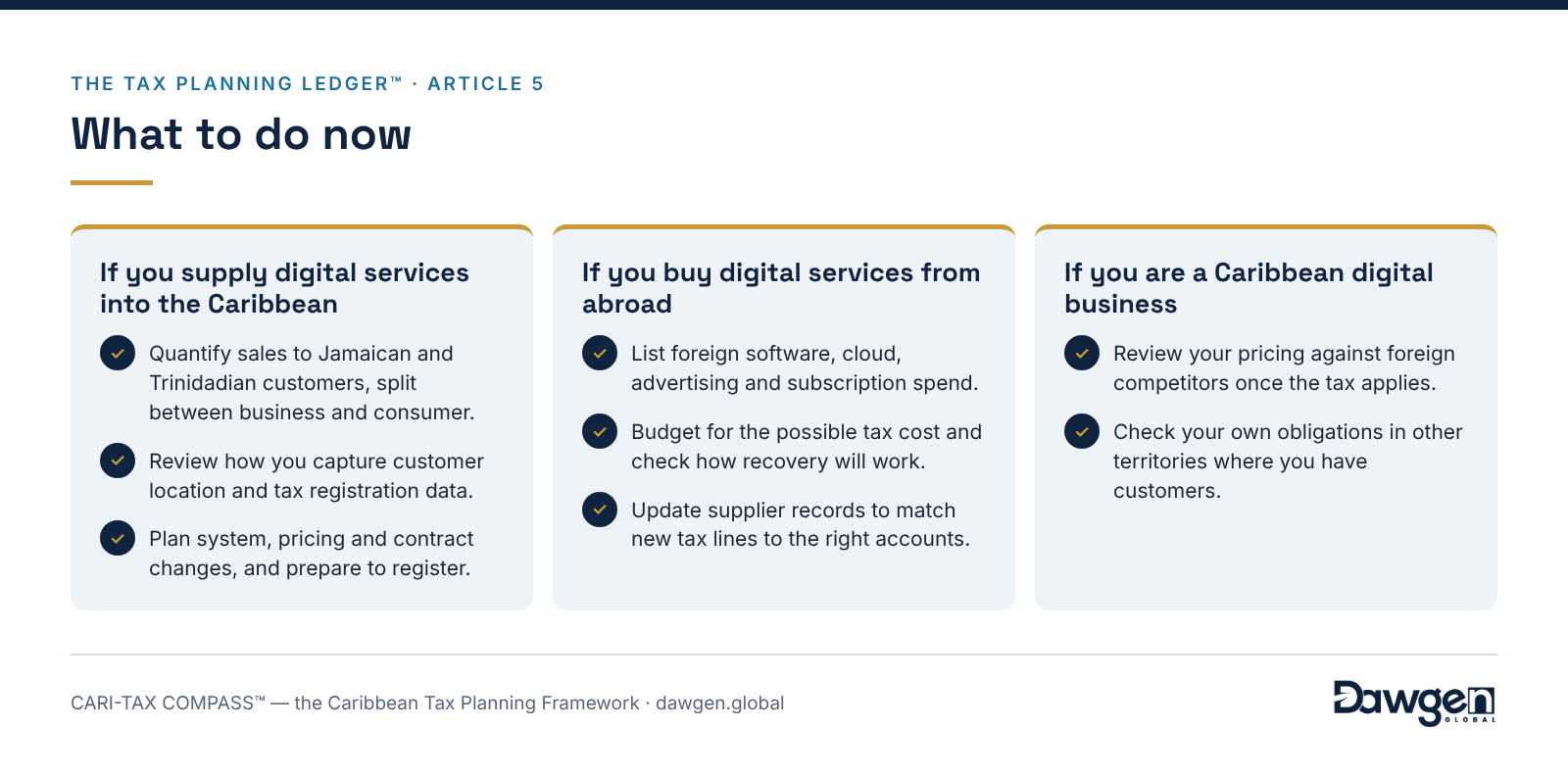
If you supply digital services into the Caribbean:
- Quantify your sales to Jamaican and Trinidadian customers and split them between business and consumer customers.
- Review how you capture customer location and tax registration data.
- Plan the system, pricing and contract changes needed, and prepare to register as soon as rules are published.
If you buy digital services from abroad:
- List your foreign software, cloud, advertising and subscription spend.
- Budget for the possible tax cost and check how recovery will work for your business.
- Update supplier records so you can match new tax lines to the right accounts.
If you are a Caribbean digital business:
- Review your pricing against foreign competitors once the tax applies.
- Check your own obligations in other territories where you have customers.
 Dawgen Global illustration
How Dawgen Global can help
We have followed digital taxation closely through our Digital Tax Without Borders series and our Budget Reviews, and we track developments in every territory we serve.
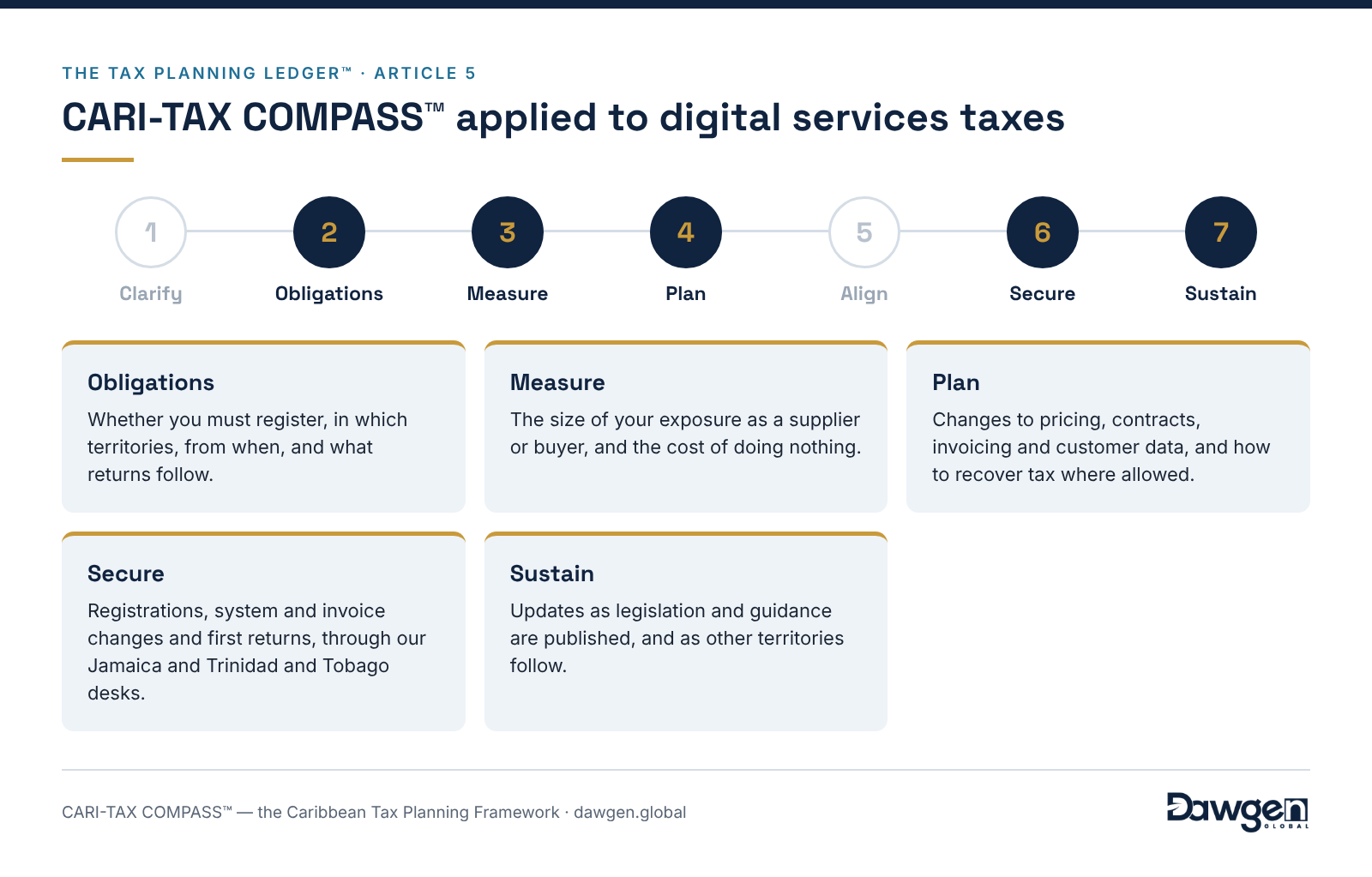
Our Digital Tax Readiness Review, delivered in two to four weeks, applies the relevant stages of CARI-TAX COMPASS™, the Caribbean Tax Planning Framework:
- Obligations: whether you must register, in which territories, from when, and what returns follow.
- Measure: the size of your exposure, as a supplier or as a buyer, and the cost of doing nothing.
- Plan: the changes needed to pricing, contracts, invoicing and customer data, and how to recover tax where the law allows.
- Secure: registrations, system and invoice changes and first returns, prepared and reviewed by our team through our Jamaica and Trinidad and Tobago desks.
- Sustain: updates as legislation and guidance are published, and as other territories follow.
 Dawgen Global illustration
Where to start
Take the CARI-TAX COMPASS™ Tax Health Score at dawgen.global/tax-health-score; it asks whether you have assessed the effect of digital services taxes on your business. Or speak with our Caribbean Tax Service Desk at info@dawgen.global or (876) 926-5210, or with our Trinidad and Tobago desk at trinidadandtobago@dawgen.com.
In Article 6, we look at transfer pricing: how groups that operate across several islands should price what their companies charge each other.
Dawgen Global — Big Firm Capabilities. Caribbean Understanding.
This article is general information and is not a substitute for advice on your circumstances. Both measures depend on legislation and guidance not yet published when this article was written; confirm the current position before acting.
About Dawgen Global
Dawgen Global is an independent, integrated multidisciplinary professional services firm headquartered at 47 Trinidad Terrace, New Kingston, Jamaica, serving 35 territories across the Caribbean. Founded and led by Dr. Dawkins Brown, Executive Chairman, the firm is independent and not affiliated with any international network. It delivers a full suite of professional services under one roof: audit and assurance; tax advisory; IT and digital transformation; risk management; cybersecurity; actuarial and insurance regulatory advisory; HR advisory; mergers and acquisitions; corporate recovery; business advisory and strategy; accounting BPO and virtual CFO services; and legal process outsourcing.
The proposition is simple: big-firm capability without the big-firm price. Dawgen Global’s integrated approach is built for the specific complexities and opportunities of the Caribbean market, helping organizations make sharper, better-informed decisions that drive measurable progress.
To explore a partnership, reach out:
- Website: dawgen.global
- Email: info@dawgen.global
- WhatsApp (Global): +1 555-795-9071
- Caribbean offices: +1 876-665-5926 | +1 876-929-3670 | +1 876-926-5210